A facility criticality workshop turns a long asset register into a ranked list that shows your team what to protect first. Most commercial portfolios hold hundreds of air handlers, pumps, elevators, panels, and life safety devices, yet maintenance effort is usually spread almost evenly across them. One well-run day can score 500 or more assets and finish with A, B, and C tiers that operations, finance, and engineering all accept. This checklist covers pre-work, room setup, calibration, scoring cadence, and follow-up, and shows how results feed asset management and preventive maintenance in Oxmaint the same week.
Facility Criticality Scoring Workshop: One-Day Playbook
A 46-item checklist to run pre-work, scoring, and calibration in a single day and score 500+ commercial facility assets by close of business.
How to Use This Checklist
- Work top to bottom; each phase unlocks the next
- Every item has a named owner and a "done when" test
- Do not start scoring until all Phase 1 and Phase 2 items are ticked
- Print it or keep it on the room display so the whole team sees progress
Phase 1: Pre-Work (10 Days Before)
Most workshop overruns trace back to a dirty asset list or missing attendees, not to the scoring itself.
- Export the full asset register. Include ID, description, location, class, and install year. Done when every active asset appears once. Owner: Planner
- Remove duplicates and retired units. Cross-check against the latest site walk. Done when no decommissioned equipment remains. Owner: Planner
- Group assets into 30 to 60 classes. Examples: rooftop units, domestic pumps, fire panels, traction elevators. Done when no asset sits outside a class. Owner: Lead technician
- Tag redundancy for each class. Record N+1 backup, bypass, or manual fallback, and whether the backup was tested. Done when every class has a redundancy note. Owner: Building engineer
- Collect 12 to 24 months of failure history. Pull work orders, tenant complaints, and incident notes by class. Done when each class has a history summary. Owner: Planner
- Circulate the scoring scale and weights. Send the criteria below for comment. Done when objections are resolved before the day. Owner: Facilitator
- Confirm attendees. Facility manager, lead technician, building engineer, safety or compliance lead, tenant or operations voice, and finance. Done when calendars are accepted. Owner: Facility manager
- Collect floor plans and one-line diagrams. Dependencies are easier to agree on when the system is visible. Done when diagrams are on the shared drive. Owner: Building engineer
- Build the scoring sheet. One row per class with columns for five criteria, likelihood, redundancy, and exception flag. Done when the sheet calculates tiers. Owner: Facilitator
- Select 15 calibration assets. Cover low, medium, and high consequence. Done when the list is approved. Owner: Facilitator
- Appoint a scribe. The scribe records the reason for every score of 4 or 5. Done when named. Owner: Facility manager
- Book the room and display. Everyone must see the sheet update live. Done when booked for the full day. Owner: Coordinator
Scoring Scale to Approve in Pre-Work
Criticality follows common risk logic used in SMRP-style frameworks: consequence of failure multiplied by likelihood. Weights are a starting point.
| Criterion | Starting Weight | Score 1 | Score 5 |
|---|---|---|---|
| Safety and life safety | 30% | No injury potential | Serious injury or loss of life safety function |
| Occupant and tenant impact | 25% | Unnoticed by occupants | Building or floor unusable |
| Business and operations | 20% | No operational effect | Core operation or revenue stops |
| Regulatory and environmental | 15% | No code or permit link | Violation, citation, or release risk |
| Repair cost and lead time | 10% | Low cost, same-day fix | High cost, long lead time |
- Likelihood 1 to 5 uses failure history, age, condition, and duty
- Reduce operations and tenant scores by one point only for a tested backup
- Criticality score equals weighted consequence multiplied by likelihood
Phase 2: Room Setup and Frame (08:00 to 08:45)
- Display the sheet and scale. Print one copy of the scale and examples per attendee. Done when everyone has a copy. Owner: Facilitator
- State the purpose. Scores reflect consequence of failure, not complaint volume. Done when the room agrees. Owner: Facility manager
- Agree the time rules. Three minutes per class, then record both views and move on. Done when stated aloud. Owner: Facilitator
- Set the evidence rule. Any score of 4 or 5 needs a stated reason. Done when the scribe confirms. Owner: Scribe
- Close laptops and email. Only the sheet stays open. Done when the facilitator confirms. Owner: Facilitator
- Confirm the tier planning targets. Tier A near 10 to 20 percent of assets as a target, not a quota. Done when written on the sheet. Owner: Facility manager
Store Criticality Against Every Asset From Day One
Oxmaint keeps asset records, tiers, and maintenance history together so scoring results drive real schedules.
Phase 3: Calibration Round (08:45 to 09:45)
- Score the 15 sample assets silently. Each person scores before discussion. Done when all sheets are complete. Owner: All
- Reveal scores together. Show every score on the display at once. Done when gaps are visible. Owner: Facilitator
- Discuss gaps of two points or more. Ask for the evidence behind each view. Done when the room settles on one score. Owner: Facilitator
- Record anchor examples. Note one asset per score level for each criterion. Done when anchors are in the sheet. Owner: Scribe
- Adjust weights only if needed. Change them now or not at all. Done when weights are locked. Owner: Facility manager
- Check for early bias. Watch for departments inflating their own systems. Done when noted and addressed. Owner: Facilitator
Phase 4: Scoring Blocks (09:45 to 15:00)
Scoring 500 assets in about five working hours leaves well under a minute each, so score classes first and handle exceptions after.
- Block one: building systems. HVAC, electrical, plumbing, and controls. Target roughly 250 assets by 12:30. Owner: All
- Score the class default. Fill all five criteria and likelihood for the class. Done when the row calculates a tier. Owner: Scribe
- Flag exceptions without debating. Mark any asset whose location or duty differs from the class. Done when the flag column is filled. Owner: Lead technician
- Log reasons for 4s and 5s. Short and factual. Done when no high score lacks a note. Owner: Scribe
- Break at 12:30. The scribe cleans data while the room rests. Done when the sheet is checked. Owner: Scribe
- Block two: life safety and site. Fire and life safety, vertical transport, envelope, security, and site. Target 250 or more by 15:00. Owner: All
- Split classes that keep diverging. If views stay far apart, split the class. Done when each part has agreement. Owner: Facilitator
- Protect locked scores. No reopening without new evidence. Done when the rule holds all day. Owner: Facilitator
Tier Matrix to Apply During Scoring
Phase 5: Exceptions, Calibration Review, and Lock (15:00 to 16:30)
- Clear flagged exceptions in batch. Example: a single pump serving a critical tenant. Done when every flag is resolved or assigned. Owner: Facilitator
- Review the tier distribution. If Tier A is far above target, re-review the highest scores. Done when the share is defensible. Owner: Facility manager
- Compare similar classes across buildings. Scores should match unless a reason is recorded. Done when differences are explained. Owner: Building engineer
- Re-score two assets blind. Compare with the locked result. Done when scores match within one point. Owner: Facilitator
- Name an owner for every Tier A class. Include the main failure mode. Done when no Tier A row lacks an owner. Owner: Facility manager
- Lock the sheet and save. Send to all attendees within 24 hours. Done when the file is shared. Owner: Scribe
Common Biases to Watch For
| Bias | What It Looks Like | Fix |
|---|---|---|
| Recency | Last month's failure scores too high | Review 12 to 24 months of history |
| Squeaky wheel | Complaints inflate consequence | Score impact, not volume |
| Everything is critical | Over half of assets in Tier A | Re-anchor with examples |
| Department bias | Teams inflate their own systems | Cross-functional scoring with reasons |
| Redundancy blindness | Backups ignored or over-trusted | Reduce only for tested backups |
Phase 6: First 30 Days After the Workshop
- Load criticality and tier against every asset. Done when each asset record shows a tier. Owner: Planner
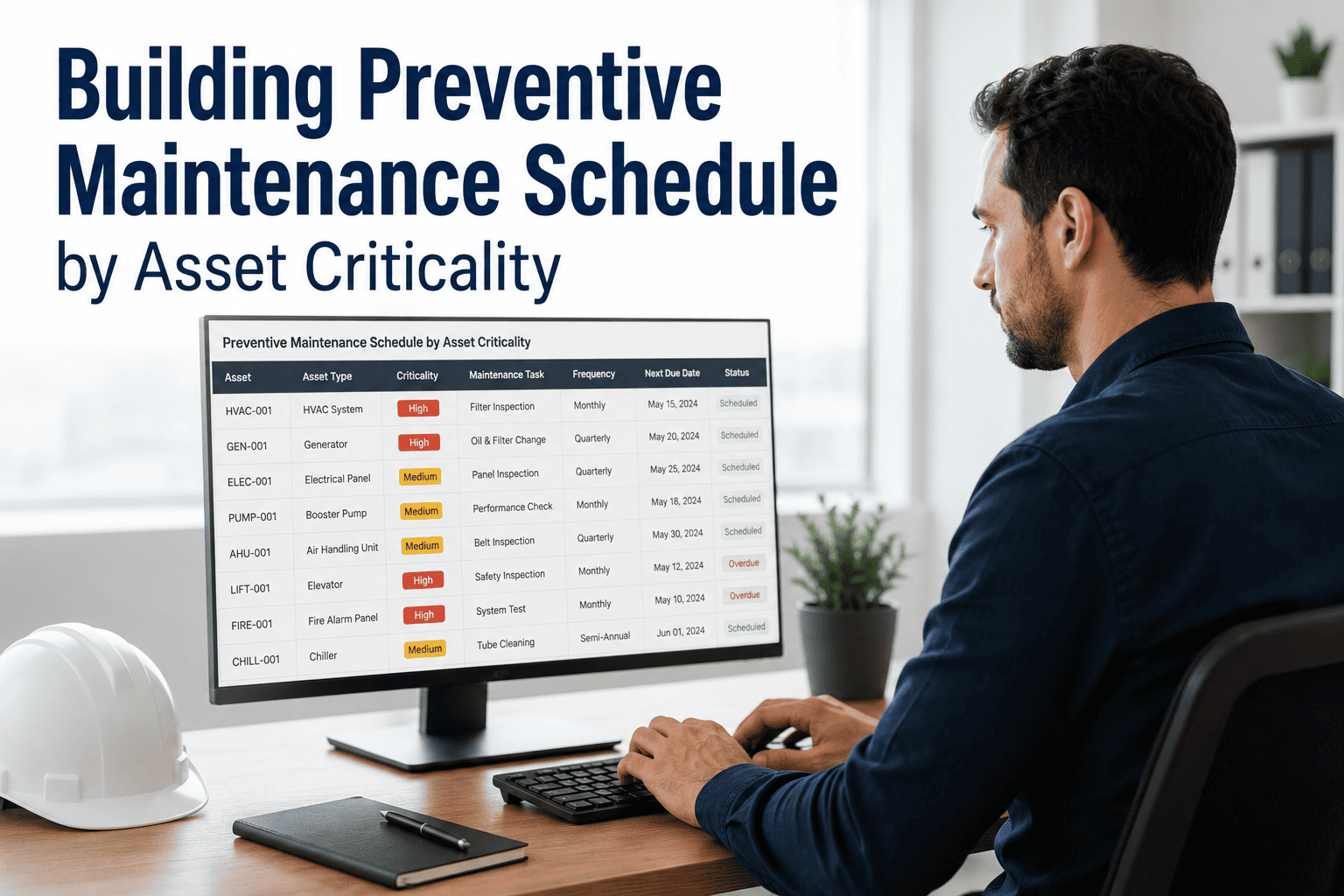
- Rebuild PM frequencies by tier. Strict PM and condition checks for Tier A; reduced effort where safe for Tier C. Owner: Maintenance planner
- Set work order priority rules. Tier A faults get first response. Done when rules are published. Owner: Facility manager
- Review spares for Tier A. Stock critical parts or confirm a supply plan. Owner: Storeroom lead
- Add inspections for Tier A classes. Use findings to adjust likelihood. Owner: Lead technician
- Build a tier dashboard. Track PM compliance, response time, and reactive share by tier. Owner: Planner
- Brief leadership. Present tiers and the budget implications. Owner: Facility manager
- Schedule the annual re-score. Re-score earlier after major failures or capital projects. Owner: Facilitator
KPIs That Prove It Worked
Frequently Asked Questions
Can one day really cover 500 assets?
Yes, if you score by class and handle exceptions separately. Clean pre-work matters more than speed.
How many people should attend?
Six to eight works well. More voices slow decisions; fewer miss key consequences.
Do I need a CMMS first?
No, but a clean register helps. You can start in Oxmaint and load scores afterwards.
How often should scores be reviewed?
Yearly and after major changes or failures. Re-score an asset when use or redundancy changes.
Can Oxmaint apply the results?
Yes, tiers can drive PM, priority, and reporting. Book a demo to see the workflow.
Finish the Workshop With a Plan Your Team Can Run
Turn Tier A, B, and C results into scheduled preventive maintenance, prioritised work orders, and clear reports with Oxmaint.