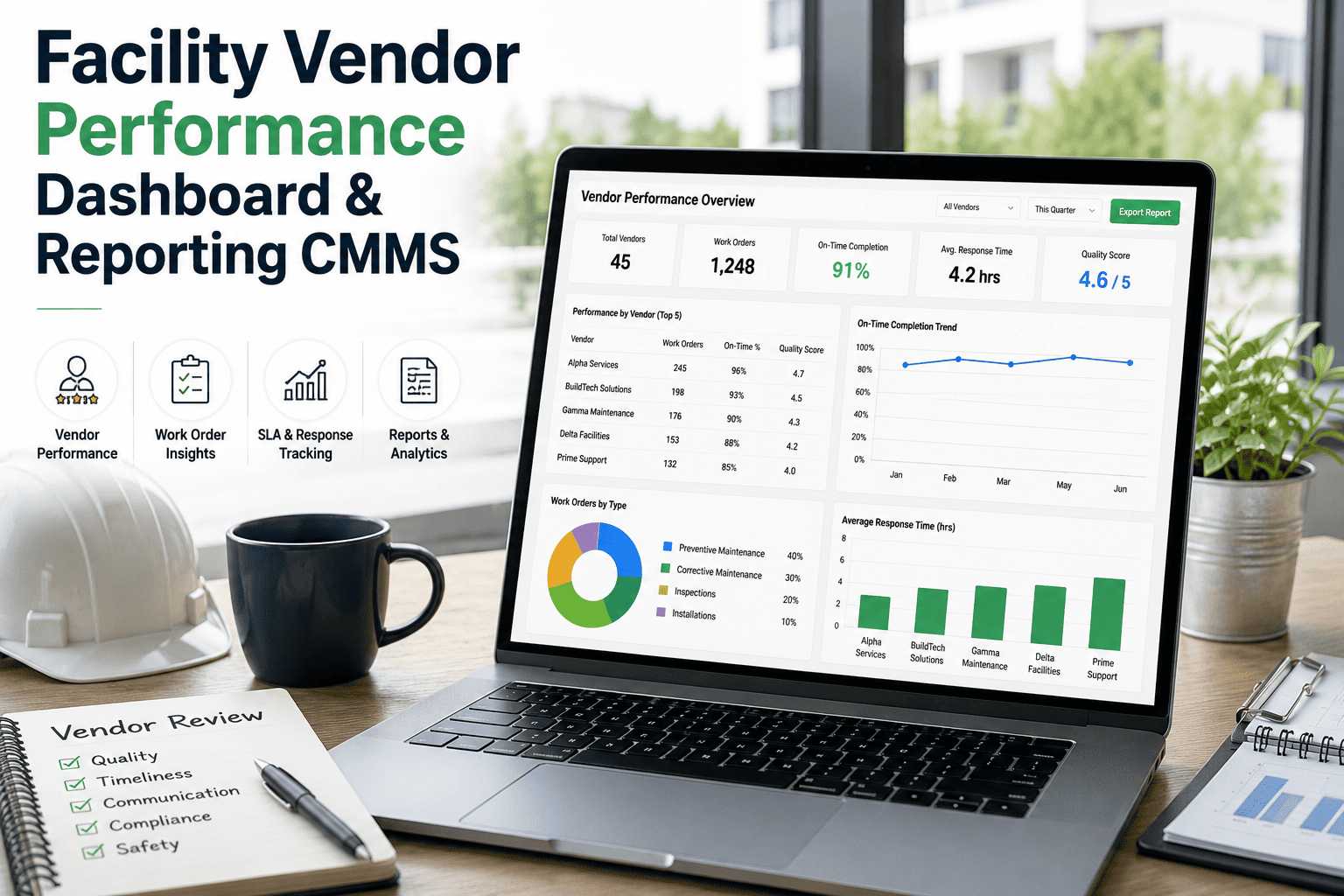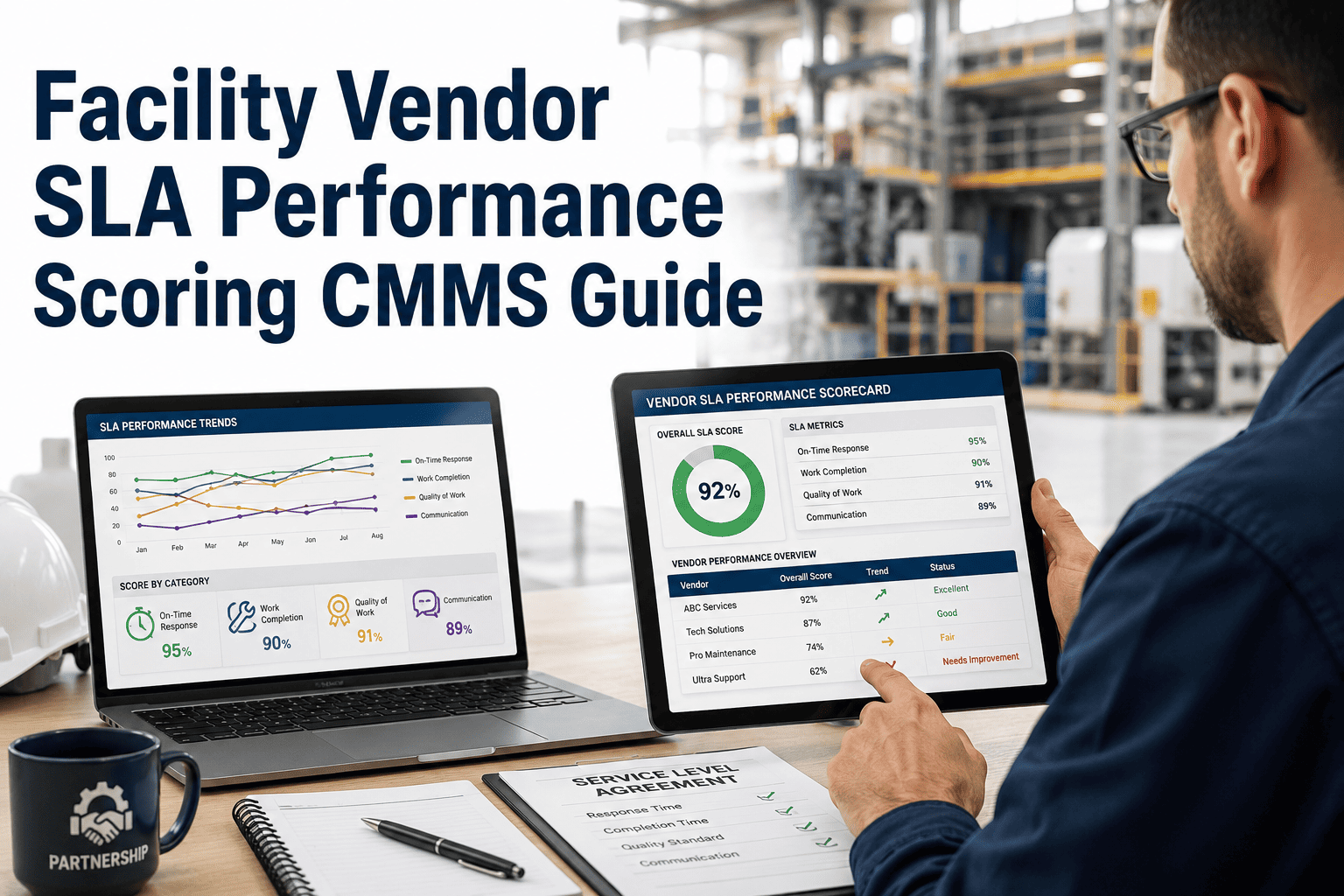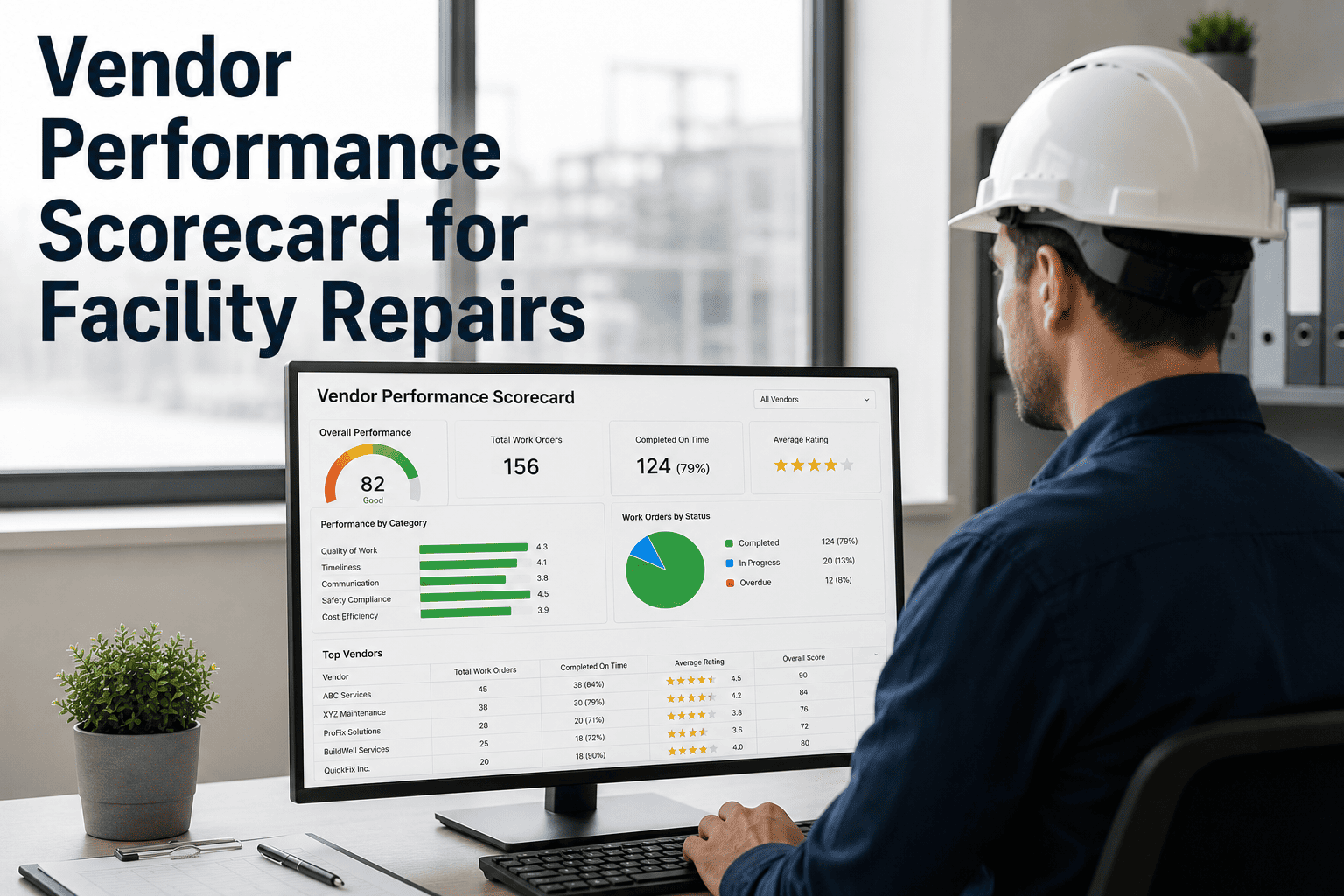
Facility vendors rarely fail loudly. They drift: response times creep up, paperwork gets thinner, and invoices need more questions. Without a regular scorecard, each of those problems is handled as a one-off complaint. A quarterly scorecard replaces anecdotes with a consistent set of weighted metrics, a shared rating scale, and a structured review meeting. This guide lays out a 15-metric scorecard, a weighting model, and a QBR agenda, and shows how facility maintenance software supplies the data.
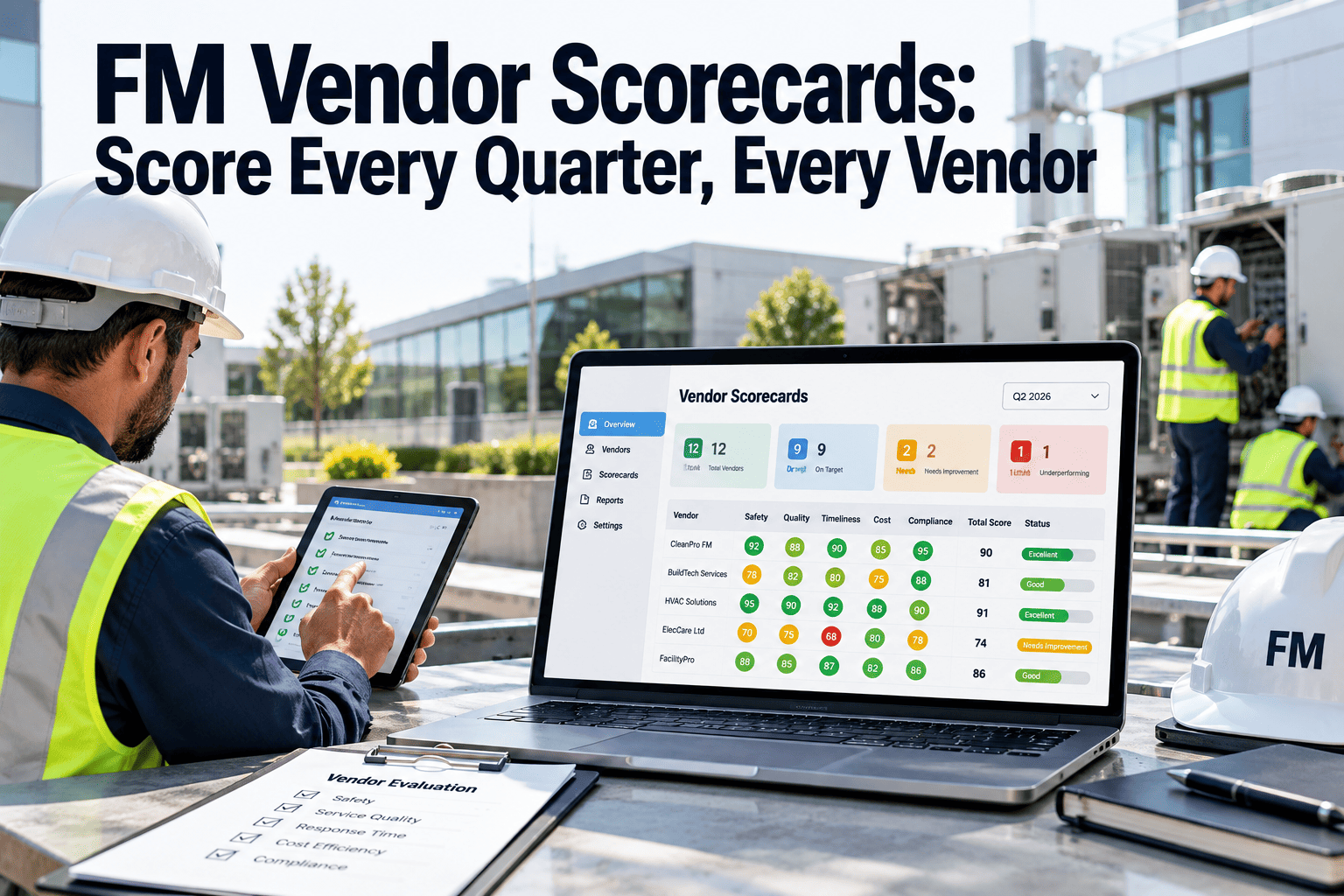
FM Vendor Scorecards: Score Every Quarter, Every Vendor
Fifteen weighted metrics, one rating scale, and a repeatable QBR turn vendor management from opinion into evidence.
What Goes Wrong Without a Scorecard
Recency bias
The last bad incident overshadows a quarter of solid work, or the reverse.
Inconsistent standards
Different site managers judge the same vendor differently.
No improvement loop
Problems are raised but never tracked to closure between reviews.
Weak renewal decisions
Contract extensions rely on relationships rather than results.
The 15-Metric Scorecard and Weights
Weights below total 100 and are a starting point. Adjust them to your risk profile and contract scope.
| Category | Metric | Weight | Data Source |
|---|---|---|---|
| Service delivery | Response time adherence | 8 | Work order timestamps |
| Service delivery | Resolution time adherence | 8 | Work order timestamps |
| Service delivery | First-time fix rate | 7 | Callback records |
| Service delivery | Backlog age | 7 | Open work orders |
| Maintenance quality | PM compliance | 8 | PM schedule completion |
| Maintenance quality | Rework and repeat calls | 6 | Asset history |
| Maintenance quality | Documentation completeness | 6 | Checklist and photo audit |
| Safety and compliance | Incident and near-miss record | 6 | Incident log |
| Safety and compliance | Permit and isolation compliance | 7 | Permit records |
| Safety and compliance | Certification currency | 7 | Vendor documents |
| Commercial | Invoice accuracy | 5 | Finance review |
| Commercial | Quote-to-actual variance | 5 | Work order cost |
| Commercial | Reporting timeliness | 5 | Report dates |
| Relationship | Client satisfaction | 8 | Post-job survey |
| Relationship | Staff continuity | 7 | Roster and turnover |
Scoring Scale and Rating Bands
Score each metric the same way
Convert every metric to a 1 to 5 score against defined thresholds, multiply by its weight, and total. Fixed thresholds stop scoring drift between reviewers.
Start Scoring Vendors From Real Data
Pull response, PM, and quality figures straight from work orders and bring them to every review.
The Quarterly Cycle
Extract data
Close the quarter and pull metrics from the system of record.
Draft scores
Apply the scale, add commentary, and share with the vendor before the meeting.
Hold the QBR
Review results, agree actions, and confirm owners and dates.
Track actions
Follow improvement items through the quarter, not only at the next meeting.
A QBR Agenda That Stays on Track
- Scorecard results and trend against the last four quarters
- Deep dive on the two lowest-scoring metrics
- Safety review: incidents, permits, and certificates
- Open action items from the previous QBR
- Upcoming work, risks, and resource plans
- Vendor improvement proposals and client feedback
- Agreed actions, owners, and dates
Making Scores Fair and Defensible
Do
- Share the scorecard design at contract start
- Use system data for every measurable metric
- Let vendors respond before the meeting
- Compare vendors on like-for-like scope
Avoid
- Changing weights mid-quarter without notice
- Scoring from memory or email threads
- Punishing metrics the vendor cannot control
- Skipping reviews for well-performing vendors
How Oxmaint Feeds the Scorecard
Frequently Asked Questions
How often should FM vendors be scored?
Why fifteen metrics?
Should vendors see their scores first?
Where does the data come from?
Can I see a vendor dashboard?
Make Every Quarter Count
Give vendors clear targets, give your team clear evidence, and build steady improvement into your FM program.