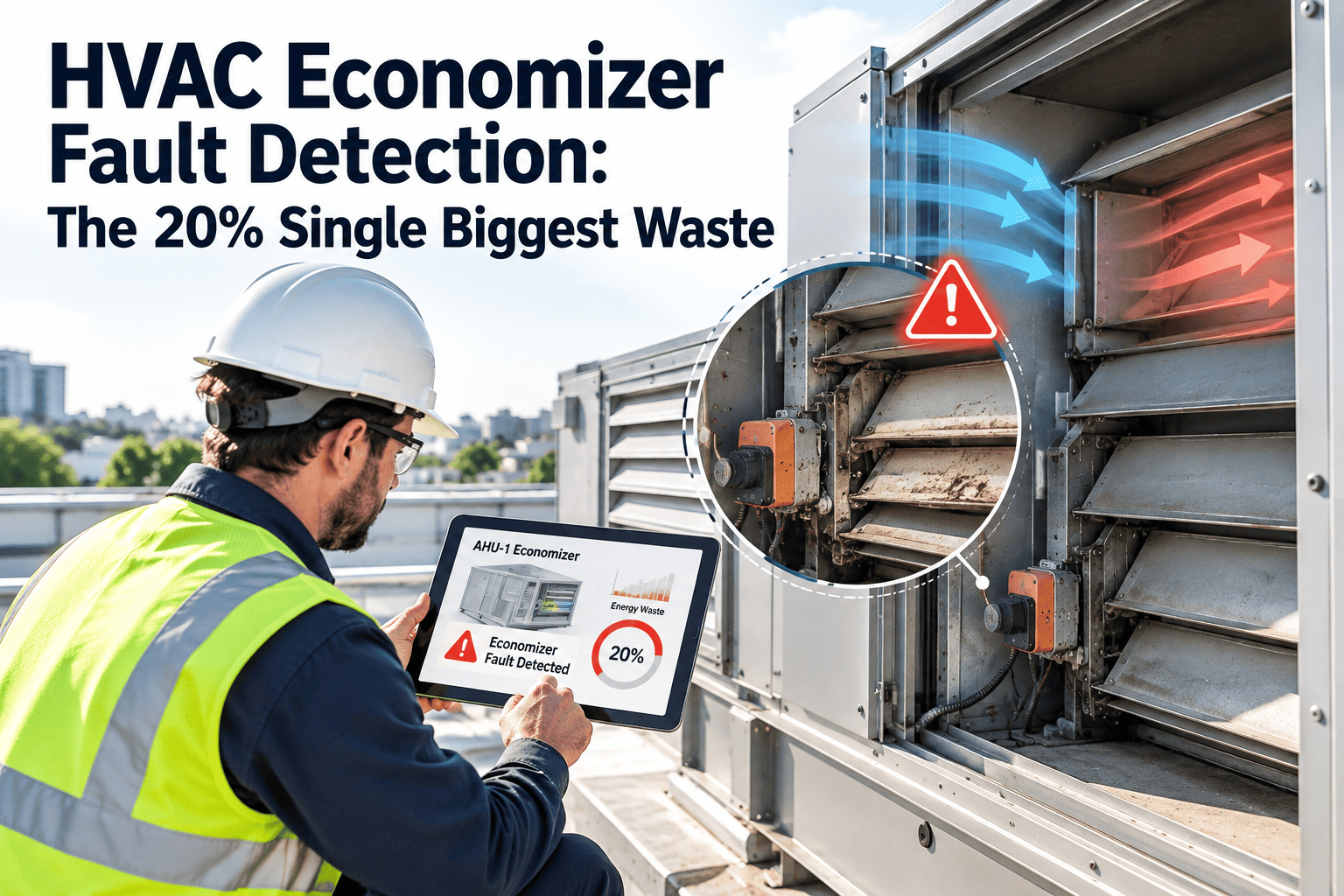
An economizer is supposed to cool a building for free whenever the outdoor air is cooler or drier than the return air. When it works, compressors rest and energy bills drop. When it fails, the damper quietly does the opposite, and nobody notices because the building stays comfortable while the mechanical cooling works overtime. Field research from PNNL and LBNL keeps finding the same thing: economizer faults are among the most common and most expensive rooftop unit problems. This guide covers the five ways an economizer typically fails, a repeatable detection routine, and how Oxmaint maintenance management software turns each finding into tracked work.
HVAC Economizer Fault Detection: Finding the Single Biggest Source of Wasted HVAC Energy
A failed economizer rarely triggers a complaint. It just burns compressor energy for years. Learn how to detect the five common failure modes and route every fault to a work order.
Why Economizer Waste Hides So Well
Mechanical cooling covers for a broken economizer. Space temperature stays on setpoint, so the fault never shows up as a complaint or an alarm.
- The cost appears on the utility bill, not the work order queue.
- Rooftop units are rarely opened outside of filter changes.
- Damper position is invisible from the ground.
- Controls often report "economizer enabled" even when the actuator has failed.
The waste also scales with fleet size. One stuck damper is a small leak. Fifty of them across a portfolio are a budget line.
What a Healthy Economizer Does
Fault detection starts with knowing the expected behavior for each outdoor condition. This table is the baseline every rule is measured against.
| Outdoor condition | Expected outdoor air damper | Expected cooling |
|---|---|---|
| Below the high-limit and cooler than return air | Modulating open to hold supply temperature | Free cooling first, compressors only if needed |
| Above the high-limit changeover | Closed to minimum ventilation | Mechanical cooling |
| Cold outdoor air | Mixing to protect the mixed air temperature | Little or none |
| Unoccupied | Fully closed unless night purge is active | Per schedule |
The 5 Ways an Economizer Typically Fails
Damper stuck closed
Free cooling never happens. Compressors carry loads the outside air could have handled. Look for mixed air temperature that tracks return air all season.
Damper stuck open
Hot or humid air floods the unit during peak load, or cold air enters in winter. Ventilation load rises well past design and mixed air temperature drifts toward outdoor temperature.
Failed or drifting sensors
Outdoor air, return air and mixed air sensors that read wrong cause wrong changeover decisions. The economizer enables when it should not, or locks out when conditions are ideal.
Actuator or linkage failure
The signal is correct but the motor, linkage or coupling is not. Commanded and actual position diverge. Loose set screws and seized blades are common causes.
Wrong setpoints and control logic
Changeover limits set too low, minimum position set too high, or the economizer disabled during a past repair and never restored. Software faults are as costly as mechanical ones.
Which Faults to Fix First
Not every fault carries the same cost. Rank by energy impact and by how often it occurs on your equipment.
| Fault | Energy impact | Comfort or IAQ risk | Typical fix |
|---|---|---|---|
| Stuck closed | High in mild seasons | Low | Replace actuator, free linkage |
| Stuck open | High in extremes | Moderate, humidity and freeze risk | Repair actuator, verify minimum position |
| Bad sensor | Moderate to high | Low | Calibrate or replace sensor |
| Actuator or linkage | Moderate | Low | Reseat coupling, replace motor |
| Wrong setpoints | Varies widely | Varies | Restore control logic, document |
Turn Every Economizer Fault Into Assigned Work
Record each rooftop unit as an asset, attach the test results, and raise a work order the moment a damper fails its check.
The Economizer Detection Routine
A good routine mixes automated rules on trend data with a short physical check. Run it in this order.
Rules That Catch Most Faults
- Commanded damper position differs from feedback by a wide margin for a sustained period.
- Economizer enabled, outdoor air favorable, but mixed air temperature equals return air temperature.
- Outdoor air above the changeover limit, yet the damper sits well above minimum position.
- Mixed air temperature outside the range between outdoor and return air.
- Cooling stages on while free cooling should satisfy the load.
- Damper open during unoccupied periods without a purge schedule.
Manual Test Versus Continuous Detection
What gets missed
- A fault that begins right after the visit runs for months.
- Technicians test what is easy to reach, not every unit.
- Results stay on paper and are not compared year to year.
- Repairs are not tied back to energy impact.
What gets caught
- Faults surface when the data departs from expected behavior.
- Every unit is scored on the same rules.
- Test history lives against the asset.
- Repair and retest are closed out in one record.
Root Causes Behind Recurring Failures
Replacing an actuator without asking why it failed invites a repeat. Common underlying causes include:
- Deferred maintenance, since economizers are treated as optional equipment.
- Overrides left in place after a service call.
- Dirty or corroded blades and seals that raise actuator load.
- Sensors installed in poor locations or never calibrated.
- Controls changes that nobody documented.
- No owner for economizer performance between the HVAC contractor and the in-house team.
Codes and Standards Raise the Stakes
Many energy codes now expect economizers to be verified, not just installed. ASHRAE 90.1 and several state codes, including California Title 24, include fault detection and diagnostics provisions for certain economizer equipment. Requirements differ by jurisdiction and code year, so confirm what applies to your buildings.
From Detection to Closed Work Order
How Oxmaint Fits the Workflow
- Asset records for each rooftop and air handling unit, with economizer type and test history.
- Preventive maintenance schedules for seasonal damper stroke tests and sensor calibration.
- Corrective work orders that carry the finding, location and priority.
- Mobile inspections so technicians can log damper position and attach photos on the roof.
- Inventory for actuators, linkages and sensors, so repairs are not delayed.
- Reports that show repeat failures by unit, model or site.
KPIs to Track
When Each Fault Costs the Most
The same fault wastes energy differently in each season. Knowing the pattern tells you where to look first and when to schedule testing.
| Season | Stuck closed | Stuck open | Bad sensor |
|---|---|---|---|
| Spring and fall | Largest loss, because free cooling hours go unused | Moderate extra outdoor air load | Wrong changeover wastes favorable hours |
| Summer | Little effect, since mechanical cooling is needed anyway | Large load from hot, humid air entering the unit | Economizer may enable on hot days |
| Winter | Little effect | Heating penalty and coil freeze risk | Mixed air control can fail |
Choosing the Changeover Strategy
The economizer decides when outdoor air is better than return air. The strategy behind that decision should match your climate and your code.
| Strategy | How it decides | Watch for |
|---|---|---|
| Fixed dry bulb | Enables below a set outdoor temperature | Ignores humidity, so a limit set too high admits damp air |
| Differential dry bulb | Enables when outdoor air is cooler than return air | Needs two sensors that agree with each other |
| Fixed enthalpy | Uses temperature and humidity against a limit | Humidity sensors drift and need calibration |
| Differential enthalpy | Compares total heat content of outdoor and return air | Most sensor dependent, so sensor faults matter most |
Whatever you choose, document the setpoints. An undocumented limit is the first thing to be changed and the last thing to be restored.
Diagnosing Each Fault on the Roof
Stuck closed
- Command the damper to full open from the controller and watch the blades move.
- Check the actuator for power, control signal and a working gear train.
- Inspect the shaft coupling and set screws, which are the most common loose parts.
- Look for seized blades from corrosion, debris or ice.
Stuck open
- Verify the actuator returns to closed on power loss if it has a spring return.
- Inspect blade seals and the outdoor air hood for gaps.
- Confirm the minimum position setpoint matches the design ventilation rate.
Sensor faults
- Compare each reading against a calibrated handheld instrument.
- Check the sensor location. A mixed air sensor in stratified air can read wrong even when healthy.
- Look for direct sun, condensation, damaged wiring and loose terminals.
Actuator and linkage faults
- Listen for a stalled motor and check the actuator torque against the blade load.
- Replace worn actuators rather than readjusting them repeatedly.
- Confirm the feedback signal matches the physical position.
Control and setpoint faults
- Compare current setpoints with the design sequence of operations.
- Check for overrides, forced values and disabled enable logic.
- Review occupied and unoccupied schedules and any demand-controlled ventilation logic.
Roof Safety During Testing
Economizer work happens on roofs and around moving dampers. Build safety into the checklist instead of assuming it.
- Use fall protection at roof edges and follow lockout and tagout before touching linkages.
- Keep hands clear of blades when commanding overrides.
- Release every override and record that you did so before leaving the unit.
Making the Business Case Without Guessing
You do not need a precise savings number to justify testing. A simple method using your own data is enough.
Common Mistakes in Economizer Programs
- Testing only when a unit is already being serviced, which leaves most units unchecked.
- Trusting the controller status instead of confirming the physical damper position.
- Fixing the symptom, such as replacing an actuator, without checking the sensors that command it.
- Forgetting to retest after repairs.
- Leaving manual overrides in place after commissioning or troubleshooting.
- Treating economizers as an energy project instead of routine maintenance.
See Your Rooftop Units in One Maintenance Record
Walk through economizer inspections, seasonal PM and fault work orders with a team that knows commercial HVAC.
Economizers and Indoor Air Quality
A working economizer is also a ventilation device, so faults can affect occupants as well as bills.
- A damper stuck closed can leave a space under-ventilated if minimum position control also fails.
- A damper stuck open can bring in humid air, raising moisture and comfort problems.
- Poor filtration on the outdoor air path lets dust and pollen reach the coil.
- Outdoor air intakes near exhausts or loading docks can pull in unwanted contaminants.
What to Record After Every Test
- Unit ID, date, technician and outdoor conditions during the test.
- Commanded versus observed damper position at several points.
- Sensor readings against a reference instrument.
- Setpoints found and any changes made.
- Photos of damaged parts and the final repaired condition.
Frequently Asked Questions
Stop Paying Compressors to Do the Damper's Job
Detect economizer faults, assign the repair, and verify the fix in one maintenance system built for facility teams.