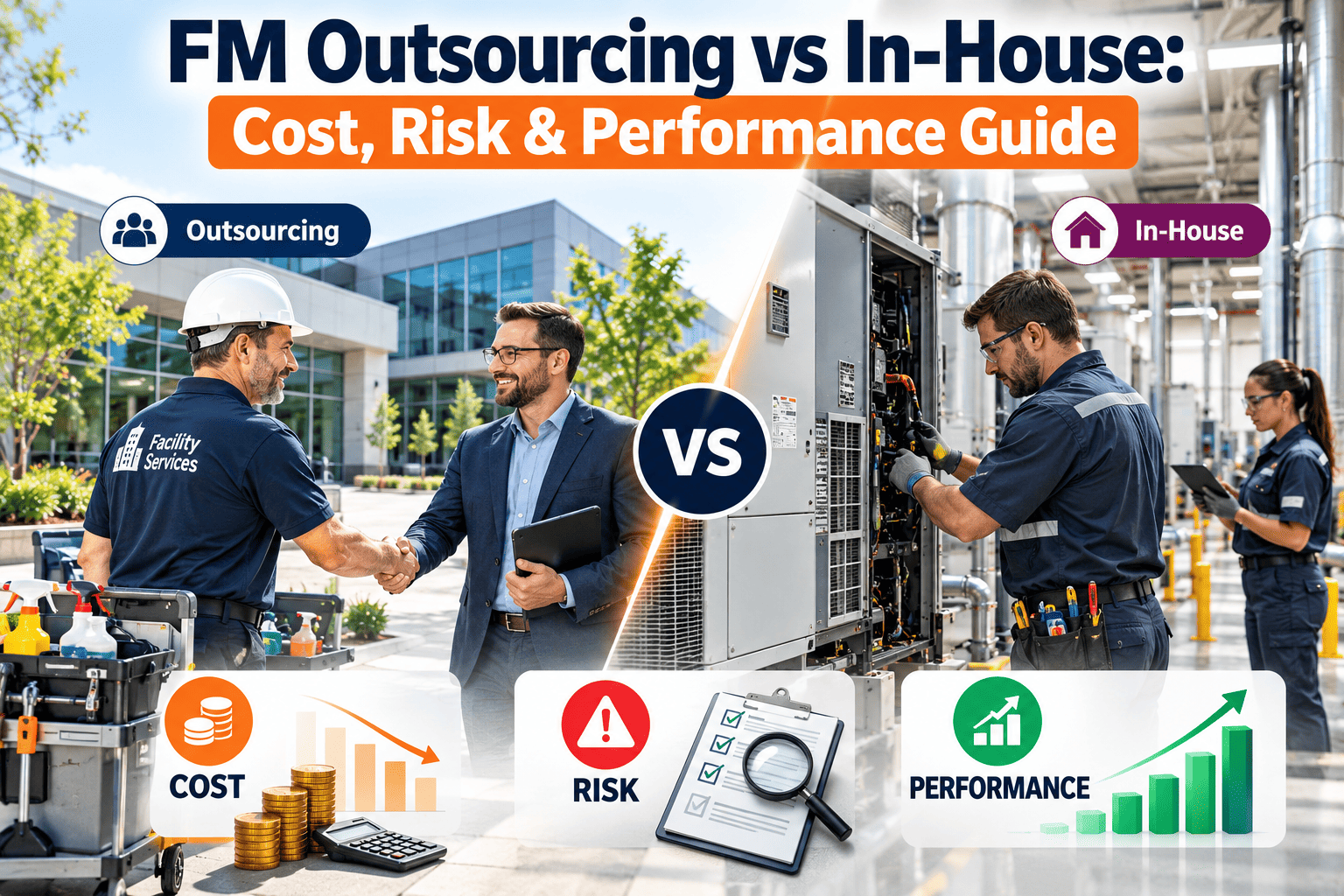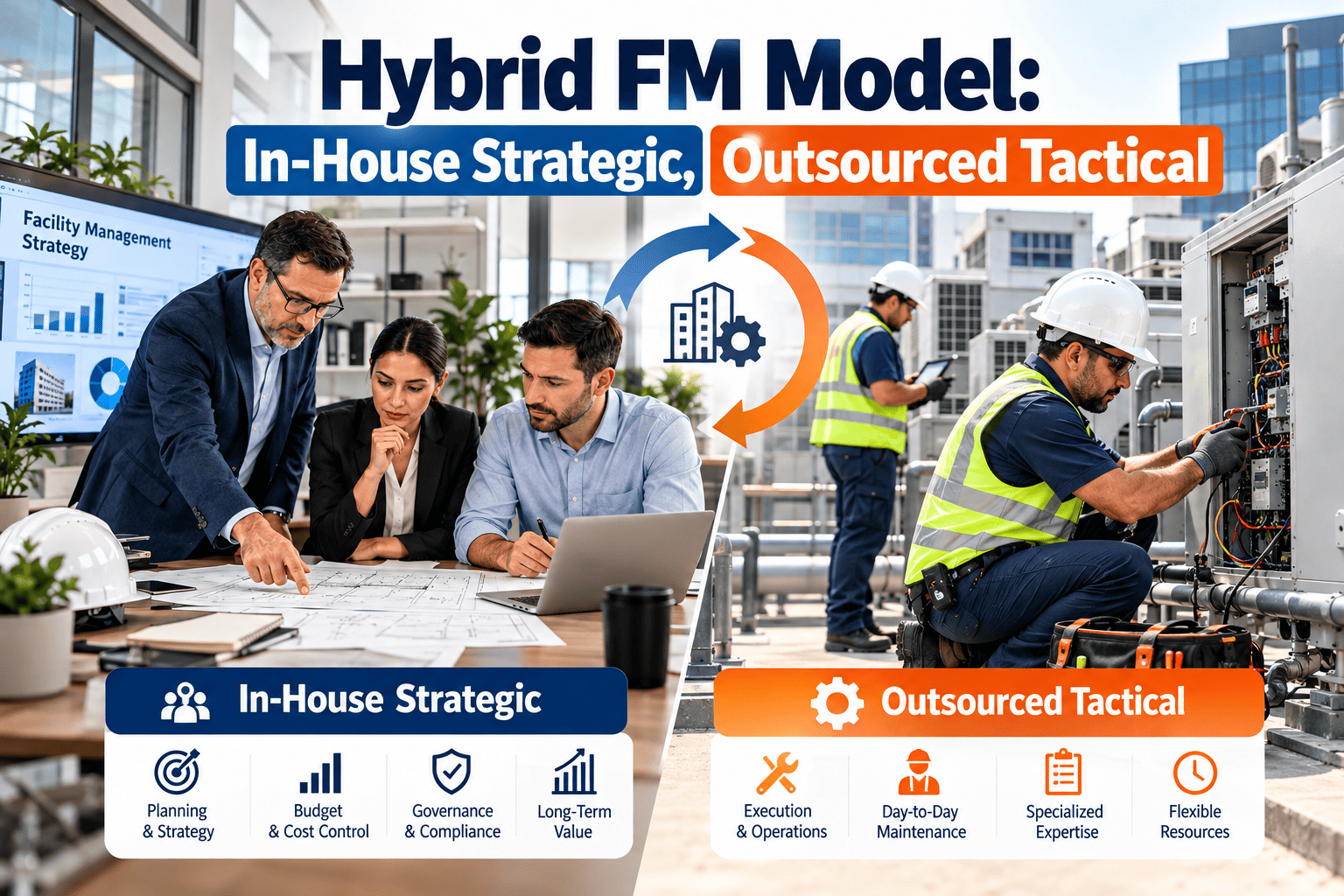
A hybrid FM model keeps the work that shapes your portfolio in-house and hands repeatable, labor-heavy work to specialist providers. Done well, it protects control over budgets, risk, and standards while giving you scale and flexibility on the floor. Done badly, it creates two teams, two data sets, and constant finger-pointing. This guide explains how to split strategic and tactical responsibilities, which roles to retain, and how governance keeps the arrangement honest. A shared system of record such as Oxmaint maintenance management software keeps both sides working from the same asset and work order data.
Hybrid FM Model: Keep Strategy In-House, Outsource Tactical Delivery
A practical operating model for commercial facilities teams that want vendor scale without losing ownership of standards, risk, cost, and data.
- Portfolio and budget strategy
- Standards, policies, and risk appetite
- Vendor governance and performance
- Data, reporting, and capital planning
- Routine preventive maintenance rounds
- Reactive call-out response
- Cleaning, grounds, and soft services
- Specialist trades and statutory testing
What a hybrid facility management model actually is
Hybrid FM sits between a fully in-house team and a single outsourced contract. Industry bodies such as IFMA describe sourcing as a spectrum, and hybrid delivery is the point on it where the organization keeps a deliberate core and buys the rest.
| Dimension | Fully in-house | Fully outsourced | Hybrid |
|---|---|---|---|
| Strategic control | Complete | Often drifts to the provider | Retained by design |
| Labor flexibility | Limited by headcount | High | High on tactical work |
| Management overhead | Spread across many supervisors | Lower, but contract oversight still needed | Focused on a small retained team |
| Cost visibility | Good, if tracked well | Depends on contract reporting | Good when vendors report into your system |
| Knowledge retention | Strong | Leaves with the provider | Strong on critical assets |
| Typical fit | Complex or sensitive sites | Simple, uniform portfolios | Mixed commercial portfolios |
Why commercial portfolios are moving toward hybrid FM
Few commercial owners and occupiers want to run everything themselves, and fewer still are comfortable handing over everything. Hybrid delivery tends to appear when several pressures meet at once.
Fixed headcount is hard to flex
Specialist trades are scarce
Boards want visible control
Operational triggers that start the conversation
- Reactive call-outs consume most of the team's week, leaving little time for planned work
- Multiple sites with different standards, vendors, and record formats
- Audit findings caused by missing inspection evidence rather than missing inspections
- A fully outsourced contract that no longer matches how the buildings are used
- Rising tenant expectations for response times and transparency
The split: what stays in-house and what moves out
The cleanest way to describe the divide is decisions versus execution. Anything that decides what good looks like stays with you. Anything that carries out the plan to that standard can be sourced.
Keep: decisions and accountability
- Maintenance strategy and asset criticality ranking
- Annual budget, capital replacement, and lifecycle planning
- Compliance ownership and audit readiness
- Service level definitions and vendor scorecards
- Tenant and stakeholder relationships
- Master data: asset register, maintenance history, cost records
Move: execution and capacity
- Scheduled inspections and preventive tasks
- First-line reactive repairs and out-of-hours cover
- Janitorial, landscaping, waste, and pest control
- Specialist trades such as lifts, fire systems, and HVAC servicing
- Seasonal or project-driven surge labor
A four-question filter for every service line
Rather than debating the split in the abstract, run each service line through the same short test. The answers usually make the placement obvious.
Does it shape asset value, risk, or tenant experience?
Does it depend on institutional knowledge?
Is the work repeatable and measurable?
Is there a competitive supplier market locally?
Service allocation matrix for commercial buildings
Use this as a starting point, not a rule. Your portfolio, tenants, and local supplier market will move some lines.
| Service line | Typical placement | Reason | What you still retain |
|---|---|---|---|
| Maintenance strategy | In-house | Sets risk and cost trade-offs | Full ownership |
| Preventive maintenance rounds | Outsourced | Repeatable and schedulable | Task lists and frequencies |
| Reactive call-outs | Outsourced with SLAs | Needs fast, local capacity | Priority rules and escalation |
| Critical plant such as chillers and generators | Hybrid | High consequence of failure | Technical authority and sign-off |
| Statutory inspections | Outsourced testing | Needs certified contractors | Compliance accountability and records |
| Cleaning and grounds | Outsourced | Labor-intensive, standardized | Quality audits |
| Space and tenant requests | In-house | Relationship sensitive | Service desk ownership |
| Capital planning | In-house | Strategic and financial | Full ownership |
| Reporting and analytics | In-house | Basis for governance | Data model and definitions |
Hybrid FM risks and how to control them
Splitting responsibility creates handoffs, and handoffs are where service quality is usually lost. Name the risks early and assign a control to each.
| Risk | Early warning sign | Control |
|---|---|---|
| Unclear ownership at the boundary | Work orders bounce between teams | Responsibility matrix by asset class, reviewed quarterly |
| Vendor dependency | Only the provider understands critical plant | Keep technical authority in-house and store method statements and history in your system |
| Data fragmentation | Reports differ between your team and the vendor | One work order platform with mandatory fields |
| Weak retained team | Contract reviews are skipped or rushed | Protect the five core roles in the budget |
| Compliance gaps | Certificates found missing during audits | Records attached to each asset with expiry alerts |
| Misaligned incentives | Vendor hits SLA while repeat failures grow | Add repeat failure and planned work ratios to the scorecard |
Roles the retained organization cannot lose
Hybrid models rarely fail because of the vendor. They fail because the retained team was cut too thin to manage the vendor. These five roles form the minimum core.
Compliance: you can outsource the task, not the accountability
Regulators, insurers, and tenants hold the building owner or operator responsible, whoever carried out the work. Frameworks such as ISO 41001 for facility management systems reinforce the idea that governance and records stay with the organization.
- Keep a single compliance register covering fire safety, electrical testing, lifts, pressure systems, water hygiene, and local statutory items
- Require contractors to attach completed checklists, readings, and certificates to the asset record
- Track expiry dates and generate reminders well before deadlines
- Retain the right to audit contractor work on a sample basis
- Keep records after contracts end, so a provider change never erases history
What auditors usually want to see
- Who performed the work, when, and against which procedure
- Evidence of findings and how they were corrected
- Proof that overdue items were escalated
Governance rhythm that keeps hybrid delivery honest
A hybrid model needs a predictable meeting and reporting cadence. Without it, issues surface only when a tenant complains or an auditor arrives.
See one shared workflow for in-house teams and vendors
Walk through how asset records, work orders, and vendor reporting can sit in a single platform built for your split.
Where hybrid models break down
Most hybrid failures trace back to the same few gaps. The difference between an unmanaged and a governed model is mostly about clarity and data.
- Responsibilities described loosely in contract schedules
- Vendors keep their own records, shared as monthly spreadsheets
- No single asset register, so history is fragmented
- SLAs measured by the party being measured
- Compliance evidence chased by email before audits
- Retained team reduced to invoice approval
- Responsibility matrix agreed per service line and asset class
- Vendors raise, update, and close work orders in your system
- One asset register with full maintenance history
- SLA clocks calculated from system timestamps
- Inspection and certificate records stored against the asset
- Retained team focused on performance, risk, and planning
How Oxmaint supports a hybrid FM operating model
A hybrid model depends on shared data. The platform becomes the neutral ground where your team and your providers see the same assets, tasks, and results.
Capabilities that matter most for a split model
- Asset management with criticality, location, and maintenance history so vendors work from your data, not theirs
- Preventive maintenance scheduling with task checklists that define the standard you expect from providers
- Work orders that can be assigned to internal technicians or external contractors, with priorities and due dates
- Mobile workflows so field staff can update status, add notes, and attach photos from the site
- Inspection and compliance records stored against each asset for audit-ready evidence
- Inventory visibility for critical spares, so ownership of parts is clear
- Reporting and dashboards for backlog, completion rates, repeat failures, and cost by asset or vendor
Illustrative example: a mixed commercial portfolio
Consider a hypothetical operator with one headquarters office, two multi-tenant buildings, and a small warehouse. The split below shows how the same principles produce different answers by site.
Higher in-house share
Balanced split
Mostly outsourced
A KPI scorecard split by strategic and tactical layers
Measure the two layers differently. Tactical measures judge vendors. Strategic measures judge whether the model itself is working.
Tactical measures
Strategic measures
A phased rollout for moving to hybrid
Shifting to a hybrid structure is a change program, not a procurement event. A phased approach reduces service disruption.
Baseline
Design
Contract and onboard
Operate and tune
Contract and readiness checklist before you commit
Confirm these points before signing or renewing a provider agreement.
- Every service line has a named owner on both the client and provider side
- The asset register is accurate enough to price and schedule work against
- Vendors agree to use your system for work orders, not a parallel tool
- SLAs define priority levels, response times, and how they are measured
- Data ownership and exit terms guarantee you keep full maintenance history
- Compliance responsibilities and evidence formats are written into the contract
- Critical spares and who owns them are listed
- Escalation routes and change control are documented
- A review date is set to re-test the split
Questions to settle before the first contract review
- Which decisions can a provider make alone, and which need your approval first
- How quickly must urgent faults be reported, and through which channel
- Who pays for repeat visits caused by an incomplete first repair
- How performance data is shared when a provider uses its own tools
Hybrid FM model: frequently asked questions
What is a hybrid FM model?
Which FM services are usually kept in-house?
How do you stop vendors from controlling your data?
How often should the in-house and outsourced split be reviewed?
Can software support both internal teams and contractors?
Build a hybrid FM model your team can actually govern
Give your retained team and your providers one asset register, one work order flow, and one set of reports.