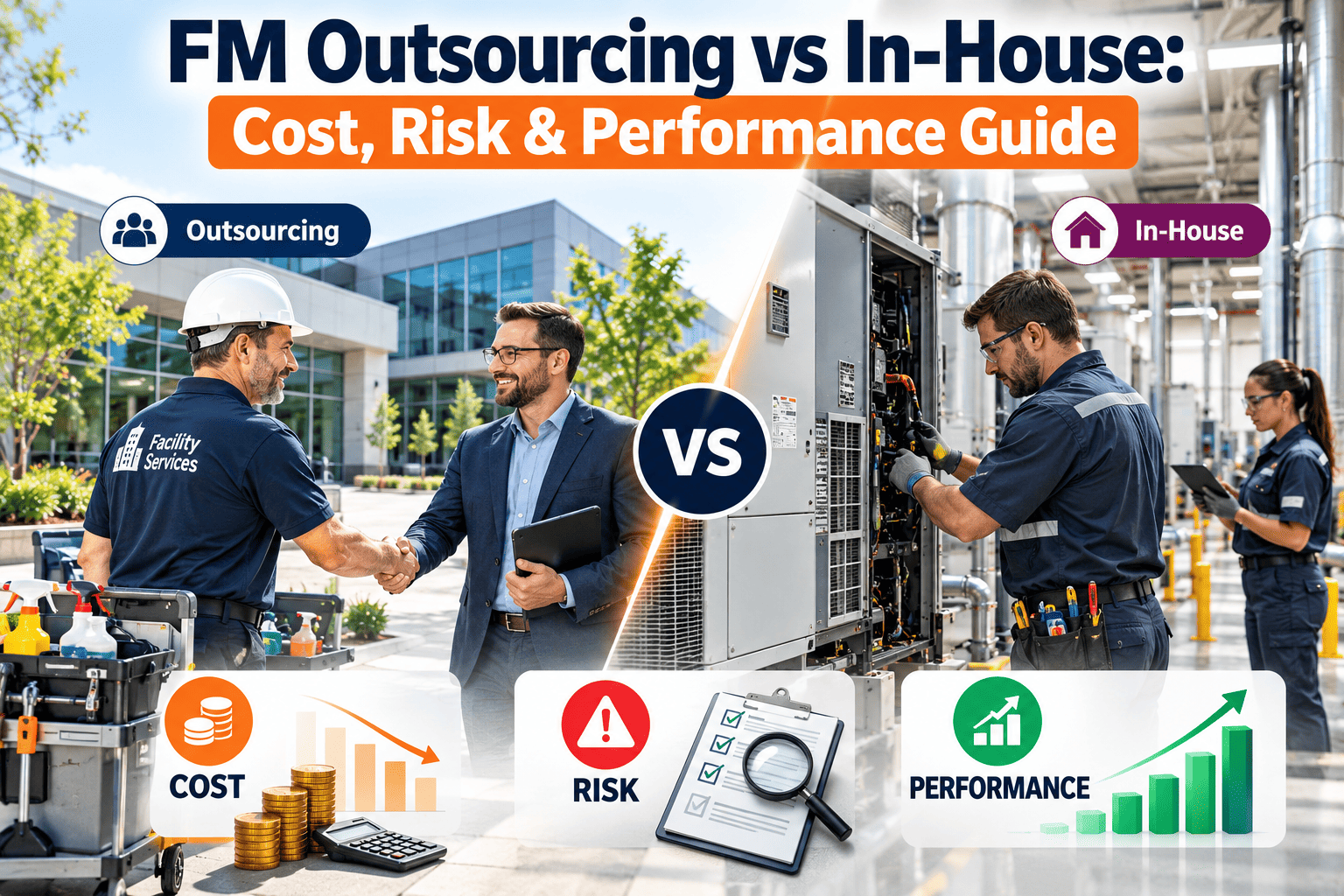
The outsourcing versus in-house facility management decision is rarely made once and held permanently. It is revisited every budget cycle, every time a key technician leaves, and every time a regulatory inspection reveals a compliance gap that the current model failed to prevent. Most FM directors approach it as a binary choice when the operationally superior answer in 2026 is almost always a calibrated hybrid. The global FM market reached $1.75 trillion in 2024 with the outsourced segment leading at 61.5% market share — but for mid-size commercial facilities, McKinsey research shows FM costs running 10 to 25% of total indirect spend, and reactive emergency repairs costing 4.8 times more than the same work performed as planned maintenance. The critical question is not whether to outsource, but which functions to outsource, at what service level, under what SLA structure, and with what CMMS integration to maintain visibility regardless of who executes the work. Book a 30-minute demo to see how Oxmaint's Vendor Management platform gives FM directors unified visibility across both in-house teams and outsourced contractors from one dashboard — or start a free trial and configure your first vendor performance scorecard today.
Vendor Management · Operations & Workflow · Decision Framework
FM Outsourcing vs In-House: The 2026 Decision Framework
A structured framework for deciding which FM functions to keep in-house, which to outsource, and how to configure the hybrid model that delivers the lowest total cost of ownership with full CMMS visibility across both delivery channels.
61.5%
FM market share held by outsourced models globally (2024)
34%
Cost reduction: hybrid vs fully outsourced at mid-size facility
4.8×
Cost of reactive repairs vs the same work completed as planned maintenance
78%
Of executives cite specialist skills — not cost — as primary outsourcing driver
The Three Models — What Each Looks Like in Practice
Understanding the three delivery models before comparing them prevents the most common FM decision error: evaluating outsourcing against an idealised version of in-house rather than against the organisation's actual in-house capability and cost structure.
In-House
Full internal delivery
StaffingDirect-hire technicians, supervisors, and FM management on payroll
Cost structureFixed — salaries, benefits, training, tools, uniforms regardless of demand
ControlMaximum — direct line management, immediate response, full institutional knowledge
RiskKey-person dependency, skills gap as technology evolves, recruitment difficulty
Best fitsSingle-site, regulated environments (pharma, defence), high-security facilities
Fully Outsourced
IFM / bundled contract model
StaffingManaged service provider supplies all personnel, tools, and management layer
Cost structureVariable — monthly service fee based on scope, with reactive callout premiums
ControlOutcome-based — FM director manages SLA performance, not task execution
RiskVisibility loss without shared CMMS, reactive callout premium at 4.8× planned cost
Best fitsMulti-site retail, hospitality, distributed portfolios where specialist scale wins
Hybrid
Recommended for most portfolios
StaffingIn-house team handles critical PM and emergency response; contractors handle specialist and scheduled work
Cost structureFixed core + variable contracted scope — lowest 5-year TCO in most portfolios
ControlCMMS visibility maintained across both channels — SLA tracking identical for in-house and contractors
RiskRequires disciplined vendor management and CMMS integration to retain control
Best fitsCommercial offices, manufacturing, healthcare — any portfolio with mixed criticality assets
The Cost Comparison — What the Numbers Actually Show at a 50,000 sq ft Facility
The comparison below uses a mid-size commercial facility (50,000 sq ft, 200 assets, 2 FTE equivalent technicians) as the baseline. The most common error in FM cost comparisons is omitting the reactive callout premium, contractor management overhead, and the hidden cost of visibility loss from the fully outsourced model.
| Cost Category |
In-House |
Fully Outsourced |
Hybrid (Recommended) |
| Core staff salaries & benefits | $145,000 | Included in contract fee | $72,000 (1 FTE) |
| Managed service / contract fee | — | $220,000 | $95,000 (specialist scope) |
| Reactive callout premium cost | $38,000 (high reactive rate) | $65,000 (at 4.8× rate) | $18,000 (low reactive rate) |
| Tools, PPE, consumables | $22,000 | Included in fee | $12,000 |
| Training & certification | $12,000 | Included in fee | $7,000 |
| CMMS / vendor management | $8,000 | $8,000 | $8,000 |
| Annual total | $225,000 | $308,000 | $208,000 |
Hybrid saves $100,000/yr vs fully outsourced and $17,000/yr vs fully in-house at this scale — primarily by eliminating the reactive callout premium that accounts for $47,000 of the outsourced model's annual cost.
Oxmaint manages both in-house and outsourced work orders in the same system — SLA timers, completion tracking, and vendor scorecards work identically for your technicians and your contractors.
The Decision Framework — 6 Dimensions That Determine Your Right Model
No single outsourcing model is correct across all FM contexts. The six dimensions below determine where each facility or portfolio sits on the outsource-insource spectrum. Score each dimension to identify your optimal configuration.
D1
Asset Criticality & Complexity
Assets with regulatory compliance obligations, life-safety functions, or production-critical status favour in-house delivery where institutional knowledge and immediate response matter most. Generic commercial assets (landscaping, cleaning, pest control) favour outsourcing to specialist service providers at competitive rates.
In-house signalsPharmaceutical GMP, hospital critical systems, data centre cooling
Outsource signalsCommercial HVAC PM, grounds, cleaning, pest control, lift maintenance
D2
Portfolio Size & Distribution
A single facility with 2 technicians can maintain in-house capability efficiently. A 50-site retail portfolio across 8 cities cannot staff or supervise in-house across all locations — outsourced IFM providers deliver scale and geographic coverage that in-house staffing cannot replicate at comparable cost.
In-house signals1–3 sites, dense urban cluster, central facility team
Outsource signals10+ sites, multi-city/country, remote or low-density locations
D3
Skills Availability & Labour Market
The global FM technician shortage affects in-house models disproportionately — a facility competing against an IFM provider for HVAC engineers or electricians will almost always lose on compensation and career progression. 78% of executives now cite specialist access as the primary outsourcing driver, ahead of cost savings.
In-house signalsStable local labour market, apprenticeship programme, established workforce
Outsource signalsSpecialist skills scarcity, high turnover, rural/remote location
D4
Compliance & Documentation Requirements
Highly regulated environments (healthcare, pharma, food production) require compliance documentation that the FM team owns and controls — meaning outsourced contractors must operate within the facility's CMMS and documentation framework, not their own. Facilities with lower regulatory burden can accept the documentation practices of their IFM provider more readily.
In-house signalsFDA, GMP, OSHA recordkeeping, fire authority, NFPA regulated operations
Outsource signalsStandard commercial compliance, provider-managed certifications
D5
Budget Flexibility & Cost Predictability
In-house models carry high fixed cost but predictable budgets with no reactive callout premium. Fully outsourced models carry lower fixed cost but variable callout risk — the 4.8× reactive premium becomes a budget management problem when it is unpredictable. Hybrid models use in-house teams to absorb reactive events and contractors for planned specialist work, achieving the best of both cost profiles.
In-house signalsHigh reactive demand, volatile call volume, budget certainty required
Outsource signalsPredictable PM-dominated workload, seasonal demand spikes, project-heavy periods
D6
Visibility & CMMS Integration Commitment
The most common reason outsourced FM fails is not poor contractor quality — it is CMMS visibility loss when the work is handed to a contractor. When contractors log work orders in their own system and report monthly on paper, the FM director loses the real-time performance data that drives accountability. Any outsourcing model that cannot commit to working within the client's CMMS should be treated as a higher-risk option.
In-house signalsReal-time dashboard required, audit trail critical, asset history must accumulate
Outsource signalsProvider commits to client CMMS use and SLA tracking on shared platform
Expert Review — The Hybrid Model Only Works If You Keep the CMMS Layer
"Every time I have been called in to troubleshoot a failed outsourcing transition, the root cause is the same: the FM director gave the contractor the work and lost the visibility. The contractor is logging jobs in their own system, emailing a monthly report, and the client FM team has no real-time view of SLA performance, no accumulating asset history, and no way to verify that PM was actually completed rather than just billed. When you outsource facility management execution while retaining CMMS ownership — meaning every contractor work order is raised, tracked, and closed in your platform — you get the contractor's specialist skills without sacrificing the accountability that makes the investment defensible to finance. The hybrid model is not complicated. In-house handles the reactive response and critical PM where institutional knowledge matters. Contractors handle the specialist, seasonal, and scale work where their expertise and economics win. Both channels operate from the same work order queue, the same SLA framework, and the same asset history. That is the model that saves 34% over fully outsourced while delivering better service quality than fully in-house."
Natalie Okafor, CFM, PMP
Certified Facility Manager · Project Management Professional · 19 years FM outsourcing strategy consulting · Former Head of FM Procurement, multinational real estate portfolio · IFMA thought leader on hybrid service model design
Frequently Asked Questions
What is the most common mistake FM directors make when outsourcing?
Removing the CMMS visibility layer when handing work to a contractor. Without a shared platform, SLA accountability and asset maintenance history disappear. Within 6 to 12 months, the FM director is managing from monthly contractor reports rather than real-time data — which means they cannot detect SLA drift until it becomes a tenant complaint or a compliance gap. Every outsourcing contract should include a contractual requirement for the contractor to work within the client's CMMS.
Book a demo to see how Oxmaint assigns work orders to both in-house technicians and contracted vendors from the same queue.
How much cheaper is a hybrid FM model compared to fully outsourced?
At a 50,000 sq ft commercial facility with 200 assets, a structured hybrid model runs approximately $208,000 annually versus $308,000 for a fully outsourced model — a 34% cost reduction. The primary saving is the reactive callout premium: in-house teams absorb reactive events at standard cost while outsourced contractors bill emergency callouts at 4.8× the planned maintenance rate. A hybrid model eliminates the majority of reactive callout exposure by deploying in-house staff for reactive response.
Which FM functions should always stay in-house?
Functions requiring immediate response, deep institutional knowledge, or regulatory documentation control perform best in-house. This typically includes emergency reactive response, life-safety system first response, GMP or FDA-regulated environments, and assets where compliance documentation must remain under direct FM team control. Specialist functions requiring expensive certifications or infrequent scheduled events (lift maintenance, pressure vessel inspection, fire suppression servicing) are better outsourced to specialists.
How does Oxmaint support hybrid FM models with both in-house and outsourced contractors?
Oxmaint assigns work orders to in-house technicians and contracted vendors from the same queue. SLA timers, completion tracking, photo evidence requirements, and asset history accumulation work identically for both. The FM director sees a unified real-time dashboard regardless of who executes the task — eliminating the visibility loss that undermines most outsourcing transitions. Vendor scorecards track SLA compliance, first-time fix rates, and cost per work order across the contractor network.
Start a free trial to configure your vendor network.
What SLA response targets should be specified in an FM outsourcing contract?
Industry standard targets for contracted FM SLAs: 2 to 4 hours on-site for emergency work orders (life safety, habitability, security); same business day for urgent (customer-facing defects, comfort complaints); 5 to 10 business days for routine (scheduled PM, minor cosmetic). Compliance-critical tasks need specific windows tied to regulatory deadlines — a fire suppression inspection window is not the same as a general PM window and must be specified separately in the contract.
The Best FM Model Is Not In-House or Outsourced. It Is Both, On One Platform.
Oxmaint Vendor Management gives FM teams unified visibility across in-house technicians and outsourced contractors — same work order queue, same SLA framework, same asset history, same performance scorecard — so the hybrid model that saves 34% also delivers full accountability.