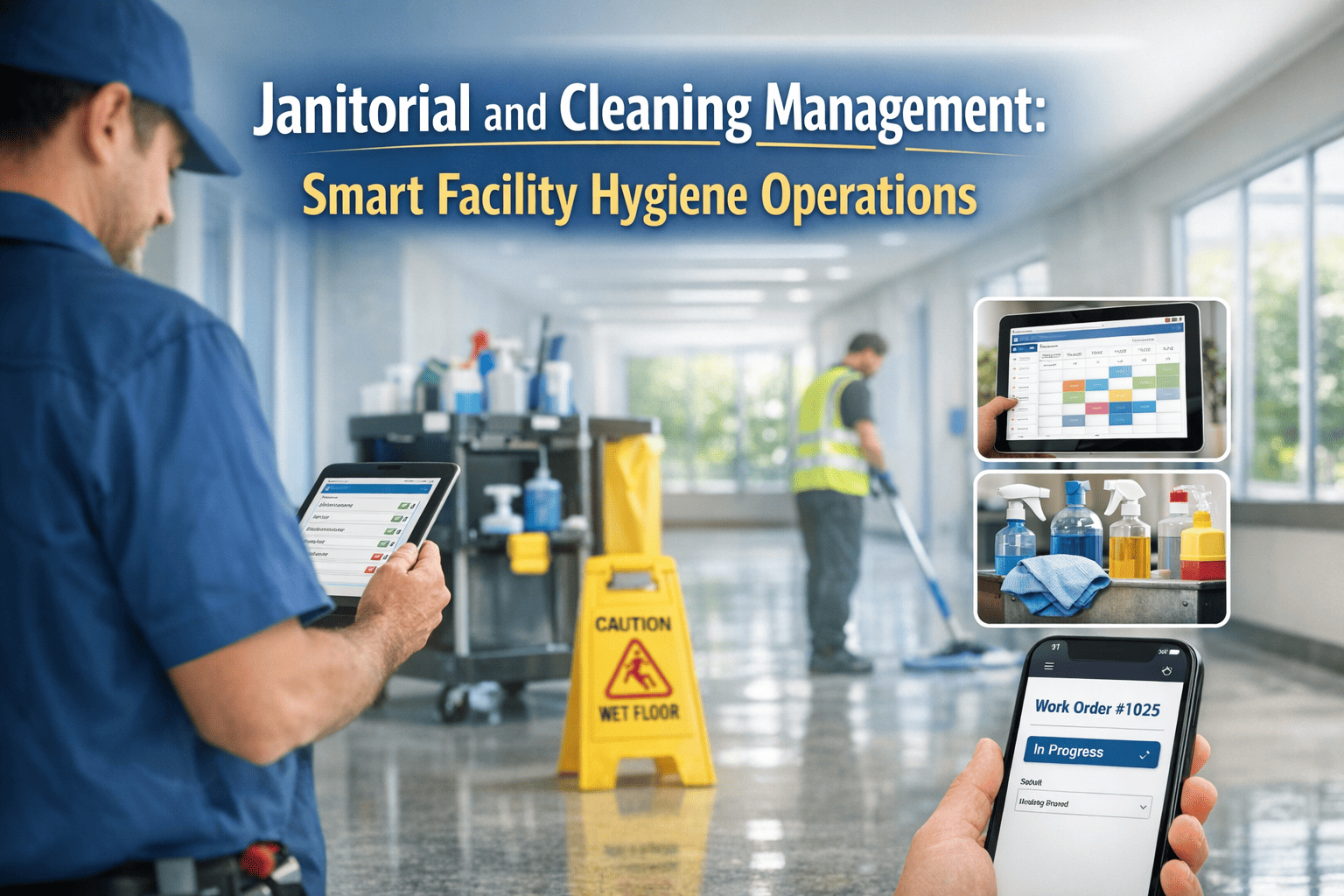
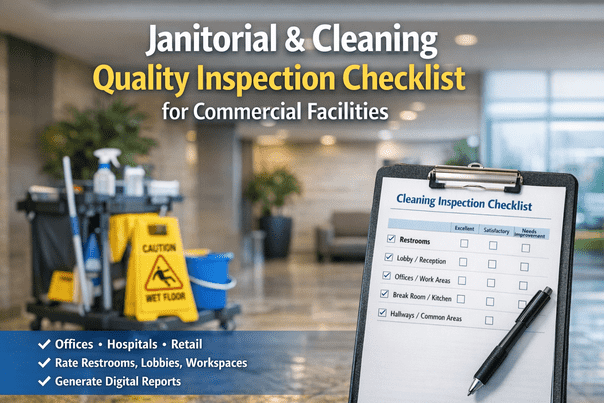
Cleaning is the only facility function where the customer is always watching and the work is almost never seen. Every tenant, visitor, and employee forms an opinion about the building from the state of the restroom, the smell of the lobby, and the streaks on the conference-room glass. Yet most janitorial operations still run on paper checklists, WhatsApp group chats, and the tribal knowledge of whoever closes out the shift — a structure that worked for a 50,000 sq ft single tenant and collapses the moment a contractor scales to multi-site, multi-shift, or multi-tenant operations. Industry research shows labor accounts for 50 to 80 percent of total cleaning cost and that ISSA-grade facilities hold production at 2,500 to 3,500 sq ft per labor hour — numbers only achievable when schedules, inspections, and proof-of-service live in a system, not in memory. Book a demo to see how Oxmaint structures janitorial work orders, inspections, and audit trails across multi-site facility portfolios.
Quick Answer
Modern janitorial operations need four things working together: zone-based scheduling tied to APPA cleanliness targets, weighted inspections that produce photo-verified proof of service, real-time complaint-to-work-order routing, and consumable tracking that kills both overstock and emergency deliveries. Oxmaint consolidates all four into a single platform so that clients audit a dashboard instead of arguing about what was or was not cleaned — and supervisors spend their shift managing exceptions instead of chasing custodians by phone.
94%
of customers will avoid a business that has dirty restrooms — ISSA research
-46%
reduction in workplace absenteeism linked to consistent cleaning programs
50-80%
of total janitorial service cost is direct labor — scheduling is the single largest lever
3,500
sq ft per labor hour — industry production benchmark for well-managed office operations
Background: Why Janitorial Operations Keep Breaking at Scale
A single-building cleaning operation runs on memory and goodwill. The supervisor knows which tenants complain, which custodian handles restrooms well, and which floor gets overlooked when someone calls out sick. That informal system starts failing the moment the contract extends to multiple buildings, multiple shifts, or a client sophisticated enough to audit against the APPA standards written into the scope of work.
The industry has mature standards — APPA's five cleanliness levels, ISSA's CIMS certification, OSHA 1910.141 for restrooms, CDC guidance for high-touch surfaces — but the operational systems connecting those standards to the actual cleaning shift are still dominated by paper and messaging apps. The gap between what was delivered and what was documented is where SLA penalties, lost renewals, and tenant complaints live.
01
Paper Checklists Don't Prove Service
Tenant complaint arrives Thursday. Your custodian cleaned the zone Wednesday night but the paper checklist is at the building. The dispute closes in the tenant's favor by default. Without timestamped, photo-verified records per zone per shift, the cleaning was functionally invisible.
02
Scheduling Lives in WhatsApp
Call-outs handled by text message. Route swaps by verbal request. Open shifts filled by whoever picks up first. The supervisor spends 40 percent of the shift on scheduling logistics instead of quality control. Coverage gaps surface only when the tenant notices.
03
Inspections Are Opinion, Not Data
Walkthrough inspections without weighted scoring, photo capture, or zone-specific checklists produce disputes not decisions. The client says restrooms were sub-Level-2. The contractor says they were Level-2. Neither has evidence. Contract renewal becomes a trust negotiation.
04
Supplies Run Out Without Warning
Paper towel dispenser empty at 10 AM. Soap dispenser out at 3 PM. Neither is on any scheduled check. Both become tenant tickets. Consumable inventory tracked on whiteboards leads to emergency ordering at premium prices and a stockroom full of sizes no building actually uses.
Four Principles of Smart Janitorial Operations
The research and the industry consensus converge on the same four principles. Every cleaning program that scales successfully across multiple buildings has all four in place — and every program that fails is usually missing at least two. The four pillars below are the structural foundation.
Zone-Based Scheduling
Every zone carries a defined frequency, task list, and APPA target level. Custodians see their route with estimated minutes per task. Supervisors see what is done, in progress, and overdue in real time across every building.
Photo-Verified Work Orders
Every task completion requires a timestamped photo and GPS stamp. The evidence is attached to the work order before it closes. Tenant disputes end in seconds — the proof is already in the system, not in someone's memory.
Weighted Digital Inspections
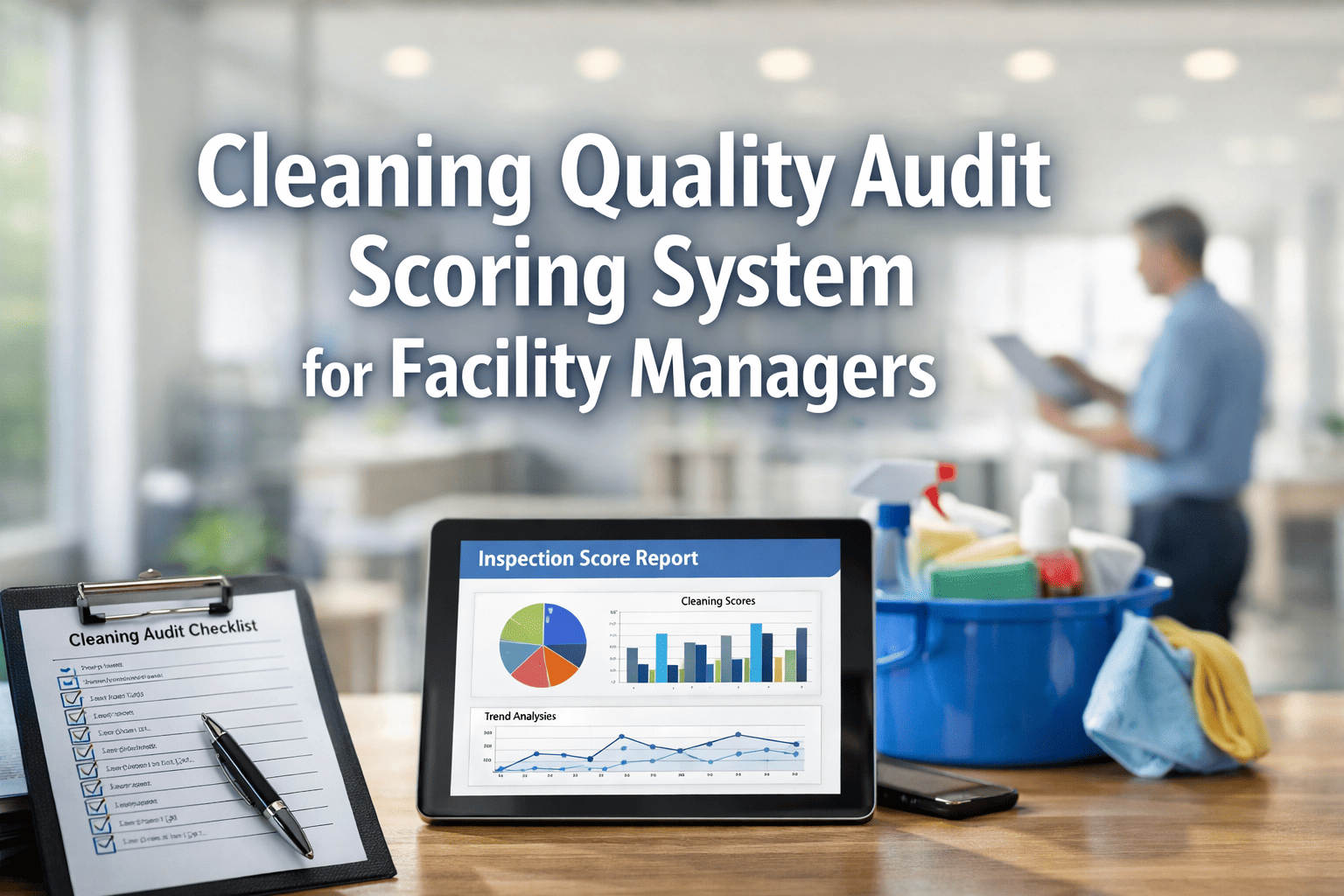
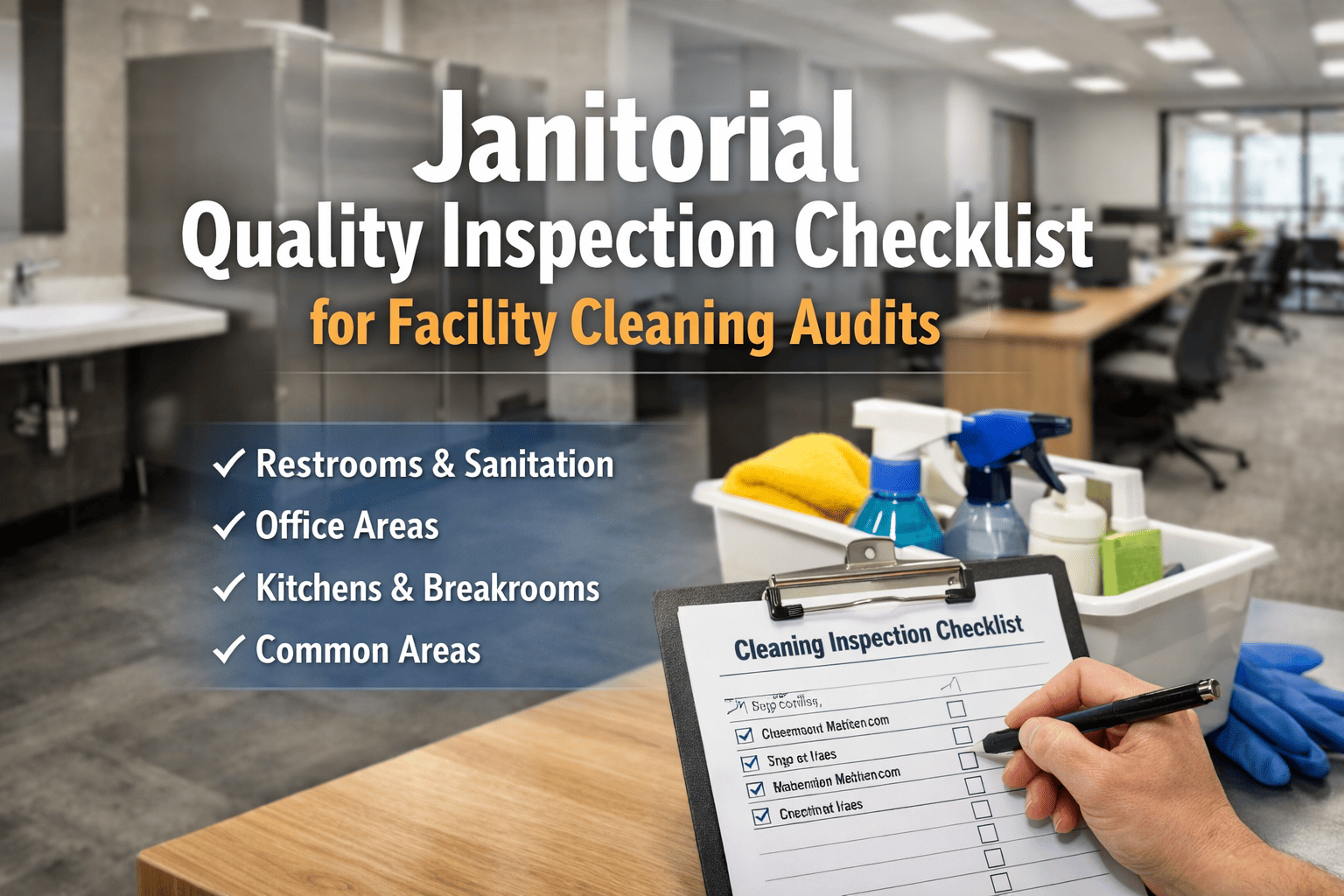
Inspection forms with zone-specific checklists, weighted scoring against APPA levels, and photo capture on every line item. Scores roll up to contract-level SLA compliance and down to individual operator performance records.
Consumable & Supply Tracking
Paper, soap, liners, and chemicals tracked per building with automatic reorder triggers. Usage linked to work orders for accurate billing on variable-cost contracts. Emergency deliveries at premium prices disappear from the invoice.
The Cleaning Cycle — Cadence Matrix by Frequency Tier
Cleaning frequency mistakes go in both directions. Over-cleaning low-traffic zones burns labor hours and chemical spend. Under-cleaning restrooms or high-touch surfaces destroys the tenant relationship. The four-tier structure below is the research-grounded cadence for a standard commercial office — scope documents may adjust by building type, occupancy, or industry.
Daily
High-Frequency Maintenance — The Visible Baseline
Restrooms
1-4x
Full clean and disinfect under 50 occupants; add midday restock 50-150; hourly spot check for high-traffic public
High-Touch Surfaces
Per shift
Door handles, elevator buttons, handrails, faucet actuators, light switches — CDC list fully enumerated per zone
Waste & Spills
As-triggered
Bin empty at threshold, spill response under 15-minute SLA, restock consumables before stockout
Weekly
Sanitation Layer — The Hygiene Reset
Restroom Deep
Full cycle
Stall partition scrub, grout brush, drain strainer removal, mirror polish beyond daily pass
Floor Treatment
Vacuum + mop
Full vacuum of carpeted zones, mop of hard surfaces, buff traffic lanes in lobby and corridors
Surface Dust
All zones
Workstations, shelves, chair bases, monitor stands, window sills — full horizontal dust pass
Monthly
Detail Layer — The Deep Reset
Fixture Descale
Restroom
Toilet descale, faucet mineral treatment, grout reseal cycle, floor drain deep clean
Vents & Baseboards
Full floor
Supply and return vent dust, baseboard wipe-down, ceiling fan clean, high-window attention
Pantry Deep
Full reset
Fridge interior clean, microwave deep clean, cabinet interior wipe, shared dispenser sanitize
Quarterly+
Capital Layer — The Annual Program
Carpet Extraction
1-2x/yr
Hot-water extraction on all carpeted zones, traffic-lane spot treatment, upholstery deep clean
Hard Floor
Strip & wax
VCT strip and recoat, tile regrout where needed, polished concrete reseal on schedule
Window Program
Exterior
Exterior window clean, high glass interior pass, entrance glass detail, skylight access
What Digital Janitorial Management Delivers at 90 Days
Teams moving from paper and WhatsApp to Oxmaint-managed operations report consistent improvements across six performance categories within the first quarter. The numbers below are typical for a 150,000 sq ft multi-tenant commercial office after 90 days of full deployment.
Tenant Complaints
-65%
Tenant complaints per month reduced by 65 percent. Issues caught at shift-level inspection before reaching the tenant. Paper-towel stockouts, missed bins, and smear streaks resolved same-shift instead of surfacing in email.
SLA Documentation
100%
Every zone, every shift, every task stamped with timestamp and photo evidence. Contract audits become view-only operations. SLA penalty disputes drop to near zero on documented delivery.
Route Completion
+18%
Clear route visibility and missed-task roll-forward eliminate the silent drift where 8 percent of daily tasks fall off the shift-end schedule. Custodians see what is outstanding before clocking out.
Supply Cost
-22%
Consumable tracking ends overordering and emergency premium deliveries. Paper, soap, and liner spend drops without touching service quality. Stockroom SKUs match what the buildings actually use.
Supervisor Time
-42%
Supervisor hours spent on call-out logistics, route coordination, and status chasing reduced by 42 percent. Freed time redirected to quality walks, inspections, and tenant relationship management.
Inspection Coverage
4x
Digital inspection capacity quadruples compared to paper-based walks. Supervisors complete more inspections in less time with photo-verified evidence attached to each line item.
Before and After — The Operational Shift
| Operational Dimension | Paper & WhatsApp Baseline | With Oxmaint (90 Days) |
|---|
| Work order completion proof | Signed paper sheet, verbal confirmation | Timestamped photo, GPS stamp, operator ID attached |
| Tenant complaint to resolution | 4-8 hours, routed by phone | Under 45 minutes — auto-routed to zone custodian |
| Monthly inspection count per building | 2-3 supervisor walks, no scoring | 8-12 digital inspections with weighted APPA scoring |
| Consumable reorder trigger | Stockout or verbal request | Automatic threshold-based reorder with lead time buffer |
| Client audit preparation | 2-3 days assembling paper logs per site | Client view-only portal — zero prep, live records |
| Call-out coverage decision | Supervisor phone chain, hope-based | Open-shift pickup with skill and proximity match |
| Individual operator performance | Opinion of whoever manages the zone | Inspection scores by operator over time — measurable |
Cleaning Standards Coverage by Industry
| Industry | Applicable Standards | Oxmaint Documentation Coverage |
|---|
| Commercial Office | APPA Levels 1-5, ISSA CIMS, OSHA 1910.141, CDC high-touch guidance | Zone-level cleaning records, weighted APPA inspection scoring, high-touch surface checklists, SLA documentation |
| Healthcare & Medical | AORN, AHE, CDC, Joint Commission EC standards, EPA List N disinfectants | Terminal clean records, EPA-registered chemical tracking, contact-time compliance, infection-control audit trail |
| Food Service & Retail | FDA Food Code, HACCP cleaning SOPs, local health department codes | Kitchen cleaning schedule, HACCP task verification, health inspection readiness records, temperature log integration |
| Education (K-12 & Higher) | APPA Custodial Staffing Guidelines, Green Cleaning mandates, state IAQ standards | APPA Level-based scheduling, green chemical inventory, IAQ-aligned cleaning records, district audit reporting |
| Hospitality | AHLA standards, Marriott/Hilton brand protocols, OSHA BBP standards | Room-status work orders, brand-specific checklists, turnover time tracking, guest complaint routing |
Five Industries. One Platform. Every Cleaning Standard Documented.
Oxmaint generates compliant janitorial documentation for all five industries above from the same dashboard your custodians use on their phones. No manual consolidation across sites. No separate inspection apps.
Perspective: What Operators and Clients Said
Before we moved to digital work orders, half of my supervisor's shift was phone calls. Who showed up, who is late, who is covering the second-floor zone tonight. Now he walks buildings and actually inspects. The same headcount now covers three more sites because the administrative friction is gone from the shift.
Regional Operations Manager
Building Service Contractor, Multi-State Operations
The shift happened when the tenant stopped emailing complaints and started checking the dashboard. They can see what was cleaned, when, by whom, with photos. Disputes do not start anymore. If they think something looks off, they click the zone and see the record. The contract renewed for three more years without a negotiation round.
Account Manager
Commercial Cleaning Contractor, Urban Portfolio
Frequently Asked Questions
QHow does Oxmaint handle zone-based versus crew-based staffing models?
Oxmaint supports both models natively. Zone-based operations assign custodians to defined square footage with their own route; crew-based operations assign teams by task across the building. The same platform handles either — or a mixed model where premium floors use zone staffing and lower-traffic floors use crew sweeps.
Book a demo to see both staffing models configured for a sample portfolio.
QCan tenants submit cleaning complaints directly into the system without training?
Yes. Tenants submit complaints via QR code posted in each zone, a web portal, or email. Each complaint auto-converts to a work order routed to the responsible zone custodian with a priority tag and SLA timer. No tenant training or app installation required.
QHow are APPA cleanliness levels scored inside the inspection module?
QDoes Oxmaint handle consumable inventory across multiple buildings at once?
Yes. Consumable inventory is tracked per building with automatic reorder alerts based on configured thresholds. Usage is linked to work orders so variable-cost contracts bill accurately. Portfolio-level dashboards show supply levels across all buildings in one view.
QIs a 2-week deployment realistic for a 150,000 sq ft single building?
Yes for a single building with existing scope documents. Week 1 covers zone setup, asset QR codes, and custodian mobile onboarding. Week 2 activates inspections, the tenant complaint portal, and the client audit dashboard. Portfolio rollouts typically run 6-8 weeks across 8-12 buildings.
Turn Paper Checklists Into Photo-Verified Proof. In Every Building, On Every Shift.
Oxmaint structures cleaning work orders, zone schedules, weighted inspections, consumable tracking, and tenant complaint routing into one platform your crew uses on their phones and your clients audit from a dashboard — without changing your crew, your buildings, or your contracts.
Photo-Verified Work Orders
APPA Level Scoring
Tenant Complaint Portal
Consumable Auto-Reorder