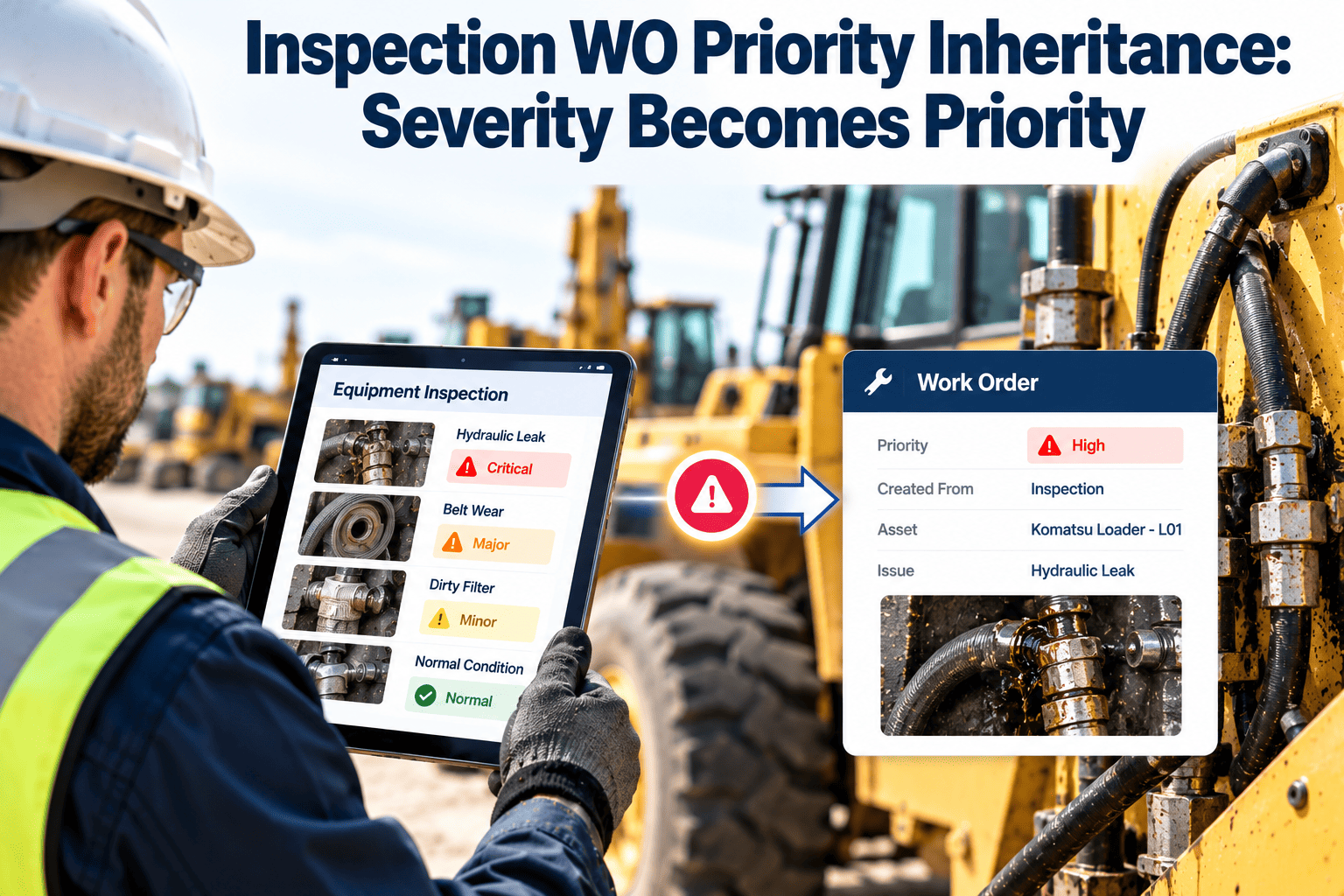
Two inspectors find the same cracked handrail on different days. One logs it as urgent, the other as routine, and the repair queue now holds two versions of the truth. Inconsistent priorities are one of the quiet causes of slow response on genuinely dangerous defects, because the dispatcher has to guess how serious a finding really was. Priority inheritance removes the guess: the severity recorded at inspection carries straight into the work order's priority through agreed rules. This guide explains how to design the mapping, handle overrides, and use Oxmaint work order and inspection software to keep the chain consistent from checklist to completion.
Inspection WO Priority Inheritance: Severity Becomes Priority
Let the inspector rate the condition, not the queue position. The system converts that severity into a priority and a response target using rules your team has already agreed.
Severity and priority are not the same thing
Mixing the two terms is the root of most priority arguments. Keeping them separate makes automatic inheritance possible.
Severity describes the defect
- Set by the inspector at the point of finding
- Based on condition, hazard, and likely consequence
- Stays with the finding as a permanent record
- Judged against written criteria, not instinct
Priority describes the response
- Set on the work order from severity and context
- Drives response time and queue order
- Can change as conditions change
- Reviewed by supervisors, not re-argued by requesters
Severity criteria inspectors can apply the same way
A severity scale only works if two inspectors reading the same defect reach the same rating. Write criteria in observable terms.
| Severity | Test the inspector applies | Example findings |
|---|---|---|
| Critical | Immediate risk to life, health, or critical operation if left as is | Exposed live conductors, blocked fire exit, gas smell, major active leak |
| Major | Likely to cause injury, significant damage, or loss of a key service soon | Failed emergency lighting, loose handrail, leaking roof over equipment, failed duty pump |
| Moderate | Affects performance, comfort, or compliance, with no immediate hazard | Worn door closer, noisy fan, damaged ceiling tile, slow drain |
| Minor | Cosmetic or low-impact, can be scheduled with other work | Scuffed paint, minor sealant gap, cosmetic signage damage |
The base mapping from severity to priority
Start with a one-to-one mapping. It is easy to explain, easy to audit, and covers most findings without any extra logic.
Make severity drive priority automatically
Keep inspection ratings and work order priorities aligned, with fewer disputes and faster response on real hazards.
Adding context: severity combined with asset criticality
The same defect matters more on a life-safety system or a data hall than on a storage room. A simple matrix adjusts priority without losing consistency. The cells below are an example to adapt.
Modifiers that can raise or lower inherited priority
Keep modifiers few and explicit. Each one should have a written definition and a clear direction of effect.
Occupancy and exposure
Defects in busy public areas or near vulnerable users can move up one level. The same defect in a locked, unused room may stay as inherited.Regulatory or insurer requirement
Findings linked to statutory duties or insurance conditions may carry a minimum priority, whatever the severity looks like in isolation.Redundancy available
A failed duty pump with a working standby may sit one level lower than a failure with no backup, while the standby remains at risk.Repeat finding
A defect found again after repair deserves attention beyond its stated severity, because it signals a deeper cause.Deterioration risk
Small leaks and early corrosion can worsen fast, so a minor rating may merit earlier action when the trend points the wrong way.Make-safe completed
Once a hazard has been isolated or barriered, the follow-up repair may move down a level, with the make-safe recorded as proof.Override rules that protect consistency
Overrides are necessary, but unmanaged overrides destroy the point of inheritance. Make them visible and reviewable.
- Allow overrides only by roleSupervisors or planners may change inherited priority. Requesters and general users may not.
- Require a reasonA short coded reason is recorded with every change, so reviews can find patterns.
- Keep both valuesStore the inherited priority and the final priority, so the difference stays visible in reports.
- Review overrides monthlyFrequent overrides on the same finding type show that the criteria or mapping needs revising.
Aging and escalation after the priority is set
Inheritance sets the starting priority. Rules for time and escalation make sure it is honored.
Mistakes that undermine priority inheritance
Vague severity definitions
Words like serious and important mean different things to different people. Use observable tests and example photos.Too many priority levels
Seven levels invite hair-splitting. Four levels with clear response targets are easier to apply and audit.Everything becomes urgent
If most work lands in the top levels, the scale has lost meaning. Check severity criteria and requester pressure.No calibration between inspectors
Run periodic joint walk-throughs so inspectors rate the same defects the same way.KPIs for priority consistency
Override rate
Work orders where final priority differs from inherited priorityResponse target compliance
Jobs started within the target for their priorityPriority distribution
Share of work in each level, to spot inflation or driftInspector agreement
Match rate when inspectors rate the same sample findingsTime from finding to P1 dispatch
Minutes between a critical finding and an assigned responderRe-rated after repair
Findings whose severity was later judged wrongHow Oxmaint supports priority inheritance
Oxmaint is maintenance management software. It records inspection findings and work orders together, while your team defines the severity scale, priority levels, and response targets.
Inspection checklists with severity
Inspectors rate each defect on mobile with consistent options, photos, and notes.Work orders from defects
Create a work order from a finding so severity and evidence travel with it.Priority levels and scheduling
Use defined priority levels to order work and plan technician time.Asset criticality
Hold criticality on each asset record so context is available when work is prioritized.Compliance records
Keep an auditable trail of findings, priorities, make-safe actions, and completion.Dashboards and reports
Review open work by priority and response time, and spot unusual override patterns.Severity examples by building system
Examples help inspectors rate consistently. Add photos from your own buildings to make each level unmistakable, and review the list as standards and equipment change.
Electrical
Critical: exposed live parts. Major: tripping circuit in a critical area. Moderate: failed luminaire in a corridor. Minor: loose cover plate with no exposure.Fire and life safety
Critical: blocked exit or disabled alarm. Major: failed emergency light. Moderate: worn door closer on a fire door. Minor: faded signage that remains legible.Mechanical and HVAC
Critical: refrigerant or carbon monoxide hazard. Major: failed duty pump. Moderate: noisy fan or dirty filter. Minor: damaged insulation off the main run.Plumbing
Critical: active flooding near electrics. Major: leak over equipment. Moderate: slow drain. Minor: dripping tap with a bucket-free path.Building fabric
Critical: falling hazard overhead. Major: loose handrail or trip hazard on stairs. Moderate: damaged ceiling tile. Minor: scuffed paint or cosmetic cracking.Grounds and external
Critical: live fallen cable or collapsed barrier. Major: deep pothole on a pedestrian route. Moderate: blocked drain. Minor: weeds in paving joints.Response targets by priority
A priority has no meaning without a clock. The figures in this table are examples to adapt to your lease terms, contracts, and staffing.
| Priority | Example response target | Typical first action | Communication |
|---|---|---|---|
| P1 Emergency | Immediate dispatch | Make safe, isolate, or evacuate as needed | On-call lead and supervisor notified by phone |
| P2 Urgent | Same shift | Assess, stabilize, and schedule the repair | Requester updated at start and end of work |
| P3 Standard | Within the routine window | Schedule with parts and access confirmed | Expected date shared with the requester |
| P4 Planned | Batched with planned work | Add to the zone's planned works list | Summary in the periodic update |
Calibrating inspectors so ratings agree
Inheritance only works if the severity going in is reliable. Calibration is a small recurring effort that keeps the whole chain trustworthy.
- Walk togetherInspectors rate the same set of defects on a joint walk, without discussing ratings until afterwards.
- Compare and discussReview differences, agree the correct rating, and note the reasoning behind it.
- Update the examplesAdd the agreed photos and wording to the severity guide so the lesson is kept.
- Repeat on a scheduleRun the exercise regularly and whenever a new inspector or a new building joins.
Fixed minimums for life safety findings
Some findings should never fall below a set priority, however the matrix or modifiers would score them. Write these as hard floors.
When one finding creates several work orders
A single defect can need a make-safe action, a temporary fix, and a permanent repair. Each may deserve a different priority.
Inherit the highest, then split
- The make-safe order inherits the full severity of the finding
- The permanent repair is set after the hazard is controlled
- Linked orders share the same finding reference and photos
- Closing the make-safe does not close the finding
Keep the story together
- Show all linked work orders on the original inspection record
- Report time to make safe and time to permanent repair separately
- Review the gap between them for aging temporary fixes
- Re-rate the repair if the temporary measure fails
Spotting priority drift in your reports
Top-heavy distribution
If a large share of work sits in P1 and P2, either severity criteria are too loose or requesters are pressuring the process.Rising override rate
When supervisors keep changing the inherited value for one finding type, the mapping for that type is wrong and should be revised.Inspector differences
If one inspector's ratings consistently sit higher or lower than colleagues', schedule a calibration walk with that person.Missed response targets
Repeated misses in one priority level suggest a staffing or dispatch problem, not a priority problem, and need a different fix.Introducing inheritance without disrupting live work
Changing how priorities are set affects everyone who requests or performs work. A staged introduction avoids confusion in the middle of a busy week.
- Test on past findingsApply the draft mapping to recent inspection results and see whether the resulting priorities feel right.
- Brief the teamExplain the severity scale, the mapping, and the override rules to inspectors, dispatchers, and technicians together.
- Start with one buildingRun inheritance in a single site, and collect examples where the result was questioned.
- Adjust and expandRevise criteria from the pilot, publish the final version, and extend to the remaining sites.
Handling requester pressure on priority
What requesters often ask
- Move my job up because of an important meeting
- Treat this as urgent because it annoys the whole team
- Skip the queue because the problem has been reported before
- Raise priority because a senior person is affected
How to respond consistently
- Explain that priority follows condition and risk, not volume of requests
- Ask whether anything about the hazard or service impact has changed
- Re-rate through the override process if the facts justify it
- Offer a clear expected date so the requester can plan around it
Priority inheritance FAQs
Should severity map directly to priority every time?
Use a direct mapping as the default, then add a small number of explicit modifiers such as asset criticality. Keep every exception documented and reviewable.
Who should be allowed to override priority?
Supervisors or planners, with a recorded reason. Limiting overrides by role keeps the inherited value meaningful.
How many severity levels are enough?
Four is common: critical, major, moderate, and minor. More levels rarely improve decisions and often reduce consistency between inspectors.
What if inspectors disagree on ratings?
Hold calibration walk-throughs and add photo examples to the criteria. Oxmaint inspections keep photos with each finding.
How do we begin?
Write the severity criteria and base mapping first, then test them on past findings. Book a demo to plan the setup.
Let every finding set the right priority
Give inspectors, supervisors, and technicians one consistent scale from the first observation to the closed work order.