The maintenance strategy your facility runs today determines a larger share of your operating cost than almost any other operational decision — yet sign up for Oxmaint free and you will discover that most organizations are still spending between 38% and 52% of their maintenance budget on reactive repairs, at 4 to 5 times the cost of the same work performed proactively. Only 51% of maintenance activities are preventive, according to McKinsey — leaving nearly half as reactive. The gap between the three available strategies is no longer a matter of preference or philosophy. It is a measurable financial difference: reactive maintenance costs 3 to 5 times more than preventive; predictive maintenance reduces costs a further 18 to 25% below preventive and up to 40% below reactive. Understanding which strategy to deploy — and on which assets — is the highest-ROI decision available to any facility manager, maintenance director, or VP of operations managing real equipment and real budgets in 2026. Book a demo to see how Oxmaint's CMMS structures your maintenance programme for the strategy that fits each asset class.
$50B
Annual cost of unplanned downtime for industrial manufacturers globally — the bill reactive-dominant maintenance programmes pay every year
3–5x
Reactive maintenance cost premium versus preventive — the foundational financial case that has been documented since the 1990s and remains unchanged in 2026
49%
Of maintenance activities remain reactive across industry — the majority of facilities are still making this expensive choice even knowing the cost differential
10–30x
ROI achievable with mature predictive maintenance — McKinsey and US Department of Energy documented benchmarks for high-criticality industrial assets
Oxmaint · CMMS Strategy & Analytics
Your Maintenance Strategy Gap Is Costing You 3–5x What It Should. Oxmaint Closes It — From Reactive to Planned in One Platform.
Preventive maintenance scheduling tied to asset records. Condition-based triggers replacing calendar guesswork. Work order cost tracking that quantifies your reactive spend. CapEx forecasting from real condition data. All in one CMMS — free to start.
3–5xReactive cost premium
40%PdM savings vs reactive
545%ROI on PM spend (JLL)
60–90 daysTo deploy Oxmaint
The Three Strategies Defined
Reactive, Preventive, and Predictive Maintenance — Sharp Definitions and When Each Is the Right Choice
Every facility runs a blend of all three strategies. The question is never which one to use exclusively — it is which one to deploy on which asset class, and whether the current mix reflects a deliberate decision or a default inherited from under-resourced prior teams.
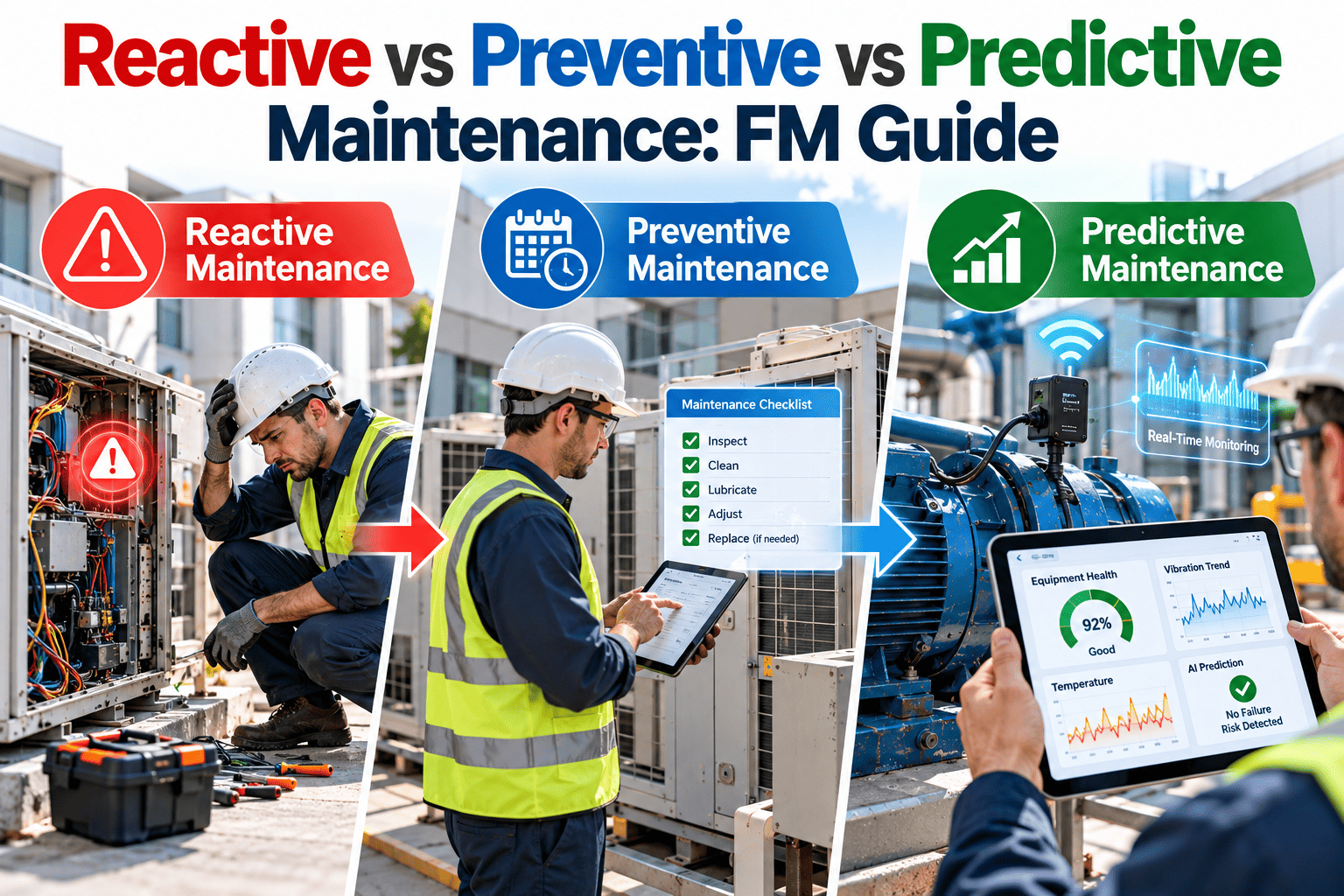
Fix it when it breaks. No scheduled maintenance. No condition monitoring. Equipment runs until failure triggers a repair. The only intentional choice justified by reactive maintenance is on non-critical assets with very low failure consequence and cheap, fast replacement.
When It Is Appropriate
Non-critical assets where failure has no production impact
Assets that are cheap and fast to replace with parts always in stock
Redundant assets where a failure triggers a standby automatically
Assets with random failure modes that PM cannot prevent
4–6% of Replacement Asset Value spent annually by reactive-dominant operations — vs. 1.5–2.5% RAV for best-in-class (Mitsubishi Manufacturing, 2026)
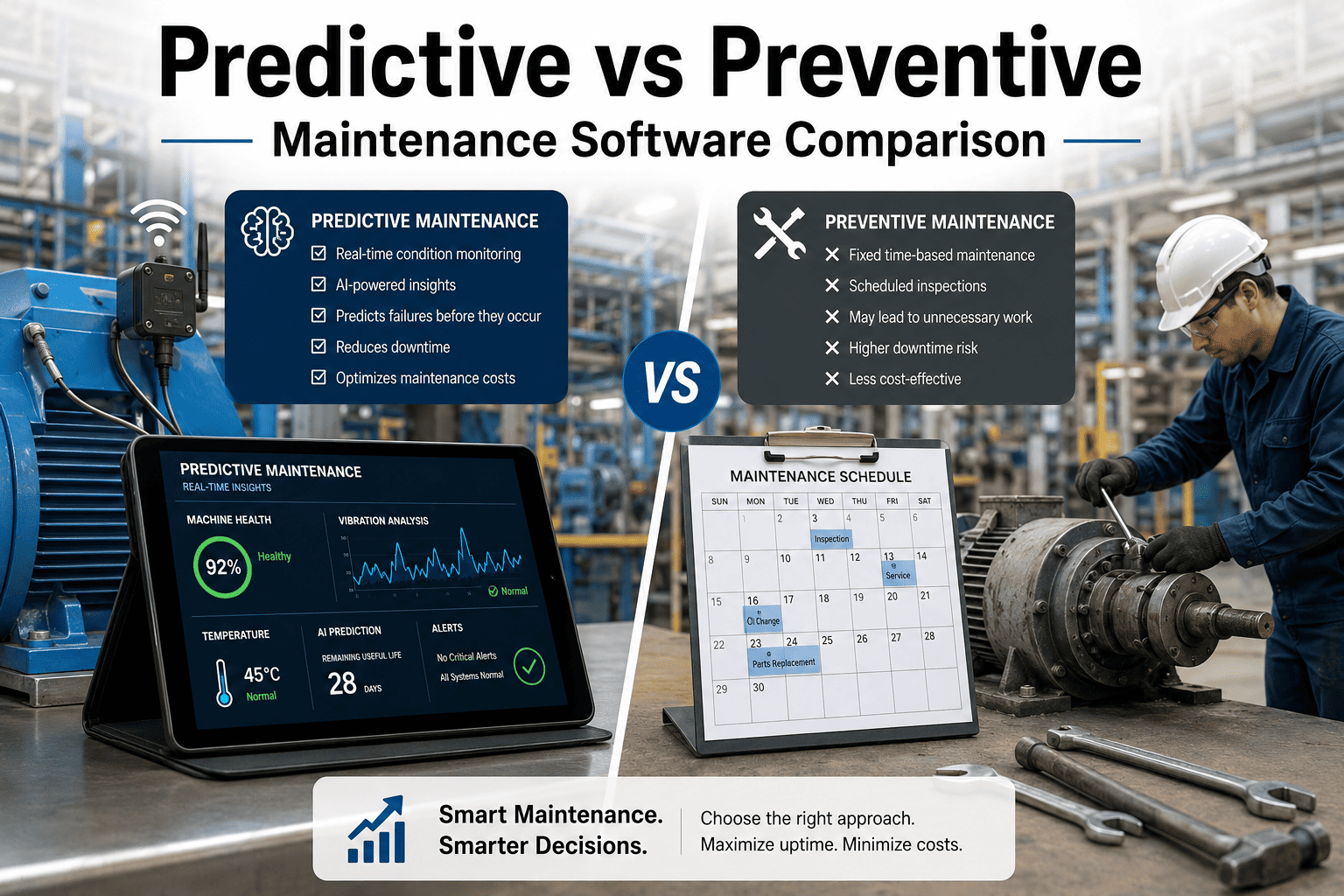
Scheduled maintenance on fixed intervals — monthly, quarterly, annually, or by operating hours. Addresses the most predictable failure modes before they cause breakdown. The most widely deployed strategy: 71% of maintenance professionals use it as their primary approach (2025 State of Industrial Maintenance).
When It Is Appropriate
Assets with predictable wear patterns that respond to regular servicing
Lower-criticality assets where condition monitoring ROI does not justify sensor investment
Regulated equipment requiring statutory inspection at defined intervals
Assets in the first 2–3 years of operation before condition data accumulates
US DOE: PM costs 12–18% less than reactive. JLL study: every $1 spent on PM returns 545% — the foundational ROI case for structured maintenance programmes.
Continuous or periodic monitoring of actual asset condition — vibration, temperature, oil analysis, pressure — to identify degradation before failure, triggering maintenance only when data indicates it is needed. Not too early (wasted resources like over-PM), not too late (emergency repairs). The highest-ROI strategy for critical, high-value assets.
When It Is Appropriate
Critical assets where failure cost justifies sensor investment
Assets with variable failure timelines where fixed intervals waste resources
High-value rotating equipment: motors, compressors, turbines, gearboxes
Assets with 3–6 months of condition history for ML model training
McKinsey: PdM reduces costs 18–25% vs PM and up to 40% vs reactive. 10:1 to 30:1 ROI documented within 12–18 months on high-criticality assets.
The Real Cost Numbers
What Each Strategy Actually Costs — The 2026 Data Behind the Comparison
The cost differential between strategies is not theoretical. It is measurable in every maintenance budget that breaks down emergency versus planned repair spend. Here are the specific cost drivers that make reactive maintenance so expensive and predictive maintenance the highest-ROI choice for critical assets.
$260,000
Per Hour of Unplanned Downtime
Average cost of unplanned industrial downtime per hour (WSJ / Machine Metrics). In process industries, this reaches $2 million per hour. The single most powerful financial argument for moving any critical asset off reactive maintenance.
1.5–2x
Emergency Labor Rate Premium
After-hours emergency labor rates versus standard shop rates. Combined with expedited parts shipping ($275–$690 premium over ground), every reactive repair carries a structural cost premium that planned maintenance eliminates entirely.
$84,000
vs $127,000 Per Unit Annually
2026 heavy equipment benchmark: predictive maintenance averages $84,000 per unit annually versus $127,000 for preventive-only maintenance — a $43,000 saving per unit from eliminating unnecessary PM and catching failures earlier (Heavy Vehicle Inspection, Jan 2026).
4–6%
vs 1.5–2.5% of RAV
Reactive-dominant operations spend 4–6% of Replacement Asset Value on maintenance annually. Best-in-class facilities with structured PM and condition monitoring achieve 1.5–2.5% RAV. On a $10M asset base, this gap is $150K–$350K per year.
30%
Parts Inventory Reduction
Predictive maintenance enables just-in-time parts ordering, reducing safety stock by 20–30% while eliminating stockouts. Knowing what will fail and when replaces the broad safety stock that reactive operations maintain against unpredictable failure timing.
80%
Cannot Calculate Downtime Cost
Approximately 80% of industrial facilities cannot accurately calculate their total downtime cost (industry research), which means they cannot quantify the reactive maintenance tax they are paying — and cannot build the ROI case for moving to preventive or predictive programmes.
Strategy Selection Matrix
Which Strategy for Which Asset — The Decision Framework Facility Managers Need
The mistake most organizations make is applying one strategy uniformly across all asset classes. Best-in-class operations apply a deliberate mix: predictive on critical, high-consequence assets; preventive on moderate-criticality assets; reactive only on assets where failure consequence is genuinely low and replacement is fast and cheap.
Critical Assets — Production-Stopping Failure
Predictive (Condition-Based)
HVAC chillers, electrical switchgear, production line motors, compressors, boilers, elevators, cooling towers, critical pumps
Failure stops operations. Every hour of unplanned downtime costs thousands. Sensor investment typically pays back within 3–6 months. PdM catches degradation 2–8 weeks before failure.
High-Importance Assets — Significant Impact
Preventive (Scheduled PM)
Secondary HVAC units, lighting systems, non-critical pumps, fire suppression systems, building envelope systems, plumbing infrastructure
Regular PM prevents the majority of failures at manageable cost. Failure impact is significant but not production-stopping. PM compliance tracked in CMMS with automated work order generation.
Low-Consequence Assets — Minimal Impact
Reactive (Run-to-Failure)
Office lighting, non-critical door hardware, minor consumables, small tools, low-value equipment with cheap fast replacement
Failure has minimal operational consequence. Replacement is fast and cheap. PM cost exceeds failure cost. CMMS tracks asset records but no PM schedule required.
The 2026 Hybrid Standard
66% of manufacturers use a hybrid approach
Deploying the right strategy per asset class rather than applying one strategy uniformly — the approach that achieves 50–65% reductions in unplanned downtime
Neither predictive nor preventive is universally better. The manufacturers winning in 2026 build hybrid strategies that leverage each approach where it creates maximum ROI for their specific asset portfolio.
Full Strategy Comparison
Reactive vs. Preventive vs. Predictive Maintenance — Full Comparison Across Every Operational Dimension
How Oxmaint Supports All Three
How Oxmaint's CMMS Structures Your Maintenance Strategy Across All Three Approaches
The right CMMS does not pick a strategy for you. It gives you the data visibility and workflow automation to deploy the right strategy on each asset class simultaneously — and to track whether your current strategy mix is actually performing as intended.
Preventive Scheduling
Automated PM Scheduling Tied to Asset Records
PM tasks scheduled against specific asset records with condition-based triggers — calendar, operating hours, cycles, or production units. Work orders auto-generated and assigned. PM compliance rate tracked as a live KPI. Most facilities achieve 80%+ PM compliance within 6 months of deploying structured CMMS versus the 35% or below typical of paper or spreadsheet systems.
Reactive Tracking
Emergency vs. Planned Repair Cost Quantification
Every reactive repair logged with total event cost — labor, parts, contractor, and downtime duration. Emergency versus planned repair ratio tracked as an operational KPI per asset class. Most operations discover for the first time what their reactive maintenance premium actually costs when they run Oxmaint's cost breakdown for the first 90 days. This data becomes the ROI case for transitioning reactive assets to preventive.
Condition Monitoring
IoT and SCADA Integration for Predictive Triggers
Oxmaint integrates with IoT sensors, SCADA systems, and building automation via OPC-UA and REST API. Sensor threshold breaches automatically generate condition-triggered work orders without manual review. Vibration, temperature, pressure, and energy consumption data stored against asset records for trend analysis. Predictive maintenance on the assets where it delivers the highest ROI — without requiring a separate predictive maintenance platform.
Capital Planning
Remaining Useful Life and 5–10 Year CapEx Forecasting
Condition scores and maintenance history feed Remaining Useful Life calculations per asset. Rolling 5–10 year CapEx forecasts updated dynamically as condition data accumulates. Refurbish versus replace analysis with total cost of ownership data for every major asset class. The capital planning output that transforms maintenance from a cost centre into a strategic asset management function — the final step beyond reactive operations.
Strategy Analytics
Maintenance Strategy Mix Dashboard and KPI Tracking
Portfolio-level dashboard showing planned versus unplanned repair ratio, PM compliance rate, MTBF and MTTR per asset class, emergency repair cost percentage, and cost per asset versus Replacement Asset Value benchmark. The visibility that most FM leaders have never had — not because the data did not exist, but because it was never aggregated in one place with the right KPIs surfaced automatically.
Multi-Site Scale
Portfolio-Level Strategy Consistency Across All Locations
Standardized PM schedules, inspection checklists, and condition monitoring configurations deployed consistently across all properties in a portfolio. Cross-site benchmarking identifies which locations are underperforming their peer properties on reactive spend, PM compliance, or OEE. The visibility that multi-site owners, asset managers, and portfolio directors need to identify where strategy investment delivers the highest return.
ROI Benchmarks
The Strategy ROI Numbers — What Research Shows Across All Three Approaches
545%
ROI on Every PM Dollar
Jones Lang LaSalle study: every $1 spent on preventive maintenance returns more than $5.45. The foundational ROI benchmark that makes preventive maintenance the most defensible capital allocation in any facility budget.
10–30x
Predictive Maintenance ROI
McKinsey and US Department of Energy documented 10:1 to 30:1 ROI on predictive maintenance investment within 12–18 months for high-criticality assets. 95% of adopters report positive returns. 27% achieve payback within 12 months.
40%
Cost Reduction vs Reactive
McKinsey: predictive maintenance reduces costs up to 40% versus reactive operations. A 50-unit fleet saving $43,000 per unit annually generates $2.15 million in annual savings — enough to fund implementation multiple times over.
30–50%
Unplanned Downtime Reduction
Predictive maintenance reduces unplanned downtime by 30–50% versus reactive operations. Fortune 500 companies are estimated to save 2.1 million hours annually with full adoption of condition monitoring. At $260,000 per downtime hour, the financial case is immediate.
20–40%
Asset Lifespan Extension
Consistent condition-based maintenance extends average asset lifespan by 20–40% versus reactive operations. Delayed capital replacement at this scale represents millions in deferred CapEx for portfolios with significant asset bases at or approaching end-of-design-life.
88%
Use Preventive as Primary
2025 Plant Engineering study: 88% of manufacturing companies use preventive maintenance, but only 27% apply predictive maintenance. The 61% gap between PM adoption and PdM adoption is where the next decade of maintenance performance improvement lives for most organizations.
Oxmaint · CMMS for All Three Strategies
Your Current Strategy Mix Is Either Costing You Money or Missing ROI. Oxmaint Quantifies Both — Free to Start.
Build your asset registry. Configure condition-based PM schedules. Connect IoT sensors for predictive triggers. Track emergency versus planned repair ratios. Generate 5-year CapEx forecasts from real condition data. All in one CMMS. Free to start. No implementation fees. Deploy in 60–90 days.
Frequently Asked Questions
Maintenance Strategy Comparison — What Operations Leaders Ask First
Is reactive maintenance ever the right choice — or should every asset be on a preventive or predictive programme?
Reactive maintenance is the correct strategy for a specific category of assets — and most operations have more of these than they realize. The decision rule is simple: if the consequence of failure is low (no production impact, no safety risk, no compliance exposure) and the replacement cost and time is minimal (parts in stock, repair in under an hour), then run-to-failure is the economically rational choice. Putting these assets on preventive maintenance schedules wastes labor on unnecessary servicing. Research shows that a substantial portion of scheduled preventive maintenance tasks are unnecessary on assets that would not have failed within the next several service intervals anyway — this over-PM overhead is a direct cost of applying preventive maintenance too broadly. The three-strategy framework is not about eliminating reactive maintenance. It is about applying each strategy to the right asset class. Reactive on low-consequence assets; preventive on moderate-criticality assets; predictive on high-consequence critical assets where the investment pays back within months. Oxmaint's asset registry and criticality scoring helps facility managers classify their asset base correctly and build PM schedules only where they deliver positive ROI.
Sign up free to start classifying your asset base, or
book a demo to see how Oxmaint structures a three-strategy mixed-approach programme.
What is the real cost difference between reactive and preventive maintenance — and how do I calculate it for my facility?
The documented cost differential between reactive and preventive maintenance is 3 to 5 times — meaning the same repair performed reactively costs 3 to 5 times more than the same intervention performed as planned preventive maintenance. The cost premium comes from four sources. First, labor rates: emergency after-hours callouts carry 1.5 to 2 times the standard labor rate for overtime and contractor mobilization. Second, parts procurement: expedited shipping for parts not in stock runs $275 to $690 per shipment above standard ground rates, plus premium pricing for sourcing from whoever has the part immediately rather than the lowest-cost supplier. Third, cascade damage: a failed bearing that is run to destruction damages the shaft, housing, and adjacent components — turning a $400 planned bearing replacement into a $2,500 to $5,000 emergency repair plus the cost of repairs to cascade-damaged components. Fourth, downtime duration: reactive repairs average longer than planned repairs because technicians start without prior knowledge of the failure mode, required parts, or optimal repair sequence — all of which Oxmaint's work order history provides before the technician reaches the asset. To calculate your facility's reactive maintenance cost, Oxmaint tracks emergency versus planned repair ratios and total event costs automatically from work order data — surfacing the reactive premium for the first time for most operations within 90 days of deployment.
Book a demo to see how the cost tracking works, or
sign up free to start measuring your reactive premium today.
How long does it take for predictive maintenance to deliver ROI — and what does getting started actually require?
The payback timeline for predictive maintenance depends on two variables: the downtime cost of the assets being monitored and the implementation quality. For high-criticality assets in continuous process industries where downtime costs $20,000 to $100,000 or more per hour, a single prevented failure event can pay back the entire programme investment. For discrete manufacturing with lower downtime costs per hour, payback typically runs 12 to 18 months. Across all industries, 95% of predictive maintenance adopters report positive returns and 27% achieve payback within 12 months (IoT Analytics). Getting started requires four things. First, a CMMS with asset records and work order history — the baseline data that PdM models need to contextualize condition readings against maintenance history. Second, sensor infrastructure: basic temperature and vibration sensors start at $100 to $500 per asset. A pilot programme on 10 to 20 critical assets can be instrumented for $5,000 to $15,000. Third, integration between sensors and CMMS: Oxmaint connects via OPC-UA and REST API to any sensor system, generating condition-triggered work orders automatically on threshold breach. Fourth, 3 to 6 months of model training time for per-asset ML accuracy to reach 85–92% prediction accuracy. The practical starting point is a pilot on the 5 to 10 most expensive recurring failure events in your asset history — the failures that, if prevented, would each independently justify the programme cost.
Sign up free to start with your asset registry and work order history, or
book a demo to see Oxmaint's IoT and SCADA integration architecture for predictive maintenance deployment.
What maintenance strategy does Oxmaint recommend — and how does it support the transition from reactive to planned?
Oxmaint does not prescribe a single strategy because no single strategy is universally optimal. The platform supports all three approaches simultaneously and gives operations teams the data to make the right strategy decision for each asset class. The recommended transition path for reactive-dominant operations is structured in three phases. Phase one — typically months 1 to 3 — is asset inventory and reactive cost quantification. Build the asset registry, start logging every repair against the correct asset record, and measure your emergency versus planned repair ratio and cost per event. Most operations discover in this phase that their reactive premium is significantly higher than estimated — typically 40 to 60% of total maintenance spend at 4.8 times the cost of the same work performed proactively. Phase two — months 3 to 9 — is preventive maintenance programme deployment. Configure PM schedules for your moderate-to-high criticality assets based on manufacturer recommendations and operating data. Oxmaint auto-generates and assigns work orders. PM compliance tracking begins. Emergency repair share starts declining as planned interventions replace reactive callouts. Most operations see their reactive spend drop from 40–50% of maintenance budget to 15–25% within 18 months. Phase three — month 9 onward — is condition-based monitoring on critical assets. Connect IoT sensors on the assets with the highest failure cost. Integrate with existing SCADA and BMS systems. Condition-triggered work orders replace fixed-interval PM on the assets where it delivers the highest ROI. Oxmaint's CapEx forecasting module builds the capital plan from live condition data.
Book a demo to see the full transition pathway structured for your facility's current maintenance maturity, or
sign up free to start phase one with your asset registry today.
What KPIs should I track to measure maintenance strategy performance — and what are the 2026 benchmarks?
The six KPIs that most directly measure maintenance strategy performance — and their 2026 industry benchmarks — are: Emergency versus planned repair ratio (benchmark: under 20% emergency for well-managed operations; reactive-dominant facilities typically run 38–52% emergency); Maintenance cost as percentage of Replacement Asset Value (benchmark: 1.5–2.5% RAV for best-in-class; 4–6% RAV for reactive-dominant); PM compliance rate — percentage of scheduled PM tasks completed on time (benchmark: 80%+ for structured programmes; reactive-dominant facilities typically run 31–40%); Mean Time Between Failures per critical asset class (improving MTBF confirms PM and PdM are catching degradation before failure); Mean Time to Repair (benchmark: planned repairs average 30–40% shorter than reactive emergency repairs from structured work order history); and OEE — Overall Equipment Effectiveness (benchmark: 65–75% achievable with structured maintenance; below 50% is typical for reactive-dominant operations per Deloitte). Oxmaint's analytics dashboard calculates all six KPIs automatically from work order and asset condition data, updated continuously without any manual reporting effort. Most facilities see actionable KPI data within 30 days of deployment.
Sign up free to start tracking these KPIs for your facility, or
book a demo to see the KPI dashboard live with your asset data.
Oxmaint · Maintenance Strategy Platform
49% of Maintenance Activities Are Still Reactive. The Operations Teams Winning in 2026 Are the Ones Who Quantified That Cost and Acted On It. Oxmaint Is Where You Start.
Asset registry and criticality scoring. PM scheduling tied to asset records. Emergency versus planned cost tracking. IoT and SCADA integration for predictive triggers. Remaining Useful Life calculations. 5–10 year CapEx forecasting. All three strategies. One CMMS. Free to start. Deploy in 60–90 days. No implementation fees. No consulting dependency.
Preventive PM Scheduling
Reactive Cost Tracking
IoT Predictive Integration
RUL Forecasting
CapEx Planning
Strategy KPI Dashboard