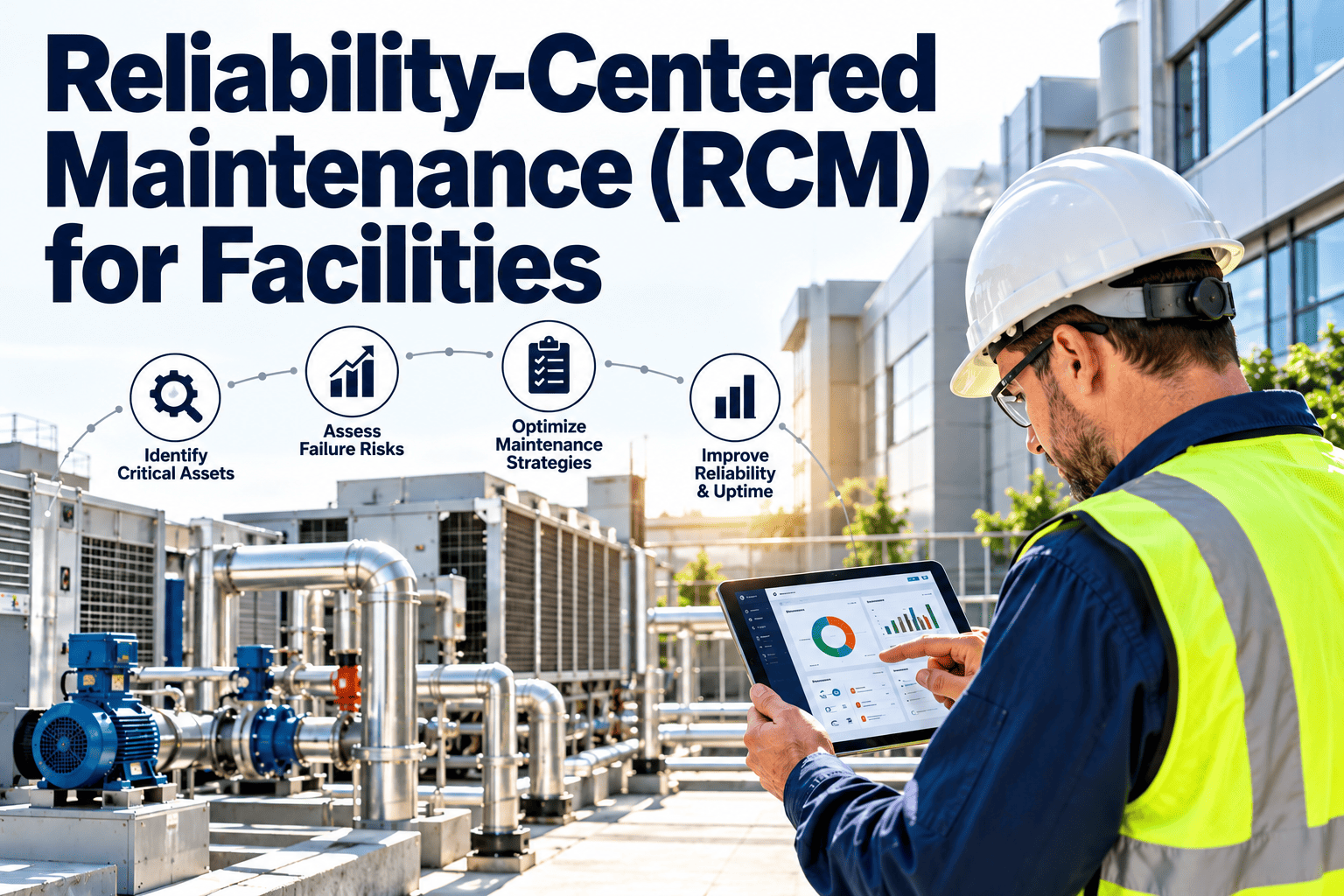
Most facility teams run every asset on the same playbook: time-based preventive maintenance, adjusted only when something breaks anyway regardless of how much that failure actually costs the building. Reliability-centered maintenance flips that logic entirely. It asks what a specific asset truly fails from, how much that failure costs in dollars and disruption, and only then decides whether the right response is a scheduled task, a condition check, or letting it run to failure on purpose. You do not need a six-month consultant engagement to apply the thinking — a CMMS with the failure history already in it gets you most of the way there.
Reliability-Centered Maintenance for facility teams
RCM, formalized in standards like SAE JA1011 and JA1012, matches maintenance strategy to failure mode instead of applying one blanket PM schedule across every asset. Here is how to apply the logic to a real facility portfolio without a formal consulting project.
Why blanket preventive schedules waste budget on some assets and underprotect others
A quarterly filter change on a rarely used air handler and a quarterly filter change on the unit serving the server room cost the same labor hour but carry wildly different consequences if skipped. Time-based PM treats them identically, and that gap is exactly what RCM is designed to close for a facility team.
- Every pump, motor, and AHU gets the same interval regardless of criticality
- Low-risk equipment is over-maintained, burning labor hours on tasks that add little value
- High-risk equipment is under-protected because its failure mode does not actually respond to a calendar-based task
- PM compliance percentage looks good on a report while actual reliability stays flat
- Each asset's strategy is chosen based on how it actually fails, not a generic manufacturer interval
- Labor shifts toward the assets where a failure has real operational or safety consequence
- Condition-based and predictive tasks replace calendar tasks where the failure mode is detectable in advance
- Run-to-failure is a deliberate, documented decision for low-consequence assets, not neglect
The seven questions RCM asks about every asset
SAE JA1011 defines RCM as a process that answers seven questions in sequence for each significant asset or system, moving from function through consequence to final task selection. Facility teams rarely need the full rigor of an aviation or process-plant RCM study, but the sequence of questions still holds and provides useful structure.
What are the functions of the asset?
Not just "it's a pump" — what flow rate, pressure, or condition must it deliver to meet the building's actual requirement, including any performance standard set by code or tenant lease.
How can it fail to perform that function?
A functional failure is any way the asset stops meeting the standard defined in question one, not just a total stoppage.
What causes each failure?
Bearing wear, belt slip, control failure, and loss of lubrication are different failure modes with different warning signs, different root causes, and different fixes, even on the same piece of equipment.
What happens when it fails?
Failure effects describe what an operator or occupant would actually observe and what downstream systems are affected.
How much does the failure matter?
Safety, code compliance, tenant impact, and cost are ranked here — this is what determines how aggressive the response should be.
What can be done to predict or prevent it?
Only tasks that are technically feasible and worth doing for that consequence level make it onto the final PM plan.
What if no suitable task exists?
If nothing feasible prevents the failure, the honest answer is a documented run-to-failure or redesign decision, not a task that does not actually work.
Matching strategy to consequence and failure pattern
Once an asset's failure modes and consequences are understood, the strategy decision follows a fairly consistent logic across facility types, whether the building is a hospital, a warehouse, a school, or a corporate campus with a mixed portfolio of mechanical and electrical systems.
Condition-based / predictive
Vibration monitoring, oil analysis, and thermography fit here — chillers, generators, and main switchgear are typical candidates.
Scheduled preventive
Belt replacement, filter changes, and lubrication schedules fit failure modes that genuinely correlate with time or run hours.
Run-to-failure
A single office space heater or a redundant exhaust fan may cost less to replace on failure than to maintain proactively.
Mandatory inspection regardless of cost
Fire suppression, backflow preventers, and elevator systems follow code-mandated intervals independent of the RCM cost logic — these tasks stay on the schedule even when a pure cost analysis might argue against them.
Where facility teams get RCM wrong on the first attempt
RCM is a simple idea that is easy to apply badly. A few patterns show up repeatedly when facility teams try it for the first time without outside guidance.
Treating criticality as a fixed asset attribute rather than a function of context — a backup chiller is low priority until the primary unit is down, at which point it becomes the most critical asset in the building.
Analyzing every asset at the same depth. Spending equal analysis time on a hand dryer and a main switchgear wastes the effort that should go toward the assets that actually matter.
Assuming the manufacturer's PM interval already reflects a failure mode analysis. Many OEM schedules are conservative defaults built to limit warranty liability, not tuned to your specific operating environment.
Choosing run-to-failure without documenting the decision. An undocumented gap in the PM schedule looks identical to a deliberate strategy choice until someone asks why the asset was never maintained.
Never revisiting the plan. An RCM analysis reflects the failure data available at the time it was written — a plan from three years ago will not account for equipment that has since aged into a different failure pattern.
Why age-based PM only works for some failure patterns
One of RCM's more counterintuitive findings, drawn from reliability studies across aviation and industrial equipment, is that only a minority of failure modes actually correlate with age in a way that makes a fixed replacement interval useful.
Wear-out patterns
Belts, filters, and some seals genuinely wear out on a predictable curve — this is the minority of failure modes where a calendar-based replacement interval is the right tool.
Random failure patterns
Control boards, sensors, and many electronic components fail at a fairly constant rate regardless of age, which means replacing them on a schedule wastes good components without reducing failure risk.
Infant mortality patterns
Newly installed or newly repaired equipment often shows a higher early failure rate that settles down after a burn-in period, which argues for closer monitoring right after installation rather than a fixed later interval.
Condition-detectable patterns
Bearing wear, refrigerant loss, and insulation breakdown usually show a detectable warning period before failure, making condition-based monitoring more effective than either a fixed schedule or run-to-failure.
Making the case for a strategy change without a full study budget
The hardest part of applying RCM at a facility is rarely the analysis — it is getting a maintenance team and their manager to accept that some PM tasks should stop and some run-to-failure decisions are intentional, not neglect.
Lead with the highest-cost repeat failures first, since a strategy change that visibly reduces a recurring problem builds more trust than a theoretical framework presented up front.
Frame run-to-failure decisions as a documented choice with a dollar figure attached, not as skipping maintenance — technicians respond very differently to those two framings of the same decision.
Bring the technicians who work on the equipment into the failure mode discussion — they often know the real failure pattern better than the OEM manual does.
Show the freed-up labor hours being redirected toward the highest-consequence assets, not cut from the budget, since reallocation is an easier sell than reduction.
Apply RCM logic without a six-month study
Start with the criticality data already sitting in your work order history and asset records — the strategy decisions follow from there.
Running a lightweight RCM pass on an existing facility portfolio
Full RCM studies were built for aircraft and process plants where a single failure mode analysis could take days. A facility team can apply the same logic at a much faster pace using data already in the CMMS.
Pull the last two years of work order history and rank assets by downtime hours and repeat-failure frequency, not by purchase cost.
For the top 20 percent of assets by consequence, document the actual failure mode from technician notes rather than assuming it from the equipment type.
Match each failure mode to a detectable warning sign — vibration, temperature, pressure, or visual wear — and decide if a sensor or inspection route can catch it early.
For everything outside the top tier, default to manufacturer-recommended intervals or a documented run-to-failure decision instead of a bespoke schedule.
Review the plan annually against new failure history — RCM is a living decision set, not a binder that gets filed away.
How Oxmaint supports a facility-scale RCM approach
RCM lives or dies on data. Without a system tracking failure history by asset, the analysis reverts to guesswork within a year.
Failure history by asset, not by ticket
Work orders link to a persistent asset record, so repeat failure modes and downtime patterns are visible without manually cross-referencing spreadsheets.
Mixed strategies on one schedule
Calendar-based PMs, meter-based triggers, and condition-based inspection tasks can all live on the same asset without forcing a single approach across the portfolio.
Criticality tagging drives prioritization
Assets tagged by consequence surface at the top of dashboards and technician queues, so the highest-risk equipment gets attention first during a busy week.
Documentation for run-to-failure decisions
A deliberate run-to-failure call gets recorded against the asset, so it reads as a decision on audit rather than a gap someone forgot to schedule, which matters both for internal governance and for insurance or compliance reviews.
Trend data supports the next review cycle
Because every work order, meter reading, and inspection result accumulates against the same asset, the annual RCM review starts from real trend data instead of technicians reconstructing history from memory.
Knowing whether the RCM plan is actually working
RCM is not a one-time deliverable — it is a set of decisions that should show up in the numbers within a few maintenance cycles if the strategy assignments were right. If nothing changes after six to twelve months, that is a signal to revisit the consequence rankings rather than assume the framework does not apply.
| Indicator | What a Working Plan Looks Like | What a Miscalibrated Plan Looks Like |
|---|---|---|
| Repeat failures on high-consequence assets | Declining over successive quarters | Flat or rising despite scheduled PM |
| PM completion vs actual downtime | High completion correlates with fewer failures | High PM completion, downtime unchanged |
| Labor hours on low-criticality assets | Trending down as run-to-failure is adopted | Unchanged, still following legacy schedules |
| Condition-based tasks catching issues early | Findings logged before functional failure occurs | Findings logged only after a failure already happened |
RCM for facility management — answered
Is RCM only relevant to industrial plants, or does it apply to commercial facilities?
The seven-question framework in SAE JA1011 originated in aviation and process industries, but the underlying logic — match strategy to failure mode and consequence rather than apply one interval to everything — applies equally to office towers, hospitals, and university campuses.
Do we need a formal RCM consultant to get value from this approach?
Not for most facility portfolios. A lightweight internal pass focused on your highest-consequence 20 percent of assets, run by the maintenance team itself, captures most of the benefit without the cost or timeline of a formal outside study.
How is RCM different from just doing more preventive maintenance?
RCM sometimes recommends less PM, not more — a low-consequence asset with an unpredictable failure pattern may be better served by run-to-failure than a scheduled task that adds cost without meaningfully reducing risk. The goal is matching effort to consequence, not maximizing task count.
What data do we need before starting an RCM review?
At minimum, an asset list with criticality notes and two years of work order or failure history. Get Started to see how that data organizes inside a CMMS.
How often should the RCM plan be revisited?
Annually at minimum, and immediately after any repeat failure that suggests the original failure mode assumption or consequence ranking was wrong. Major renovations, equipment replacements, or occupancy changes are also good triggers to revisit the plan.
Let your failure history tell you where to focus
Bring criticality, failure modes, and maintenance strategy into one asset record instead of a static RCM binder.
Free 14-day trial · No credit card