Campus facility management carries a deferred maintenance liability that grows every year it goes unaddressed. The average US university carries $11 in deferred maintenance for every $100 of replacement asset value. That backlog compounds annually through accelerated asset deterioration, higher emergency repair frequency, and compliance exposure on life safety systems allowed to slip past service intervals. Education FM teams managing campus operations without a CMMS are not managing deferred maintenance. They are accumulating it. Book a demo to see how Oxmaint structures campus FM and deferred maintenance tracking for education institutions.
Blog
School and University Facility Management: Campus Operations Excellence
Industry-Specific FM · P1 · 8 min read
$11
deferred maintenance per $100 of replacement asset value at the average US university campus according to APPA benchmarks
38%
of campus facility budgets consumed by reactive and emergency maintenance in institutions without structured PM programmes
4.8x
higher cost per repair event for reactive emergency maintenance versus planned maintenance at equivalent campus asset
62%
of education FM directors cite deferred maintenance backlog as the primary obstacle to campus safety and regulatory compliance
Campus Deferred Maintenance Tracking, PM Scheduling, and Work Order Management in One Platform
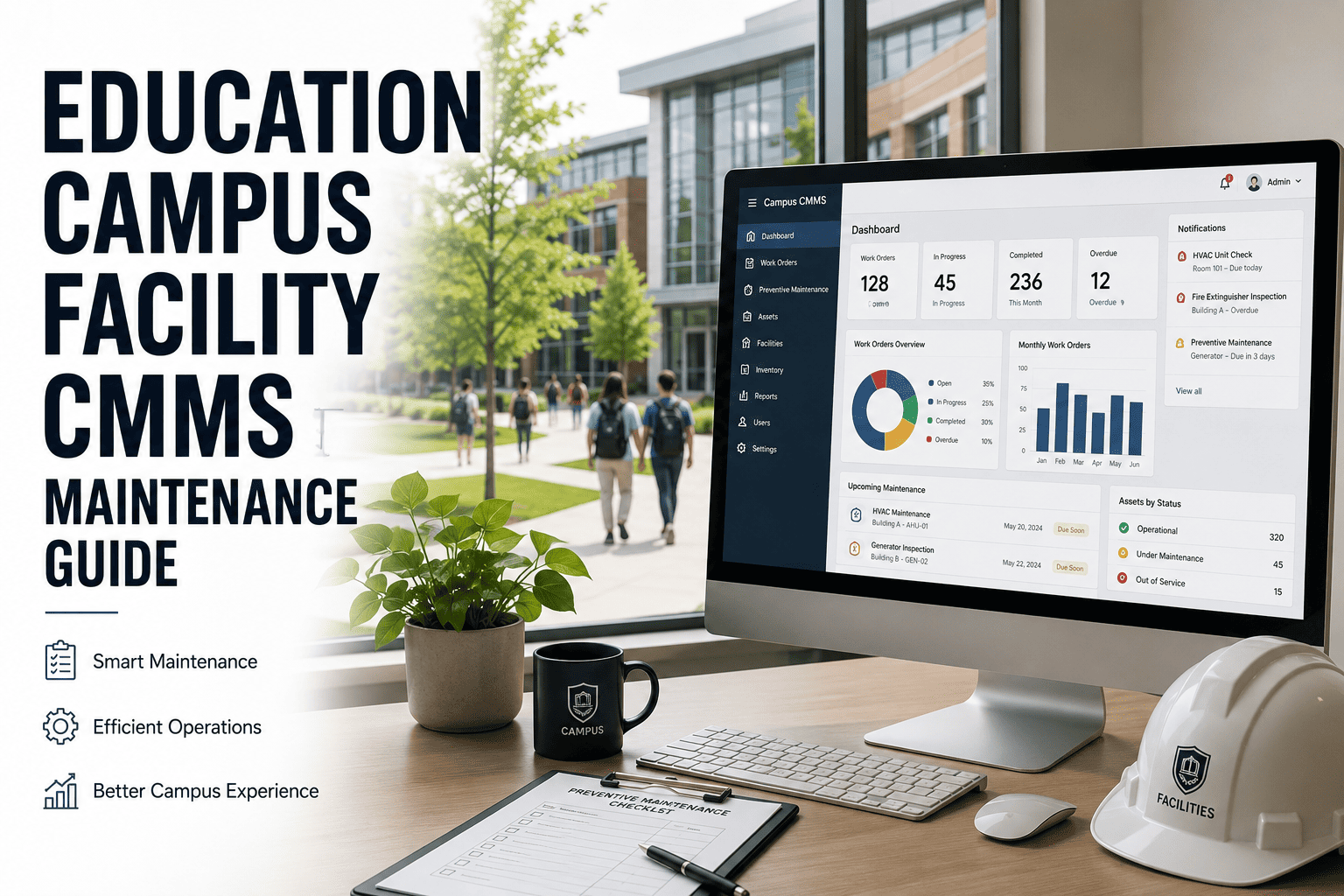
Oxmaint gives campus FM teams an asset register with condition scoring, APPA FCI-aligned deferred maintenance tracking, PM compliance dashboards, and work order management across every building and system on campus. Go live in under 14 days with no implementation project. Book a demo to see the campus FM module configured for your institution type.
The Four Structural Challenges of Campus Facility Management
Challenge 1
Deferred Maintenance Backlog Accumulation
Every deferred PM, delayed corrective repair, and postponed capital renewal adds to the backlog. At the average US institution, the backlog grows 3% to 5% per year without intervention. The APPA FCI provides the measurement framework: an FCI above 0.10 indicates a facility in serious condition. Most campuses have multiple buildings above this threshold.
Challenge 2
Multi-Building, Multi-System Complexity
A university campus of 40 to 80 buildings contains hundreds of HVAC systems, thousands of electrical circuits, and multiple life safety systems each with unique requirements. FM teams managing this complexity without asset-level PM scheduling inevitably prioritise reactive requests over proactive PM tasks, accelerating deferred maintenance accumulation.
Challenge 3
Safety and Regulatory Compliance Across All Buildings
K-12 schools and universities operate under fire code, ADA, OSHA, and in some cases EPA compliance obligations requiring documented maintenance records. Fire suppression testing, emergency lighting checks, fume hood certifications, and elevator inspections all require PM tasks with pass/fail documentation. A missed inspection found during an AHJ visit produces citations that cannot be retroactively remediated.
Challenge 4
Budget Justification Without Asset-Level Data
Campus FM teams requesting capital budgets without asset condition data face predictable outcomes: underfunded budgets, deferred renewals, and a backlog growing faster than available resources. FM teams with FCI scores, per-building maintenance cost data, and 5-year capital renewal forecasts from a CMMS present requests that administration can evaluate on financial merit.
Key Campus Asset Systems and Maintenance Requirements
HVAC and Mechanical Systems
Chillers, AHUs, boilers, VAVs, controls
PM Priorities
Filter changes
Belt inspections
Coil cleaning
Controls calibration
45%
of campus energy cost reducible through HVAC PM compliance and controls optimisation
Life Safety Systems
Fire suppression, alarms, emergency lighting
PM Priorities
Quarterly alarm tests
Sprinkler inspections
Exit lighting tests
Extinguisher checks
Annual
AHJ inspection requirement for fire suppression and alarm systems across all campus buildings
Electrical and Lighting
Distribution, panels, lighting, emergency power
PM Priorities
Thermal scanning
Panel inspections
Generator tests
LED retroft tracking
3-yr
recommended thermal imaging cycle for electrical distribution panels on campus buildings
Building Envelope and Roofing
Roofs, facades, windows, waterproofing
PM Priorities
Annual roof inspections
Sealant condition
Drain clearing
Facade surveys
$22
per sq ft average interior remediation cost when roof deferred maintenance leads to water ingress
Campus FM: Reactive vs Structured Approach
ROI: What Structured Campus FM Delivers
$11
DM per $100 RAV
Average US university deferred maintenance benchmark. FCI-linked CMMS data stops the backlog growing and enables funded capital renewal plans
38%
Budget on reactive FM
Proportion of campus FM budgets absorbed by reactive and emergency maintenance in institutions without structured PM programmes
4.8x
Emergency vs planned cost
Cost per repair event reactive versus planned at equivalent campus building system asset type
14 days
Go-live time
Time from signup to active PM schedules, asset register, and work order management live across campus in Oxmaint
Continue Reading: Industry-Specific FM
Healthcare Facility Maintenance: Joint Commission Compliance and Patient SafetyEC.02 standards, life safety PM, medical equipment compliance, and survey-ready documentation for healthcare FM teams.
Read More
Manufacturing Facility Maintenance: OEE Optimization and Production UptimeProduction-based PM scheduling, OEE-linked asset records, and manufacturing maintenance KPI dashboards in Oxmaint.
Read More
Data Center Facility Management: Uptime, Cooling Optimization and ComplianceCooling optimization, power redundancy, environmental monitoring, and Tier compliance for critical infrastructure FM.
Read More
Hotel and Hospitality Facility Management: Guest Experience Through Proactive MaintenanceRoom readiness, preventive maintenance, energy optimization, and asset tracking for hospitality FM teams.
Read More
Frequently Asked Questions
QWhat is the APPA Facilities Condition Index and how does Oxmaint support it?
The APPA FCI is the ratio of deferred maintenance cost to asset replacement value. An FCI above 0.10 indicates serious facility condition. Oxmaint tracks deferred maintenance costs against each asset's replacement value, producing a live FCI score per building and campus-wide.
Book a demo to see FCI tracking configured for your campus asset register.
QHow does Oxmaint handle work order management across multiple campus buildings?
Oxmaint supports multi-building campus configurations with QR code scan-to-request from any asset location, automatic work order routing by building zone and technician skill, and a central dashboard showing all open work orders across the campus.
Start free trial to set up your campus building structure today.
QCan Oxmaint generate the compliance documentation needed for fire safety AHJ inspections?
Yes. Oxmaint stores all life safety inspection results with date, technician, pass/fail status, and asset location. Records export by building, system, and date range for AHJ review. Survey preparation that previously took 2 to 4 weeks of document assembly completes in under 2 hours.
Book a demo to see the compliance documentation export.
QHow do campus FM teams use Oxmaint to build a capital renewal budget case?
Oxmaint generates a 5 to 10 year capital renewal forecast from asset condition scores, age, and remaining useful life estimates stored against each asset record. FM directors export a prioritised renewal schedule by building with projected cost per system per year.
Sign up free or
book a demo to see the capital forecasting module for campus assets.
Deferred Maintenance Tracked. PM Compliant. Compliance Documentation Ready on Demand.
Oxmaint connects campus asset records, FCI-aligned condition scoring, PM scheduling across all buildings, and compliance documentation into one platform. Education FM teams go live in under 14 days with no implementation project required.