Manufacturing facilities at 70% OEE leave 30% of installed capacity on the table. The gap is almost never a design or workforce problem. It is a maintenance problem. Unplanned breakdowns, deferred PMs, and reactive cycles costing 4.8x more than planned interventions are the primary OEE loss drivers. Facilities that close the gap do it through structured PM programmes and maintenance KPI dashboards that connect FM decisions to production output. Book a demo to see how Oxmaint connects facility maintenance to real-time OEE tracking across your plant.
Article
Manufacturing Facility Maintenance: OEE Optimization and Production Uptime
Industry-Specific FM · P1 · 9 min read
23%
average OEE improvement in manufacturing plants that implement structured CMMS-linked preventive maintenance programmes
4.8x
higher cost per repair event for reactive emergency maintenance versus planned maintenance at equivalent manufacturing asset
$180K
average cost per unplanned production line stoppage in a mid-size manufacturing facility at $12K per hour output value
68%
of manufacturing maintenance teams still use spreadsheets for PM tracking with no real-time OEE linkage to maintenance data
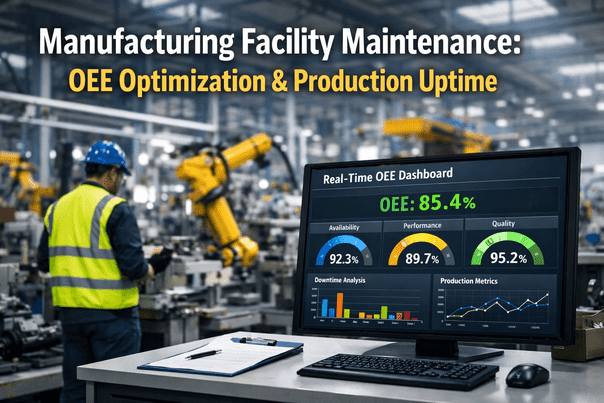
OEE Dashboard Connected to Every Asset's Maintenance Record
Oxmaint links real-time OEE data to individual asset PM schedules, work order history, and condition scores. When OEE drops on a specific line, FM teams see which assets have deferred maintenance, open faults, or upcoming PMs that correlate to the loss. Book a demo to see the OEE-linked maintenance dashboard for your facility.
What Is OEE and Why Does Facility Maintenance Drive It?
OEE is the product of Availability (percentage of scheduled time running), Performance (proximity to design speed), and Quality (first-pass yield rate). World-class manufacturing OEE is 85%. The average is 60%. The gap lives almost entirely in Availability, which is directly controlled by maintenance. When reactive, availability is determined by failure response speed. When planned, it is determined by how well PM schedules prevent failures. The shift from reactive to planned requires a CMMS that connects maintenance scheduling to production performance data in real time.
The Three OEE Loss Categories and Their Maintenance Drivers
OEE Component 1
Availability Loss (FM Primary Driver)
Breakdown stoppages and planned downtime overruns are the primary availability losses. Both are maintenance-controlled. Breakdowns are prevented by structured PM and condition monitoring. Planned downtime is minimised by efficient shutdown execution and accurate time estimation from work order history. Facilities with PM compliance above 90% run 18% higher availability than those below 70%.
OEE Component 2
Performance Loss (FM Contributing Driver)
Speed losses and minor stoppages are often caused by equipment in degraded but not failed condition. A conveyor with contaminated bearings reduces speed without tripping. Performance losses are the signature of deferred PM: the asset runs but not at design speed, and the degradation is visible in condition data before it becomes a breakdown.
OEE Component 3
Quality Loss (FM Secondary Driver)
First-pass yield losses linked to equipment condition include fill weight variation from worn dosing mechanisms, seal failure from degraded heat elements, and label placement error from mis-calibrated applicators. Calibration PM schedules and condition-linked quality inspection tasks are the FM mechanism for quality loss prevention.
Integration Point
OEE Data Linked to Maintenance Records
The connection most manufacturing FM teams are missing is live OEE data feeding back into the CMMS asset record. When Oxmaint sees OEE dropping on Line 3, it surfaces which assets have overdue PMs, open corrective work orders, or declining condition scores. FM teams investigate maintenance causes of production decline in real time, not in the next monthly review.
Critical Manufacturing Assets and Their FM Requirements
Production Line Drive Systems
Motors, gearboxes, couplings, belts
PM Focus
Lubrication schedule
Vibration trending
Belt tension
Coupling alignment
62%
of unplanned line stoppages originate in drive system failures that structured PM would have prevented
Automated Filling and Packaging
Fillers, sealers, labellers, wrappers
PM Focus
Calibration cycles
Seal element replacement
Cam follower wear
Sensor cleaning
18%
quality loss reduction from structured calibration PM on filling and sealing assets
HVAC and Compressed Air
Compressors, dryers, cooling, ventilation
PM Focus
Filter change cycles
Pressure monitoring
Dew point checks
Leak detection
14%
of compressed air cost wasted through system leaks in facilities with no leak detection PM
Material Handling and Conveyance
Conveyors, transfer systems, sorters
PM Focus
Belt tracking
Roller inspection
Drive chain tension
Sensor alignment
34%
of micro-stops on production lines originate in material handling system faults
PM Schedules That Auto-Adjust Based on Production Hours
Oxmaint triggers PM work orders based on actual production hours, cycle counts, and run metres, not just calendar dates. An asset that runs 200 hours gets PM triggered earlier than one that ran 80 hours. Production-based triggers prevent both over-maintenance and under-maintenance. Book a demo to see production-based PM scheduling for your line.
Manufacturing FM: Reactive vs Planned Maintenance Approach
ROI: What Structured Manufacturing FM Delivers
23%
Average OEE improvement
Manufacturing plants implementing structured CMMS-linked PM programmes within 12 months of go-live
4.8x
Emergency vs planned repair cost
Cost per repair event reactive versus planned at equivalent manufacturing asset
85%
World-class OEE benchmark
Target OEE for manufacturing facilities on structured PM and condition monitoring
62%
Unplanned stoppages prevented
Drive system failures that structured PM and vibration monitoring prevent before breakdown
Continue Reading: Industry-Specific FM
Healthcare Facility Maintenance: Joint Commission Compliance and Patient SafetyEC.02 standards, life safety system PM, medical equipment compliance, and survey-ready documentation for healthcare FM teams.
Read More
School and University Facility Management: Campus Operations ExcellenceDeferred maintenance, space utilization, safety compliance, and budget planning for education campus FM teams.
Read More
Data Center Facility Management: Uptime, Cooling Optimization and ComplianceCooling optimization, power redundancy, environmental monitoring, and Tier compliance for critical infrastructure FM.
Read More
Hotel and Hospitality Facility Management: Guest Experience Through Proactive MaintenanceRoom readiness, preventive maintenance, energy optimization, and asset tracking for hospitality FM teams.
Read More
Frequently Asked Questions
QWhat is the relationship between PM compliance rate and OEE in manufacturing?
Research across manufacturing sectors shows that every 5-point increase in PM compliance rate above 75% produces a 3% to 5% improvement in OEE Availability. Plants at 95% PM compliance run 18% higher availability than those at 70%. PM compliance is the leading indicator that predicts OEE performance 30 to 90 days ahead.
Book a demo to see how Oxmaint tracks PM compliance linked to line-level OEE.
QHow does Oxmaint trigger PM work orders based on production hours rather than calendar dates?
Oxmaint connects to production data via API, SCADA integration, or manual meter entry to receive actual runtime hours and cycle counts per asset. PM work orders trigger when the configured threshold is reached, regardless of calendar date. Assets running double shifts get serviced at the right interval, not too late.
Start free trial to configure production-based PM triggers in Oxmaint.
QWhat manufacturing maintenance KPIs does Oxmaint calculate automatically?
Oxmaint auto-calculates MTBF, MTTR, PM compliance rate, planned versus unplanned maintenance ratio, work order backlog, first-time fix rate, wrench time, and maintenance cost per unit produced. All KPIs update in real time from work order completion data with no manual calculation required.
Book a demo to see the manufacturing KPI dashboard live.
QHow quickly can a manufacturing facility implement Oxmaint and see OEE improvement?
Most manufacturing facilities go live with Oxmaint in under 14 days with no implementation project. PM compliance improvements are typically visible within 30 days of go-live. OEE availability improvements from reduced unplanned breakdowns typically appear within 60 to 90 days of consistent PM execution.
Sign up free or
book a demo to get started today.
OEE Linked to Maintenance. PM Auto-Scheduled by Production Hours. Live in 14 Days.
Oxmaint connects manufacturing asset records, production-based PM scheduling, real-time OEE dashboards, and maintenance KPI reporting into one platform. Go live in under 14 days with no implementation project required.




.jpeg)