Smart Building IoT & CMMS Integration

By John Polus on April 1, 2026

smart-building-iot-cmms-integration

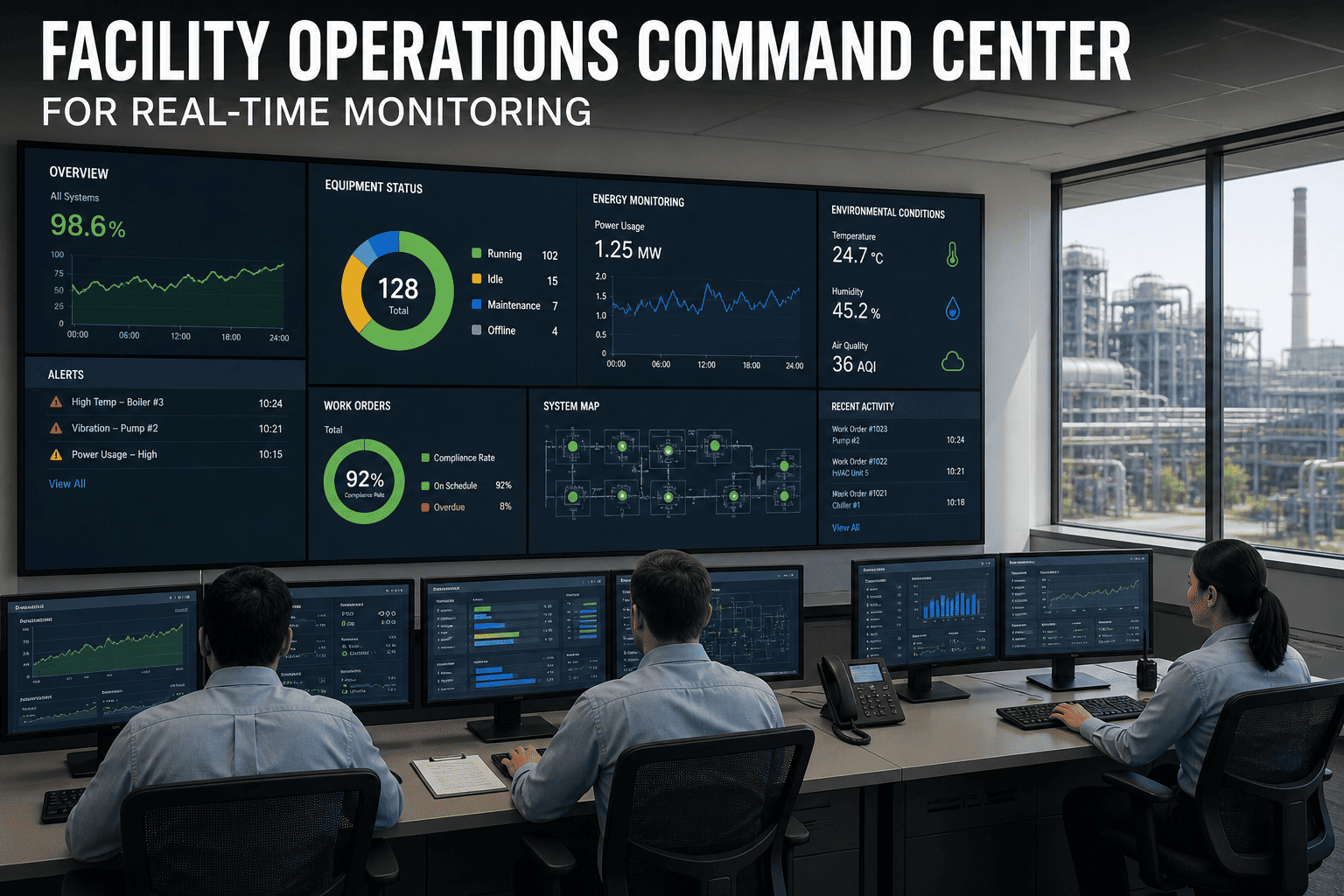
Commercial buildings in the USA and UAE are generating more sensor data than ever before temperature readings, energy consumption, occupancy counts, equipment vibration, air quality levels, and security events, all flowing from thousands of connected devices across every floor. When IoT sensors and CMMS platforms are fully integrated, that wall disappears. A temperature excursion in a mechanical room becomes a work order. A vibration alert on a chiller becomes a predictive maintenance task. An occupancy pattern change becomes a scheduled HVAC adjustment. In 2026, the global smart building market reached $121 billion and is growing at 23.1 percent CAGR, driven by facility operators in the USA and UAE who discovered that IoT data without CMMS action is just noise, and CMMS without IoT data is just guesswork. Oxmaint bridges both sides of that equation in a single platform. Ready to connect your building systems? Sign up free or book a demo with our smart building team today.

$121B Global smart building market in 2026, growing at 23.1 percent CAGR through 2030
30% Average energy savings achieved when IoT monitoring integrates with CMMS-driven maintenance in commercial buildings
4.8x Cost of emergency repairs versus planned maintenance, a gap closed by real-time IoT anomaly detection to work order automation
68% Of facility managers in the USA and UAE report that IoT sensor data never reaches the maintenance team in a usable format

Connect Your Building Systems to Real Maintenance Action

Oxmaint integrates IoT sensors, BAS data, and SCADA feeds with automated work orders, preventive maintenance scheduling, and real-time asset dashboards. One platform for everything your smart building generates and everything your maintenance team needs to act on it.

What It Is

Smart Building IoT and CMMS Integration: What It Means for Facility Managers

Smart building IoT plus CMMS integration means your facility's connected sensors, building automation systems, and energy monitors feed directly into your maintenance management platform, generating work orders, updating asset condition scores, and triggering PM tasks automatically without any manual handoff between teams.

IoT Layer
Sensors, Controllers, and BAS
Temperature sensors, vibration monitors, occupancy detectors, energy meters, air quality sensors, and BAS controllers continuously capturing equipment and environment data across the facility at intervals that human inspection cannot match.
Integration Layer
Protocol Translation and Thresholds
OPC-UA, BACnet, Modbus, and REST API connections translate sensor data into CMMS-readable asset parameters. Threshold logic converts raw readings into maintenance triggers without requiring a data analyst between the sensor and the technician.
CMMS Action Layer
Automated Work Orders and PM Scheduling
When sensor readings breach configured thresholds, Oxmaint automatically creates work orders assigned to the correct technician with full asset context, prior maintenance history, and recommended action protocols. Zero manual translation required.
Analytics Layer
AI Prediction and Performance Dashboards
Machine learning models analyze historical sensor patterns to predict equipment failures 2 to 8 weeks in advance. Energy performance, occupant comfort, and asset health dashboards give facility managers a live operational picture across every building system simultaneously.
Building Systems Covered

8 Smart Building Systems Oxmaint Connects to CMMS Maintenance Workflows

HVAC and Air Quality
Temperature, humidity, CO2, and airflow sensors feed HVAC performance data into Oxmaint. Filter replacement triggered by actual pressure drop readings. Chiller performance tracked in real time. Comfort complaints converted to prioritized work orders before occupants escalate.
Typical energy saving: 15 to 25 percent on HVAC systems with IoT-driven PM
Electrical and Power Systems
Smart meters, power quality analyzers, and UPS monitors send real-time consumption and fault data to Oxmaint. Thermal imaging anomalies on panels generate electrical inspection work orders. Generator load test results logged automatically against asset records.
Panel failure prevention: thermal anomalies detected 4 to 8 weeks before failure
Elevators and Vertical Transport
Elevator IoT modules track door cycle counts, motor performance, and safety device status in real time. ASME and state certification deadlines tracked in Oxmaint against asset records. Predictive maintenance work orders generated from cumulative cycle data before compliance deadlines.
Elevator uptime target: 99.2 percent achievable with IoT-driven PM compliance
Water and Plumbing Systems
Flow sensors and pressure monitors detect leak signatures, backflow anomalies, and consumption spikes across the domestic water supply. Water temperature monitoring for Legionella risk management. Automated inspection work orders generated for cooling towers and heat exchangers.
Water waste reduction: 20 to 35 percent with real-time leak detection integration
Fire and Life Safety Systems
Fire panel status, suppression system pressure, and emergency lighting battery health monitored continuously. NFPA inspection deadlines managed in Oxmaint with automated pre-deadline alerts. Every completed inspection generates a timestamped, audit-ready compliance record automatically.
Compliance gap risk: 74 percent of OSHA fire safety inspections find documentation failures
Security and Access Control
Access control systems, CCTV health monitors, and door hardware sensors feed maintenance data into Oxmaint. Door closer failures, camera offline alerts, and access reader malfunctions converted to maintenance work orders within defined response time SLAs.
Security system uptime: 99 percent achievable with proactive IoT-triggered maintenance
Lighting and Energy Management
Smart lighting systems report lamp failures, dimmer faults, and circuit anomalies to Oxmaint for maintenance dispatch. Energy consumption by zone tracked against scheduled occupancy data. BMS integration enables automatic setback scheduling tied to maintenance records and occupancy sensor data.
Lighting maintenance cost reduction: 40 percent with predictive lamp replacement scheduling
Building Envelope and Roofing
Moisture sensors, roof membrane monitors, and structural vibration sensors alert Oxmaint to infiltration events and structural anomalies before they become interior damage. Seasonal inspection work orders triggered by weather events or sensor threshold breaches rather than fixed calendar intervals.
Roof maintenance ROI: every 1 dollar spent on early intervention prevents 8 dollars in water damage repair
Why Integration Fails Without a Unified Platform

4 IoT and Facility Management Failures That Cost Buildings Performance Every Day

01
Sensor Data Lives in BAS, Maintenance Lives in CMMS, and Neither Talks to the Other
The average commercial building has 3 to 6 separate operational technology systems that do not share data. Building engineers see sensor anomalies and email the maintenance team. Maintenance teams create work orders manually hours or days after the anomaly occurred. By then, a developing fault has become an active failure at 4.8x the planned maintenance cost.
02
IoT Data Without Thresholds Is Just Noise
68 percent of facility managers report their IoT systems generate alerts that no one acts on because there is no defined threshold logic connecting readings to maintenance actions. A chiller supply temperature that is 3 degrees above baseline is a warning. A chiller supply temperature 8 degrees above baseline at maximum load is a critical work order. Without configured thresholds in a CMMS, neither gets a response.
03
PM Schedules Ignore What Sensors Already Know
Calendar-based preventive maintenance replaces filters on April 1 regardless of whether the filter pressure drop says the filter is clean or completely blocked. IoT-integrated CMMS replaces the filter when the pressure drop reading says it needs replacing, reducing filter spend by 15 to 20 percent in low-load zones while preventing failures in high-load areas that calendar PM consistently misses.
04
No Single Dashboard for Building Performance and Maintenance Performance Together
Facility directors in the USA and UAE managing 5 to 50 buildings cannot see OEE, energy intensity, PM compliance, and work order status in the same view. They toggle between a BMS dashboard and a maintenance system and a finance report and never get a single operational picture that answers the question: is this building performing well or not?
How Oxmaint Solves It

How Oxmaint Connects IoT Data to Maintenance Action in Smart Buildings

IoT Sensor Integration via BACnet, OPC-UA and REST API
Oxmaint connects to existing BAS, SCADA, and IoT platforms without replacing them. BACnet for HVAC systems, OPC-UA for industrial equipment, REST API for cloud-connected devices. Sensor data flows into Oxmaint asset records without requiring a separate middleware investment or IT project.
Threshold-Triggered Work Order Automation
Facility managers configure alarm thresholds per asset in Oxmaint. When a sensor reading breaches the threshold, Oxmaint automatically creates a work order, assigns it to the correct technician, populates it with asset history and recommended actions, and sends a mobile alert. Detection to assignment in under 60 seconds.
Condition-Based PM Scheduling From Live Sensor Data
Replace calendar-based PM with condition-triggered schedules driven by actual sensor readings. Filter replacement triggered by pressure drop. Belt inspection triggered by vibration trend. Bearing lubrication triggered by operating hours accumulated from real equipment runtime data. Every PM task tied to what the building actually needs, not what a schedule assumed.
AI Predictive Maintenance Across All Building Systems
Machine learning models analyze 6 to 24 months of sensor history and maintenance records to identify the degradation signatures that precede failures. Chillers, AHUs, elevators, generators, and electrical systems all develop predictable patterns before failure. Oxmaint surfaces them 2 to 8 weeks in advance as scheduled maintenance tasks, not emergency callouts.
Unified Smart Building Operations Dashboard
A single dashboard shows energy intensity, PM compliance rate, open work orders, asset condition scores, occupancy-to-energy ratio, and compliance deadline status across every building and every system simultaneously. Facility directors in the USA and UAE see portfolio-level performance without toggling between 6 separate operational tools.
Energy Optimization Through Maintenance Correlation
Oxmaint correlates PM completion data with energy consumption readings to quantify the energy savings delivered by specific maintenance actions. Dirty condenser coils that drive 12 percent excess chiller energy consumption are now quantifiable, preventable, and visible in the same dashboard as the work order that fixes them.
Platform Comparison

Oxmaint vs Competing Smart Building CMMS Platforms: Feature Comparison

Most CMMS platforms claim IoT integration but deliver API connectivity without the threshold logic, AI analytics, or energy correlation that make IoT data actionable for facility maintenance teams.

Scroll to compare all platforms
Smart Building Feature
Oxmaint
IBM Maximo
Archibus
ServiceNow FM
Accruent
Planon
eMaint
IoT sensor integration (BACnet, OPC-UA)
Yes
Yes
Partial
Partial
Partial
Yes
Partial
Threshold-triggered work order automation
Yes
Yes
No
Custom
Partial
Yes
Partial
AI predictive maintenance for building systems
Yes
Yes
No
No
Partial
Partial
No
Energy consumption to PM correlation
Yes
Partial
Yes
No
Partial
Yes
No
Condition-based PM from live sensor data
Yes
Yes
No
No
Partial
Partial
Partial
Multi-site portfolio IoT dashboard
Yes
Yes
Yes
Yes
Yes
Yes
Partial
Mobile-first for field technicians
Yes
Partial
Partial
Partial
Partial
Partial
Yes
Deploy in days without IT project
Yes
No
No
No
Varies
No
Yes
CapEx forecasting from condition data
Yes
Yes
Yes
Partial
Yes
Yes
No
Audit-ready compliance documentation
Yes
Yes
Yes
Partial
Yes
Yes
Partial
Regional Compliance and Context

Smart Building IoT and CMMS Requirements by Region: USA, UAE, UK, Canada, Europe

Smart building IoT integration operates under different regulatory, energy efficiency, and building code frameworks across every major market. Oxmaint is pre-configured for each region's specific compliance requirements.

Scroll to view all regions
Region
Smart Building Standards and Regulations
Key IoT and CMMS Requirements
Oxmaint Coverage
USA
ASHRAE 90.1 energy efficiency, OSHA equipment safety compliance, ENERGY STAR certification, LEED O plus M, Title 24 (California), NYC Local Law 97 carbon reporting, DOE Better Buildings Challenge
Real-time energy metering for LL97 compliance, ASHRAE 62.1 ventilation maintenance records, OSHA inspection documentation, ENERGY STAR data submission support, demand response readiness verification
Energy intensity tracking, OSHA inspection work orders, ASHRAE PM templates, ENERGY STAR data export, LL97 carbon reporting module for NYC buildings
UAE
UAE Vision 2030 Smart Building Strategy, OSHAD-SF (Abu Dhabi), Dubai Municipality Green Building Regulations, Estidama Pearl Rating, Dubai Integrated Energy Strategy 2030, DEWA smart grid integration requirements
Estidama Pearl Rating maintenance documentation, DEWA smart meter integration, Dubai green building energy reporting, OSHAD-SF equipment safety records, smart city connectivity compliance for Abu Dhabi and Dubai assets
Estidama-aligned PM templates, DEWA energy data integration, OSHAD-SF inspection scheduling, Dubai Municipality reporting exports, Vision 2030 smart building KPI dashboards
UK
Building Safety Act 2022, CIBSE TM65 embodied carbon, MEES energy efficiency standards, Building Regulations Part L (2022), BREEAM In-Use certification, NHS SHTM maintenance standards for healthcare facilities
MEES compliance documentation for commercial landlords, Part L energy performance records, Building Safety Act accountable person maintenance logs, BREEAM In-Use asset condition evidence, NHS SHTM inspection scheduling
MEES and Part L energy PM templates, Building Safety Act documentation workflows, BREEAM In-Use condition scoring, NHS SHTM maintenance scheduling, UK statutory inspection deadline tracking
Canada
CSA Z1000 maintenance management, National Energy Code for Buildings (NECB), LEED Canada, provincial energy benchmarking requirements (Ontario O. Reg. 506/18), BOMA BEST certification, NRCan energy performance disclosure
Ontario energy benchmarking disclosure compliance, BOMA BEST asset management evidence, CSA Z1000 maintenance programme documentation, NRCan energy intensity reporting, LEED Canada operations and maintenance records
CSA Z1000-aligned PM templates, Ontario energy benchmarking data exports, BOMA BEST condition documentation, LEED Canada O plus M records, NRCan energy reporting dashboards
Europe
EU Energy Performance of Buildings Directive (EPBD 2024), EU Taxonomy for Sustainable Finance, EN 15232 Building Automation and Control Systems, BREEAM Europe, ISO 50001 energy management, DIN EN 13306 maintenance standard (Germany)
EPBD Article 7 smart readiness indicator compliance, EU Taxonomy disclosure documentation, EN 15232 BAS classification records, ISO 50001 energy management audit evidence, German BetrSichV equipment inspection records
EPBD smart readiness documentation, EU Taxonomy maintenance evidence package, EN 15232-aligned BAS integration, ISO 50001 energy measurement records, German BetrSichV and DIN EN 13306 inspection scheduling
Measurable Results

What Oxmaint Smart Building Customers Measure After IoT CMMS Integration

30%
Energy Cost Reduction
IoT-driven condition-based PM eliminates the 15 to 30 percent energy waste from poorly maintained HVAC, chiller, and lighting systems. Energy savings documented and quantified per system per maintenance action in Oxmaint's energy correlation dashboard.
52%
Fewer Unplanned Failures
AI predictive alerts and threshold-triggered work orders catch developing failures 2 to 8 weeks in advance. Buildings on Oxmaint IoT integration consistently achieve 50 to 68 percent reduction in unplanned maintenance events within 12 months of deployment.
84%
PM Compliance Rate Achieved
From a typical starting point of 31 to 45 percent compliance in disconnected FM operations, Oxmaint customers reach 84 percent PM compliance through condition-triggered scheduling and mobile technician task management within 12 months.
12%
CapEx Budget Variance
IoT condition data feeding Oxmaint's Remaining Useful Life models reduces capital budget variance from an industry average of 40 percent to under 12 percent. Equipment replacement planned 3 to 5 years ahead from actual condition data, not age estimates.
Frequently Asked Questions

Smart Building IoT and CMMS Integration: What Facility Managers Ask First

What IoT protocols does Oxmaint integrate with for smart building systems?
Oxmaint integrates via BACnet IP, OPC-UA, Modbus TCP, MQTT, and REST API, covering the majority of commercial BAS, SCADA, and IoT gateway protocols in use across USA and UAE buildings. Existing sensors and controllers connect without replacement. Sign up free to start your integration, or book a demo to confirm compatibility with your specific systems.
How quickly does a sensor alert become a maintenance work order in Oxmaint?
When a sensor reading breaches a configured threshold in Oxmaint, a work order is created, assigned, and mobile-notified to the technician in under 60 seconds. No manual handoff between building engineers and maintenance teams is required at any step. Book a demo to see the threshold-to-work-order workflow live for your building systems.
Does Oxmaint support the UAE Estidama Pearl Rating and Dubai green building requirements?
Yes. Oxmaint includes Estidama-aligned PM templates, DEWA energy data integration, and OSHAD-SF inspection scheduling. Dubai Municipality reporting exports are available from the compliance dashboard within minutes. Sign up free to configure your UAE building compliance requirements, or book a demo tailored to UAE and GCC facilities.
How does IoT integration reduce energy costs and can Oxmaint quantify the savings?
Oxmaint correlates PM completion data with energy consumption readings per system, quantifying the exact energy savings delivered by specific maintenance actions like coil cleaning or filter replacement. Buildings report 15 to 30 percent energy cost reduction within the first full year of IoT-driven condition-based PM. Book a demo to see the energy correlation dashboard for your building type.
How long does it take to deploy Oxmaint IoT integration across a commercial building portfolio?
Most commercial buildings complete IoT sensor connection, threshold configuration, and team training within 14 to 21 days. Multi-site portfolios are onboarded in phases without IT projects, consultant fees, or hardware procurement. Sign up free to start your first building, or book a demo for a deployment plan tailored to your portfolio size.

Your Building Sensors Are Already Collecting Data. Oxmaint Turns It Into Maintenance Action.

IoT integration, AI predictive maintenance, condition-based PM scheduling, energy cost correlation, and multi-region compliance documentation in one platform built for facility managers in the USA and UAE. Join 1,000 plus smart building operations already running on Oxmaint.

Share This Story, Choose Your Platform!