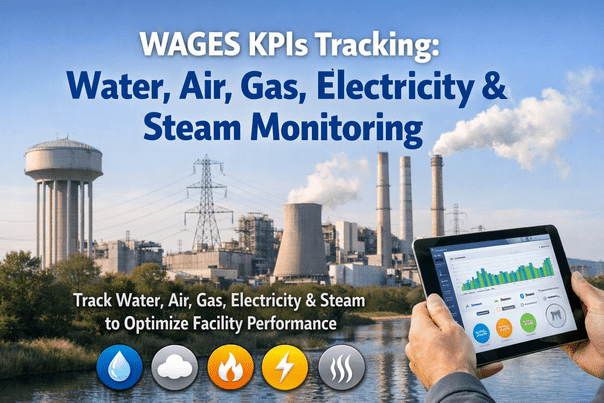
WAGES — Water, Air, Gas, Electricity, and Steam — represent the five utility streams that together account for 20 to 35% of operating costs in commercial and industrial facilities. Most organisations track these individually on monthly utility bills. What they miss is the real-time deviation detection, cross-stream correlation, and consumption trend analysis that turns utility data into actionable facility management intelligence. This guide covers the KPI framework, monitoring architecture, and CMMS integration approach that converts raw WAGES data into utility cost reduction. Sign up free on Oxmaint to start tracking WAGES KPIs across your portfolio, or book a demo for a utility monitoring walkthrough.
Track All Five WAGES Streams With Real-Time Monitoring in Oxmaint
Connect utility meters, BMS feeds, and IoT sensors to Oxmaint's WAGES dashboard for real-time consumption tracking, AI-driven anomaly alerts, and automatic work order generation on detected waste events.
A water leak at 2 gallons per minute runs undetected for 30 days on monthly billing, wasting 86,400 gallons and generating a $340 to $860 overage that appears as a billing anomaly rather than a traceable maintenance event. Real-time sub-metering with automated threshold alerts catches the same leak within hours, generating a CMMS work order before significant waste accumulates. The difference between monthly bills and real-time metering is the difference between cost tracking and cost management.
Water KPIs: Consumption, Quality, and Leak Detection
Gallons per square foot per year normalises water consumption across buildings of different sizes and use types. Class A office benchmark is 8 to 14 gallons/sq ft/yr. Buildings above 20 gallons have significant reduction headroom from irrigation optimisation, fixture upgrading, or cooling tower efficiency improvement.
Target: below 14 gal/sq ft/yr for officeCycles of concentration (CoC) measures water treatment efficiency in cooling towers. Running at 3 CoC versus 6 CoC wastes 50% more water through blowdown. AI-managed CoC optimisation based on real-time conductivity readings reduces cooling tower water consumption by 20 to 40% without scaling risk.
Optimising from 3 to 6 CoC: 40% water reductionFlow differential between building entry meter and sub-meters identifies distribution system leaks. A 5% differential between whole-building and sub-meter total indicates 5% leak loss in distribution piping. Automatic CMMS work order on differential breach triggers leak investigation before monthly bill review would detect it.
Leak threshold: generate work order above 3% differentialASHRAE 188 Legionella risk management requires domestic hot water maintained above 122 degrees Fahrenheit (50 degrees Celsius) at distribution and above 131 degrees Fahrenheit (55 degrees Celsius) at storage. Real-time temperature monitoring with CMMS alert and automatic work order generation on deviation replaces manual monthly temperature log rounds.
ASHRAE 188: 122F minimum at distributionGas Monitoring KPIs: Consumption and Safety
| Gas KPI | Normal Range | Alert Threshold | Maintenance Action |
|---|---|---|---|
| Boiler efficiency (combustion) | 85 to 95% for condensing boilers | Below 82% — alert for boiler service | Burner tuning, heat exchanger cleaning, O2 trim adjustment |
| Gas consumption per HDD | Varies by building type; benchmark against prior 12 months normalised | Above 110% of weather-normalised baseline | Boiler inspection, building envelope review, setpoint audit |
| Natural gas leak detection | Zero ppm methane in plant rooms | Any positive reading from continuous gas detectors | Immediate work order with P1 priority; section isolation if above threshold |
| Generator fuel consumption | Per OEM spec at test load | Above 115% of rated consumption at test load | Fuel injection inspection, engine compression test, governor calibration |
Electricity KPIs: Demand, Consumption, and Power Quality
Electricity is typically the largest single WAGES cost category at 40 to 60% of total utility spend. The gap between good and poor performance in electricity KPIs is widest in buildings where demand charges are a significant portion of the electricity bill.
15-minute interval peak demand in kW drives the demand charge component of commercial electricity bills, which can represent 30 to 50% of total cost. AI demand charge management — pre-cooling, load shedding, and equipment sequencing — reduces peak demand by 10 to 25% without occupant impact.
Demand charge reduction: 10 to 25% with AI managementPower factor below 0.90 typically incurs a power factor penalty on commercial electricity bills. Low power factor from VFD loads, lighting ballasts, and motor loads is corrected by capacitor bank installation and is one of the fastest payback electricity improvements available. Target power factor above 0.95 for buildings on commercial tariffs.
Power factor below 0.90: incurs monthly penaltyTHD above 5% damages sensitive equipment, reduces transformer and motor lifespans, and causes nuisance tripping of protective devices. Real-time power quality monitoring with CMMS alert on THD exceedance identifies which loads are contributing harmonic distortion before equipment damage occurs.
THD target: below 5% per IEEE 519kBtu per square foot per year normalises electricity consumption across buildings of different sizes and enables portfolio benchmarking against ENERGY STAR targets. Buildings tracking EUI monthly improve it 15 to 30% faster than buildings reviewing it annually, because monthly tracking enables course correction before full-year variance accumulates.
Buildings tracking EUI monthly improve 2x fasterFrequently Asked Questions: WAGES KPI Tracking
Track WAGES KPIs Across Your Entire Portfolio in Oxmaint
Real-time consumption monitoring, AI-driven anomaly detection, and automatic work order generation for all five utility streams. Start reducing utility costs within 30 days of deployment.