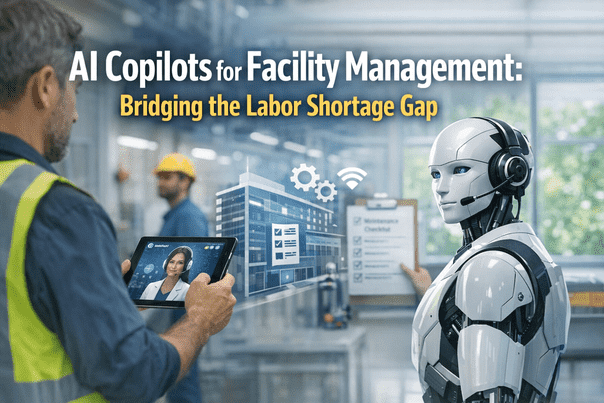
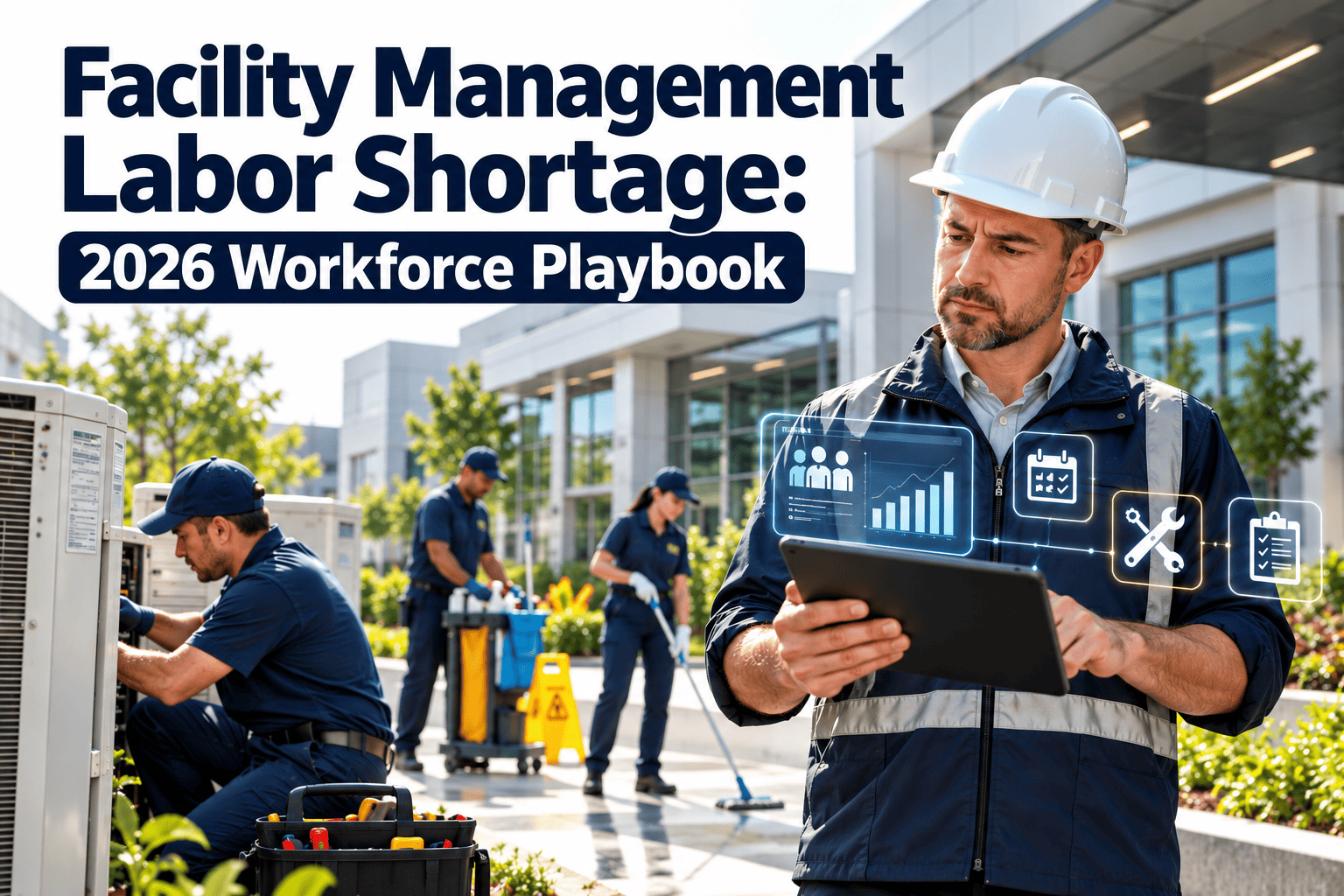
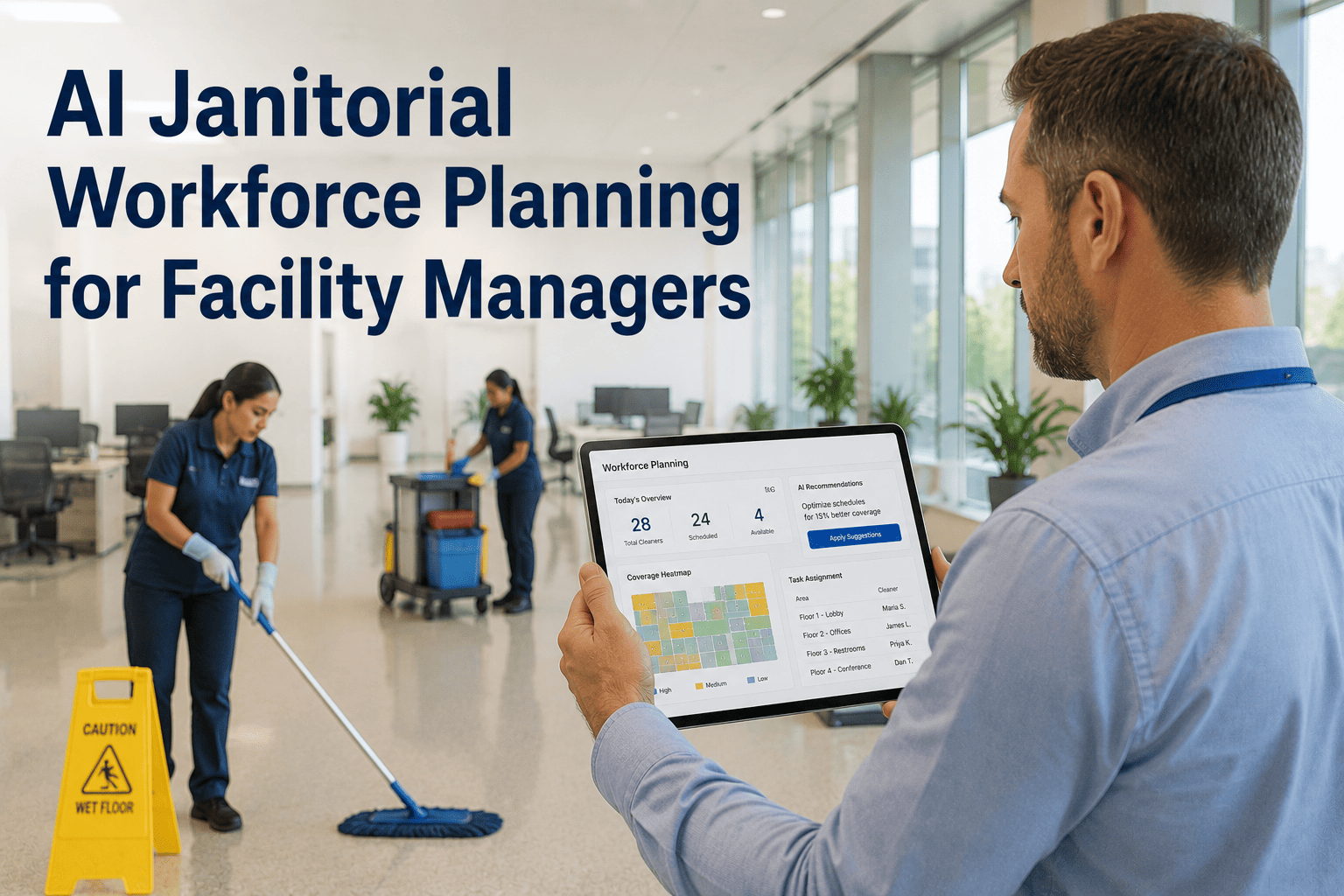
The facility management industry faces a workforce shortage that no hiring programme alone can solve. An estimated 35% of experienced FM professionals will retire by 2028, and open facility technician roles take 3 to 4 months to fill on average in most US and UK markets. AI copilots are not a replacement for facility teams. They are a force multiplier that allows a team of 8 to deliver what a team of 12 used to require, by automating the administrative, diagnostic, and reporting work that currently consumes 40 to 50% of a skilled technician's day. This guide covers the AI copilot capabilities that directly address the FM labour shortage and the implementation sequence that gets teams productive without a lengthy technology project. Sign up free on Oxmaint to deploy AI copilot workflows for your team, or book a demo for a workforce optimisation walkthrough.
Help Your Facility Team Do More With Fewer People Using Oxmaint AI
Automated work order generation, AI-driven inspection checklists, predictive maintenance alerts, and instant compliance reporting. Your current team, operating at 40% higher throughput.
The FM Labour Crisis: What the Data Shows
35%
Of experienced FM professionals expected to retire by 2028, creating a knowledge gap that new hire pipelines cannot fill quickly enough in most commercial and industrial FM markets
47%
Of facility manager time currently spent on administrative tasks including work order data entry, report compilation, and compliance documentation — all automatable with AI copilot tools in 2026
4 mo
Average time to fill an open facility technician or maintenance manager role in US and UK markets in 2026, leaving teams understaffed and reactive during hiring gaps of 90 to 120 days
40%
Increase in effective team output reported by FM operations deploying AI-automated work order management, inspection workflows, and predictive maintenance tools compared to manual process baselines
What an AI Copilot Does in Facility Management
An AI copilot in FM handles the cognitive overhead that currently consumes skilled technician time: triaging incoming maintenance requests and auto-generating prioritised work orders, selecting the correct inspection checklist based on asset type and maintenance history, alerting technicians to developing equipment conditions before failures occur, and generating compliance documentation from completed work orders without any additional data entry. The technician focuses on physical work; the AI handles the decision-support and paperwork.
Where FM Team Time Currently Goes: The Productivity Analysis
| Activity Category | % of FM Day | Manual Process | AI Copilot Replacement |
|---|
| Work order administration | 22% | Reading requests, categorising by trade, writing job instructions, assigning to technician, updating status | AI reads requests, classifies by asset type and trade, generates instructions from asset history, assigns by availability |
| Report compilation | 14% | Pulling data from CMMS, utility bills, and spreadsheets; formatting weekly/monthly reports for director review | AI generates performance reports automatically from CMMS data on schedule; one-click export to board format |
| Compliance documentation | 11% | Locating inspection records, confirming certificate currency, preparing audit packages manually for each framework | AI generates compliance packages filtered by regulation from timestamped CMMS records; minutes per audit |
| Reactive triage | 18% | Receiving calls, assessing urgency, routing to available technician, tracking response until closed | AI-driven priority scoring routes by urgency, asset criticality, and technician proximity; supervisor notified on critical only |
| Physical maintenance | 35% | Actual hands-on maintenance work — the only activity that cannot be automated and creates direct value | Target: increase to 55 to 65% of total day by automating above categories |
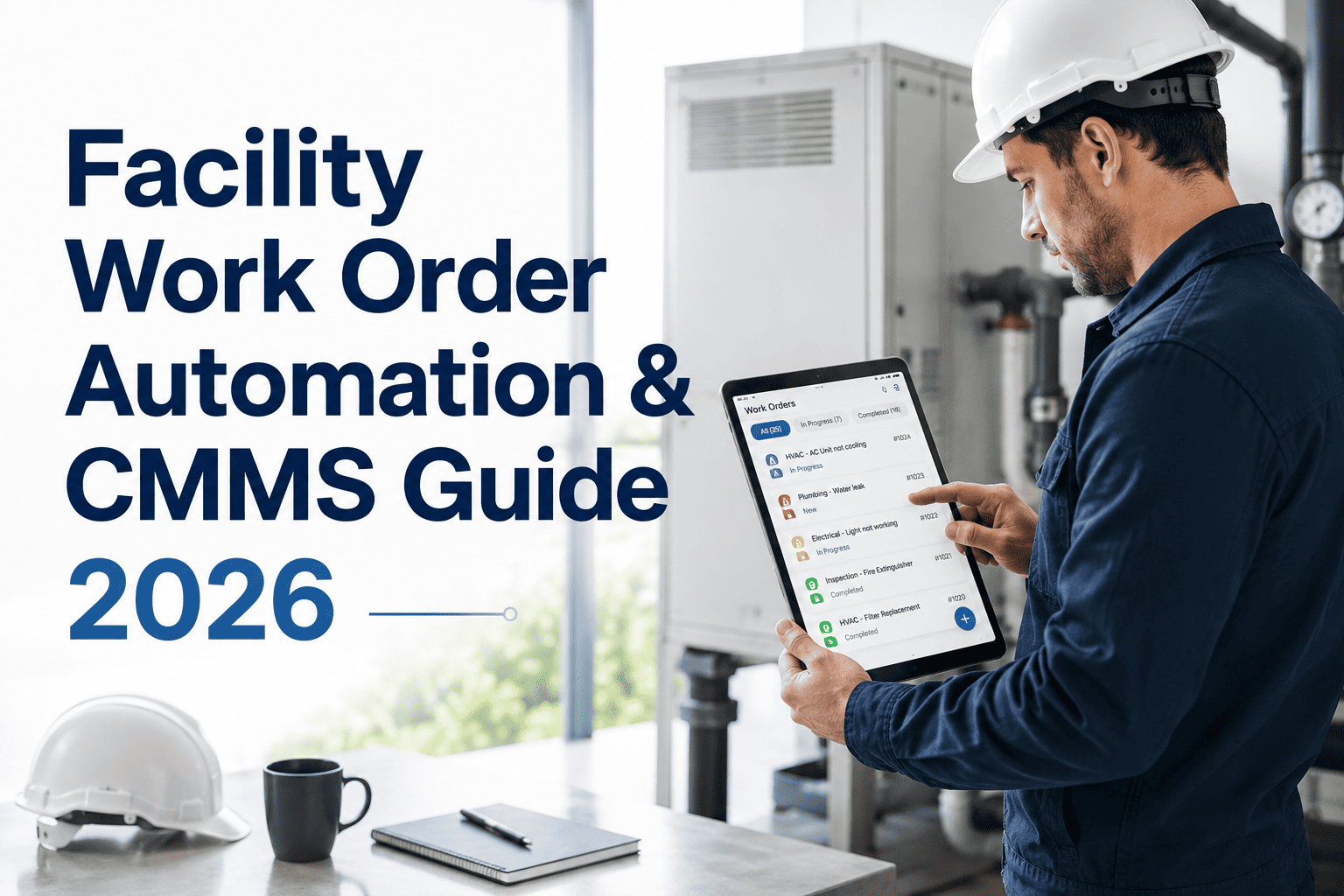
AI Work Order Automation: End-to-End Lifecycle
01
Request Intake and Classification
AI receives maintenance requests via email, mobile app, QR scan, or tenant portal. Natural language processing classifies the request by asset type, system, building, and urgency. Assets identified from the request are linked to their CMMS record automatically. No manual triage step required for standard request types, which represent 70 to 80% of all incoming work orders in commercial FM operations.
Manual triage eliminated for 70 to 80% of standard requests02
Priority Scoring and Urgency Assignment
AI scores each work order on asset criticality (life safety, production-critical, or non-critical), reported symptom severity, current building occupancy, and outstanding open work orders on the same asset. Priority scores determine whether the work order dispatches immediately, queues for the next available slot, or escalates to the supervisor for manual review. The scoring model is calibrated to each portfolio's asset criticality weighting.
False emergency escalations reduced by 60% vs manual triage03
Technician Assignment and Route Optimisation
AI assigns work orders to the best available technician based on trade certification, current workload, building location, and estimated travel time. Geographically clustered work order routing reduces technician drive time between jobs by 20 to 35% compared to random or first-in-first-out dispatch. For mobile teams covering multiple buildings, route-optimised dispatch is the single largest productivity improvement AI delivers.
Technician drive time: 20 to 35% reduction with route-optimised dispatch04
Automatic Job Instructions From Asset History
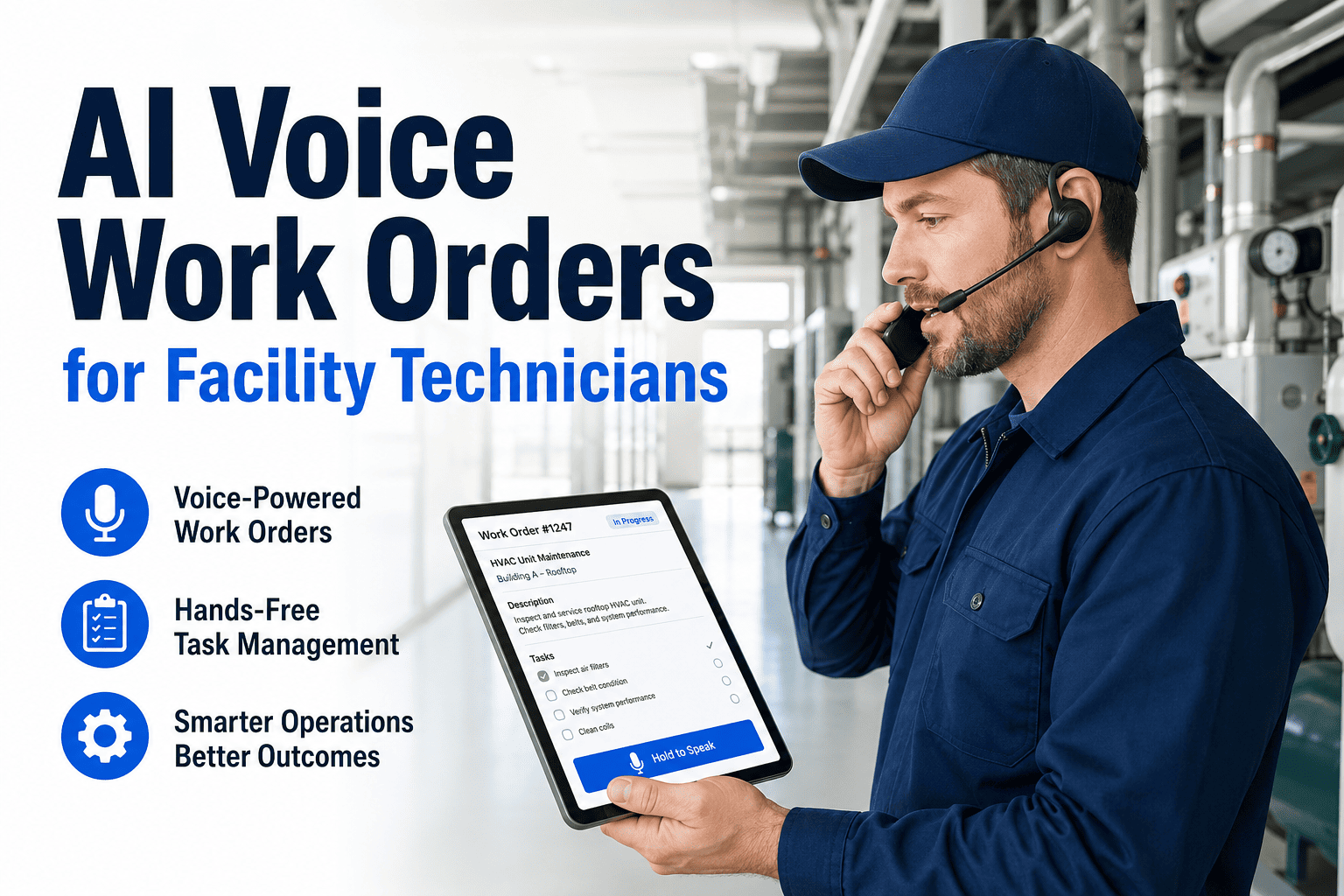
Work orders are pre-populated with asset-specific job instructions drawn from the CMMS asset record: last inspection findings, known failure history, required tools and parts, applicable safety procedures, and estimated duration. Technicians arrive at the job with full context — no manual lookup, no call back to the supervisor for additional information. New technicians operate with the knowledge base of experienced team members from day one.
Technician lookup time per job: reduced by 40 to 60%
AI-Driven Inspection and Knowledge Capture
Experienced technicians carry asset-specific diagnostic knowledge that is lost when they retire or move on. AI-driven inspection systems capture this knowledge in structured form during active inspections, making it available to the full team regardless of experience level.
AI selects and adapts inspection checklists based on asset type, time since last inspection, previous findings, and current season. A chiller inspection in August includes summer-specific checks absent from the January checklist. Inspection depth scales automatically with the asset's recent performance history, focusing technician attention on the areas most likely to show developing issues.
Findings rate increase: 35% vs static checklistsInspection findings are captured in structured format with severity classification, photo evidence, and recommended corrective action suggested by AI from similar findings on the same asset type. Structured findings are searchable across the portfolio, enabling pattern detection that identifies systemic issues affecting multiple assets across different buildings.
Finding-to-work-order: auto-generated, no data entryAI aggregates findings from completed inspections into rolling asset condition scores that update after every PM visit. Condition scores feed FCI calculations for CapEx forecasting without additional assessment work. When a senior technician retires, their knowledge of each asset's condition history remains in the CMMS condition record, accessible to whoever takes over the portfolio.
Knowledge retention: 100% of CMMS-documented historyAI analyses condition score trends and inspection finding patterns to generate predictive maintenance alerts 2 to 8 weeks before expected failure. Alerts are pre-attached to a draft work order with suggested intervention, parts estimate, and maintenance window recommendation. The team acts on a predicted problem rather than responding to a reported failure.
Emergency repairs replaced by planned interventions
Automated Compliance and Executive Reporting
Compliance Audit Package Generation
OSHA, NFPA, ADA, ISO documentation
Minutes vs Weeks
AI generates compliance packages filtered by regulatory framework from CMMS inspection records and certificates. A full OSHA facility audit package that takes 3 weeks to compile manually exports in under 10 minutes from Oxmaint.
Audit prep time reduction: 84% versus manual compilation across commercial FM deployments
Board and Investor Performance Reports
PM compliance, FCI, CapEx forecast
One Click
Weekly PM compliance rate, emergency repair ratio, asset health scores, and 5-year CapEx forecast generated automatically from CMMS data. Board-formatted reports require no manual data compilation from the operations team.
Report preparation time: reduced from 8 to 20 hours/month to under 30 minutes/month
Energy and ESG Reporting
GRESB, GRI, ENERGY STAR outputs
Zero Duplicate Entry
Energy data from BMS integration, refrigerant records from work orders, and water data from PM readings automatically populate GRESB, GRI 302/303/305, and ENERGY STAR Portfolio Manager submissions without separate data entry.
ESG submission cost reduction: 60 to 80% versus manual data collection approach
Reactive to Predictive Ratio
Emergency repair ratio improvement
38% to 12%
Emergency repair ratio reduction achievable within 18 months of AI-assisted PM and predictive maintenance deployment. The 26 percentage point shift from reactive to planned eliminates the 4.8x cost premium on emergency repairs.
Annual saving on a $500K maintenance budget: $80K to $180K from ratio improvement alone
Frequently Asked Questions: AI Copilots in FM
QHow long does it take for an AI copilot to become useful for a new FM team?
Work order automation and dispatch are active from day one with no training data required. Predictive models improve over 90 days as asset history accumulates.
Sign up free to get started, or
book a demo.
QDo technicians need to change how they work to use an AI copilot?
Primarily no. Mobile app replaces paper or desktop lookup; work orders arrive with pre-filled instructions; findings are structured rather than free text. Training takes 2 hours, not weeks.
Book a demo to see the mobile technician workflow.
QCan AI copilot tools capture the knowledge of retiring senior technicians?
Yes. CMMS condition records, inspection findings, and work order history preserve asset-specific knowledge. New technicians access the full history immediately via QR scan on mobile.
Sign up free to begin building your knowledge base.
QWhat is the ROI case for an FM director approving an AI copilot investment?
A 10-person FM team eliminating 40% of administrative overhead frees 2 full-time equivalent capacity without hiring. At $75K average salary, that is $150K in effective capacity gain.
Book a demo to model ROI for your team size.
Deploy an AI Copilot for Your Facility Team in 14 Days
Automated work order generation, AI-driven inspections, predictive maintenance alerts, and compliance reporting. Your existing team operating at 40% higher throughput without a headcount increase.
Auto Work OrdersAI Inspection ChecklistsPredictive AlertsOne-Click Reports
Continue Reading: AI and FM Workforce