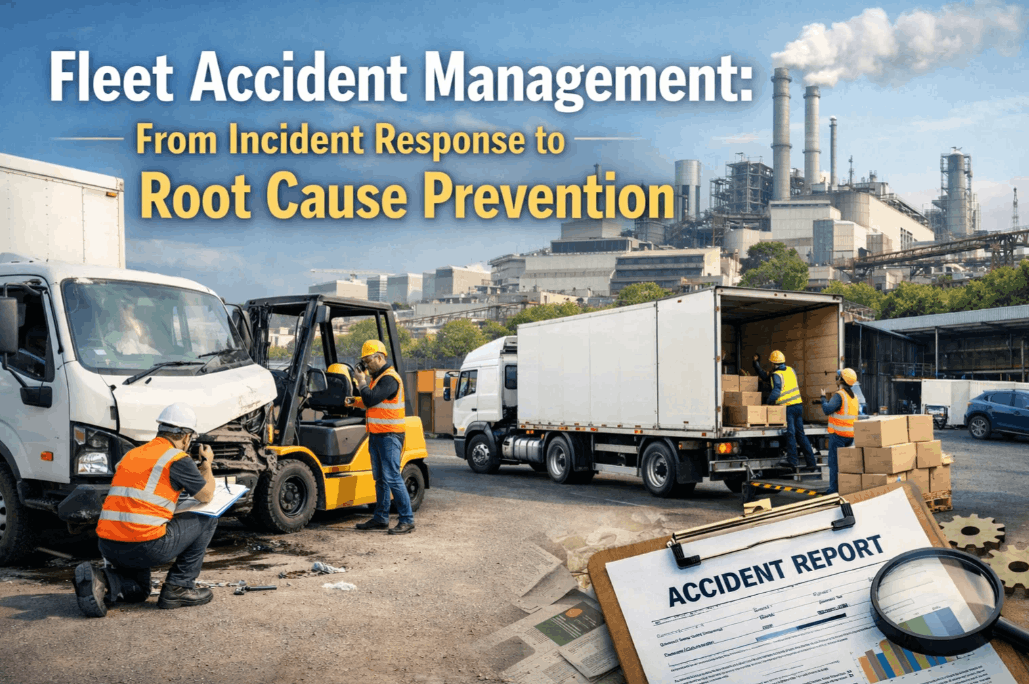
A trucking operation out of Atlanta found out how expensive a bad incident response protocol costs in the worst possible way. One of their drivers was involved in a rear-end collision on I-75 at 6:47 AM on a Tuesday. The driver called his dispatcher. The dispatcher called the safety manager, who was in a meeting. By the time anyone pulled the dashcam footage, the SD card had been overwritten. By the time the FNOL was filed with the insurer, 19 hours had passed. By the time a defense attorney reviewed the telematics data, the hard-braking event logs had been deleted in a routine data purge the company didn't know was scheduled. The claim settled for $2.1 million — with virtually no documentary defense available. The carrier had operated that truck for 4 years without a serious incident. One collision, one failed response protocol, and the exposure was uncapped. OxMaint's fleet incident management module automates the first 60 minutes of incident response — evidence capture, FNOL filing, telematics preservation, and insurance notification — so that the decisions your team makes under stress in the first hour don't cost you everything in the next three years of litigation. Book a demo to see how OxMaint closes the incident response gap before your next event.
Settlement on an I-75 rear-end collision with no preserved dashcam footage, no telematics export, and a 19-hour FNOL filing delay — Atlanta carrier
68%
Of commercial vehicle accident claims that escalate to litigation do so because critical evidence was not preserved in the first 60 minutes after the incident
4.3x
Average claim cost multiplier when FNOL is filed after 24 hours vs within 1 hour of the incident — nuclear verdict risk amplification factor
The 6 Incident Response Failures That Turn Accidents Into Multi-Million Dollar Claims
A commercial vehicle collision is a physical event that lasts seconds. The litigation that follows can last years. What determines the outcome isn't what happened — it's what evidence exists and how quickly it was preserved. OxMaint automates the 6 response actions that most fleets fail to execute under the stress of a real incident.
1
Evidence Not Preserved in the First Hour
Root cause of most indefensible claims — dashcam footage, telematics, and ELD data all have preservation windows
Dashcam SD cards overwrite on a loop — typically 48–72 hours. OBD telematics event logs purge on rolling retention schedules. ELD data is preserved for a defined window. The moment an incident occurs, a countdown clock starts on every piece of digital evidence. OxMaint triggers automatic evidence preservation flags the moment an incident is reported — locking dashcam footage, telematics download, and ELD export before any data is lost.
2
FNOL Filing Delayed — Insurer Disadvantaged
Every hour of FNOL delay reduces the insurer's ability to deploy investigators and preserves the opposing party's narrative advantage
First Notice of Loss filing within 1 hour of an incident allows the insurer to deploy an accident reconstructionist, preserve scene evidence, and begin subrogation investigation before evidence degrades. Fleets that file FNOL at 19 hours — because the driver told the dispatcher who left a voicemail for the safety manager — give the claimant's attorney 18 hours of unopposed narrative construction. OxMaint's FNOL module files automatically from driver incident submission.
3
Driver Left Without a Protocol
Drivers at an incident scene make statements and decisions that become evidence — without a script, they create exposure
A driver who says "I didn't see them coming" to a bystander has just created a witness statement. A driver who gives a recorded statement to the opposing insurer without legal guidance has waived significant defenses. OxMaint's mobile incident module gives the driver a step-by-step post-incident protocol the moment they report the incident — what to say, what to photograph, what not to do, and who is calling them next.
4
Scene Documentation Incomplete
Unguided photo documentation misses the evidence that matters — skid marks, sight lines, road conditions, vehicle positions
An unguided driver at an incident scene photographs the damage to their cab and maybe the other vehicle. They don't know to photograph the road surface condition, the sight distance to the impact point, the traffic control devices, the road lighting, and the positions of all vehicles relative to lane markings. OxMaint's mobile incident protocol guides the driver through a 24-point scene documentation checklist that produces defensible evidence, not a random phone photo album.
5
Vehicle Moved Before Documentation
Moving the vehicle destroys physical evidence — final rest position, crush depth, and trajectory are all post-move unknowns
Police officers frequently request vehicles be moved from active lanes before documentation is complete. OxMaint's incident protocol instructs drivers to photograph final rest positions, wheel orientations, and road contact surfaces before moving — and records the driver's GPS location at time of incident report submission. These records support accident reconstruction months later when the opposing expert challenges vehicle position.
6
HOS and Drug/Alcohol Testing Window Missed
FMCSA post-accident drug testing requirements have time windows — missed testing creates regulatory violation and litigation exposure simultaneously
FMCSA Part 382 requires post-accident drug and alcohol testing for qualifying incidents within specific time windows — alcohol within 8 hours, controlled substances within 32 hours. Missing these windows creates a regulatory violation that opposing counsel will use to argue consciousness of guilt. OxMaint's incident workflow triggers a testing compliance alert immediately on incident report submission, with countdown timer and testing location locator.
Fleet Incident Management — OxMaint
The First 60 Minutes After a Collision Determine the Next 3 Years of Litigation. Automate Them.
OxMaint incident response module executes every critical preservation and notification action the moment a driver reports — no dispatcher relay, no voicemail chain, no missed evidence window.
The OxMaint Incident Response Timeline — What Happens in the First 60 Minutes
Every second of delay in incident response is a second the opposing party's narrative goes unchallenged. OxMaint compresses the critical response actions into an automated sequence that executes the moment a driver submits an incident report from the scene.
0:00 — Impact
Driver Incident Report Submitted
Driver opens OxMaint mobile, selects incident type, and confirms location via GPS. Submission timestamp locked at device level — not at server receipt — preserving accurate event time regardless of network conditions
0:01 — Auto
Evidence Preservation Triggered
OxMaint sends dashcam preservation command — locking current and preceding footage window. Telematics download initiated. ELD event log flagged for preservation. All actions timestamped in the incident record
0:02 — Driver
Mobile Scene Protocol Activated
OxMaint mobile guides driver through 24-point scene documentation — what to photograph, what not to say, who is calling them, and what the drug/alcohol testing requirements are for this incident type
0:03 — Alert
Safety Team Notification
Push alerts to safety manager, fleet director, and legal contact — with incident type, GPS location, driver identity, vehicle unit number, and preliminary severity classification. No voicemail chains, no dispatcher relay
0–30 min
FNOL Filed to Insurer
First Notice of Loss submitted to insurer claims portal via OxMaint integration — with incident report, GPS data, vehicle information, and driver details pre-populated. Insurer receives actionable FNOL within 30 minutes of impact, not 19 hours
60 min
Complete Incident Record Assembled
Driver photos, GPS track, telematics download, dashcam footage link, ELD data, FNOL confirmation, drug testing alert status, and witness information — all linked to a single OxMaint incident record. Defence file ready before the tow truck arrives
Incident Severity Classification — How OxMaint Calibrates Response
Not every incident requires the same response intensity. OxMaint classifies incidents at submission and automatically scales the response protocol, notification chain, and evidence preservation requirements to severity level.
Minor collision, property damage only, no injuries
Scene photos · fleet manager alert · FNOL within 4 hours
4 hours target
Per policy
Level 4 — Minor
Parking lot contact, minor scrape, self-report only
Photo documentation · work order created · supervisor notified
End of shift
Not required
Cost of a Structured vs Unstructured Incident Response
The financial difference between a fleet with a documented incident response protocol and one without is not theoretical — it is measured in claim settlement values, insurance renewal premiums, and litigation defence costs. Every fleet in the US carrying commercial auto liability faces this exposure on every vehicle, every day.
Small Fleet
10–30 vehicles
Avg at-fault claim without documentation
$340,000 – $1.2M
Avg at-fault claim with OxMaint protocol
$80,000 – $280,000
OxMaint annual licence
$3,600 – $7,200
Insurance premium impact
6–10% reduction
Per-incident defence value
$260K – $920K
Mid Fleet
30–150 vehicles
Avg at-fault claim without documentation
$680,000 – $3.5M
Avg at-fault claim with OxMaint protocol
$160,000 – $800,000
OxMaint annual licence
$7,200 – $18,000
Insurance premium impact
8–14% reduction
Per-incident defence value
$520K – $2.7M
Large Fleet
150+ vehicles
Avg at-fault claim without documentation
$1.2M – $8M+
Avg at-fault claim with OxMaint protocol
$280,000 – $1.8M
OxMaint annual licence
$18,000 – $48,000
Insurance premium impact
10–18% reduction
Per-incident defence value
$920K – $6.2M+
"Before OxMaint, our incident response was a phone tree that depended on who answered. After a serious accident in Phoenix, we had FNOL filed in 28 minutes, the dashcam footage preserved, and the telematics download in our defense attorney's hands by noon. The claim was resolved for $185,000. Our defense attorney told us that without the OxMaint evidence package, the same incident would have been a seven-figure exposure. We now use OxMaint incident response training as part of every new driver orientation."
— VP of Safety & Compliance, regional carrier, 240 power units, Phoenix AZ, OxMaint user since 2022
Technology — How OxMaint Connects Incident Response to Fleet Intelligence
OxMaint incident management integrates four technology layers — AI camera vision, OBD telematics, ELD data, and insurer API connectivity — into a single incident record that assembles the defence file automatically. Configure your incident response protocol in OxMaint today.
AI Camera Vision
Forward-facing and cab-facing dashcams stream to OxMaint — AI detects hard-braking and impact g-force events automatically, triggering incident record creation before the driver can even report. Footage preservation locks within seconds of an event trigger.
OBD / Telematics Data
Speed, heading, acceleration, hard-braking events, and GPS track from the 60 seconds before impact — downloaded and preserved automatically on incident report submission. The telematics package is the most powerful evidence in commercial vehicle litigation defence and has the shortest preservation window.
AI Digital Twin
Each vehicle's digital twin includes maintenance history, inspection records, and prior incident data — automatically attached to the incident record at creation. Defence attorneys receive complete vehicle maintenance context without requesting separate record pulls from multiple systems.
Insurer API / FNOL Integration
OxMaint integrates with commercial auto insurance FNOL portals — filing the First Notice of Loss within 30 minutes of incident report submission without human intervention. FNOL confirmation and claim number returned to OxMaint automatically, linked to the incident record for future reference.
Frequently Asked Questions
Does OxMaint work offline if a driver loses cell signal at the incident scene?
Yes — OxMaint's mobile incident module operates offline. The driver completes the scene documentation protocol and the data queues locally, syncing the complete incident record — including timestamped photos, GPS track, and driver entries — the moment connectivity is restored. The device timestamp, not the server receipt time, is the official incident time record.
How does OxMaint handle FMCSA post-accident drug and alcohol testing compliance?
On Level 1 and Level 2 incident reports, OxMaint immediately surfaces the FMCSA Part 382 post-accident testing requirements — including the specific time windows for alcohol and controlled substance testing, the nearest certified testing facility, and the driver notification protocol. A compliance countdown timer starts at incident submission and escalates if testing confirmation is not received within the regulatory window.
Can OxMaint automatically preserve dashcam footage without dispatcher intervention?
Yes — OxMaint sends a preservation command to compatible dashcam systems (Lytx, Samsara, Motive, Netradyne, and others via API) the moment an incident report is submitted. The footage window is locked on the camera device before the dispatcher or safety manager is even notified. No human action is required to initiate preservation.
Does the OxMaint incident record include the vehicle's pre-incident maintenance history?
Yes — every incident record automatically pulls the vehicle's maintenance history from OxMaint CMMS, including the most recent PM completion, any open defects, inspection records, and repair history. This is the documentation that demonstrates the vehicle was in a maintained, compliant condition at the time of the incident — a critical defence against plaintiff allegations of mechanical negligence.
How does OxMaint incident documentation help with insurance premium negotiations?
Carriers with documented incident response programmes — demonstrating consistent FNOL speed, evidence preservation rates, and claim closure efficiency — qualify for loss control credits at commercial auto renewal. OxMaint generates an incident response performance report exportable for the underwriting submission, showing average FNOL filing time, evidence preservation completion rate, and incident-to-close cycle metrics.
Fleet Incident Management — OxMaint
Automate the First 60 Minutes. Protect the Next 3 Years.