Unscheduled repairs are not random events — they are the predictable outcome of a maintenance model that cannot see what is happening inside vehicles between scheduled service visits. In 2026, the average unscheduled fleet repair costs $760 in direct parts and labor, plus towing ($400–$900), driver downtime (4–6 hours), missed delivery penalties ($200–$1,500 per incident), and secondary damage from operating a failing component to complete breakdown. The total cost per incident runs $1,800–$4,200 — 4.8× the same repair performed on a planned basis in the shop. What makes this more significant: 68% of fleet breakdowns are preventable with proper condition monitoring. The vehicles that generate your emergency repair budget are not unlucky — they are under-monitored. AI-powered preventative maintenance eliminates the monitoring gap by reading each vehicle's condition data continuously — engine temperature trends, vibration signatures, brake efficiency ratios, fluid consumption rates — and generating service alerts weeks before breakdown, when intervention is still planned, inexpensive, and non-disruptive. The technology is operational, the ROI is documented, and the competitive gap between fleets that have deployed it and those still running fixed schedules is growing every quarter. Sign up for OxMaint and start eliminating unscheduled repairs from your fleet's cost structure today.
Fleet Operations · Blog · 2026
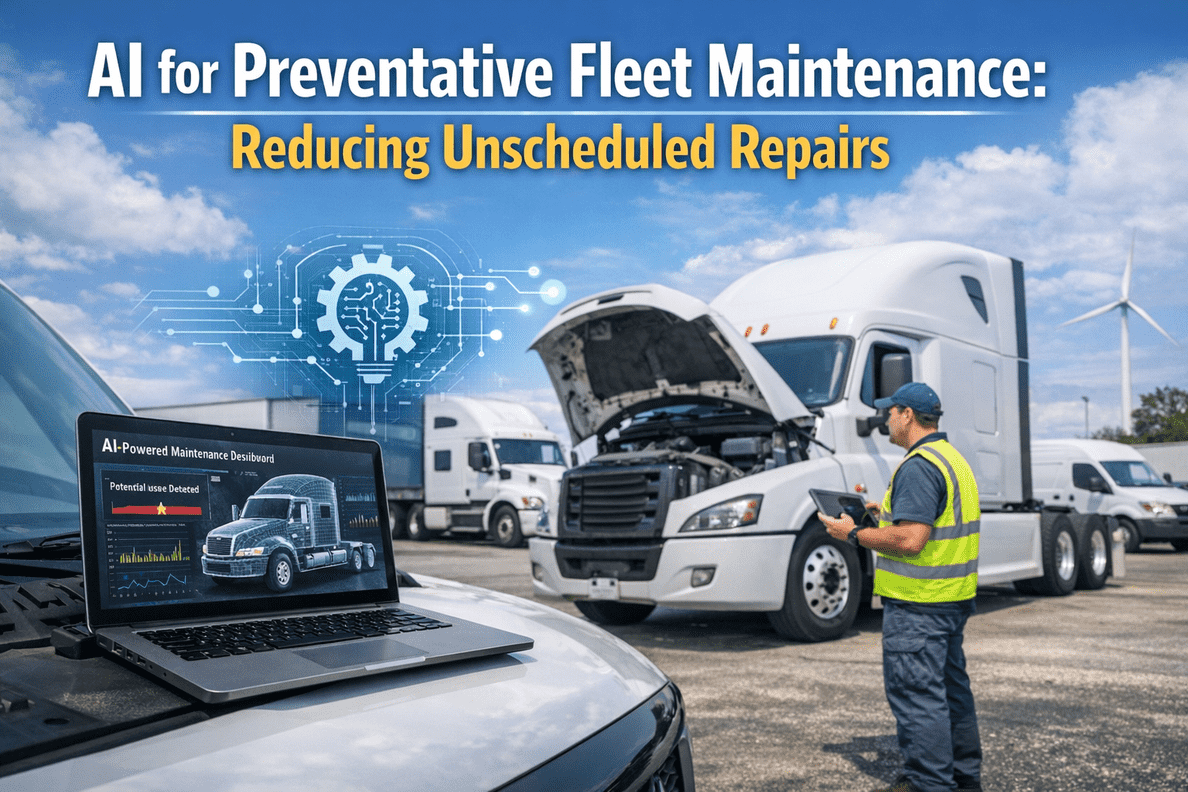
AI for Preventative Fleet Maintenance: Reducing Unscheduled Repairs
68% of fleet breakdowns are preventable. AI-powered preventative maintenance closes the monitoring gap between scheduled service visits — reading vehicle condition continuously, alerting on developing failures 2–8 weeks before breakdown, and converting emergency repair costs into planned maintenance events at 4.8× lower cost.
68%
Of fleet breakdowns are preventable with proper condition monitoring — yet most fleets still discover failures at breakdown
4.8×
Higher cost for unscheduled vs. planned repairs — every emergency event absorbs 4.8× the resource of the same planned repair
32%
Reduction in unplanned downtime achievable with AI-connected preventative maintenance programs at fleet scale
$4,200
Maximum total cost per unscheduled breakdown event — parts, labor, towing, downtime, and missed delivery penalties combined
Why Traditional Preventative Maintenance Still Misses 23% of Failures
Traditional time-based preventative maintenance represents a genuine improvement over purely reactive maintenance — but it has a structural limitation that no schedule optimization or compliance improvement can fix: it cannot monitor what is happening inside a vehicle between service visits.
The 23% of emergency repairs that occur within 2,000 miles of a completed service are not failures caused by missed maintenance. They are failures caused by conditions that developed between scheduled visits — conditions that a time-based PM schedule has no mechanism to detect. AI-powered preventative maintenance does not replace the PM schedule. It closes the monitoring gap that the PM schedule structurally cannot fill.
Traditional PM Coverage
Service Visit
Invisible Window — 5,000–10,000 miles
Next Service
23% of emergency repairs occur here — in the invisible window between scheduled visits
AI + PM Coverage
Continuous AI monitoring between every service visit — alerts 2–8 weeks before failure
Zero invisible window — AI monitoring converts the gap from failure zone to early detection zone
The 6 Root Causes of Unscheduled Fleet Repairs — and How AI Addresses Each
Unscheduled repairs are not random — they cluster around six specific failure modes, each with a different mechanism and a different AI monitoring approach. Understanding which failure modes drive your emergency repair budget determines where AI delivers the fastest ROI.
Cooling System Failure
Represents 18–22% of highway vehicle roadside failures. Develops over 3–6 weeks as coolant degradation, thermostat drift, or water pump efficiency decline generates increasing operating temperatures under load. AI monitoring: engine temperature trending against load-normalized baseline — alert 3–5 weeks before failure. Traditional PM: detects only at scheduled coolant inspection, misses condition-based degradation.
18–22% of roadside failures
Brake System Degradation
Leading cause of DOT inspection violations and a primary contributor to at-fault accidents. Brake pad wear rate varies significantly by route type, load, and driver braking behavior — making fixed-interval replacement scheduling systematically incorrect for mixed-duty fleets. AI monitoring: brake force vs. deceleration efficiency ratio per vehicle per stop — flags performance decline 2–4 weeks before DOT threshold. Traditional PM: fixed interval, misses condition-based wear rate variation.
Primary DOT inspection violation cause
Drivetrain and Bearing Wear
Bearing and driveshaft failures develop invisibly — no symptom until 2–4 weeks before complete failure, no audible indication until 1–2 weeks before failure. The failure is not sudden; the warning is. AI vibration frequency analysis from telematics accelerometers detects frequency signature changes 4–6 weeks before audible symptoms — providing a planning window that no inspection-based approach can match. Traditional PM: not detectable by visual or interval inspection.
Detectable 4–6 weeks early by AI only
Fuel System and Injection Issues
Injector fouling and fuel system degradation cause measurable fuel efficiency decline weeks before drivability symptoms develop. A vehicle showing 4–6% efficiency decline on its normalized route profile is experiencing mechanical degradation — not driver behavior change. AI route-normalized efficiency monitoring isolates vehicle-attributable decline from driver and route variation, flagging injection and fuel system issues 2–4 weeks before performance impact. Traditional PM: not detectable by interval inspection.
AI detects 2–4 weeks before drivability impact
Engine Seal and Oil Consumption
Ring seal and valve guide degradation generates accelerating oil consumption — detectable as a consumption rate increase before engine damage occurs. A vehicle consuming 0.8+ quarts per 1,000 miles (vs. 0.3–0.4 baseline) needs intervention at $400–$800. Missing the signal until engine failure generates $5,000–$15,000 repair cost. AI consumption rate tracking per vehicle flags this acceleration automatically. Traditional PM: requires technician to notice and measure consumption rate — rarely tracked systematically.
$400 intervention vs. $15,000 engine repair
Electrical and Battery Failure
Battery failure is the most common cause of commercial vehicle no-start events — and one of the most predictable. Cranking voltage, alternator output, and internal resistance tracked per vehicle flag degradation 60–90 days before cold-weather failure. AI battery monitoring generates a proactive replacement work order before the vehicle fails to start in a depot, on a route, or during a winter peak period. Traditional PM: no condition-based battery monitoring — replaced reactively after failure or on age-based schedule.
Most common no-start cause — 60–90 day AI lead time
How OxMaint's AI Eliminates Unscheduled Repairs Across the Fleet
OxMaint's AI preventative maintenance platform closes the monitoring gap that time-based PM schedules cannot fill — reading vehicle condition continuously between service visits, generating condition-based alerts weeks before failure, and automating the complete maintenance response cycle.
Continuous Condition Monitoring Between Service Visits
OxMaint's AI reads telematics data from every vehicle every 60–90 seconds — not at scheduled inspection intervals. Engine temperature, vibration, brake performance, fuel efficiency, oil pressure, and fault code frequency are monitored continuously. The monitoring window is the 5,000–10,000 miles between service visits where 23% of emergency repairs develop invisibly in traditional PM programs. AI eliminates this window permanently.
Vehicle-Specific Baseline Deviation Analysis
Each vehicle's condition readings are compared against its own historical baseline at equivalent load and route conditions — not against generic fleet thresholds. A truck that always runs warm is not flagged when it runs warm. A truck that normally runs cool and is now running warm has a developing problem. This vehicle-specific comparison reduces false positive alert rates by 60–70%, making every alert actionable rather than contributing to alert fatigue that causes teams to ignore warnings.
Automated Maintenance Work Order Generation
When AI flags a developing failure, OxMaint automatically creates a prioritized work order — vehicle, flagged component, confidence score, estimated failure window, and recommended action. Parts inventory is checked, the technician is assigned, and the repair is scheduled in the next maintenance window before the vehicle develops any symptom. The work order loop that 70% of AI maintenance pilots fail to automate is built into OxMaint's core architecture.
Fleet-Wide Failure Pattern Detection
Cross-vehicle ML identifies failure patterns across vehicle models, duty cycles, and routes — generating fleet-wide preventive alerts when the same degradation signature appears on multiple similar vehicles. One cooling system failure on a specific model at 45,000 miles is a data point. Three on the same model at 43,000–47,000 miles is a pattern — and OxMaint flags all remaining vehicles of that model for inspection before they reach the failure window.
Planned Parts Procurement — 10–14 Days Ahead
AI condition alerts generate 10–14 days of advance warning before the required repair window. This lead time converts emergency parts sourcing at spot rates to planned procurement at 15–30% lower cost. For fleets running 50+ vehicles with regular parts volume, planned procurement savings across the year typically exceed the annual platform subscription cost independently — before counting the repair cost reduction from prevented breakdowns.
Audit-Ready Preventative Maintenance Records
Every AI-flagged alert, work order, technician assignment, parts used, and repair outcome is recorded in each vehicle's permanent asset record in OxMaint — timestamped and person-attributed automatically. Warranty claims, DOT audits, insurance investigations, and customer quality reviews that require complete preventative maintenance history are satisfied with a single query, not hours of manual record assembly across paper logs and disconnected systems.
Close the Monitoring Gap That Creates Your Emergency Repair Budget
OxMaint's AI preventative maintenance reads your fleet's condition data continuously between service visits — flagging the 68% of preventable breakdowns that traditional PM schedules miss, generating work orders automatically, and converting your emergency repair spend into planned maintenance events at 4.8× lower cost. Free to start. No new hardware required.
Traditional PM vs. AI-Powered Preventative Maintenance: The Unscheduled Repair Impact
$210K
Annual savings — 35-vehicle fleet deploying AI preventative maintenance
$620K to $410K maintenance spend. 73% reduction in hydraulic failures within 6 months. System paid for 3× over.
60%
Fewer emergency repairs in fleets with AI preventative monitoring
Each prevented emergency event saves 4.8× the planned repair cost — compounding across every vehicle and every operating month
15–30%
Lower parts cost from planned vs. emergency procurement
AI alerts 10–14 days ahead convert emergency parts sourcing to planned purchasing — savings that often cover the platform cost independently
3–6 mo
Typical payback period — first prevented breakdown often covers subscription cost
Small fleets often see faster ROI percentage — one prevented engine failure covers 12–18 months of OxMaint subscription at per-vehicle pricing
Frequently Asked Questions
Why do 23% of fleet emergency repairs occur within 2,000 miles of a completed service — and how does AI fix this?
The 23% failure rate after recent service is not a compliance problem — the service was completed on schedule. It is a detection problem. Traditional preventative maintenance can only assess vehicle condition at the moment of service. A component in early-stage degradation at the time of service may pass visual inspection while already progressing toward failure. It then develops to breakdown in the 2,000 miles after service — in the invisible window where no monitoring is occurring. AI preventative maintenance eliminates this window by monitoring vehicle condition continuously between service visits, not just at them. Telematics data streams — temperature trends, vibration signatures, efficiency metrics, fault code frequency — are analyzed against each vehicle's own behavioral baseline every 60–90 seconds. When a developing failure pattern emerges, OxMaint flags it and generates a maintenance work order — regardless of where the vehicle is in its PM schedule. The repair happens at the planning window the AI creates, not at the breakdown event. This is why AI-equipped fleets achieve 60% fewer emergency repairs even when their preventative maintenance compliance rate is identical to non-AI fleets. The PM schedule prevents the predictable failures. The AI monitoring catches the condition-based failures that develop between visits. Together, they approach the 68% of failures that are preventable but currently aren't being prevented.
Sign up free to start monitoring the invisible window in your fleet.
How does OxMaint's AI distinguish between a genuine developing failure and normal vehicle variation — without generating false alerts?
False positive alert fatigue is the most common reason fleet maintenance teams disable or ignore AI monitoring systems — and OxMaint's architecture addresses it through vehicle-specific baseline comparison. A threshold-based system fires an alert when any vehicle's reading crosses a fixed value — generating excessive alerts because every vehicle operates differently. OxMaint's ML models evaluate each reading against that specific vehicle's own historical behavior at equivalent load and route conditions. A heavy-duty truck that always runs at 210°F coolant temperature is not generating an anomaly when it reads 210°F. The same reading on a vehicle whose baseline is 195°F is a genuine developing concern. This vehicle-specific comparison typically reduces false positive alert rates by 60–70% compared to threshold-based systems. Additionally, OxMaint requires trend persistence before generating a maintenance work order — a single anomalous reading triggers a monitoring flag and increases observation frequency, but a consistent trend over 3–7 days triggers the work order. Single-day anomalies caused by unusual loads, weather conditions, or route variations are filtered without generating maintenance actions. Fleet managers and technicians receive alerts that have already been validated by trend analysis — building the trust in AI recommendations that drives the behavioral adoption required for AI to deliver its full preventative value.
Book a demo to see OxMaint's alert accuracy performance for fleets similar to yours.
How does AI preventative maintenance handle fleet-wide failure patterns — not just individual vehicle alerts?
Fleet-wide failure pattern detection is consistently the highest single ROI capability in AI preventative maintenance deployments — because the value of preventing the second through twentieth failure of the same pattern far exceeds the value of catching the first. OxMaint's cross-vehicle ML analyzes failure and degradation patterns across vehicle models, mileage profiles, duty cycles, and routes. When the same degradation signature appears on multiple vehicles of the same model within a similar mileage band, OxMaint classifies it as a fleet-wide pattern and generates preventive alerts for all remaining vehicles of that model before they reach the failure window. A concrete example: a cooling system component failing on three vehicles of the same model at 43,000–47,000 miles generates a fleet-wide alert for all vehicles of that model approaching 40,000 miles — with a recommended inspection or proactive replacement. Without fleet-wide pattern recognition, vehicles 4 through 20 each fail individually as unscheduled repair events. With OxMaint's fleet-wide ML, they are resolved as a single planned maintenance initiative. This pattern prevention capability requires fleet scale to deliver maximum value — the more vehicles of similar types OxMaint monitors, the earlier patterns are detected and the more vehicles are protected.
Sign up free to build fleet-wide pattern intelligence from your existing telematics data.
What is the total cost of an unscheduled fleet repair in 2026 — and how does that compare to AI platform cost?
The total cost of an unscheduled fleet repair in 2026 consists of six components that are rarely totaled together but must be included for an accurate comparison. Direct repair cost in shop: $350–$1,200 for a typical mechanical failure event. Towing cost: $400–$900 for commercial vehicle roadside recovery. Driver downtime: 4–6 hours at fully-loaded labor cost — $160–$380 for commercial vehicle driver rates. Missed delivery penalties: $200–$1,500 depending on customer contract terms and delivery window requirements. Secondary damage from operating a failing component to complete breakdown: $800–$3,000 in additional repair cost from components that failed because an adjacent system was not addressed early. Emergency parts sourcing premium: 15–30% above planned procurement rates on all parts required for the repair. Total per-incident range: $1,800–$4,200 for a standard unscheduled commercial vehicle breakdown. OxMaint's AI preventative maintenance platform costs significantly less per prevented breakdown than any single event in this range — meaning the platform pays back on the first incident it prevents in the first operating month for most fleets. For a 20-vehicle fleet experiencing 4–8 unscheduled breakdowns per quarter (typical without AI monitoring), preventing 60% of those events reduces the quarterly breakdown cost by $4,320–$20,160 — against a quarterly platform cost that is a fraction of that range.
Book a demo to calculate the unscheduled repair cost reduction for your fleet's specific size and incident rate.
68% of Your Fleet's Breakdowns Are Preventable. OxMaint Prevents Them.
OxMaint's AI preventative maintenance closes the monitoring gap between service visits — continuous condition reading, vehicle-specific baseline analysis, fleet-wide failure pattern detection, and automated work order generation that converts emergency events into planned maintenance. Free to start. No hardware required. First prevented breakdown pays for the platform. Join 1,000+ organizations running AI-powered preventative fleet maintenance with OxMaint.