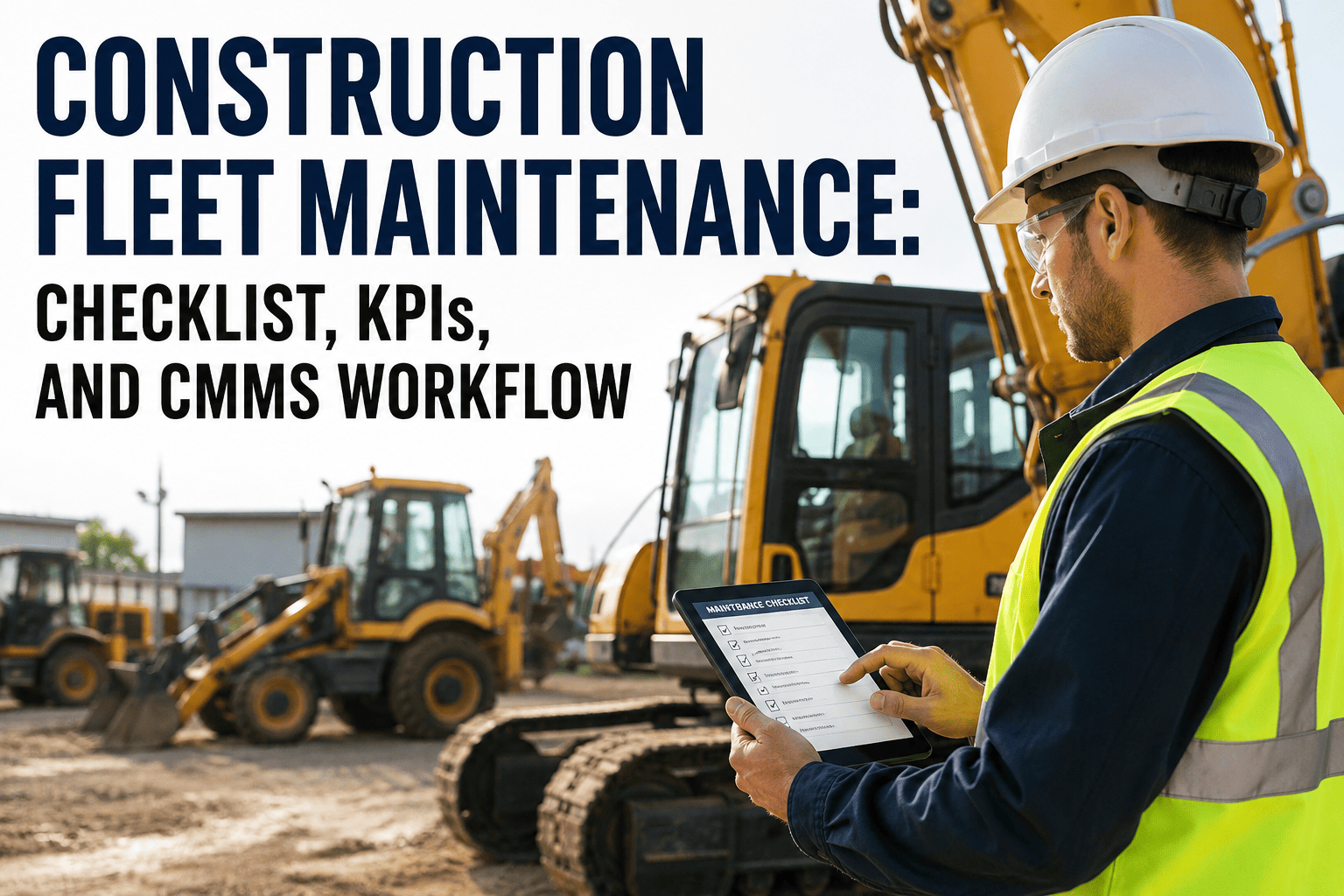
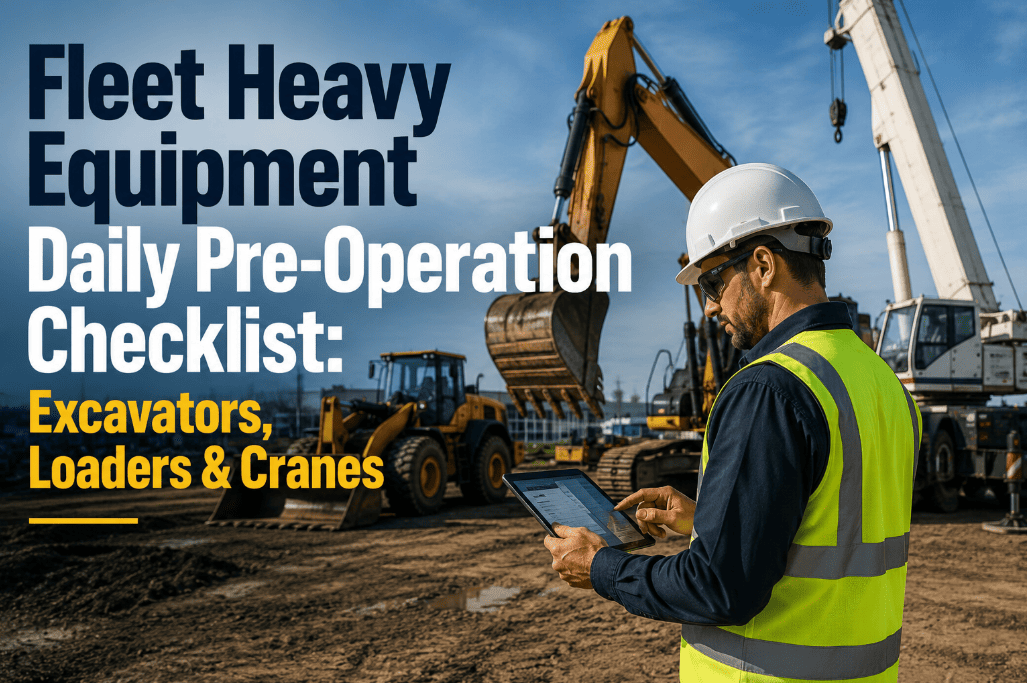
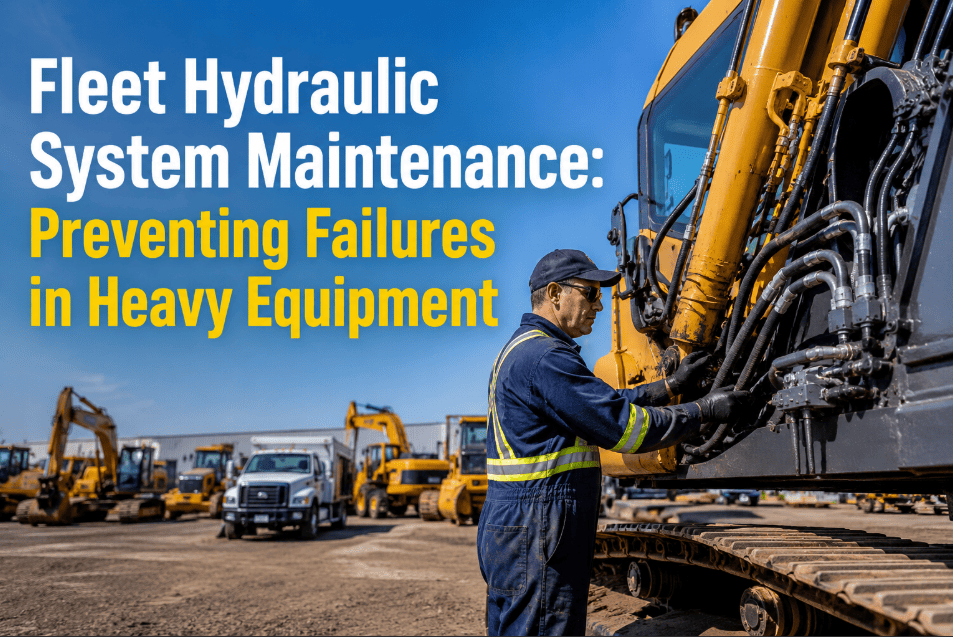
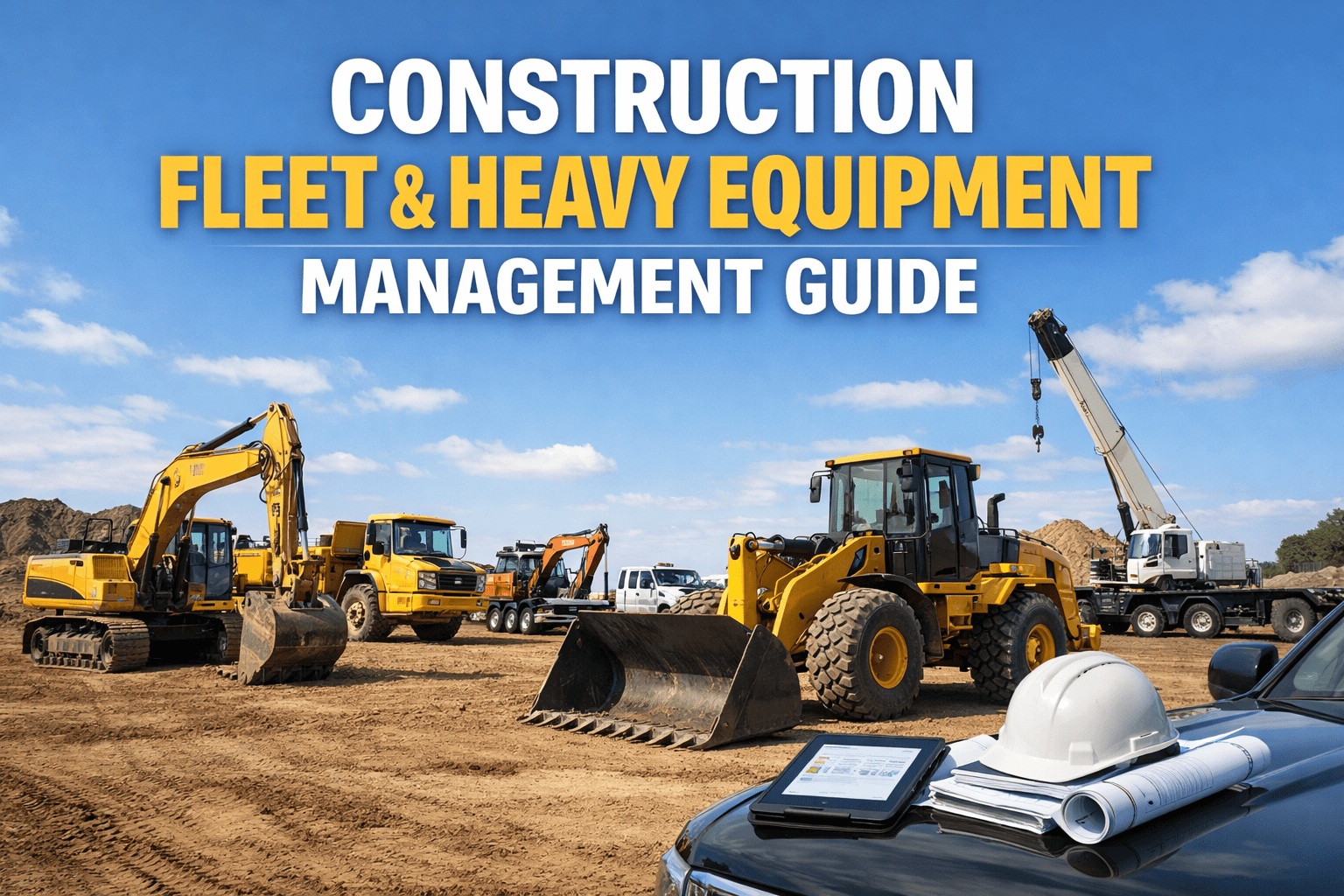
Construction fleet management is the most operationally complex fleet discipline in commercial operations — not because of vehicle count, but because of asset diversity. A mid-size civil contractor operates excavators, wheel loaders, dozers, motor graders, articulated haul trucks, on-road delivery vehicles, water trucks, fuel trucks, service trucks, and trailers simultaneously — each with different PM requirements, different hour-based vs. mileage-based service triggers, different operator certification requirements, and different utilization economics. A CMMS built for a 40-truck commercial fleet does not transfer to a 40-unit construction fleet without significant reconfiguration. OxMaint's construction fleet CMMS supports mixed asset types — tracking equipment hours alongside vehicle mileage, adapting PM triggers to harsh environment duty cycles, and giving equipment managers a single dashboard for every asset from excavator to pickup.
Construction Fleet Management: Heavy Equipment and Commercial Vehicle Maintenance
How construction operations manage mixed fleets — heavy equipment, on-road trucks, service vehicles, and trailers — with utilization tracking, harsh environment PM schedules, and CMMS adapted for the complexity of construction asset management.
Construction Fleet Asset Types — Why One System Must Handle All
The fundamental challenge in construction fleet management is that a single operation runs asset categories that require completely different maintenance logic. Heavy earthmoving equipment runs on engine hours — a 250-hour service interval on an excavator has no relationship to the 10,000-mile oil change on the F-350 service truck parked beside it. Trailers need calendar-based DOT inspections regardless of miles or hours. Aerial lifts have ANSI-mandated annual inspections that are neither mileage nor hour-based. A construction fleet CMMS must handle all four trigger types simultaneously — hours, mileage, calendar, and regulatory — per asset, with automatic work order generation from each.
Harsh Environment PM: Why Standard Intervals Fail on Construction Sites
Construction site operating conditions accelerate component wear at rates that standard OEM service intervals — designed for normal operating environments — do not account for. Dust ingestion in quarry and demolition environments clogs air filters in a fraction of the standard replacement interval. Sustained high-load hydraulic cycles during earthmoving operations heat fluid faster than typical cycle-mix operations. Extreme temperature swings between early morning startup and afternoon operation stress engine components beyond what a standard multi-grade oil recommendation anticipates. Operating in water crossings, mud, and corrosive soils attacks undercarriage, electrical connections, and lube points at 2–4× the rate of clean operating conditions. OxMaint's construction PM templates let you set harsh environment multipliers per asset — so a quarry excavator gets its air filter at 125 hours instead of 250, and the system triggers automatically without requiring the equipment manager to remember the exception.
Equipment Utilization Tracking: The Invisible Cost of Idle Iron
Heavy equipment idle cost is the construction fleet expense most consistently underestimated and least systematically tracked. A 50-ton excavator sitting idle costs $800–$1,400 per day in depreciation, insurance, financing, and site overhead — regardless of whether it moves. An excavator operating at 55% of available hours is generating 45% of its daily cost with zero production return. Industry data consistently shows that construction fleets average 55–65% utilization on owned equipment — which means the typical mid-size contractor carries 35–45% overcapacity, paying full ownership cost for iron that sits. Systematic utilization tracking identifies underperforming assets and informs three high-value decisions: redeployment to a higher-activity site, rental-out during low-demand periods, or disposal ahead of the next equipment purchase cycle.
We had a motor grader sitting on a site for four months that I thought was in regular use. OxMaint's utilization report showed 28% for the quarter. We moved it to a road-base project where it ran at 85% and sold the second unit we'd been planning to buy. Saved $340,000 on a machine we already owned.
Fluid Analysis Programs: The Early Warning System for Heavy Equipment
Scheduled oil and fluid sampling is the highest-value diagnostic tool in heavy equipment maintenance — and the most systematically underused in small and mid-size construction operations. A $30 oil analysis on an excavator engine provides a direct read on bearing wear metals, coolant contamination, fuel dilution, and silicon ingestion from dust — data that can identify an impending failure 200–400 hours before it becomes a catastrophic engine event. On a piece of equipment where a major engine overhaul costs $45,000–$90,000 and a replacement machine costs $280,000–$480,000, a $30 sample taken at every oil change is arguably the highest ROI maintenance action available. OxMaint's CMMS tracks fluid sample results per asset over time — trending wear metal values, flagging anomalies above baseline, and attaching lab reports to the equipment's permanent maintenance record for resale documentation.
One CMMS for Every Asset — From Excavator to Pickup Truck
OxMaint tracks equipment hours, mileage, regulatory intervals, and fluid samples in a single system. Free to start, no hardware required.
CMMS for Construction: Key Configuration Differences from Commercial Fleet
Deploying a CMMS on a construction fleet requires configuration decisions that do not arise in standard commercial fleet deployments. The most critical is trigger type selection per asset: equipment managers must explicitly configure each asset as hours-based, mileage-based, calendar-based, or multi-trigger — and set the correct interval for the asset's duty environment, not the OEM default. The second critical configuration is the jobsite assignment layer — construction equipment moves between project sites, and maintenance records, inspection histories, and utilization data must follow the asset, not stay with the site. Third is technician certification tracking: construction equipment maintenance frequently requires manufacturer-certified technicians for warranty compliance, and the CMMS should gate work order assignment to qualified personnel.
Equipment Cost Per Hour: The Construction Fleet's Core Financial Metric
Cost per operating hour is to construction fleet management what cost per delivery stop is to last-mile logistics — the metric that consolidates ownership cost, maintenance cost, and downtime cost into a single number that allows direct comparison across asset classes, between owned and rental options, and across the lifecycle of an individual machine. An excavator whose maintenance cost per hour has climbed from $18 to $34 over three years has crossed the economic threshold where rental or replacement generates better returns than continued ownership. Without CMMS-generated cost-per-hour data per asset, construction equipment managers make these decisions on intuition and equipment age alone — consistently missing the optimal replacement point in both directions.
Frequently Asked Questions
Your Construction Fleet Has Three Cost Problems. OxMaint Solves All Three.
Unplanned equipment breakdowns averaging $18,000 each. Unutilized iron costing full ownership expense with zero production return. And PM programs calibrated for highway duty on equipment operating in quarry conditions. OxMaint's construction CMMS tracks engine hours, mileage, and regulatory intervals across every asset type — with harsh environment PM multipliers, fluid sample records, utilization reporting, and jobsite assignment tracking all in one platform.