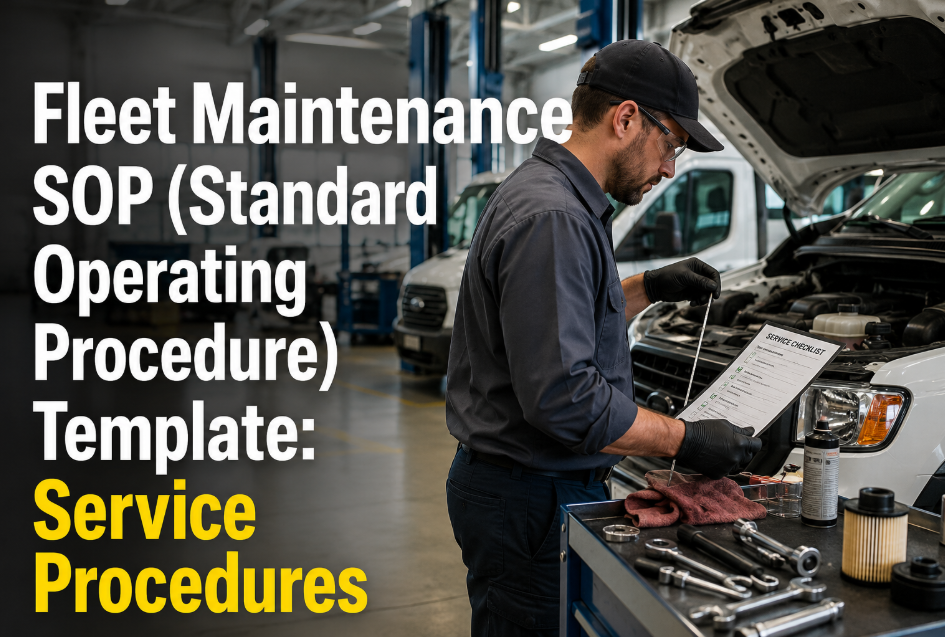
Fleet Maintenance SOP (Standard Operating Procedure) Template: Service Procedures
By Jack Miller on May 20, 2026
Fleet maintenance standard operating procedures form the backbone of every high-performing commercial fleet shop, yet 62% of fleet operations still rely on informal, undocumented service processes that create inconsistency, safety risks, and compliance gaps. Standardized SOPs for oil changes, brake inspections, tire rotations, and preventive maintenance procedures ensure every technician follows the same proven steps — reducing rework rates by up to 41% and cutting warranty claim rejections by 33%. Whether you manage 25 vehicles or 2,500, a structured SOP framework directly translates into lower cost-per-mile, faster turnaround times, and audit-ready documentation that satisfies DOT, FMCSA, and OSHA requirements. Want to digitize and automate your fleet SOPs with built-in compliance tracking? Start a free trial with Oxmaint and see how teams are eliminating paper-based procedures, or book a demo to walk through a live SOP workflow built for fleet operations.
FLEET OPERATIONS · SOP TEMPLATE · 2026
Fleet Maintenance SOP Template: Standardize Every Service Procedure Across Your Shop
Step-by-step technician instructions, safety protocols, quality checkpoints, and digital compliance trails for oil changes, brake inspections, tire rotations, and all preventive maintenance tasks.
Leading to inconsistent repairs and repeat failures across technician shifts
41%
reduction in rework rates
When standardized procedures replace informal tribal knowledge in the shop
3.2x
faster onboarding for new techs
Documented SOPs cut training time from weeks to days for new hires
$18K
avg. annual savings per 50 vehicles
From eliminated rework, reduced warranty rejections, and faster turnarounds
What Is a Fleet Maintenance SOP?
A fleet maintenance Standard Operating Procedure is a documented, step-by-step instruction set that defines exactly how each service task must be performed on every vehicle class in your fleet. Unlike informal checklists or verbal handoffs between technicians, a proper SOP specifies the tools required, safety precautions, torque specifications, fluid types, inspection criteria, quality checkpoints, and sign-off protocols for each procedure. According to the Technology and Maintenance Council (TMC), fleets with formalized SOP documentation experience 28% fewer roadside breakdowns and 35% higher first-time fix rates than those relying on technician memory alone.
The SOP serves as the single source of truth for your maintenance shop. When a Level B technician performs a brake inspection on a Class 8 tractor, the SOP ensures they follow identical steps — from wheel chock placement to pad thickness measurement thresholds to torque sequence on caliper bolts — regardless of which shift they work or which bay they occupy. This consistency is what separates fleets averaging $0.12 cost-per-mile from those bleeding $0.22 or more. Digitizing these procedures inside a CMMS platform like Oxmaint takes it further: every step completion is timestamped, every measurement is recorded, and every deviation triggers an automatic escalation — giving fleet managers the visibility they need to maintain compliance and control costs. Ready to move beyond paper SOPs? Start a free trial with Oxmaint to see digital SOP workflows in action, or book a demo with our fleet operations team.
6 Critical Components of a Fleet Maintenance SOP
Every effective fleet SOP must contain these six structural elements to ensure consistency, safety, and audit readiness across your entire shop operation. Fleets that include all six components report 44% fewer inspection failures during DOT audits compared to those using incomplete documentation.
Procedure Scope and Applicability
Essential
Define exactly which vehicle classes, model years, and engine types the SOP applies to. A brake inspection SOP for a Class 6 medium-duty truck differs significantly from one written for a Class 8 over-the-road tractor. Specify the service interval trigger — whether mileage-based (every 25,000 miles), time-based (every 90 days), or condition-based (triggered by sensor alert). Clear scope prevents technicians from applying wrong procedures to wrong assets.
Step-by-Step Technician Instructions
Essential
Each procedure must be broken into numbered, sequential steps with clear action verbs: "Position wheel chocks behind rear axle tires," "Measure brake pad thickness at three points using a calibrated digital caliper," "Record measurement in millimeters to one decimal place." Ambiguous instructions like "check brakes" lead to inconsistent execution. TMC data shows that fleets with 10+ step detail per SOP achieve 39% higher first-time fix rates.
Safety Protocols and PPE Requirements
Essential
Every SOP must list required personal protective equipment (safety glasses, nitrile gloves, steel-toe boots), lockout/tagout procedures, and hazard warnings specific to the task. OSHA reports that 78% of fleet shop injuries occur during procedures where safety steps were skipped or undocumented. Include specific warnings for hot surfaces, pressurized systems, and chemical handling — mapped to SDS sheet references for each fluid type used in the procedure.
Tools, Parts, and Specifications Table
Essential
List every tool (with size and calibration requirements), replacement part (with OEM part number and acceptable alternates), fluid specification (API rating, viscosity grade), and torque value needed to complete the procedure. Technicians waste an average of 22 minutes per work order searching for correct specifications when this information is not embedded directly in the SOP. Include manufacturer-recommended values and any fleet-specific deviations approved by engineering.
Quality Checkpoints and Pass/Fail Criteria
Essential
Define measurable acceptance criteria at each critical step. For a tire rotation SOP: "Lug nut torque must read 450-500 ft-lbs on calibrated torque wrench," "Tread depth must exceed 4/32-inch at all measurement points." Without quantified pass/fail thresholds, quality becomes subjective. Fleets using defined checkpoints report 33% fewer warranty claim rejections because every measurement is documented and defensible during disputes with parts suppliers.
Sign-Off, Escalation, and Audit Trail
Essential
Each completed SOP must capture the performing technician ID, supervisor review signature, completion timestamp, and any deviations or exceptions encountered. If a measurement falls outside specification, the SOP must define the escalation path — whether to a senior technician, shop foreman, or fleet manager. Digital sign-offs inside Oxmaint create tamper-proof audit trails that satisfy FMCSA inspection documentation requirements automatically.
Core Fleet SOP Categories and Procedure Coverage
A comprehensive fleet SOP library must cover every recurring maintenance task your shop performs. Below is the standard procedure matrix used by fleets achieving top-quartile uptime performance — 96%+ vehicle availability rates. Fleets using Oxmaint can digitize each category with embedded checklists, measurement fields, and automatic scheduling triggers.
SOP Category
Key Procedures Covered
Typical Interval
Compliance Impact
Engine Oil Service
Drain, filter replacement, refill with API-spec oil, dipstick verification, leak check, used oil disposal
Every 10,000-15,000 miles
Engine warranty compliance, EPA used oil disposal regulations
Why Informal Procedures Are Costing Your Fleet Thousands
The hidden cost of undocumented maintenance procedures is staggering. When senior technicians carry critical knowledge only in their heads, every retirement, resignation, or shift change creates an operational vulnerability. A 2024 fleet industry study found that fleets without written SOPs experience 2.7x higher technician error rates on routine services, leading to an average of $8,400 in annual rework costs per 50 vehicles. Beyond direct repair costs, inconsistent procedures generate cascading failures: an improperly torqued oil drain plug leads to a slow leak, which leads to low oil pressure, which leads to a $14,000 engine replacement that a $0.75 crush washer and a documented torque spec would have prevented.
FMCSA auditors specifically look for documented maintenance procedures during compliance reviews. Fleets that cannot produce written SOPs for critical safety systems — brakes, steering, tires — face increased Compliance, Safety, Accountability (CSA) scores, higher insurance premiums, and potential out-of-service orders. The operational drag extends to technician recruitment and retention: 71% of fleet technicians surveyed in 2024 said they prefer employers with structured training programs and documented procedures over shops that expect them to "figure it out." Digitizing your SOPs is the first step toward building a professional, scalable maintenance operation — start a free trial with Oxmaint to see how leading fleets are transforming their shop operations, or book a demo to discuss your specific SOP digitization needs.
Documented SOPs vs. Informal Procedures — Impact Comparison
The performance gap between fleets with formalized SOPs and those relying on informal knowledge transfer is measurable across every operational metric. This comparison reflects data from fleets managing 50-500 vehicles across mixed Class 3-8 operations.
Informal / No SOPs
First-time fix rate: 58-64%
Average rework rate: 18-24% of work orders
New tech onboarding: 6-10 weeks to full productivity
DOT audit findings: 3.8 average per review cycle
Warranty claim rejection rate: 22-28%
Knowledge loss risk when senior techs leave: Critical
Documented Digital SOPs
First-time fix rate: 87-93%
Average rework rate: 4-8% of work orders
New tech onboarding: 1.5-3 weeks to full productivity
DOT audit findings: 0.6 average per review cycle
Warranty claim rejection rate: 5-9%
Knowledge loss risk when senior techs leave: Minimal
Sample SOP Structure: PM-A Oil Change Procedure
Below is the structural framework for a standard PM-A oil change SOP that meets both OEM warranty requirements and FMCSA documentation standards. This template format can be adapted for any vehicle class or service procedure in your fleet. Oxmaint users can import this structure directly into digital work order templates with embedded measurement fields and photo capture requirements.
PM-A Oil Change SOP — Step Flow
From pre-service safety check through quality verification and sign-off
Step 1 — Pre-Service Safety Setup
Vehicle positioning, wheel chocks, PPE donning, work order creation
Position vehicle on level surface with parking brake engaged. Place wheel chocks at rear tires. Don safety glasses, nitrile gloves, and steel-toe boots. Open digital work order in Oxmaint and scan vehicle QR code to auto-populate asset data, service history, and OEM-specific fluid specifications. Verify VIN match to work order. Estimated time: 5 minutes.
Step 2 — Drain and Filter Replacement
Oil drain, crush washer replacement, filter swap, used oil capture
Position drain pan beneath oil pan. Remove drain plug using correct socket size (reference torque spec table). Allow complete drain for minimum 8 minutes. Replace crush washer with new OEM-spec washer. Remove old oil filter using band wrench. Apply thin film of new oil to new filter gasket. Hand-tighten filter per manufacturer specification (typically 3/4 turn past gasket contact). Capture used oil in EPA-compliant container.
Step 3 — Refill and Quality Verification
Oil refill, level check, leak inspection, idle test, final measurement
Reinstall drain plug and torque to OEM specification (record exact torque value in Oxmaint). Refill with correct API-rated oil to manufacturer-specified capacity. Start engine and idle for 3 minutes. Shut down, wait 2 minutes, then check dipstick level. Visually inspect drain plug and filter for leaks. Record final oil level, oil type, filter part number, and total quantity used in digital work order.
Step 4 — Digital Sign-Off and Next Service Scheduling
Technician sign-off, supervisor review, next PM auto-scheduling
Technician completes digital sign-off with timestamp and employee ID in Oxmaint. Attach photos of dipstick reading and drain plug area. Supervisor reviews and co-signs within 24 hours. System automatically calculates and schedules next oil service based on current mileage plus OEM interval. Reset in-cab service reminder. Total procedure time: 35-45 minutes including documentation.
How Oxmaint Digitizes Fleet SOPs
Embedded SOP Checklists in Work Orders
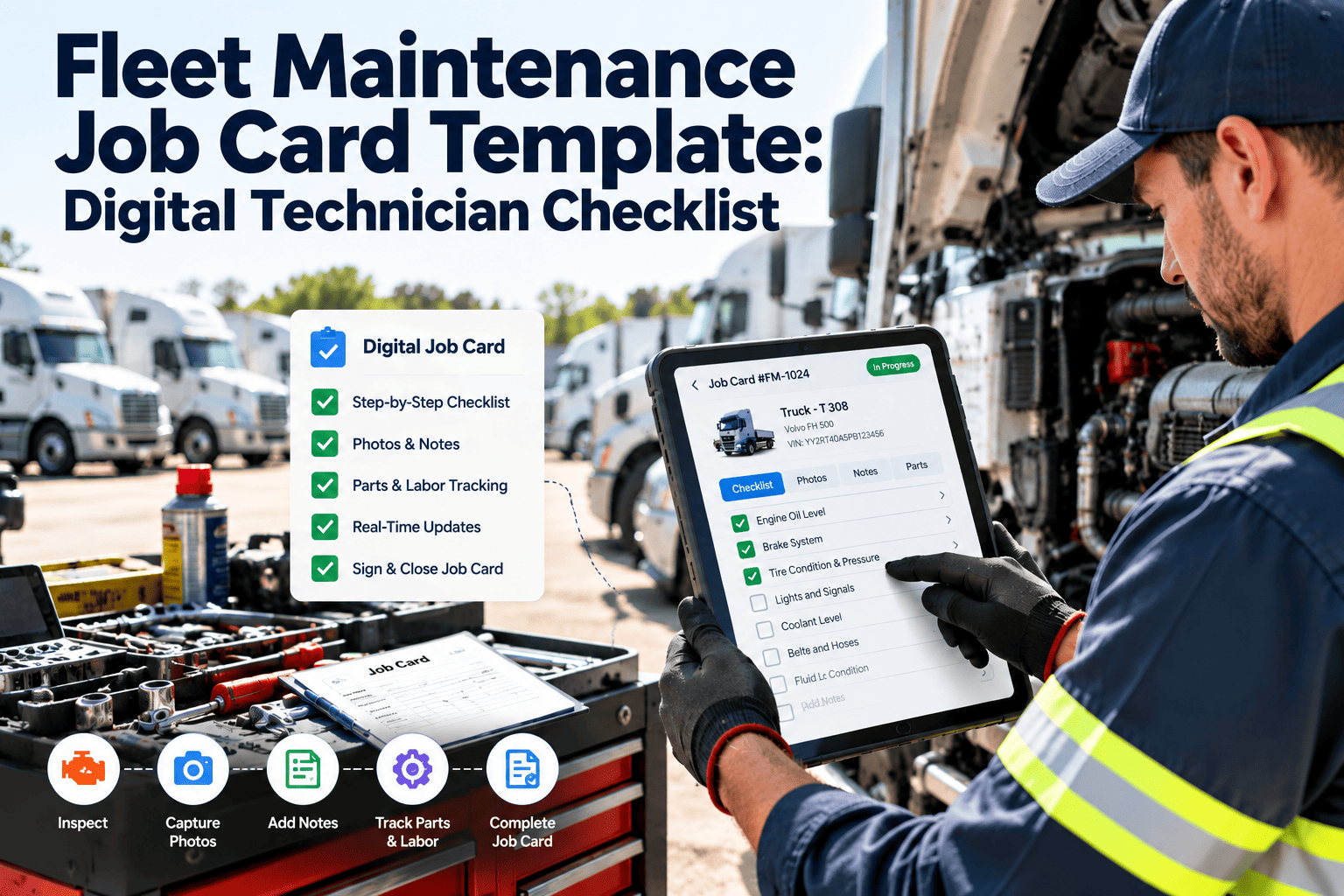
Every work order auto-loads the correct SOP checklist based on vehicle class, service type, and maintenance interval. Technicians follow step-by-step digital instructions on their mobile device, checking off each step with measurement fields, photo capture points, and pass/fail criteria embedded directly in the workflow. No more flipping through binder pages or searching for the right procedure.
Automatic Version Control and Updates
When OEM specifications change or your fleet engineering team updates a procedure, Oxmaint pushes the updated SOP to every active work order template instantly. No more outdated laminated sheets hanging in shop bays. Version history is maintained with timestamps showing who approved each change, creating a complete audit trail that satisfies FMCSA documentation requirements for procedure governance.
Measurement Capture with Threshold Alerts
Technicians enter brake pad thickness, tire tread depth, torque values, and fluid levels directly into the digital SOP. If any measurement falls outside the defined pass/fail threshold, the system blocks work order completion and triggers an automatic escalation to the shop foreman. This prevents vehicles with out-of-spec components from being returned to service — reducing roadside breakdown rates by 31%.
Multi-Language SOP Translation
Fleet shops with multilingual technician teams can deploy SOPs in Spanish, French, Portuguese, and other languages natively within the Oxmaint mobile interface. Each procedure step, safety warning, and specification table is translated accurately — ensuring every technician understands critical torque values, chemical handling procedures, and safety protocols regardless of their primary language. This eliminates a leading cause of procedural errors in diverse workforces.
SOP Compliance Analytics Dashboard
Track SOP adherence rates across technicians, shifts, and vehicle classes with real-time dashboards. Identify which procedures have the highest deviation rates, which technicians consistently skip safety checkpoints, and which vehicle classes generate the most rework. Fleet managers use this data to target training interventions precisely — improving overall shop quality scores by an average of 27% within the first 90 days of digital SOP deployment.
QR Code Asset Linking for Instant SOP Access
Every vehicle in your fleet gets a unique QR code that links directly to its specific SOP library, maintenance history, and active work orders. Technicians scan the code with their mobile device, and the correct procedures for that exact vehicle — including any fleet-specific modifications or engineering bulletins — load instantly. No more searching through filing cabinets or asking colleagues which procedure applies to which unit number.
Building a Scalable SOP Library for Multi-Site Fleet Operations
For fleets operating across multiple shop locations — whether regional depots, satellite yards, or third-party repair facilities — SOP consistency becomes exponentially more critical. A technician in your Houston shop must execute a PM-B service identically to a technician in your Chicago facility. Without a centralized digital SOP platform, procedure drift is inevitable: each shop develops its own informal variations, and quality control becomes impossible to enforce remotely. Oxmaint solves this by serving as the single repository for all fleet SOPs, accessible from any device at any location.
The financial impact of standardized multi-site SOPs is substantial. Fleets with 3 or more shop locations report an average of $34,000 in annual savings when they centralize their procedure library — primarily from reduced rework, lower warranty rejection rates, and faster cross-location technician transfers. When a technician moves from your Denver shop to your Phoenix location, they already know the procedures because the SOPs are identical. Training overhead drops, quality remains consistent, and compliance documentation flows automatically to fleet management regardless of which shop performed the work. This is exactly the kind of operational advantage that separates top-performing fleets from their competitors — start a free trial with Oxmaint to build your centralized SOP library, or book a demo to see multi-site SOP management in action.
ROI Impact of Digitized Fleet SOPs
93%
first-time fix rate achieved
Up from 62% average in fleets using informal, undocumented procedures
$8.4K
annual rework savings per 50 units
Eliminated repeat repairs from inconsistent technician execution
84%
reduction in DOT audit findings
From 3.8 average findings to 0.6 with documented digital SOPs
3.2x
faster new technician productivity
Structured SOPs cut onboarding from 8 weeks to under 2.5 weeks
Frequently Asked Questions
Can Oxmaint SOPs be customized for different vehicle classes within the same fleet?
Yes, Oxmaint supports unlimited SOP variants mapped to specific vehicle classes, model years, engine types, and transmission configurations. When a technician opens a work order for a Class 8 Freightliner Cascadia, the system loads SOPs with Detroit DD15-specific torque values and fluid specifications. The same procedure type for a Class 6 International MV loads with Cummins B6.7 specifications automatically. This ensures every procedure is precisely matched to the asset being serviced.
How does the platform handle SOP updates when OEM service bulletins are released?
Fleet administrators can update any SOP template instantly from the central dashboard. The updated procedure automatically pushes to all active and future work orders referencing that SOP across every shop location. The previous version is archived with a timestamp and the approving administrator ID. Technicians receive a notification highlighting specific changed steps, ensuring they are aware of updated torque values, fluid specifications, or safety warnings before starting the procedure.
Does the system track which technicians are certified to perform specific SOPs?
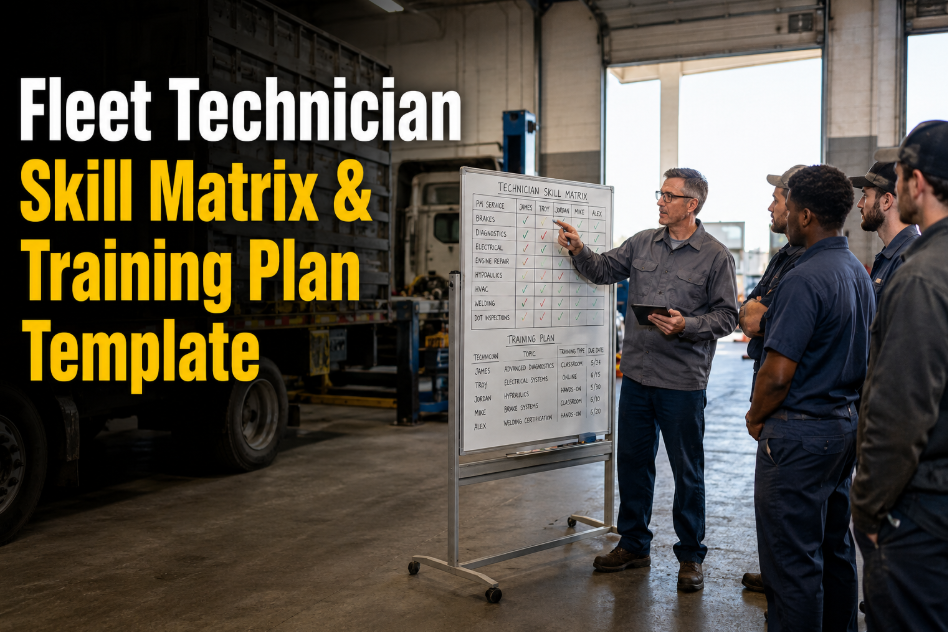
Oxmaint integrates SOP access with the technician skill matrix module. If a procedure requires ASE T4 brake certification or EPA Section 608 refrigerant handling certification, only technicians with verified, current certifications can be assigned work orders containing those SOPs. If an unqualified technician is accidentally assigned, the system blocks the work order and alerts the shop foreman to reassign to a qualified team member.
Can third-party repair shops access our fleet SOPs through the platform?
Yes, Oxmaint supports controlled external access for approved third-party vendors. Fleet managers can grant read-only SOP access to specific vendor accounts, ensuring outside shops follow your exact procedures — not their own informal methods. Every step completed by an external technician is logged with the same digital audit trail as in-house work, maintaining documentation consistency and compliance accountability across your entire repair network.
Digitize Your Fleet SOPs and Eliminate Rework Today
Join fleet operations teams across 40+ countries using Oxmaint to standardize every maintenance procedure, automate compliance documentation, and cut rework rates by up to 41%. Free trial, no credit card required.