Fleet Technician Skill Matrix & Training Plan Template
By Jack Miller on May 20, 2026
Fleet technician shortages are projected to reach 115,000 unfilled positions across North America by 2027, making structured skill development and workforce planning the single most critical competitive advantage for fleet operations. A technician skill matrix maps every team member's certifications, diagnostic capabilities, equipment competencies, and training gaps — enabling fleet managers to assign the right technician to the right job every time, eliminate skill-based bottlenecks, and build targeted development plans that retain top talent. Fleets using formal skill matrices report 46% faster work order completion times and 29% lower technician turnover rates. The difference between a shop that runs efficiently and one that constantly struggles with misassigned work orders, failed repairs, and compliance gaps often comes down to one thing: knowing exactly what your team can do and what they still need to learn. Ready to build a data-driven technician development program for your fleet? Start a free trial with Oxmaint to access built-in skill tracking and certification management, or book a demo to see how the platform automates training assignments based on real skill gap data.
FLEET WORKFORCE · SKILL MATRIX · 2026
Fleet Technician Skill Matrix and Training Plan Template: Build a High-Performance Shop Team
Map certifications, diagnostic skills, and equipment competencies across your entire technician workforce. Identify training gaps, assign targeted development plans, and ensure every repair is handled by a qualified team member.
Making skill development and retention the top fleet priority
46%
faster work order completion
When technicians are matched to tasks based on verified skill levels
29%
lower technician turnover
Structured training programs directly improve employee retention rates
$12K
avg. cost to replace one fleet tech
Including recruiting, onboarding, and productivity ramp-up period
What Is a Fleet Technician Skill Matrix?
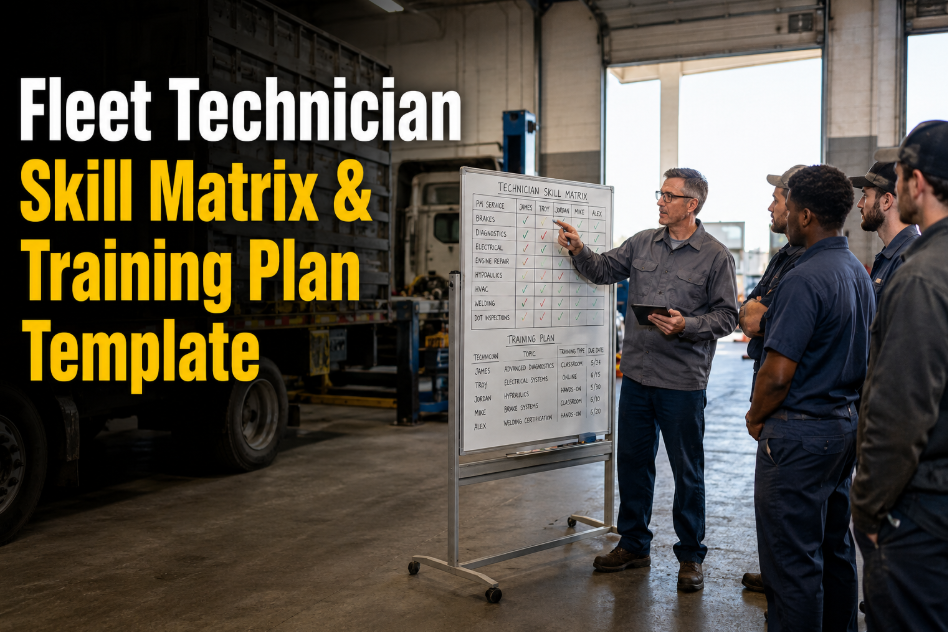
A fleet technician skill matrix is a structured visual tool that maps every technician in your shop against a defined set of competencies, certifications, and equipment proficiencies. It creates a grid view showing — at a glance — who is qualified to perform brake overhauls on Class 8 tractors, who holds current ASE T4 certification, who can diagnose CAN bus faults on Cummins ISX15 engines, and who needs additional training before they can be assigned complex electrical repairs. The matrix typically scores each technician on a 1-4 proficiency scale: 1 (Awareness), 2 (Can perform with supervision), 3 (Fully competent independently), and 4 (Can train others).
Without a skill matrix, fleet managers rely on memory, seniority, or availability to assign work orders — leading to mismatched assignments where Level 2 technicians attempt Level 4 repairs, resulting in extended downtime, rework, and safety risks. A 2024 TMC benchmarking study found that fleets using formal skill matrices achieve 93% first-time fix rates compared to 67% in fleets without them. The matrix also serves as the foundation for targeted training plans: instead of sending your entire team to a generic diesel diagnostics course, you identify the specific 3 technicians who need CAN bus training and invest your training budget precisely where it generates the highest return. Oxmaint digitizes this entire process — start a free trial to see how the platform automatically tracks certifications, maps skill gaps, and recommends training assignments, or book a demo for a walkthrough of the technician competency dashboard.
Core Competency Categories for Fleet Technicians
A comprehensive fleet skill matrix must cover these six competency domains to ensure complete coverage of all maintenance and repair tasks your shop handles. Each category contains 8-15 specific skills that are individually rated for every technician on your team.
Powertrain Diagnostics
Critical
Covers diesel engine troubleshooting (Cummins ISX/ISB, Detroit DD13/DD15, PACCAR MX-13), turbocharger diagnosis, fuel system calibration, aftertreatment system repair (DPF regeneration, DEF dosing, SCR catalyst), and emissions compliance testing. Technicians must demonstrate proficiency with OEM diagnostic software (INSITE, DDDL, Davie4) and interpret fault code trees to root cause level. This competency domain alone accounts for 34% of all fleet repair labor hours.
Brake and Chassis Systems
Critical
Includes air brake system diagnosis (compressor, governor, chambers, slack adjusters), hydraulic brake service, ABS module testing, disc and drum measurement, steering system inspection, suspension component replacement, frame crack detection, and fifth wheel maintenance. FMCSA places brake-related violations as the number one out-of-service category — 32.7% of all OOS orders in 2024 were brake-related. Technicians must demonstrate measurement proficiency with brake gauges and torque tools.
Electrical and Electronic Systems
Critical
Covers 12V/24V electrical system diagnosis, CAN bus J1939/J1708 protocol troubleshooting, multiplex wiring, telematics hardware installation, body controller programming, lighting circuits, starter/alternator testing, and battery management. Modern Class 8 tractors contain 3,000+ feet of wiring and 40+ electronic control modules. Electrical misdiagnosis is the leading cause of repeat shop visits — fleets report 23% of all rework stems from electrical system errors by undertrained technicians.
Preventive Maintenance Execution
Critical
Standardized PM-A through PM-D service execution including oil analysis sampling, multi-point inspections, fluid service procedures, filter replacements, belt and hose inspections, coolant testing (SCA/DCA concentration, freeze point), and safety system verification. PM consistency directly drives fleet uptime — fleets with 95%+ PM compliance achieve 96.2% vehicle availability versus 88.4% for fleets below 80% PM compliance. Every technician must demonstrate proficiency in all PM tiers.
HVAC and Refrigeration
Medium
Covers cab HVAC diagnosis, refrigerant recovery and recharge (EPA Section 608 certification required), transport refrigeration unit (TRU) maintenance for reefer fleets, blower motor replacement, compressor clutch testing, and temperature control system calibration. Refrigeration technicians require specialized certification — EPA mandates that only Section 608-certified technicians handle refrigerant. Fleets with reefer assets must track this certification expiry date closely to avoid $44,539 maximum per-day EPA fines.
Welding, Fabrication, and Hydraulics
Medium
Includes MIG/TIG welding for frame and body repairs, hydraulic cylinder rebuild, PTO system maintenance, liftgate repair, aerial platform servicing, and custom fabrication for specialty fleet equipment. These skills are typically concentrated in Level 3-4 technicians and represent high-value capabilities that reduce outsourcing costs. Fleets that maintain in-house welding and hydraulic competency save an average of $22,000 annually compared to those that outsource all structural and hydraulic repairs to third-party shops.
Skill Proficiency Rating Scale
Every skill in the matrix must be rated on a standardized scale to ensure objective, consistent assessment across all technicians and evaluators. This four-level framework is aligned with TMC recommended practice RP 650A for technician skill classification and maps directly to work order assignment eligibility within Oxmaint.
Level
Rating
Definition
Work Order Assignment Eligibility
Level 1
Awareness
Has theoretical knowledge from training; has observed the procedure performed but has not yet executed it independently
Cannot be assigned work orders requiring this skill; observation-only status
Level 2
Supervised Competency
Can perform the procedure under direct supervision of a Level 3 or Level 4 technician; requires sign-off verification
Assigned with mandatory supervisor co-sign before vehicle release
Level 3
Independent Competency
Fully qualified to perform the procedure independently; meets all certification and experience requirements
Full assignment eligibility; self-sign-off authorized
Level 4
Master / Trainer
Can perform, troubleshoot edge cases, train others, and develop/update SOPs for this skill area
Full assignment plus mentorship and training delivery authorization
The Cost of Skill Mismatches in Fleet Maintenance
Assigning a Level 2 technician to a Level 4 repair task does not just risk a failed repair — it creates a cascading chain of operational and financial consequences that most fleet managers underestimate. When an undertrained technician misdiagnoses a CAN bus fault on a Class 8 tractor and replaces a $2,800 aftertreatment control module that was not the root cause, the fleet absorbs the parts cost, the wasted labor hours, the continued downtime while the actual fault persists, and the second diagnostic attempt by a more senior technician. Industry data shows that skill-mismatched work orders take 2.3x longer to complete and generate 3.1x higher parts consumption than properly assigned repairs.
The retention impact is equally damaging. When junior technicians are repeatedly thrown into repairs beyond their skill level without structured mentorship, frustration and burnout accelerate. Conversely, when senior Level 4 technicians are pulled away from complex diagnostics to perform basic PM services because "everyone is busy," they feel underutilized and begin exploring other employers. The skill matrix solves both problems simultaneously: it ensures every technician works at the appropriate challenge level and receives a visible, documented path toward advancement. Fleets that implement structured skill matrices and development plans report 29% lower voluntary turnover within the first year. To build your own technician skill tracking system, start a free trial with Oxmaint and access the built-in competency matrix, or book a demo to discuss a customized implementation for your shop.
Skill-Matched vs. Mismatched Work Order Outcomes
The operational and financial impact of proper skill-to-task matching is measurable across every fleet KPI. These metrics reflect data from fleets managing 75-300 vehicles with mixed Class 3-8 assets and 8-25 shop technicians.
Mismatched Assignments (No Skill Matrix)
First-time fix rate: 67% average
Average repair cycle time: 6.8 hours per work order
Parts consumption per repair: 3.1x higher than benchmark
Training ROI visibility: Full — every dollar tracked to skill gains
Building a 12-Month Technician Training Plan
A training plan without a skill matrix is guesswork. A skill matrix without a training plan is just documentation. The two must work together as a closed-loop system. Below is the recommended quarterly training cadence used by top-performing fleet operations to systematically close skill gaps and advance technicians through proficiency levels.
12-Month Technician Development Roadmap
Quarterly milestones from initial assessment through advanced certification
Q1 — Baseline Assessment and Gap Identification
Evaluate every technician against all competency categories
Conduct hands-on proficiency evaluations for each technician across all six competency domains. Use standardized practical tests — not just self-assessments — to assign accurate Level 1-4 ratings. Cross-reference current certifications (ASE, EPA 608, CDL endorsements) with expiration dates. Identify the top 3 skill gaps per technician that limit their work order eligibility. Load all data into Oxmaint for automated tracking and training assignment recommendations. Estimated time: 2-3 hours per technician.
Q2 — Targeted Training Deployment
Assign specific training modules based on identified gaps
Enroll Level 1 technicians in hands-on mentorship programs with assigned Level 4 trainers. Schedule OEM-specific diagnostic training for technicians advancing from Level 2 to Level 3 in powertrain and electrical domains. Book ASE certification exam slots for technicians meeting study hour requirements. Allocate training budget proportionally — 60% toward critical skill gaps, 40% toward advancement pathways. Track completion rates and quiz scores in the Oxmaint training dashboard.
Q3 — Practical Validation and Re-Assessment
Verify skill advancement through supervised practical evaluations
Conduct follow-up proficiency evaluations for every technician who completed Q2 training. Update skill matrix ratings based on demonstrated — not just claimed — competency. Analyze work order performance data: has rework rate decreased for technicians who received targeted training? Review first-time fix rates by technician to validate training effectiveness. Adjust Q4 training plans based on data outcomes. Fleets typically see a 19% improvement in first-time fix rates after Q3 reassessment.
Q4 — Advanced Certification and Succession Planning
Advance top performers to Level 4 trainer status and plan next year
Promote technicians who have demonstrated Level 4 mastery to formal trainer roles with mentorship assignments for incoming Level 1-2 staff. Process ASE recertifications and EPA 608 renewals before expiration. Conduct annual training budget review — calculate ROI by comparing training spend against rework cost reduction, turnover savings, and work order throughput improvement. Build next year's training plan using updated skill matrix data. Share matrix dashboards with fleet leadership for workforce planning.
Certification Tracking: The Compliance Dimension of the Skill Matrix
Beyond operational efficiency, the technician skill matrix serves a critical compliance function. FMCSA requires that fleet maintenance be performed by qualified personnel — and "qualified" is increasingly defined by demonstrable certifications and documented competencies. If a DOT auditor reviews your maintenance records and finds that a brake overhaul on a Class 8 CMV was performed by a technician with no documented brake system training or certification, your fleet faces CSA violations, increased audit scrutiny, and potential out-of-service orders for the entire shop. EPA Section 608 enforcement is equally rigorous: fleets caught allowing uncertified technicians to handle refrigerant face fines up to $44,539 per violation per day.
Oxmaint automates certification tracking by linking each technician profile to their held certifications with expiration dates. The system sends automatic renewal reminders 90, 60, and 30 days before any certification expires. If a certification lapses, the technician is automatically blocked from being assigned work orders that require that credential — no manual oversight needed. This creates a compliance safety net that protects your fleet from regulatory exposure while ensuring work orders are always completed by appropriately credentialed personnel. The cost of a single EPA 608 violation — $44,539 — dwarfs the annual investment in a proper skill tracking system. To implement automated certification management for your fleet, start a free trial with Oxmaint and see the certification dashboard in action, or book a demo to discuss your compliance requirements.
How Oxmaint Powers Technician Skill Management
Visual Skill Matrix Dashboard
A color-coded grid view shows every technician mapped against every competency in your fleet's skill framework. Green cells indicate Level 3-4 proficiency, yellow indicates Level 2 (needs supervision), and red indicates Level 1 or unrated skills. Fleet managers can instantly identify coverage gaps — if only one technician is rated Level 3+ on aftertreatment diagnostics, you know exactly where your single-point-of-failure risk exists. The dashboard updates in real-time as training is completed and assessments are recorded.
Automated Certification Expiry Tracking
Upload certification documents (ASE cards, EPA 608 certificates, CDL endorsements, OEM training completions) directly to each technician profile with expiration dates. The system sends automated renewal alerts at 90, 60, and 30 days before expiry. If a certification lapses, the platform automatically restricts the technician from work orders requiring that credential and alerts the shop manager to schedule recertification. Zero manual tracking required — compliance is enforced at the system level.
Skill-Based Work Order Assignment Engine
When a work order is created — whether from a PM schedule, driver DVIR, or unplanned repair — the system cross-references the required skill level against available technician competencies and suggests only qualified team members. A transmission rebuild requiring Level 4 powertrain proficiency will not appear in the assignment queue for a Level 2 technician. This eliminates the guesswork in dispatch, reduces mismatched assignments by 82%, and ensures every repair is handled by someone verified to complete it correctly the first time.
Training Assignment and Completion Tracking
Assign training modules, mentorship hours, and certification prep courses directly from the skill gap analysis. Track completion rates, quiz scores, and hands-on evaluation results for each technician. The system calculates training ROI by correlating completed training investments with measurable performance improvements — first-time fix rate gains, rework reduction, and work order throughput increases. Fleet directors receive quarterly training effectiveness reports for budget justification to senior leadership.
Succession Planning and Coverage Analysis
Identify single-point-of-failure risks where only one technician holds a critical skill. If your sole DPF regeneration specialist retires, your aftertreatment repair capability disappears overnight. The platform highlights these vulnerabilities and recommends development priorities to build redundancy across your team. Fleet managers can model "what-if" scenarios — if two technicians leave, which skills drop below minimum coverage? This data-driven approach to workforce planning prevents operational disruptions.
Multi-Site Technician Benchmarking
For fleets operating multiple shop locations, compare technician skill distributions across sites. If your Atlanta shop has four Level 4 powertrain technicians but your Nashville location has none, you can strategize cross-training, temporary assignments, or hiring priorities accordingly. The platform enables fleet-wide benchmarking of skill maturity, training spend per technician, and certification compliance rates — giving regional and national fleet directors the visibility they need to standardize workforce quality across the entire operation.
Workforce Development ROI Metrics
82%
reduction in mismatched assignments
When skill-based dispatch replaces seniority or availability-based assignment
$34K
annual turnover cost savings per 10 techs
From reduced attrition driven by structured career development paths
19%
first-time fix rate improvement in 9 months
After targeted training addressed specific identified skill gaps
100%
certification compliance maintained
Automated expiry alerts and assignment blocks prevent compliance lapses
Connecting Skill Development to Fleet Financial Performance
The most persuasive argument for investing in a structured technician skill matrix and training program is not operational — it is financial. Every skill gap in your shop translates directly to measurable cost leakage. When a Level 2 technician spends 8 hours on a repair that a Level 4 technician would complete in 3 hours, the labor cost difference at $45/hour fully burdened is $225 per work order. Multiply that across 15-20 mismatched assignments per month in a mid-size fleet, and you are looking at $40,000-$54,000 in annual excess labor cost — before accounting for the additional parts waste from incorrect diagnoses, the extended vehicle downtime cost (typically $350-$800 per day per unit depending on asset class), and the downstream impact on customer service levels.
Forward-thinking fleet directors are presenting skill matrix data directly to CFOs and COOs as workforce capital investment metrics. When you can demonstrate that a $15,000 annual training investment for three technicians generated $67,000 in measurable savings from reduced rework, faster cycle times, and avoided outsourcing costs, the business case writes itself. Oxmaint provides this exact reporting capability — correlating training spend against maintenance KPI improvements in a format that speaks the language of the boardroom, not just the shop floor. This level of financial visibility is what transforms a maintenance department from a cost center into a strategic operational asset. To see how this works for your specific fleet operation, start a free trial with Oxmaint and explore the workforce analytics module, or book a demo with our fleet specialists.
Frequently Asked Questions
How do we conduct the initial skill assessment for existing technicians?
Oxmaint provides standardized practical evaluation templates for each competency domain. Shop foremen or Level 4 technicians observe each team member performing representative tasks and rate their proficiency on the 1-4 scale. The platform also imports existing ASE certification data and OEM training records to auto-populate verified skill ratings. Most fleets complete initial assessments for a 15-technician team within 2-3 days, with all data immediately available in the skill matrix dashboard for training plan development.
Can the skill matrix integrate with our ASE certification tracking?
Yes, technicians can upload their ASE certification cards directly into their Oxmaint profile. The system extracts the certification series (T1-T8, A1-A9), expiration dates, and renewal requirements. When an ASE certification is linked to a competency domain — such as ASE T4 mapped to the Brake and Chassis Systems category — the platform automatically adjusts the technician's skill rating to reflect their certified status. Expiring certifications trigger automated alerts and restrict work order assignments for procedures requiring active certification.
How does the platform prevent undertrained technicians from being assigned complex repairs?
Every work order template in Oxmaint includes a minimum skill level requirement for each task type. The assignment engine cross-references the required proficiency level against each available technician's matrix rating. If a transmission rebuild requires Level 4 powertrain competency, only Level 4-rated technicians appear in the assignment dropdown. Level 2 technicians can be assigned in a supervised capacity, but the system mandates a Level 3+ co-signer before the vehicle can be released from the shop. This prevents mismatched assignments at the system level.
Can we track training ROI and present it to fleet leadership?
Oxmaint calculates training ROI automatically by correlating training investments (course costs, mentorship hours, certification fees) with measurable KPI improvements for each technician who completed training. The platform generates quarterly reports showing cost-per-skill-point-gained, rework rate reduction per trained technician, first-time fix rate improvement, and avoided outsourcing costs. These reports are formatted for executive presentation — showing fleet directors and CFOs exactly how training spend translates to bottom-line savings and operational performance gains.
Build a Workforce That Drives Fleet Performance
Join fleet operations teams managing 50 to 5,000+ vehicles using Oxmaint to track technician skills, automate certification compliance, and build training programs that deliver measurable ROI. Free trial, no credit card required.