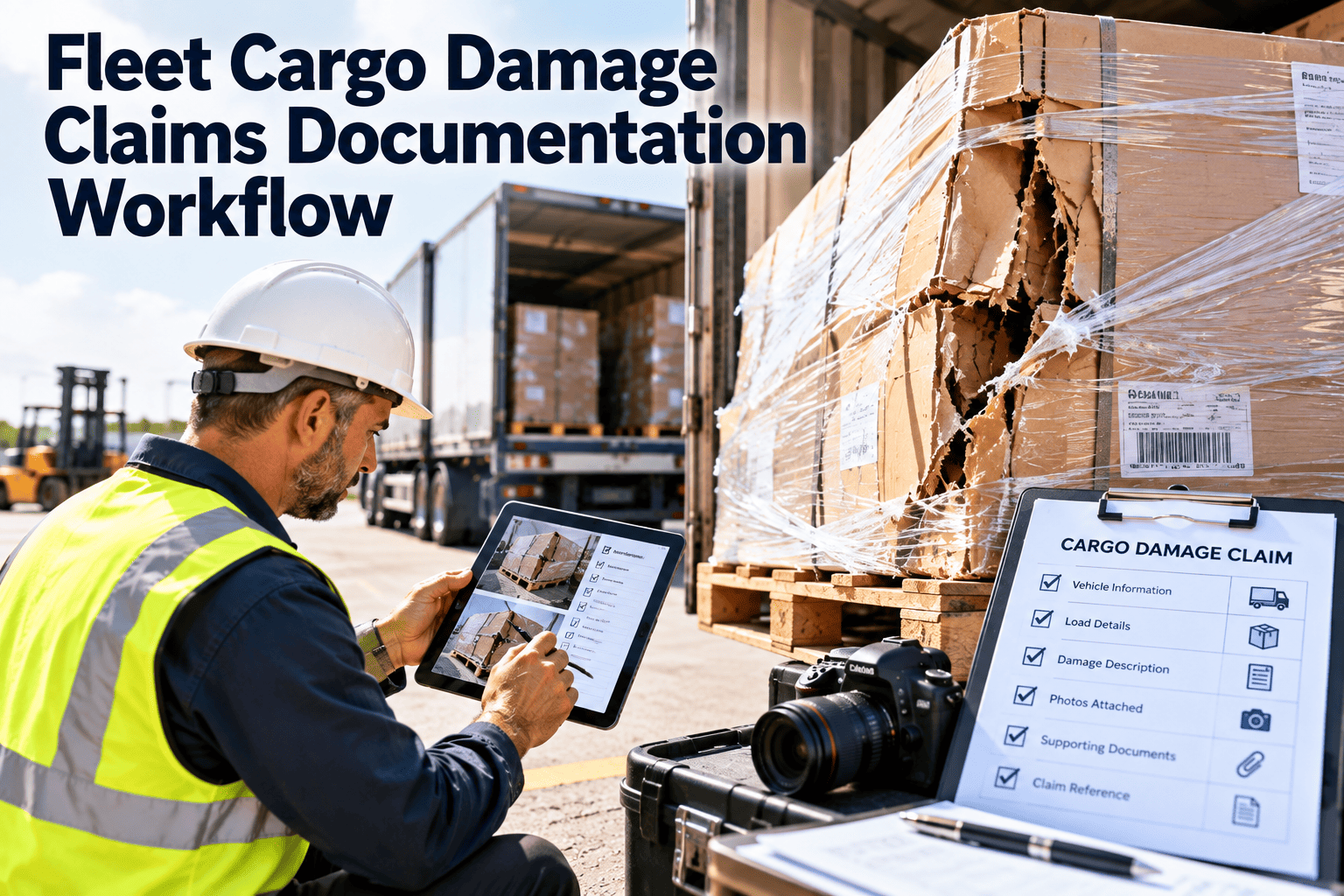
Open a stack of freight damage claims from almost any carrier or 3PL and the same photo keeps showing up: a pallet corner folded in, the carton beneath it dented, and a receiver refusing the load or deducting the invoice. Crushed corners are consistently one of the most common categories in cargo claims, and unlike weather damage or theft, most of it is preventable with better stacking, protection, and inspection discipline.
Crushed-Corner Damage: Fixing The #1 Freight Claim Category
Crushed corners show up again and again in freight damage claims, driven by weak stacking, missing corner protection, and strapping pressure with nowhere to distribute. See the root causes, the fixes that actually work, and how scheduled inspections catch the pattern before it becomes a recurring claim.
Strap tension, stack weight, and impact all concentrate at the four vertical corners of a load, the point of least support and highest exposure.
Why Corners Fail Before Any Other Part Of The Load
A corner is structurally the weakest point of a carton or a palletized stack. It carries vertical load from stacking, lateral pressure from strapping, and the first impact from any collision with a wall, a forklift, or a neighboring pallet, all with the least amount of surrounding material to absorb it.
High-tension polyester or steel strapping without a corner board cuts directly into the carton edge, concentrating force on a single point.
A poorly built stack shifts weight onto one edge of the pallet, so corners bear more than their share of compressive load.
Corners are the first surface a forklift tine or dock wall makes contact with during handling, loading, and repositioning.
Cartons that extend past the edge of the pallet base lose support exactly where corner protection matters most.
Catch The Pattern Before It Becomes A Recurring Claim
Oxmaint logs damage inspections and root-cause notes per load and per dock, so a recurring crushed-corner pattern shows up in the data long before it shows up as a stack of rejected invoices.
What Changes When A Load Gets Proper Corner Protection
The difference between a rejected pallet and an accepted one is often a few cents of packaging material placed correctly, not a redesign of the entire supply chain.
- Strapping cuts directly into carton corners
- Stack pressure concentrates on exposed edges
- No sacrificial layer to absorb impact
- Damage often invisible until unwrapped at the dock
- Corner boards distribute strap tension evenly
- Compression strength of the stack improves
- Boards act as a sacrificial layer, not the product
- Damage visible on the board, not the cargo, at inspection
Five Practices That Cut Crushed-Corner Claims
Place edge protectors under strapping so tension distributes across a wider surface instead of biting into one point.
Interlock layers and keep cartons within the pallet footprint so no single corner absorbs excess weight.
Heavier or taller stacks need thicker, higher-strength edgeboard than light, single-layer cartons.
Slow, squared approaches to racking and dock walls prevent the tine strikes that account for many corner impacts.
A pre-shipment check catches a crushed corner while it is still a warehouse fix, not a customer complaint.
Choosing The Right Corner Protection For The Load
Not every shipment needs the same level of corner protection. Matching the material to the load weight, handling exposure, and value keeps cost proportionate to risk.
| Material | Best For | Trade-Off |
|---|---|---|
| Cardboard edgeboard | Light to mid-weight single-use shipments | Low cost, not reusable, moisture-sensitive |
| Composite laminate board | Heavier stacked cartons | Higher strength, moderate cost increase |
| Reusable plastic corner protector | Closed-loop or repeat-lane shipments | Higher upfront cost, lower cost per trip over time |
| Foam corner block | High-value or fragile goods | Best impact absorption, higher unit cost |
Catching Crushed-Corner Damage Before It Reaches The Receiver
The cheapest place to catch corner damage is the outbound dock, where a pallet can still be repacked or reworked. The most expensive place to catch it is at the receiver, where a rejected load turns into a claim, a redelivery, and a strained account relationship.
Turn Damage Findings Into A Fixable Pattern
A single crushed corner is a packaging problem. A repeating one, tied to the same dock or the same handling step, is an operational problem that scheduled inspections and logged findings can actually solve.
Turning Dock Inspections Into Data You Can Act On
Most crushed-corner damage is not a one-time accident. It is a pattern tied to a specific dock, a specific forklift, a specific packaging shortcut, or a specific lane, and patterns only become visible when inspection findings are logged consistently instead of scattered across paper checklists and phone photos.
Standardize a corner and stack-integrity check as a recurring step before every outbound load leaves the dock.
Dock staff capture and log damage findings from a phone, tied to the load, dock, and shift automatically.
Roll up findings across docks and lanes to see whether crushed-corner claims cluster around one root cause.
Turn a recurring damage pattern into a corrective work order, whether that means equipment repair or a packaging change.
What A Crushed-Corner Claim Actually Costs Beyond The Product
The line-item value of the damaged goods is usually the smallest part of what a crushed-corner claim costs a carrier or shipper. The full cost stacks up across several categories that rarely appear on the same invoice, which is part of why the problem stays invisible until someone tallies it across a full quarter.
A rejected pallet often has to be repacked, rerouted, or redelivered, consuming dock labor and a second freight movement.
Filing, documenting, and negotiating a damage claim takes staff time on both the carrier and the shipper side.
A pattern of damaged deliveries erodes trust with a receiver faster than almost any other service failure.
A rising claims history can affect cargo insurance premiums and a carrier's standing with shippers evaluating bids.
Building A Pallet Stack That Protects Its Own Corners
Corner protection material only works as well as the stack it is applied to. A poorly built pallet defeats even the best edgeboard, because the underlying weight distribution is what determines how much pressure the corners actually carry.
Forklift And Dock Habits That Prevent Impact Damage
Corner protection material addresses compressive and strapping pressure, but it does little against a direct forklift strike or a hard contact with a dock wall. Impact damage requires a different fix, rooted in handling technique rather than packaging.
| Handling Step | Common Mistake | Better Practice |
|---|---|---|
| Approaching racking | Fast, angled approach | Slow, squared approach with clear sightlines |
| Setting down a pallet | Dropping from height | Lowering smoothly to full contact with the surface |
| Repositioning in a trailer | Repeated shifting to fit | Planning load sequence before the first pallet goes in |
| Double-stacking | Stacking without checking base stability | Verifying base pallet is square and centered first |
Frequently Asked Questions
Why are crushed corners the most common freight damage claim?+
Do corner boards actually reduce claim rates?+
What thickness of corner board should I use?
Where should crushed-corner damage be caught?+
How can a fleet track recurring corner damage across docks?+
Documenting Crushed-Corner Damage When It Does Reach A Receiver
Even a well-run operation will occasionally ship a damaged pallet. When that happens, how the damage is documented at the point of discovery determines whether the claim resolves quickly or drags into a dispute over responsibility.
Capture the damaged corner, the overall pallet, and any visible strapping or wrap condition before repositioning the load.
Specify the exact location of the damage, since a pattern across the same corner position points to a handling or stacking root cause.
Confirm whether corner boards were used, and whether they show the crushing instead of the product underneath.
Compare against the outbound photo record to establish whether the damage occurred in transit or was already present at dispatch.
This is also where a logged load-out inspection pays for itself directly. A carrier that can produce a timestamped photo of a clean, undamaged corner at dispatch has a materially stronger position in a damage dispute than one relying on memory or a generic bill of lading notation. The documentation does not prevent every disagreement, but it shortens most of them considerably.
When Crushed-Corner Risk Rises Across A Network
Corner damage risk is not constant across the year or across every lane. A few conditions reliably raise the rate of crushed-corner claims, and recognizing them lets an operation tighten protection standards temporarily rather than applying the same baseline everywhere.
Higher throughput compresses the time available for careful stacking and inspection at busy docks.
More handling events and repositioning along a route multiply the number of chances for an impact strike.
Cardboard corner boards lose rigidity in high humidity, reducing the protection they provide right when handling risk is often elevated.
Pallets built from varied box sizes and weights are inherently less stable and more prone to corner overload.
Adjusting protection standards for these known risk periods, rather than applying one fixed specification year-round, is usually a small process change with an outsized effect on claim rates. A slightly thicker corner board during peak season or a humid summer lane costs little compared to the redelivery and dispute cost of a claim that a thin board would not have prevented anyway. The same logic applies to labor: a brief refresher on squared stacking before a peak-season hiring surge is far cheaper than the claims that follow a season of rushed, undertrained loading.
Stop Treating Crushed Corners As A One-Off Problem
Better stacking, the right corner protection, and a consistent load-out inspection close most of the gap. Logging every finding is what turns a recurring claim category into a pattern you can actually fix at the root.