Every fleetmanager running diesel-powered vehicles knows the sinking feeling: a truck gets flagged during a DOT roadside inspection for a DEF system malfunction, and suddenly you are facing fines, out-of-service orders, and costly downtime. Diesel Exhaust Fluid (DEF) systems are no longer optional add-ons — they are federally mandated emissions control components that directly impact your DOT and FMCSA compliance standing. With the FMCSA's updated Safety Measurement System now splitting Vehicle Maintenance into two separate scoring categories, even a single DEF-related violation can push your fleet closer to an audit trigger. This guide breaks down exactly what fleet operators need to know about DEF system maintenance, inspections, and staying audit-ready in 2025 and beyond.
DOT / FMCSA Compliance for DEF System Maintenance & Inspections
Keep your fleet compliant, avoid costly fines, and stay audit-ready with proactive DEF system management
What Is a DEF System and Why Does DOT Care?
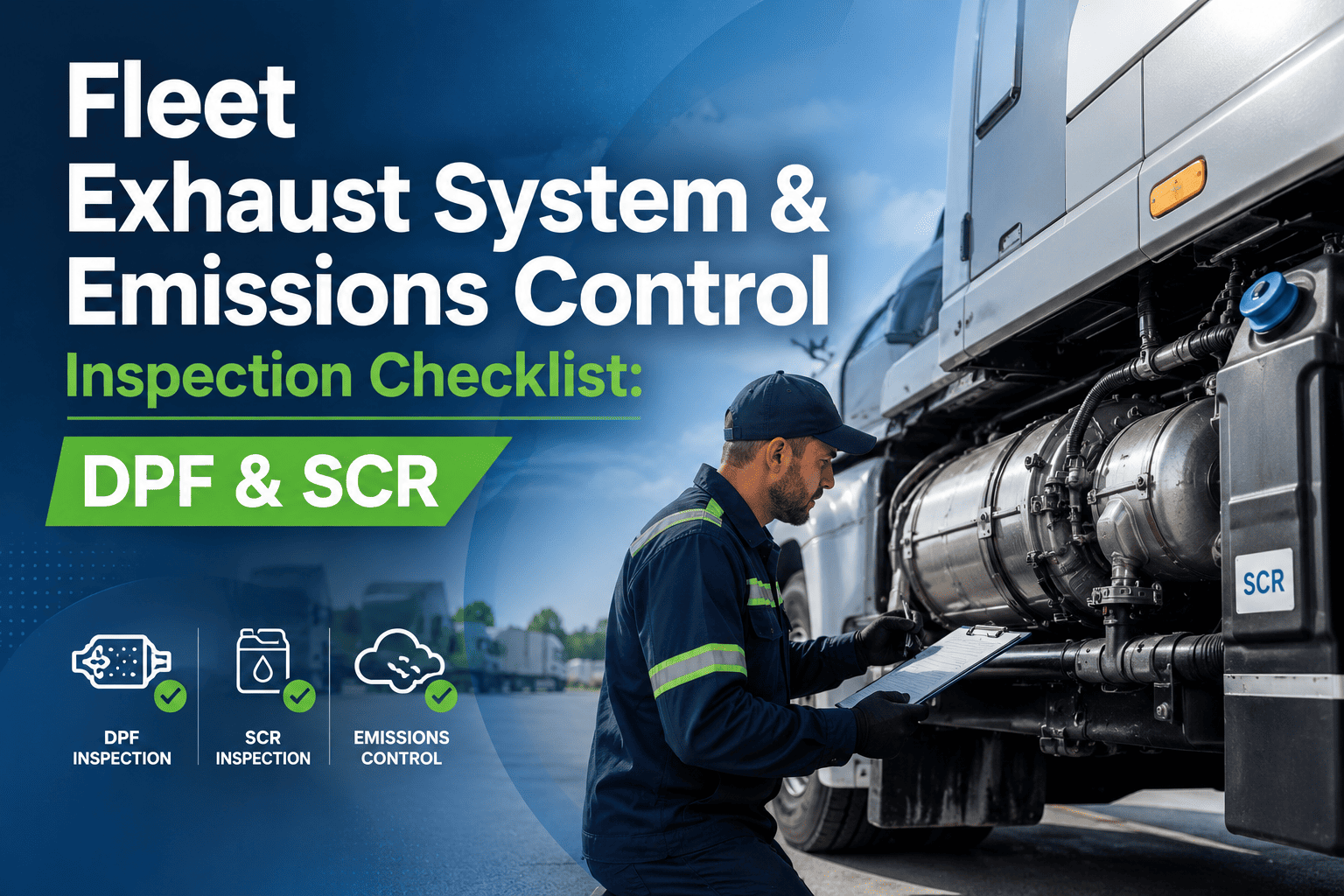
Diesel Exhaust Fluid is a precisely formulated solution of 32.5% high-purity urea and 67.5% deionized water. It is injected into the exhaust stream of diesel engines equipped with Selective Catalytic Reduction (SCR) technology. The SCR system heats up to over 400°F, catalyzing a chemical reaction that converts harmful nitrogen oxides (NOx) into harmless nitrogen, CO2, and water vapor. Since the EPA's 2010 emissions standards took effect, virtually every Class 6–8 diesel truck on the road relies on this system to meet federal emissions requirements.
The DOT and FMCSA care because a malfunctioning DEF system means your vehicle is no longer emissions-compliant — and that translates directly into roadside inspection failures, out-of-service orders, and negative CSA scores. Under 49 CFR Parts 393 and 396, carriers are required to maintain all vehicle systems — including emissions aftertreatment — in safe and proper operating condition. A DEF fault code or a tampered SCR system is not just an environmental concern; it is a compliance violation that can cascade into operational disruption. If your fleet is struggling to keep up with these requirements, sign up for OxMaint to automate your DEF maintenance tracking from day one.
The Real Cost of DEF Compliance Failures
Many fleet managers underestimate how quickly a single DEF-related issue can spiral into a financial problem. The American Trucking Associations estimates that aftertreatment and emissions-related repairs account for roughly 13% of total maintenance costs for Class 8 trucks. A single DPF replacement can cost $2,000 to $8,000, and SCR system repairs can easily exceed $10,000. Add labor, towing, downtime, and missed revenue, and a single failure event can cost $15,000 to $20,000 or more.
But the direct repair costs are just the beginning. DOT violations carry civil penalties that can reach $16,000 or more per offense, and repeated infractions damage your CSA score — the metric FMCSA uses to decide which carriers get audited. Under the updated SMS methodology, Vehicle Maintenance violations are being split into two categories (driver-observed and inspector-detected), meaning DEF issues found during a roadside inspection now carry their own distinct scoring weight. Carriers with percentiles above 80% in Vehicle Maintenance are flagged for intervention. A proactive approach to DEF system maintenance is not just good practice — it is a financial imperative.
Cost of Non-Compliance
Cost of Prevention with OxMaint
Stop Risking DOT Fines — Start Managing DEF Compliance Digitally
OxMaint automates your DEF system inspections, maintenance logs, and compliance documentation so you are always audit-ready.
DEF System Maintenance: The Inspection Framework Every Fleet Needs
A robust DEF maintenance program goes far beyond just topping off fluid levels. The most common fault code fleet technicians encounter is related to low SCR conversion efficiency — and while multiple factors can contribute, DEF quality is always the first thing to check. Here is a structured approach to DEF system maintenance that aligns with DOT and FMCSA compliance requirements:
Verify DEF level indicator on dashboard
Check for warning lights related to SCR or aftertreatment
Inspect DEF tank cap for proper seal
Note any unusual exhaust odor or color in DVIR
Test DEF concentration with a digital refractometer (target: 32.5% urea)
Inspect DEF lines and fittings for crystallization or leaks
Check DEF injector for clogging or damage
Verify DEF tank heating element functionality
Perform SCR conversion efficiency diagnostic scan
Inspect DPF for soot buildup and regeneration frequency
Review DEF consumption rate trends for anomalies
Clean dispensing equipment with deionized water
Drain and replace DEF stored longer than 12 months
Calibrate DEF dispensing systems for accurate dosing
Audit DEF storage conditions (12°F to 86°F range)
Review and update maintenance SOPs for compliance
Managing all of this manually across a fleet of 20, 50, or 200 vehicles is virtually impossible without the right tools. That is exactly why leading fleet operators use OxMaint — sign up here to digitize their entire DEF inspection workflow with automated scheduling and real-time compliance dashboards.
Common DEF Problems That Trigger DOT Violations
Understanding what goes wrong — and why — is the first step to preventing compliance failures. According to industry experts and fleet service providers, these are the most frequent DEF-related issues that lead to roadside inspection problems:
Each of these problems is preventable with the right maintenance program. If you want to see how digital maintenance management eliminates these risks, book a demo with OxMaint and walk through a live compliance dashboard built for fleets like yours.
FMCSA's Updated CSA Scoring: What DEF Violations Mean for Your Fleet
The FMCSA's Safety Measurement System is undergoing its most significant overhaul in over a decade, and DEF-related maintenance issues are directly in the crosshairs. Under the updated methodology, the old Vehicle Maintenance BASIC is being split into two distinct categories: driver-observed issues and inspector-detected issues. This means a DEF system problem caught during a roadside Level I inspection now falls into its own scoring bucket — separate from issues drivers report in their DVIRs.
How the New CSA Scoring Impacts DEF Violations
What does this mean practically? A DEF system violation found by a DOT inspector during a roadside check is now categorized differently than one your driver notes on a DVIR. Both count, but inspector-detected violations carry more weight in triggering compliance reviews. The good news is that only violations from the past 12 months now count toward your score — meaning a proactive cleanup of your maintenance practices can improve your standing relatively quickly. Fleet managers who want to stay ahead of these changes are using OxMaint to track and improve their compliance scores in real time.
Building an Audit-Ready DEF Maintenance Program
When a DOT compliance officer shows up for an audit — and they can arrive with minimal notice — your maintenance records are the first thing they review. The FMCSA explicitly allows electronic DVIRs (eDVIRs), and the agency has recently proposed clarifying regulations to encourage their adoption. Electronic records that are complete, timestamped, and easily retrievable are your strongest defense during any audit.
The 5-Pillar Audit-Ready Framework
Replace paper forms with electronic vehicle inspection reports that auto-capture timestamps, driver signatures, and GPS location. Store for minimum 3 months as required.
Automate preventive maintenance schedules for DEF system components — injectors, filters, sensors, and fluid quality testing — tied to mileage or time intervals.
Maintain a complete digital trail of every repair, replacement, and service action taken on DEF / SCR components with parts used, labor hours, and technician notes.
Set up automated notifications for upcoming inspections, expiring certifications, overdue maintenance, and DEF quality test schedules so nothing falls through the cracks.
Generate on-demand compliance reports showing maintenance history, inspection pass rates, violation trends, and DEF consumption patterns for auditor review.
This is exactly what OxMaint was built to do. From automated scheduling to one-click audit reports, every feature is designed to keep your fleet DOT-compliant without the administrative headache. Sign up for OxMaint and build your audit-ready maintenance program today.
DEF Storage and Handling Best Practices
Even the highest-quality DEF can be rendered useless by improper storage and handling. The American Petroleum Institute (API) licenses DEF products that meet ISO 22241 standards, and following their guidelines is essential for maintaining both fluid quality and regulatory compliance. Here are the best practices every fleet should follow:
Do This
Store DEF between 12°F and 86°F in a cool, shaded area
Use dedicated dispensing equipment for DEF only
Purchase only API-certified DEF with the certification mark
Check expiration dates and use oldest stock first
Clean equipment with deionized water only
Use containers made from HDPE or corrosion-resistant materials
Avoid This
Storing DEF above 86°F or in direct sunlight
Using funnels or hoses shared with other fluids
Adding any additives to frozen DEF in tanks
Using non-certified or unknown-source DEF
Cleaning DEF equipment with tap water
Storing DEF in steel, iron, copper, or aluminum containers
DEF is corrosive to metals including steel, iron, zinc, nickel, copper, aluminum, and magnesium. Contamination from any of these materials — or from chemicals, coolants, or engine oil — will compromise fluid quality and can lead to deposit formation, injector clogging, and catalyst damage. Following these practices consistently across your fleet is a straightforward way to prevent the most common DEF-related failures. To make sure your team follows these protocols every time, book a demo and see how OxMaint standardizes your DEF handling procedures fleet-wide.
Ready to Eliminate DEF Compliance Headaches?
Join thousands of fleet operators who trust OxMaint to manage their maintenance compliance, automate inspections, and stay audit-ready 365 days a year.
EPA's 2025 DEF Guidance: What Changed
In August 2025, the EPA announced revised guidance for diesel exhaust fluid systems across light-duty vehicles, heavy-duty diesel engines, and nonroad compression-ignition engines using SCR technology. The guidance specifically addresses the engine derating problem — where vehicles lose power or enter "limp mode" due to DEF system faults — that has caused significant operational disruptions for fleet operators, farmers, and construction companies.
The updated guidance works with manufacturers to ensure that necessary software changes can be deployed across the existing fleet to address derating issues while maintaining emissions compliance. The EPA has also streamlined the process by not requiring separate approvals beyond what the guidance provides, removing bureaucratic delays from getting fixes deployed. For fleet managers, this means that manufacturer-issued software updates for DEF/SCR derating problems should be applied promptly as part of your regular maintenance program — and documented in your maintenance records for compliance purposes.
Frequently Asked Questions
What is DEF and why is it required for DOT compliance?
Diesel Exhaust Fluid (DEF) is a solution of 32.5% urea and 67.5% deionized water used in Selective Catalytic Reduction (SCR) systems to reduce nitrogen oxide (NOx) emissions from diesel engines. It has been federally required since the EPA's 2010 emissions standards. Vehicles with malfunctioning or empty DEF systems can be cited during DOT roadside inspections, receive out-of-service orders, and accumulate negative CSA scores that trigger FMCSA compliance reviews.
What happens if my truck runs out of DEF during operation?
When a diesel vehicle runs low or out of DEF, the onboard monitoring system will first display a warning. If the DEF is not replenished, the engine management system will progressively reduce power — a process called "derating" — ultimately limiting the vehicle to a maximum speed of approximately 5 mph. This is a federally mandated safeguard to prevent operation without emissions controls. Running out of DEF during a DOT inspection results in a vehicle maintenance violation.
How often should DEF quality be tested in a fleet setting?
DEF quality should be tested using a digital refractometer anytime a conversion-efficiency fault code appears, during weekly technician inspections as a best practice, and whenever DEF is drawn from bulk storage containers. Unopened 2.5-gallon containers from reputable API-certified suppliers generally do not need testing, but bulk storage tanks (55-gallon drums or larger) should be tested periodically. DEF stored longer than 12 months or exposed to temperatures above 86°F should be drained and replaced.
Can I delete or bypass the DEF/SCR system on my trucks?
No. Tampering with, disabling, or removing SCR/DEF systems is a violation of the federal Clean Air Act. Penalties include fines of up to $5,000 per vehicle for individuals and significantly higher amounts for commercial fleet operators. FMCSA inspectors are trained to detect emissions system tampering, and violations will result in out-of-service orders, fines, and severe CSA score impacts. There is no legal exemption for commercial motor vehicles.
How does a DEF system violation affect my CSA score?
Under the FMCSA's updated Safety Measurement System, Vehicle Maintenance violations — including DEF system issues — are being split into driver-observed and inspector-detected categories. Carriers with Vehicle Maintenance percentiles above 80% are flagged for intervention. DEF-related violations found during roadside inspections fall into the inspector-detected category and carry a severity weight of 1 or 2. The good news is that only violations from the past 12 months now count, so improving your maintenance practices can improve your score relatively quickly.
What DEF storage conditions are required to maintain quality?
DEF should be stored between 12°F (-11°C) and 86°F (30°C) in a cool, dry location away from direct sunlight. It must be kept in containers made from HDPE or other corrosion-resistant materials — never in steel, iron, copper, or aluminum. DEF stored at 86°F or higher has a reduced shelf life of approximately six months. Properly stored DEF lasts about 12 months. Always use dedicated dispensing equipment cleaned with deionized water, and look for the API certification mark when purchasing.
How can OxMaint help with DEF system compliance management?
OxMaint is a CMMS (Computerized Maintenance Management System) built for fleet operations that automates DEF maintenance scheduling, digitizes vehicle inspection reports (eDVIRs), tracks work order history for every vehicle component, sends automated compliance alerts for upcoming inspections and overdue tasks, and generates audit-ready reports on demand. It replaces manual tracking with a centralized digital platform that ensures nothing falls through the cracks — from daily driver checks to annual DEF system overhauls.