The Diesel Exhaust Fluid system is one of the most failure-prone emissions components in modern commercial diesel vehicles — and one of the most misunderstood by fleet maintenance teams. A single DEF system fault can trigger a derate event that cuts engine power by 25–65%, stranding a driver mid-route with a truck still carrying full cargo. This page gives fleet managers a complete DEF system maintenance checklist, covers the most common failure points, and explains how a structured CMMS workflow prevents derate events before they occur. Sign up free on OxMaint to build DEF maintenance workflows and track SCR system health across your entire fleet, or book a demo with our diesel fleet specialists.
Stop DEF Failures Before They Derate Your Fleet
OxMaint helps diesel fleet teams track DEF system health, schedule SCR and dosing system PMs, log fault code history, and prevent the derate events that strand drivers and kill delivery SLAs.
What Is the DEF System and Why Does It Fail?
Selective Catalytic Reduction (SCR) systems inject DEF into the exhaust stream to convert harmful NOx emissions into nitrogen and water. The system involves multiple components — tank, pump, dosing injector, NOx sensors, and catalyst — any one of which can cause a system fault and trigger engine derate. Understanding each failure point is the foundation of effective DEF maintenance.
DEF Tank
Contamination, ice damage, sensor failure
Inspect every PM cycle
DEF Pump
Crystallization, clogging, seal failure
Test flow rate quarterly
Dosing Injector
Coking, clogging, spray pattern degradation
Clean or replace at 150k miles
NOx Sensors
Contamination, drift, connector corrosion
Scan fault codes every PM
SCR Catalyst
Poisoning, thermal damage, physical cracking
Efficiency test at 200k miles
Heated Lines
Heater element failure, line cracking in cold
Test heating function pre-winter
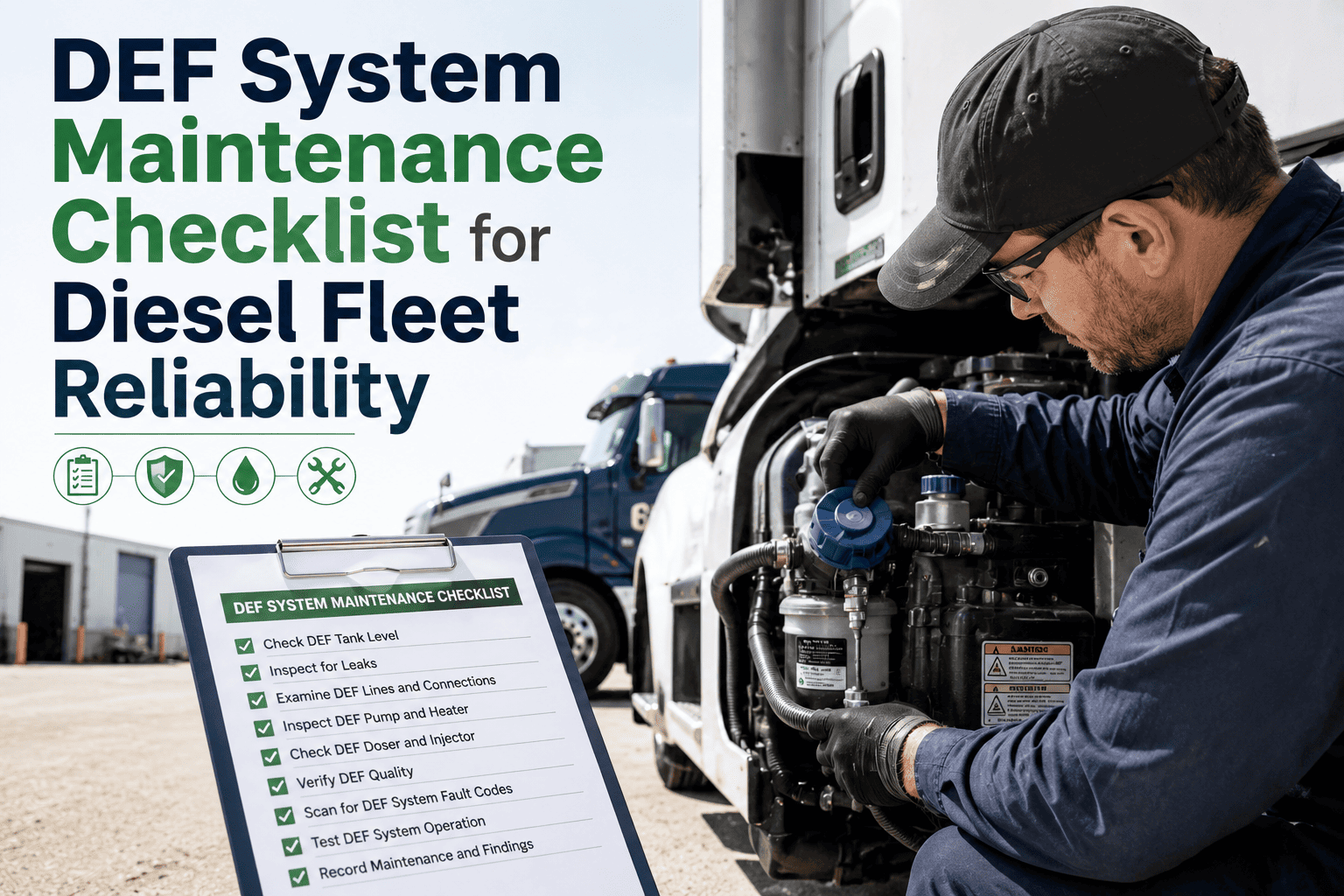
DEF System Maintenance Checklist (50-Point)
This checklist is structured for scheduled PM use. Complete it at every major PM interval, with targeted sub-checks at oil-change intervals. Log all findings in your CMMS to build a DEF system fault history that supports predictive maintenance decisions.
1. DEF Concentration Check
Test DEF concentration with a refractometer. Proper DEF is 32.5% urea concentration. Diluted DEF (below 30%) causes SCR underperformance and NOx spikes. Over-concentrated DEF (above 36%) damages the SCR catalyst. Never refill DEF tanks with untested bulk fluid.
2. DEF Contamination Inspection
Visually inspect DEF in tank filler neck for discoloration, oily film, or particulates. Contaminated DEF — often from diesel fuel cross-fill or improper storage — causes immediate catalyst damage. If contamination is found, drain and flush the entire DEF circuit before refilling.
3. DEF Level Sensor Accuracy Verification
Confirm that the dash-displayed DEF level matches actual tank level measured manually. Faulty level sensors cause drivers to ignore genuine low-DEF warnings, resulting in derate events from empty tanks on active routes.
4. DEF Tank Cap and Seal Inspection
Inspect the DEF filler cap for cracks and verify the seal is intact. A damaged cap allows moisture ingress and contamination — DEF is hygroscopic and degrades quickly when exposed to environmental moisture through a compromised seal.
5. Tank Heater Element Function Test
In climates where ambient temperatures fall below 12°F (-11°C), DEF freezes. Verify tank heater element resistance and function. A failed tank heater in winter causes DEF to freeze, preventing system operation and triggering derate within minutes of cold startup.
6. DEF Storage Condition Audit
Inspect your depot DEF storage for UV exposure, temperature extremes, and container age. DEF degrades at temperatures above 86°F and has a shelf life of approximately 12 months. Bulk DEF stored improperly degrades before reaching the vehicle — causing fleet-wide concentration problems.
7. DEF Pump Operation and Flow Rate Test
Command a DEF pump activation via diagnostic tool and verify flow rate meets OEM specification. Low flow rates indicate pump wear, filter restriction, or suction line blockage. Pump failure is the most common DEF system component failure in high-mileage diesel fleets.
8. DEF Pump Filter Inspection and Replacement
Inspect the DEF pump inlet filter for crystalline DEF buildup. Replace filter at intervals specified by OEM — typically every 100,000 miles or annually. A clogged filter starves the dosing system, causing NOx exceedances and system fault codes before any visible symptom appears.
9. DEF Pump Pressure Check
Verify DEF system operating pressure using a diagnostic tool. Correct pressure range varies by OEM (typically 100–130 psi). Low pressure indicates pump wear or a downstream restriction. High pressure suggests a dosing injector blockage — both require immediate investigation.
10. Dosing Injector Spray Pattern Verification
Remove and inspect the DEF dosing injector for coking deposits and verify spray pattern during bench test. An injector spraying DEF in a jet rather than a fine mist causes crystalline deposit buildup in the mixing chamber and eventual SCR catalyst contamination.
11. Return Line and Suction Line Inspection
Inspect DEF pump return lines and suction lines for kinking, cracking, and crystalline blockage at connection points. DEF crystallizes when lines are not properly purged after shutdown — verify that the pump executes a full purge cycle on every key-off event.
12. DEF Pump Heater Function Verification
In cold climates, the DEF pump housing contains integral heaters that must be functional. Test heater operation and verify wiring harness integrity at the pump connector. A frozen pump housing causes no-start DEF delivery conditions identical to tank freeze, but with a completely different repair approach.
13. SCR Catalyst Efficiency Test
Connect a J1939 diagnostic tool and read NOx sensor values upstream and downstream of the SCR catalyst under load. The downstream NOx value should be significantly lower than upstream. Efficiency below OEM threshold triggers a "Low SCR Efficiency" fault and derate cycle within defined operating hours.
14. Mixing Chamber Crystalline Deposit Check
Remove the DEF mixing elbow and inspect for urea crystal buildup. Crystalline deposits form when DEF is injected at insufficient exhaust temperatures or when dosing injector spray patterns are incorrect. Heavy deposits restrict exhaust flow and reduce SCR conversion efficiency to failure levels.
15. DPF and SCR Differential Pressure Monitoring
Log DPF and SCR differential pressure readings from the ECM. Rising backpressure across the SCR catalyst indicates ash accumulation or catalyst substrate damage requiring cleaning or replacement. Track this KPI monthly to identify degradation trends before a fault code appears.
16. Exhaust Temperature Sensor Validation
Verify exhaust temperature sensor accuracy at pre-DPF, pre-SCR, and post-SCR positions. Faulty temperature sensors cause incorrect dosing commands — either over-injecting DEF (causing catalyst poisoning) or under-injecting (causing NOx failures and derate). Cross-check sensor values against pyrometer readings during diagnosis.
17. NOx Sensor Calibration Check
NOx sensors drift over time, particularly on vehicles with high idle hours or DPF regen events. Pull NOx sensor data during a diagnostic session and verify readings against known baseline values. A drifted NOx sensor causes the ECM to request incorrect DEF dosing rates — a root cause of premature SCR catalyst failure.
18. Exhaust Back-Pressure Check
Measure exhaust backpressure upstream of the DPF/SCR assembly under load. Elevated backpressure degrades turbocharger performance and indicates a restricted aftertreatment system. Backpressure-driven turbo damage is a $3,000–$5,000 repair that originates in a neglected aftertreatment system.
19. Full J1939/OBD-II DEF Fault Code Scan
Pull all active, pending, and historical fault codes related to the DEF and SCR system. Document code history in your CMMS. Recurring codes that were previously cleared — particularly SCR efficiency codes — indicate a systemic failure pattern, not a one-time event. Treat cleared codes as if they were still active during fleet acquisition due diligence.
20. Derate Event History Review
Query ECM memory for derate event records, including timestamps, fault codes at derate, and recovery actions. A vehicle with multiple derate events in its history has a chronic DEF system problem — not a resolved one. Derate history should be documented in every CMMS asset record and referenced during PM planning.
21. DEF Quality Sensor Accuracy Test
Some OEM systems include an inline DEF quality sensor that detects concentration and contamination. Test sensor accuracy using a reference DEF sample of known concentration. A faulty quality sensor can block the entire DEF circuit — causing a derate event on a vehicle with perfectly good fluid.
22. Aftertreatment Wiring Harness Inspection
Inspect the wiring harness serving NOx sensors, DEF pump, dosing injector, and temperature sensors for chafing, heat damage, and connector corrosion. Aftertreatment wiring harness damage is a leading cause of intermittent DEF system faults that resist diagnosis — particularly in vehicles operating in high-vibration duty cycles.
DEF Fault Derate Sequence — What Fleet Managers Must Know
The DEF derate sequence is designed to force compliance with emissions regulations, not to protect the engine. Understanding the sequence lets fleet managers intervene before a vehicle becomes inoperable on-route.
Stage 1
Warning Only
DEF level low or system fault detected. Dash warning illuminated. No power reduction yet. Approximately 2,500 miles or 50 engine hours before derate begins — time to resolve the issue with scheduled service.
→
Stage 2
Speed Derate
Engine derated to maximum 5 mph in some OEM implementations once DEF is completely empty or fault persists. Severe performance limitation — vehicle cannot complete route. Requires immediate DEF fill or repair.
→
Stage 3
No-Start Derate
Following derate event, some OEM systems require a technician unlock via diagnostic tool before the engine will restart. Vehicle is fully immobilized until a qualified shop can perform the unlock — a tow and emergency repair event.
Prevent DEF Derates With OxMaint's Predictive Maintenance Workflow
Track DEF fault code history, schedule dosing injector and pump service by mileage, and get automated alerts before derate sequences begin. OxMaint integrates with your telematics system to make DEF health a proactive KPI, not a reactive emergency.
DEF System PM Schedule by Mileage
Integrate these service intervals into your CMMS PM triggers. OxMaint supports mileage, engine hour, and calendar-based dual triggers — ensuring DEF PMs fire correctly for both high-mileage highway fleets and lower-mileage high-idle urban units.
| Interval |
Component |
Action |
Failure Risk if Skipped |
| Every PM (15k mi) | DEF level and concentration | Check and fill | Derate from low/bad DEF |
| Every PM (15k mi) | DEF fault codes | Scan and document | Missed early fault indicators |
| Annual or 50k mi | DEF pump filter | Replace | Flow restriction, pump failure |
| Annual or 50k mi | DEF lines and heaters | Inspect and pressure test | Freeze failure in winter |
| 100k mi | DEF dosing injector | Clean or replace | SCR catalyst contamination |
| 100k mi | NOx sensors | Test calibration | Incorrect dosing, catalyst damage |
| 150k–200k mi | SCR catalyst | Efficiency test | Emissions non-compliance, derate |
| Pre-winter | All heated components | Full heater function test | System freeze, derate on cold start |
Frequently Asked Questions
What causes the most DEF system failures in commercial diesel fleets?
DEF pump clogging from crystallized urea is the most common failure mode, followed by contaminated DEF from improper storage or cross-fill with diesel. Both are entirely preventable with a structured inspection checklist and verified DEF procurement protocol.
Track DEF fault history in OxMaint.
How long does a DEF system fault take to cause a derate event?
Most OEM derate sequences begin after 2,500–3,000 miles or 50 engine hours of a DEF fault condition — giving fleet teams a window to intervene. However, certain faults (complete DEF tank empty, active NOx sensor failure) can trigger immediate or next-start derates, bypassing the warning period entirely.
Book a demo to learn how OxMaint alerts before derate begins.
Can I use any DEF fluid in my commercial diesel trucks?
No. DEF must meet ISO 22241 specification — 32.5% urea concentration, pharmaceutical-grade urea, and deionized water. Off-spec DEF, diluted fluid, or contaminated fluid causes SCR catalyst damage that costs $1,500–$4,000 to repair. Only use API-certified DEF from verified suppliers and test bulk storage regularly with a refractometer.
How does OxMaint help manage DEF system maintenance across a fleet?
OxMaint stores DEF fault code history per asset, triggers PM work orders at mileage and engine-hour intervals specific to each vehicle's duty cycle, and integrates with telematics to flag DEF-related events. This creates a complete DEF maintenance audit trail and prevents the reactive "derate and tow" cycle that costs fleets far more than scheduled service.
Sign up free to build your DEF PM workflow.
Does OxMaint support different DEF PM schedules for different truck makes?
Yes. OxMaint's PM templates are fully customizable per asset type, make, and model. A Cummins ISX15 fleet can have different DEF PM intervals than a DD15 fleet, with the correct thresholds applied automatically. This is critical for mixed-fleet operators where a single universal PM schedule leads to both over-maintenance and under-maintenance within the same garage.
Book a demo to see multi-platform PM configuration.
Build Your DEF Maintenance Program in OxMaint
Create complete DEF system PM workflows, track fault code history per asset, set mileage and engine-hour triggers, and generate compliance reports — all from one CMMS built for diesel fleet reliability.