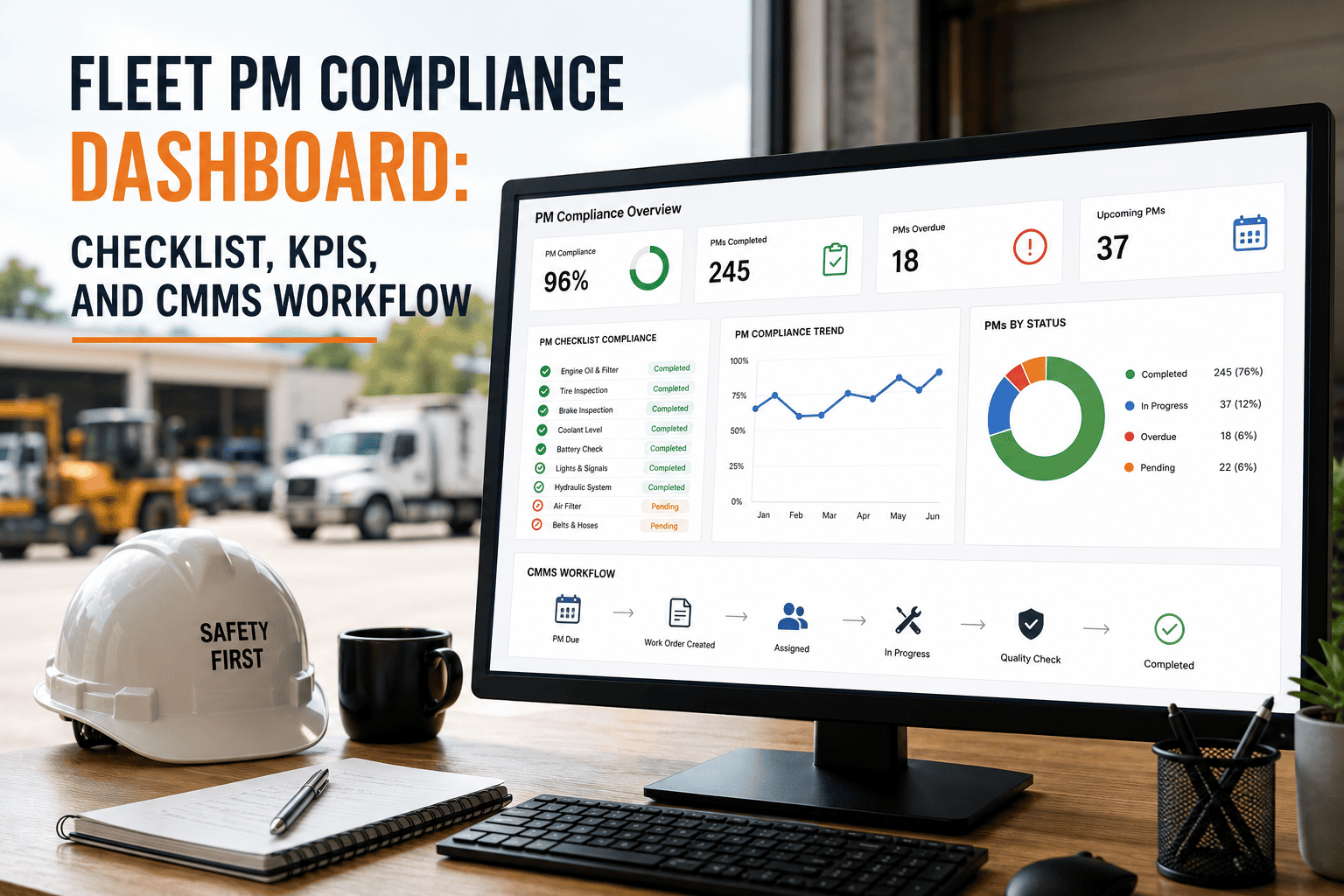
A dozer that skips its 250-hour undercarriage inspection because the operator was reassigned to a different job site does not fail on the day the inspection was missed — it fails three weeks later, mid-grade, when a track pin nobody checked finally lets go. Construction fleet maintenance is harder than over-the-road trucking because the assets move between job sites instead of returning to a yard, run on hour meters instead of odometers, and sit idle through weather delays that quietly push every PM interval off schedule. This checklist gives fleet managers, site superintendents, and maintenance leads a structured way to keep excavators, loaders, dozers, and haul trucks running to their duty cycle instead of to whatever attention a busy site happens to have left over, with every inspection and work order tracked inside OxMaint's CMMS so equipment history follows the machine, not the job site.
Construction Fleet Maintenance Checklist: Field-Ready KPIs and CMMS Workflow
A by-equipment-type maintenance framework for excavators, loaders, dozers, cranes, and haul trucks, built around hour-meter intervals and multi-site tracking instead of a single-yard inspection routine.
Excavators and Track Loaders: Hour-Based Inspection Points
Undercarriage components on tracked machines wear at a rate tied directly to hours in operation and ground conditions, which means a fixed calendar interval will always be wrong for at least part of the fleet. These checks are triggered by the hour meter, not the calendar, so a machine working double shifts on rocky terrain gets inspected sooner than one running light duty.
Haul Trucks and Dozers: Drivetrain and Braking Systems
A haul truck moving material on a grade puts continuous load on its braking and drivetrain systems in a way a highway tractor never does, so these checks weight braking and cooling components more heavily than a standard on-road inspection would.
Job sites change weekly and equipment moves between them faster than paper logs can keep up. OxMaint attaches hour-meter data, inspection history, and open work orders to each machine so the record travels with the equipment across every site, crew, and shift.
Telematics Triggers That Predict a Failure Before the Next Scheduled PM
Fixed-interval PM catches problems that develop slowly and predictably. It does not catch a hydraulic pump starting to overheat on a Tuesday when the next scheduled inspection is three weeks away. AI-driven predictive maintenance closes that gap by watching sensor trends between services and generating a work order the moment a reading moves outside its normal range.
Metrics That Show a Construction Fleet Is Under Control
| Metric | How to Measure | Target |
|---|---|---|
| PM Compliance Rate | PMs completed within hour window / PMs due | 95%+ |
| Mean Time to Repair | Total repair hours / Number of repairs | <8 hours |
| Unplanned Downtime | Unplanned downtime hours / Total scheduled hours | <5% |
| Fleet Utilisation | Hours operated / Hours available | 75%+ |
Frequently Asked Questions
How is construction fleet maintenance different from over-the-road trucking?
Construction equipment is scheduled by hour meter rather than mileage, moves between job sites instead of returning to one yard, and sits idle for weather or permit delays that push calendar-based PM off track. See how OxMaint tracks hour-based PM across multiple sites in one dashboard.
What is the most common cause of undercarriage failure on tracked machines?
Delayed or skipped track tension and wear inspections are the leading cause, since wear accelerates once a component passes its threshold and the remaining life drops sharply.
How often should hydraulic fluid be sampled on heavy equipment?
Most manufacturers recommend fluid analysis every 500 hours, with results compared against prior samples to catch a wear trend before a pump or cylinder fails outright.
Can predictive maintenance replace scheduled PM on construction equipment?
No, predictive alerts and scheduled PM work together — sensor trends catch developing problems between services, while scheduled PM still covers wear items that do not trigger a sensor alarm. Book a demo to see both running side by side.
How should a fleet manager track equipment that moves between job sites?
Maintenance history should be tied to the asset's ID rather than a site location, so hour meters, inspection records, and open work orders follow the machine automatically when it is relocated.
Every Machine Tracked by Hours, Not by Guesswork
OxMaint gives your maintenance team hour-based PM schedules, predictive alerts, and mobile work orders that follow each machine across every job site, so nothing gets missed between crews.