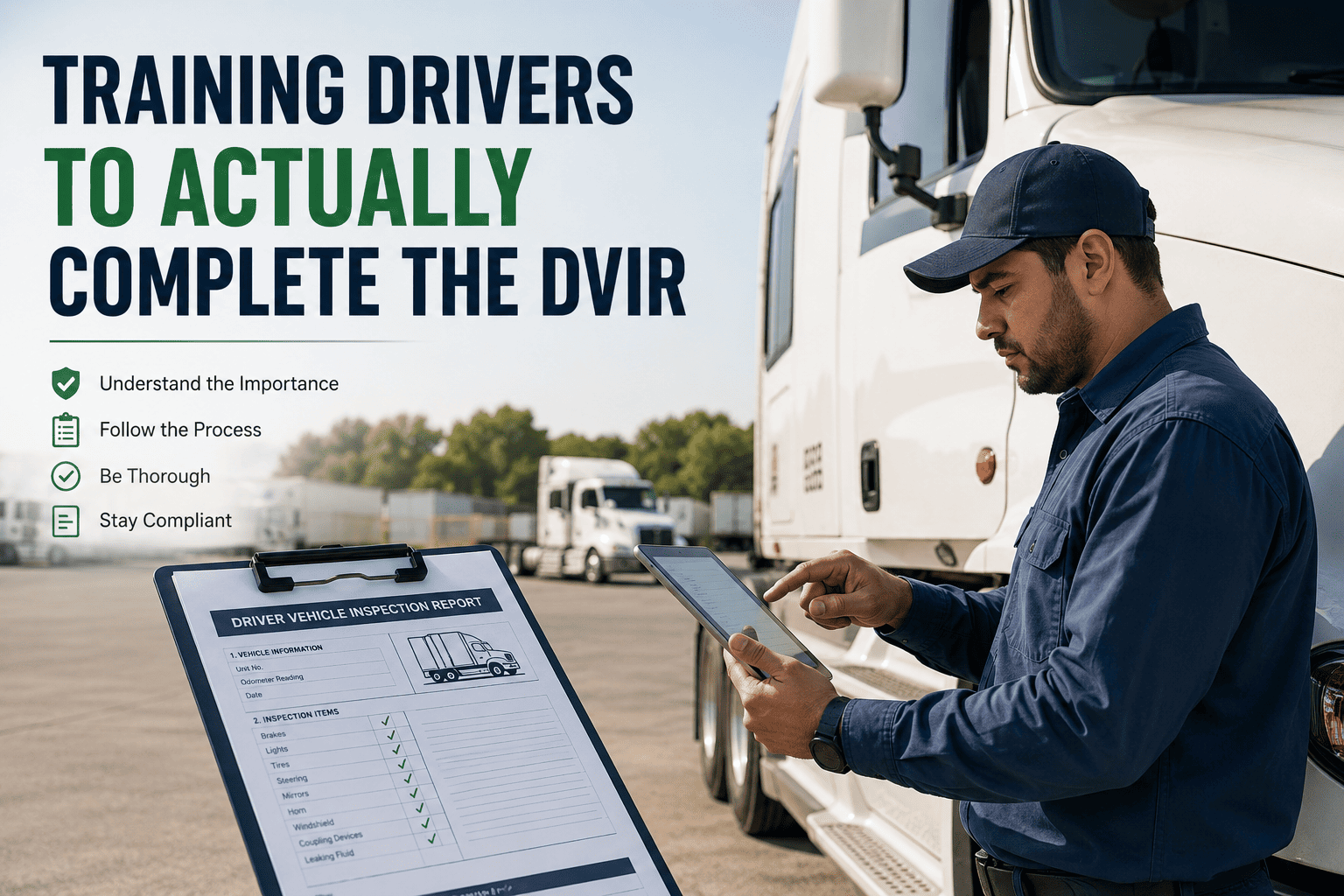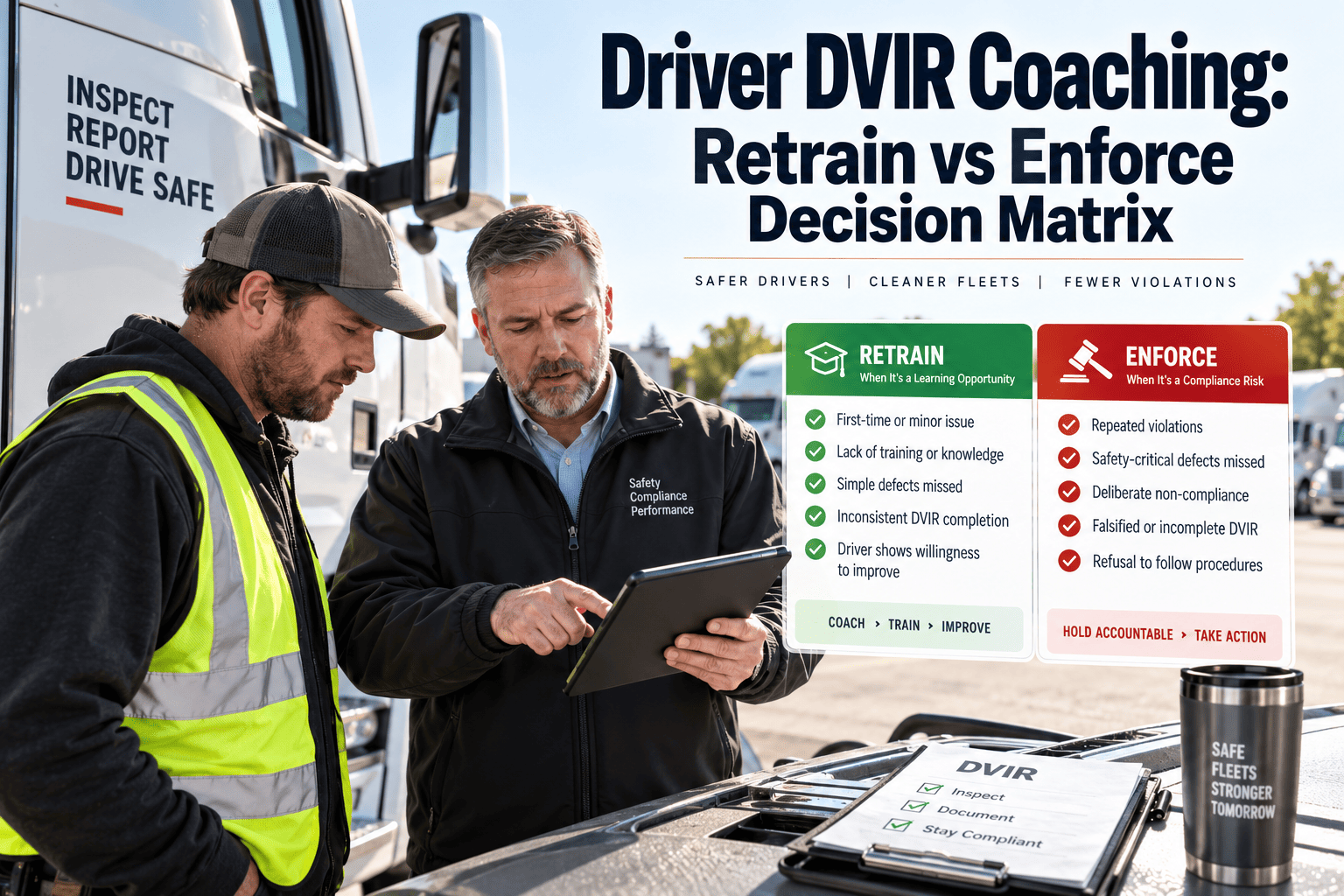
A driver misses a pre-trip inspection item for the third time this month, and the safety manager has two options sitting on the desk: pull them in for retraining, or move straight to a documented corrective action. Most fleets pick whichever one the manager feels like that day, and that inconsistency is exactly what shows up in a DOT compliance review. The Driver Vehicle Inspection Report exists to catch mechanical defects before they become roadside violations, but the coaching response to a DVIR failure needs its own structure just as much as the inspection itself — otherwise two drivers with identical violation histories end up treated completely differently, and neither the safety record nor the driver relationship benefits from that.
Not every DVIR failure needs retraining. Some need enforcement instead.
A decision matrix that tells safety managers when to coach and when to escalate — built on violation type, frequency, and severity, not gut feel.
What a DVIR failure actually means under FMCSA rules
The Driver Vehicle Inspection Report is codified under 49 CFR §396.11 and §396.13. Drivers of commercial motor vehicles must conduct pre-trip and post-trip inspections and document any defect that could affect safe operation — brakes, steering, lighting, tires, coupling devices, and a defined list of other systems. Since the 2014 and 2024 rule updates, interstate drivers of non-passenger CMVs no longer have to file a report when no defect is found, since roughly 95% of DVIRs historically came back clean. That change removed paperwork volume, but it also means every DVIR that does get filed with a defect, or that a driver skips filing entirely, is now a more meaningful signal — not noise to be processed the same way every time.
Why "just talk to them" isn't a policy
Ask five safety managers what they do when a driver has a third DVIR issue in a month, and you'll typically get five different answers. That inconsistency creates two distinct risks.
Over-coaching
Drivers with genuinely minor, one-off issues get pulled into retraining sessions that feel punitive, eroding trust in the inspection process and making drivers less likely to report defects honestly next time.
Under-enforcing
Drivers with a genuine pattern — falsified reports, repeated critical-system defects, skipped inspections — keep getting an informal conversation instead of documented corrective action, until a roadside inspector finds the same defect the driver never logged.
Retrain vs enforce: how to route every DVIR event
Two variables decide the response: what kind of failure occurred, and how often it has happened for that driver in a rolling 90-day window.
| Violation Type | First Occurrence | Second Occurrence (90 days) | Third+ Occurrence |
|---|---|---|---|
| Missed minor item (mirror, wiper) | Verbal reminder, log only | Short coaching session | Formal retraining |
| Incomplete inspection (item skipped) | Coaching session | Formal retraining | Written corrective action |
| Critical-system defect not reported | Formal retraining | Written corrective action | Suspension review |
| Falsified DVIR (marked pass, unchecked) | Written corrective action | Suspension review | Termination review |
| Driving with known uncertified defect | Immediate enforcement, no coaching step | Suspension review | Termination review |
What changes when the matrix replaces judgment calls
- Response depends on which manager is on shift
- No written record tying violation history to action taken
- Repeat offenders get repeat conversations, no escalation
- Drivers can't predict consequences, so behavior doesn't change
- Same violation type and frequency triggers the same response every time
- Every coaching or enforcement action logs against the driver's compliance record
- Escalation happens automatically at the third occurrence threshold
- Drivers know exactly what happens next, which drives self-correction and reduces repeat violations over time
Attach the decision matrix to every DVIR your drivers file
See how violation history, frequency, and coaching triggers connect automatically to each driver record.
Rolling the matrix out without it feeling like a crackdown
Publish the matrix before enforcing it
Share the exact violation-type and frequency table with every driver in advance, so the first time anyone sees it isn't during their own corrective-action meeting.
Tie every DVIR event to a driver profile
Each logged defect, skipped inspection, or falsified report needs to accumulate against a single driver history, not a per-vehicle log that loses the pattern when drivers rotate trucks.
Automate the 90-day rolling window
Manually tracking occurrence counts across dozens of drivers is where matrices break down in practice. A rolling count that resets on its own keeps the escalation fair and current.
Document every coaching and enforcement step
A written record of the coaching conversation, not just the violation, is what protects the fleet during a compliance review or a wrongful-termination dispute, and it's also what lets a new safety manager pick up a driver's history without starting from zero.
What inconsistent coaching costs beyond the safety risk
DVIR-related penalties escalate quickly once a pattern of non-compliance is established, and fines are only part of the exposure.
A consistent coaching matrix directly reduces exposure here: repeat offenders get escalated before a roadside inspector finds the defect first, and documented corrective action gives the fleet a defensible record during a compliance audit.
What a defensible coaching record actually needs to contain
A coaching conversation that lives only in a manager's memory doesn't hold up during a compliance review, a CSA score dispute, or a wrongful-termination claim. Four elements separate a defensible record from a vague one.
The specific violation, not a summary
"Missed brake inspection item on Truck 214, pre-trip, March 12" holds up. "Talked to driver about being more careful" does not.
The matrix tier applied and why
Record which occurrence count triggered the response, so a later reviewer can confirm the matrix was followed consistently rather than improvised.
Driver acknowledgment
A signature or digital confirmation that the driver understood the corrective action and the consequence of a repeat occurrence.
How DVIR patterns connect to your safety rating
FMCSA's Compliance, Safety, Accountability program weighs vehicle maintenance violations found during roadside inspections directly against a carrier's public safety score. Vehicle maintenance-related violations consistently rank among the leading causes of out-of-service orders, and brake and tire defects contribute to a meaningful share of large-truck crashes. A pattern of skipped or falsified DVIRs doesn't just risk a fine at the moment it's caught — it raises the odds that a defect an inspection should have caught instead surfaces at a roadside stop, where it counts against the carrier's CSA score for two years. Consistent coaching that catches the pattern internally, before a roadside inspector does, is one of the few controllable levers a fleet has over that score.
Where matrix-based coaching programs go wrong in year one
Treating the matrix as a punishment ladder instead of explaining it as a fairness tool that applies equally to every driver.
Letting the occurrence window reset manually instead of automatically, which lets managers quietly extend leniency to favored drivers.
Skipping the coaching step for minor violations entirely, which removes the early-warning signal the matrix is designed to catch.
Failing to separate mechanical root causes from driver behavior, so a driver gets coached for reporting a defect that was actually a genuine maintenance failure.
Turning the matrix into an automatic workflow
A decision matrix on paper only works if it's applied the same way every single time a DVIR comes in, across every shift and every safety manager. Oxmaint's mobile inspection workflows capture every DVIR digitally, attach each defect or skipped item to the driver's compliance record, and track occurrence counts on a rolling window automatically. Work orders generated from reported defects link back to the original inspection, corrective-action documentation stores against the driver profile, and dashboards surface which drivers are approaching an escalation threshold before the third occurrence happens — not after.
Applying the matrix differently across small and large rosters
A five-driver owner-operator fleet and a 400-driver regional carrier both need the same underlying matrix, but the mechanics of applying it fairly change with scale. Small fleets often struggle with consistency because the same manager who does dispatch, safety, and HR is also the one deciding whether a violation is a "first" or "second" occurrence from memory — a written matrix removes the guesswork even without dedicated software. Large fleets face the opposite problem: multiple terminals and multiple safety managers applying the same rules differently across locations, which is exactly the inconsistency that shows up as a pattern during a multi-terminal DOT compliance review, since auditors increasingly compare enforcement records across a carrier's full operation rather than reviewing one terminal in isolation. In both cases, the fix is the same — a single documented matrix, applied through whatever system tracks driver records, rather than left to memory or local terminal culture.
What safety managers need before rolling the matrix out
A shared understanding of which violations count as "critical-system" versus "minor," since that classification drives the entire matrix.
Practice scripts for the coaching conversation itself, so the tone stays constructive even at the escalation tiers.
Clear escalation authority — who signs off on a suspension review versus who can close it out at the coaching level.
A shared view of each driver's occurrence history so managers across shifts or terminals see the same record.
DVIR coaching — common questions
Do we still need DVIRs if no defect is found?
For most interstate non-passenger CMV drivers, no — the 2014 and 2024 rule updates removed the requirement to file a report when no defect exists. Coaching matrices should focus on the reports that do get filed.
What counts as a falsified DVIR?
Marking an inspection item as passed without actually inspecting it, or omitting a known defect from the report, both count and typically carry the steepest fine tier of any DVIR violation.
Should the matrix apply the same way to owner-operators and company drivers?
The violation-type and frequency logic applies equally, though enforcement steps like suspension review may follow different contractual paths depending on employment classification.
How long should the occurrence window be?
A 90-day rolling window is common practice — long enough to catch a genuine pattern, short enough that an old, corrected issue doesn't unfairly escalate a driver's current standing.
Can this matrix be enforced without new software?
It can, on a spreadsheet, but tracking rolling occurrence counts manually across a large driver roster is where most fleets lose consistency. Get Started to see it applied automatically.
When the matrix needs a human override
No matrix covers every scenario perfectly, and building in a deliberate, documented override path is better than letting managers quietly ignore the matrix when it doesn't fit. A driver who reports a genuine defect promptly but happened to miss an unrelated minor item on the same inspection shouldn't be coached the same way as one who skipped the inspection entirely — the matrix should distinguish partial compliance from non-compliance, and the exception log itself becomes useful evidence that the fleet's coaching program is applied thoughtfully rather than mechanically. Similarly, a driver whose "critical-system defect not reported" violation turns out to be a defect that only became detectable after the inspection, confirmed by a technician's timestamp, deserves an override path that gets documented and reviewed, not silently waived, since silently waiving it removes the record a future audit would need to see. The override itself should require sign-off above the immediate manager, so the exception process doesn't become the same inconsistency the matrix was built to eliminate, and every override should still generate a written record explaining why the standard tier didn't apply.
Why drivers generally accept the matrix once it's explained
The most common objection to a formal coaching matrix isn't that it's too strict — it's that drivers assume it will be applied unevenly, the same way informal coaching often was. Once drivers see that a colleague with an identical violation history received the identical response, resistance tends to fade quickly, because the matrix reads as fairness rather than surveillance. Fleets that roll it out alongside a plain explanation of the underlying FMCSA stakes — not just "corporate policy," but the actual fine ranges and out-of-service risk a missed inspection creates — generally see faster buy-in than fleets that present it as a new rule with no context, because drivers respond better to a policy they understand the reasoning behind than one that simply appears on a bulletin board.
Give every safety manager the same coaching playbook
Stop deciding retrain-or-enforce case by case. Apply one matrix, automatically, across every driver and every DVIR.
Free trial · No credit card