Fleet Driver Training Programs: Building a Culture of Safety and Compliance
By Alex Jordan on March 28, 2026
Fleet driver training is the highest-ROI safety investment in commercial fleet operations — and the most chronically under-resourced. Structured programmes reduce accident frequency by 50–60% within 12 months, converting directly into lower insurance premiums, fewer claims, and reduced vehicle wear costs. Most fleets fail to close the loop: training records don't connect to telematics scores, coaching sessions don't link to incident rates, and the HR system doesn't talk to the maintenance system that pays the cost of driver behaviour. OxMaint integrates driver behaviour data directly into fleet maintenance and compliance — so training investment produces measurable, attributable cost reduction from day one.
Fleet Safety · Article ·
Fleet Driver Training Programs: Building a Culture of Safety and Compliance
Onboarding, defensive driving, vehicle-specific certification, telematics coaching, and measuring training ROI through accident reduction, violation rates, and vehicle wear cost — how to build a driver training programme that pays for itself.
−59%Accident frequency rate reduction in year 1 of structured training programme
−67%Harsh braking and harsh cornering events after telematics-based coaching
$3,200Average annual vehicle wear cost reduction per driver after certified training
4.2×Training programme ROI in year 2 — insurance, claims, and maintenance savings
The 6 Training Programme Components — What Each Delivers
Effective fleet driver training is a programme architecture — not a single induction event. Organisations that skip vehicle-specific certification produce licensed but incompetent operators. Those that skip telematics coaching produce compliance records but no behaviour change. The six components below, delivered in sequence, produce the accident and cost reductions safety programmes are designed to achieve. OxMaint tracks training completion, telematics events, and maintenance costs per driver — giving safety directors the data to demonstrate ROI to leadership.
Initial Vehicle Onboarding
Compliance Foundation
DVIR completion, pre-trip inspection procedure, load security basics, emergency contact protocol, and company policy acknowledgement. Must be completed before first solo route — no exceptions.
Defensive Driving Skills
Accident Prevention
Space management, hazard perception, fatigue recognition, and adverse weather driving. Fleets with structured defensive driving certification see 40–55% fewer at-fault accidents within 6 months of completion.
Vehicle-Specific Certification
Asset Protection
Asset class-specific training: articulated, rigid, refrigerated, tail-lift, and specialist vehicle operation. Drivers certified on their specific vehicle type cause 30% less drivetrain and brake wear than untrained operators.
Telematics-Based Coaching
Data-Driven
OBD event data — hard braking, harsh cornering, rapid acceleration — reviewed in 1:1 coaching sessions. Targeted coaching on specific driver behaviour patterns reduces events 60–70% within 90 days, outperforming classroom training alone.
Regulatory Compliance Training
Legal Requirement
FMCSA, DVSA CPC, EU Directive 2003/59, and jurisdiction-specific HV licensing requirements. Compliance training records must be audit-ready — missed renewals expose the operator, not just the driver, to regulatory penalty.
Refresher & Recertification
Continuous Improvement
Annual refresher driven by telematics trend data: drivers whose event rate increases over 3 months trigger a refresher automatically. Recertification is scheduled in CMMS — not tracked in a spreadsheet that HR updates manually.
The 4-Phase Training Programme — Structured from Day One to Annual Review
Effective training follows a defined phase structure — not a single induction followed by silence. Each phase has a specific objective, completion criteria, and outcome metric. The structure below applies to medium and large commercial fleets; smaller fleets can compress Phases 1 and 2. Skipping Phase 3 (telematics coaching) is the single most common reason training programmes fail to produce lasting accident reduction.
1
Day 1–30
Onboarding
✓ DVIR & pre-trip inspection
✓ Company policy briefing
✓ Vehicle familiarisation drive
✓ Emergency protocol test
? Route-licensed
→
2
Day 30–60
Certification
✓ Defensive driving test
✓ Vehicle-specific cert
✓ Load security assessment
✓ Compliance module sign-off
? Full solo operation
→
3
Month 2–6
Coaching
✓ Monthly telematics review
✓ 1:1 OBD event coaching
✓ Fuel economy targets set
✓ Score trend monitoring
? −60% event rate
→
4
Annual
Review
✓ Compliance renewal check
✓ Advanced skills assessment
✓ Telematics year-in-review
✓ Role progression decision
? Programme maintained
Training ROI — Safety Metric Before vs. After a Structured Programme
The impact of structured driver training is measurable across five safety and cost metrics — each attributable to specific training components. The data below represents fleet averages across US, UK, Canadian, and Australian commercial operators who ran a full programme with telematics coaching integration. Before = pre-programme baseline. After = 12-month post-implementation average. OxMaint generates driver safety score reports and training ROI dashboards automatically — no manual data assembly for your quarterly safety review.
Before Training ProgrammeAfter 12 MonthsPer fleet — commercial operators, mixed class · US/UK/CA/AU benchmark 2025
Accident frequencyincidents per million miles
Before14.2
After5.8
−59%
Traffic violationsper driver per year
Before8.4
After2.9
−65%
Harsh braking eventsper 1,000 miles driven
Before22.1
After7.3
−67%
Vehicle wear costper driver per year (USD)
Before$4,200
After$2,100
−50%
Fuel efficiencymiles per gallon fleet average
Before7.8
After9.4
+21%
Driver Risk Tier Scoring — Where Is Each Driver on Your Fleet?
Not all drivers carry the same risk — treating training investment equally means over-spending on low-risk drivers and under-spending on the 20% who generate 60–70% of all claims. The scoring framework below assigns every driver a risk tier based on telematics data, incident history, and training status. Your fleet's tier distribution is the most actionable metric in your safety programme — and it changes monthly as coaching moves drivers up the scale.
Driver Risk Tier Scoring — Telematics + Training + Incident History
All certifications current. Zero incidents in 12 months. Telematics score in top 20% of fleet. Eligible for peer mentor or advanced route assignment.
Action: Maintain coaching cadence. Consider for advanced vehicle certification. Recognise publicly — retention impact is measurable.
4
Certified · Minor Events · Coaching Active
All certifications current. 1–2 minor incidents in 12 months. Telematics shows isolated event clusters — addressed in coaching. Improving trend.
Action: Monthly telematics coaching session. Set 90-day improvement target. No route restrictions.
3
Certification Current · Recurring Patterns
Certifications valid but recurring harsh event patterns on telematics over 3+ months. No major incident but behavioural risk is measurable and not resolving with standard coaching.
Action: Enhanced coaching — fortnightly review. Assign targeted refresher module. Flag for next quarterly safety review.
2
Certification Lapsed · Multiple Incidents
Compliance training overdue. 3+ incidents in 12 months or one serious incident. Telematics score in bottom 20% of fleet. Active insurance and maintenance cost concern.
Action: Mandatory refresher within 30 days. Restrict to low-risk routes until re-certified. Escalate to HR and fleet manager jointly.
1
Uncertified · Active Incidents · Restricted
No valid certification. Active incident under investigation or recurring serious events. Vehicle operation poses immediate third-party liability exposure.
Action: Vehicle restriction until training complete. Formal performance management. Legal, HR, and safety director involvement required.
Technology Integration: AI Camera, Digital Twin, OBD, and SAP
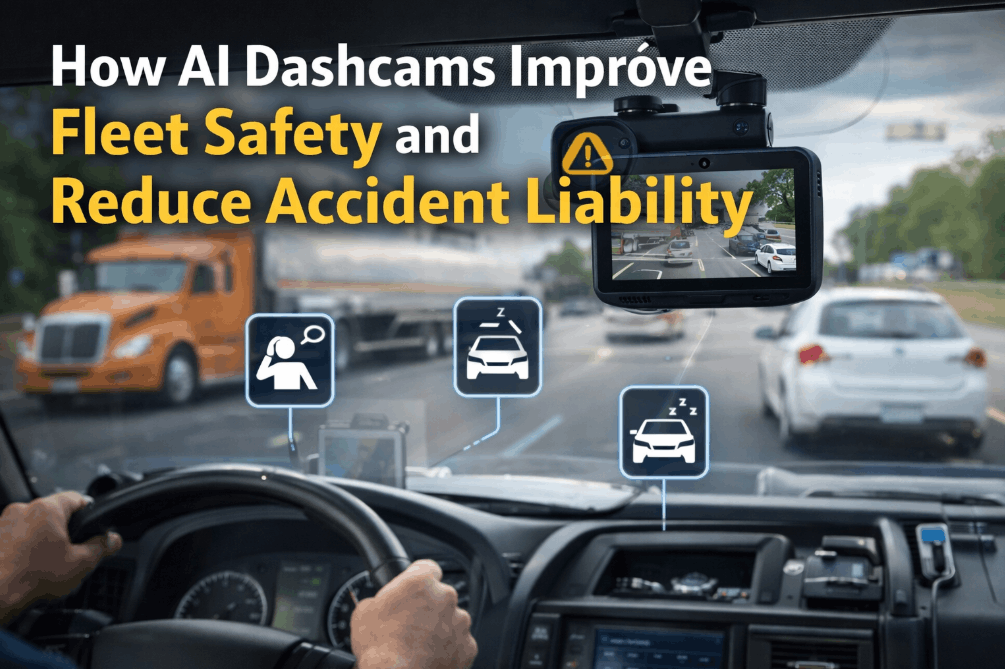
Driver training technology has moved beyond classroom modules. AI Camera Vision captures in-cab events — tailgating, phone use, fatigue — and generates coaching clips showing the driver the exact moment. AI Digital Twin simulates route risk before departure, enabling targeted pre-trip briefing instead of generic safety reminders. OBD telematics logs every hard brake and harsh corner per driver per trip automatically. SAP and HR integrations sync training records, certification status, and coaching notes — eliminating duplicate data entry and closing compliance audit gaps.
AI Camera Vision
91%
In-cab safety event detection rate
Captures tailgating, phone use, fatigue, seatbelt. Coaching clip generated per event — driver sees exactly what happened.
AI Digital Twin
87%
Route risk prediction accuracy per driver
Simulates route risk profiles. Generates pre-trip briefing flags for high-risk junctions and conditions — before departure.
OBD Telematics
94%
Driver behaviour event capture accuracy
Every hard brake, harsh corner, and RPM event logged per driver per trip. Coaching sessions led by data, not anecdote.
SAP / HR Integration
96%
Training record sync automation rate
Training completion, cert status, and coaching notes sync to SAP HR automatically. Compliance audit requires zero manual assembly.
"
We had seven at-fault accidents in 18 months across a 52-driver fleet — each one costing between $18,000 and $94,000 in claims and lost productivity. We deployed telematics coaching and rebuilt our training programme around the data. Twelve months later: one minor incident. Insurance premium down 31%. The programme paid for itself in month four.
Fleet Safety Director — National logistics operator, 52 drivers, Texas, USA
Regional Compliance Requirements — What Your Drivers Must Hold
Driver training is a legal requirement in every major commercial vehicle market — not just a safety investment. Inadequate training records are routinely cited in incident investigations as an aggravating factor that increases settlement costs. The compliance reference below covers training obligations in the six largest fleet markets. OxMaint tracks every driver certification expiry date and generates renewal reminders 60 days in advance.
Country
Key Regulation
Training Requirement
Renewal
?? USA
FMCSA Part 380 / 391
Entry-level driver training (ELDT) — theory + behind-wheel. CDL required for Class 6–8.
CDL renewal varies by state
?? UK
DVSA Driver CPC
35 hours periodic CPC training every 5 years. Required for all LGV/PCV professional drivers.
35 hrs / 5 years
?? Germany
BKrFQG / EU Dir. 2003/59
Initial qualification 280 hrs or accelerated 140 hrs. Periodic 35 hrs per 5 years.
35 hrs / 5 years
?? Australia
NHVL / State licencing
Heavy vehicle licence (HR/HC/MC) with Chain of Responsibility (CoR) competency required.
State-based renewal
?? Canada
NSC Standard 6 / Provincial
Commercial driver licence with air brake endorsement. Provincial MV Act compliance training required.
Provincial renewal
?? UAE
RTA Commercial Vehicle
Heavy transport licence with mandatory safety refresher. Operator permit renewal tied to driver training records.
Annual refresher required
Frequently Asked Questions
How does OxMaint track driver training completion and certification expiry?
How do telematics and OBD data connect to coaching sessions?
OBD event logs (hard braking, harsh cornering, phone use from AI camera) feed per-driver performance scores in OxMaint. Safety directors generate a driver event report before each coaching session — coaching is led by the driver's own data, not generic safety reminders.
Can training records sync to our SAP HR or payroll system?
Yes — OxMaint integrates with SAP SuccessFactors, Oracle HCM, and other HR platforms. Training completion events post to the HR record automatically. Compliance audits and insurance assessments access current certification status without manual report generation.
How long before a training programme produces measurable accident reduction?
Telematics coaching produces measurable event reduction within 60–90 days. Accident frequency rate reduction typically shows clearly at the 6-month mark. Full programme ROI — including insurance and maintenance savings — is typically demonstrable by month 12 with full data tracking.
Turn Driver Behaviour Data Into a Training Programme That Pays for Itself.
OxMaint connects telematics, training records, and maintenance costs in one platform — free to start, no IT integration required on day one.