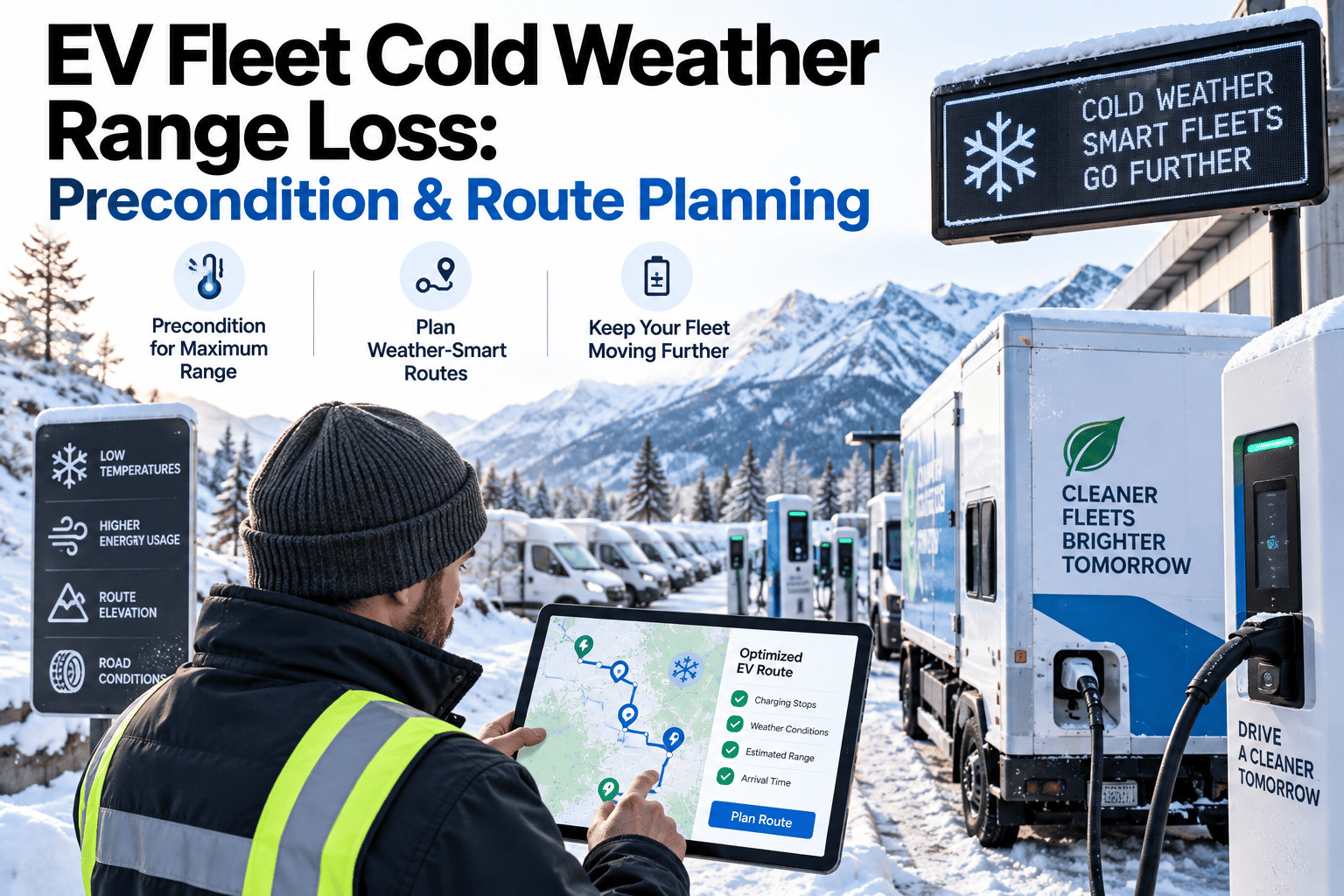
EV Fleet Cold Weather Range Loss: Precondition & Route Planning

By Corin Hale on September 17, 2026

ev-fleet-cold-weather-range-loss-guide

A route planned around a 250-mile summer range can fail on a 20°F morning long before the truck runs out of battery, because the range that matters is not the one on the spec sheet. It is the one the pack actually delivers once the cabin heater, the cold chemistry, and the slower fast-charging speed all take their share first.

EV Fleet Operations · Winter Performance
Cold Weather Doesn't Break EVs. It Breaks Routes Planned Around Summer Range.
The preconditioning habits, cabin heat management, and route planning adjustments that keep winter EV service on schedule instead of stranded.

Why Cold Range Loss Isn't a Defect

Lithium-ion batteries rely on chemical reactions that simply run slower in the cold, which increases internal resistance and reduces how much energy the pack can deliver per charge. On top of that chemistry penalty, an EV has no waste engine heat to warm the cabin the way a diesel does, so every degree of comfort is drawn directly from the same battery that powers the wheels.

Up to 39%
average range loss at roughly 20°F with the cabin heater running
78%
of rated range typically retained at 32°F across a large real-world vehicle sample
20–30%
of lost cold-weather range recovered through battery preconditioning
50–70 kW
typical delivered charging rate on a 150 kW-rated charger when the battery arrives cold

Where the Winter Range Actually Goes

Range loss in cold weather is not one problem — it is three separate mechanisms stacking on top of each other, and each one has a different fix.

01
Battery chemistry slows down. Cold increases internal resistance, so the pack delivers less usable energy even before the cabin heater turns on.
02
Cabin heating draws directly from the battery. Without engine waste heat to rely on, resistive or heat-pump systems pull real energy away from driving range.
03
Charging speed drops. A cold battery cannot safely accept power as fast, so DC fast charging that should take twenty minutes can stretch well past that.

Preconditioning — The Single Highest-Leverage Habit

Preconditioning warms the battery pack to its ideal operating range, typically 60–86°F, while the vehicle is still plugged in and drawing grid power instead of battery power. Done correctly, it is the only mitigation that recovers lost range without costing any range to achieve it.

Preconditioning Before a Cold-Weather Route
01
Stay Plugged In
Leave the vehicle connected to depot power until the scheduled departure time, rather than unplugging early.
02
Warm Pack and Cabin Together
Scheduled or app-triggered preconditioning brings both the battery and the cabin to temperature before departure, drawing from the grid, not the pack.
03
Depart at Operating Temperature
The vehicle leaves the depot with the battery already near its efficient range, instead of spending the first miles of the route warming up.
04
Precondition Again Before Fast Charging
Triggering preconditioning ahead of a mid-route DC fast charge lets the battery accept near its full rated charging speed on arrival.
Preconditioning recovers roughly 20–30% of cold-weather range loss and shaves real minutes off fast-charging stops
OxMaint · EV Winter Readiness
Schedule Preconditioning and Track Winter Range Against Every Route
OxMaint logs vehicle range, charging events, and route assignments in one place, so a dispatcher can see which routes are winter-viable before the truck leaves the yard.

Route Planning: Summer Range Assumptions Don't Survive Winter

Planning Factor
Summer Assumption
Winter Reality
Usable range
Full rated range
As little as 60–78% of rated range
Fast-charge stop duration
Rated 10–80% time
Longer without preconditioning
Buffer before next charge
Minimal margin needed
Larger safety margin required
Regenerative braking
Full effectiveness
Reduced or disabled when battery is cold

A dispatcher planning a 200-mile winter route on a 250-mile-rated vehicle is not planning with a 50-mile buffer — depending on the temperature and cabin heat use, that buffer can shrink close to zero. Routes that comfortably fit an EV in July need a second look before the first cold front of the season.

Four Adjustments That Keep Winter Routes on Schedule

Rebuild Route Buffers Seasonally
Recalculate range assumptions for winter rather than carrying the same margin used in warmer months.
Schedule Preconditioning by Default
Set preconditioning to trigger automatically ahead of every cold-weather departure, not as an optional driver step.
Favor Seat and Steering Wheel Heat
Localized heating elements draw far less power than heating the full cabin air volume.
Time Fast-Charge Stops Around Preconditioning
Trigger battery warming before arrival at a charger rather than after plugging in cold.

The First Cold Snap Is When Most Fleets Find Out

Fleet managers running EVs through their first full winter often describe the same discovery moment: a route that ran comfortably all fall suddenly leaves a vehicle sitting at fifteen percent charge with miles still to go, on a morning that happened to be the first hard freeze of the season. The vehicle did not malfunction. The route was simply planned around range figures that only ever applied in mild weather.

What makes this predictable rather than a surprise is that the range loss pattern repeats every year on a schedule tied to temperature, not to vehicle age or mileage. A fleet that tracks which routes ran tight in the prior winter has a head start on knowing which ones need adjustment before the next cold season arrives, rather than relearning the lesson vehicle by vehicle.

The operational fix is treating winter range as its own planning input rather than a seasonal footnote. A route that is comfortably electric in September may need a mid-route charging stop added in January — not because anything about the truck changed, but because the range available to it did.

Heat Pumps vs Resistive Heating — Why the Vehicle's Hardware Matters

Not every EV loses range to cold at the same rate, and the difference often comes down to how the cabin heating system is built. Older or simpler EVs rely on resistive heating, which works like an electric space heater — effective, but a direct and continuous draw on the battery for as long as the cabin needs warmth.

Newer EVs increasingly use heat pumps, which move heat rather than generate it directly, extracting warmth from the surrounding air similarly to how a home heat pump or refrigerator moves heat rather than creating it from scratch. This approach uses meaningfully less energy per degree of cabin warmth, which is part of why newer EV models are showing smaller winter range losses than earlier generations tested under the same conditions.

Resistive
Direct electric heating element, simple and reliable, but a continuous and comparatively large draw on the battery throughout a cold route
Heat Pump
Moves ambient heat rather than generating it directly, drawing meaningfully less power for the same cabin temperature in most conditions
Seat/Wheel Heat
Localized heating elements warm the driver directly at a fraction of the power cost of heating the full cabin air volume

For a fleet buying new EVs with winter operations in mind, whether a model uses a heat pump is not a minor spec sheet detail — it is one of the more reliable predictors of how much range that vehicle will actually retain on a cold morning route.

Building a Winter Readiness Checklist Into the Fleet's Calendar

Fleets that handle winter well treat it as a seasonal transition with its own checklist, not a single memo sent out when the first freeze warning appears. The most effective version of this checklist runs on a calendar trigger, well before temperatures actually drop.

Audit Routes in Early Fall
Identify which routes ran with tight range margins the prior winter before the same conditions return.
Confirm Preconditioning Defaults
Verify scheduled preconditioning is actually configured on every vehicle, not assumed to already be active.
Brief Drivers on Seat Heat Priority
Reinforce using localized heating before full cabin heat on range-sensitive routes.
Re-Check Range Margins Monthly
Winter severity varies month to month, so a route that was fine in November may need adjustment by January.

What Regenerative Braking Loss Adds to the Problem

Range loss discussions usually focus on the battery and the cabin heater, but regenerative braking is a third factor that quietly compounds both. In cold conditions, a battery near its charge limit or below its ideal temperature range often cannot safely accept the energy regenerative braking would normally recover, so the system reduces or disables it and the vehicle relies more heavily on conventional friction brakes.

The practical effect is a double loss — the vehicle already has less range available from the cold battery and cabin heating draw, and it also recovers less of that range back through braking on stop-heavy urban or delivery routes where regen normally contributes meaningfully. Routes with frequent stops, which are often the routes where regenerative braking matters most, are exactly the ones where cold weather removes the most benefit from it.

Cold Start
Regenerative braking is typically weakest in the first several minutes of a cold-weather trip, before the battery has warmed through normal driving
Warmed Pack
Once the battery reaches a more normal operating temperature, regenerative braking effectiveness typically recovers close to warm-weather levels
Preconditioned Start
A preconditioned battery at departure retains more regenerative braking capacity from the very first stop of the route, rather than losing it during the early cold minutes

This is another reason preconditioning carries more weight than any single mitigation on this list. It does not just recover range lost to chemistry and cabin heat — it also restores regenerative braking sooner in the trip, which matters disproportionately for stop-and-go delivery and service routes where cold weather already hits the hardest.

Frequently Asked Questions

How much range does an EV actually lose in freezing weather?
Real-world data shows an average of around 78% of rated range retained at 32°F, with losses climbing toward 39% or more once temperatures fall near 20°F and the cabin heater runs continuously — the exact figure varies by vehicle and heating system.
Does preconditioning cost any range if the vehicle is still plugged in?
No — preconditioning while connected to depot power draws from the grid, not the battery, so it recovers lost cold-weather range without spending any of the pack's own capacity to do it.
Why does DC fast charging slow down in cold weather?
A cold battery cannot safely accept power as quickly as a warm one, so a charger rated for 150 kW may only deliver 50–70 kW to a cold pack until preconditioning or the charging session itself brings the temperature up.
Can OxMaint help plan winter EV routes around range loss?
Yes — OxMaint tracks vehicle range history, charging events, and route assignments together, so dispatchers can see which routes still fit an EV's realistic winter range before assigning them. Start a free trial to review your fleet's data.
Is cabin heat the main cause of winter range loss?
It is a major factor but not the only one — battery chemistry itself slows down in the cold independent of heating, which is why even a parked, unheated EV shows some range reduction in freezing temperatures.
Plan Winter Routes Around Real Range, Not the Spec Sheet

Track range, charging, and route assignments together so cold-weather planning is built on your fleet's actual data.

Share This Story, Choose Your Platform!