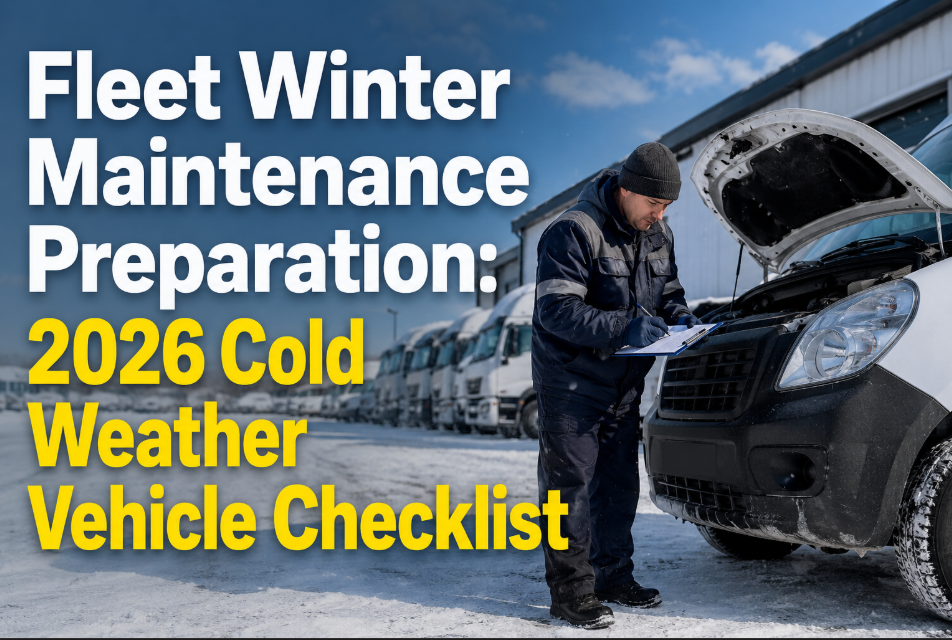
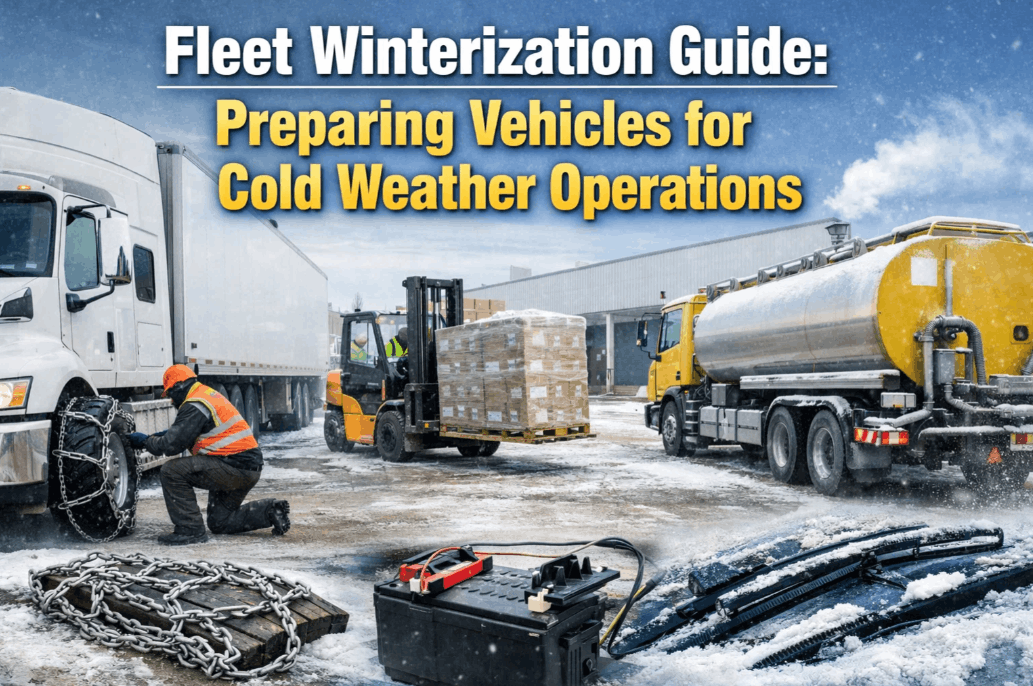
Winter doesn't announce itself with a warning email. It arrives as a no-start condition at 5:47 AM when a driver turns the key on a truck with a borderline battery, summer-weight oil, and a coolant mix that protects to 20°F in a region that just hit 8°F overnight. That single event — one truck, one cold morning — cascades into a missed delivery, an emergency tow, a $2,400 roadside service call, and a customer SLA violation that takes weeks to repair. Multiply that by a 100-vehicle fleet with no systematic winterization program, and you're looking at $85,000+ in preventable cold-weather failures before January. DOT FMCSA 49 CFR 396.3 requires carriers to maintain vehicles in safe operating condition — and cold-weather failures like brake fade, tire blowouts, and fluid freezing are leading causes of winter commercial vehicle accidents. OxMaint automates fleet winterization with checklist-driven PM scheduling, component-specific cold-weather work orders, and compliance documentation that proves your fleet was prepared — not reactive.
Fleet Cold Weather Operations · 2026
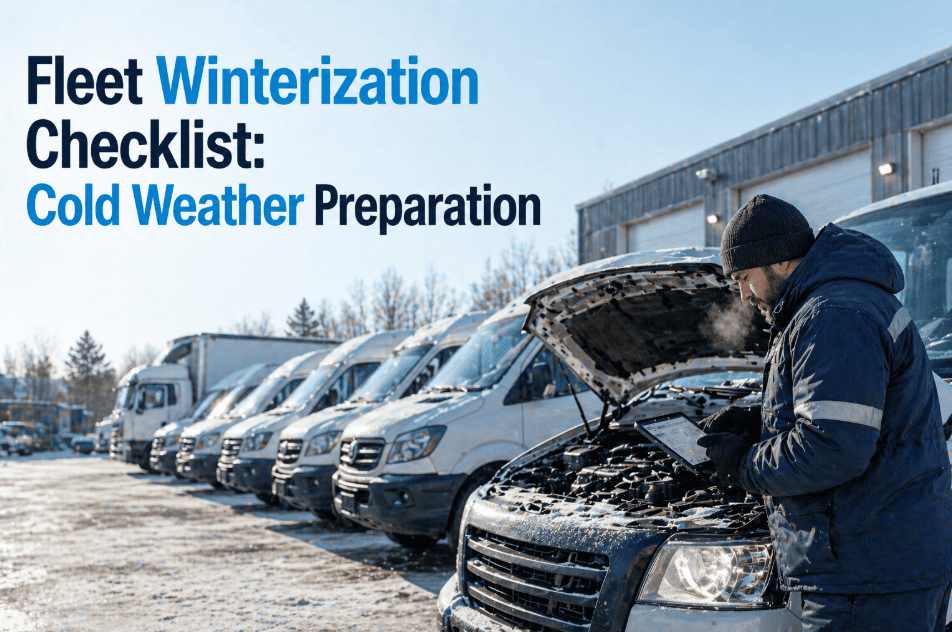
Fleet Winterization Checklist: Cold Weather Preparation That Prevents Every No-Start
Companies with comprehensive winterization checklists achieve 87% reduction in cold-weather failures and $275,000+ annual savings per 20-vehicle fleet. The difference between prepared and reactive fleets is documented, systematic, and measurable.
Every cold-weather failure traces back to one of these seven systems. OxMaint generates a winterization work order for each system, assigned to the right technician, with the right checklist — scheduled 6–8 weeks before first frost in your operating region.
01
Engine Oil & Fluids
Switch to winter-weight oil per OEM spec (lower viscosity for cold-start flow)
Test coolant freeze protection — verify mix protects to lowest regional temp
Top off power steering, brake, and transmission fluid
Fill windshield washer with winter-rated fluid (rated below -20°F)
Failure risk: Summer-weight oil thickens in cold, preventing engine turn-over. Coolant that protects to 20°F fails at 8°F — cracked block, $12,000+ repair.
02
Fuel System & Anti-Gel
Switch to winter-blend diesel (prevents paraffin gelling below 15°F)
Drain water separator — water turns to ice, plugs filters, causes no-starts
Replace fuel filters before season (not mid-winter when gelling has started)
Stock anti-gel additive and document dosage protocol by temperature range
Failure risk: Diesel contains paraffin that gels in cold. A gelled fuel system is the #1 cold-weather no-start cause — indistinguishable from battery failure without diagnosis.
03
Battery & Electrical
Load-test all batteries — minimum 75% capacity required for winter operation
Clean and tighten terminals — corrosion adds resistance in cold weather
Failure risk: A discharged battery freezes at 32°F. A fully charged battery won't freeze until -70°F. Borderline batteries that work in September fail in November — test before first frost.
04
Tires & Traction
Verify minimum 4/32" tread depth (winter recommendation for commercial vehicles)
Adjust tire pressure for temperature drop (1 PSI per 10°F reference chart)
Inspect for sidewall damage, cuts, and irregular wear patterns
Ensure tire chains are on board and drivers are trained on installation
Failure risk: Underinflated tires reduce load capacity, wear faster, and generate excess heat. A tire at correct pressure in 80°F weather is 8–10 PSI low at 0°F.
05
Brake & Air System
Inspect brake pads, rotors, drums, and air brake components
Service air dryer — removes moisture that freezes in lines and valves
Drain all air tanks to remove accumulated water before freeze risk
Verify ABS functionality and check for dashboard warning indicators
Failure risk: Moisture in air lines freezes, causing complete brake system failure. Air dryer malfunction is the root cause — one of the most dangerous winter equipment failures.
DEF protection briefing — DEF freezes at 28–32°F; verify heaters are working
Key point: A prepared driver in a well-maintained truck handles winter. An unprepared driver in the same truck creates incidents.
The 5 Most Expensive Winter Maintenance Mistakes
1
Waiting for the first freeze to start winterization
By the time the first freeze arrives, every fleet in your region is competing for the same technicians, parts, and shop time. Start 6–8 weeks before projected first frost. OxMaint schedules winterization work orders automatically based on your region's historical frost dates.
Typical cost of delay: $1,800–$4,200 per emergency service call
2
Skipping battery load tests on "good" batteries
A battery that starts fine at 45°F can fail completely at 15°F. Load testing identifies borderline batteries before they become no-starts. Replace batteries below 75% capacity before winter — not after the first failure.
Typical cost per no-start: $800–$2,400 (tow + emergency service + downtime)
3
Not draining water separators before cold weather
Water in fuel tanks condenses from warm fuel meeting cold tank walls. That water freezes in filters and fuel lines, mimicking fuel gelling but requiring different repairs. Daily water separator checks should be on every driver's winter pre-trip.
Typical cost: $600–$1,500 per fuel system freeze event
4
Ignoring air dryer maintenance on air brake systems
A malfunctioning air dryer lets moisture into brake lines. That moisture freezes. Brakes fail. This is not a performance issue — it's a catastrophic safety failure. Air dryer service should be completed before winter and verified monthly.
Not adjusting tire pressure for seasonal temperature drops
A tire inflated correctly at 80°F loses 8–10 PSI by the time temperatures hit 0°F. Underinflated tires reduce load capacity, wear faster, and increase blowout risk on cold, hard road surfaces. Pressure checks should increase to weekly during winter.
Typical cost per tire failure: $400–$1,200 (tire + roadside service + downtime)
CMMS Winterization Timeline
Effective winterization isn't a single event — it's a phased process that begins weeks before first frost and continues through the entire cold season. OxMaint automates every phase.
8 Weeks Before First Frost
Assessment Phase: Fleet-wide winterization audit work orders generated. Battery load tests, coolant analysis, tire condition assessment, air dryer inspection scheduled for every vehicle.
6 Weeks Before
Procurement Phase: Winter parts ordered from assessment results: batteries, belts, hoses, winter-weight oil, anti-gel additive, winter wiper blades, emergency kits. Bulk ordering at planned pricing, not emergency markup.
4 Weeks Before
Execution Phase: Winterization work orders executed: oil changes, coolant service, battery replacements, brake inspection, air dryer service, tire adjustments. Each vehicle cleared with a winterization completion certificate in CMMS.
First Frost to Spring
Monitoring Phase: Weekly tire pressure checks, daily water separator drains, fuel additive dosage tracking, block heater usage documentation. Ongoing cold-weather PM compliance monitored on the fleet dashboard.
Fleet Winterization CMMS
Winterize Every Vehicle. Document Every Check. Prevent Every No-Start.
OxMaint generates winterization checklists for every vehicle, schedules them weeks before first frost, tracks completion to 100%, and provides the documentation that proves your fleet was prepared — not just hoping for the best.
Start 6–8 weeks before your region's historical first frost date. This provides time for fleet-wide assessment, parts procurement at planned pricing (not emergency markup), and systematic execution without pulling vehicles from service during peak demand. OxMaint can be configured with your regional frost date to auto-generate winterization schedules annually.
What is the most common cause of winter fleet breakdowns?+
Battery failures and fuel system issues (gelling and water freezing) account for the majority of winter no-start events. Battery capacity drops significantly in cold weather — a battery at 80% capacity in September may only deliver 50% at 0°F. Diesel fuel gelling from paraffin wax crystallization is the second most common cause. Both are entirely preventable with pre-season testing and winter fuel management protocols.
How does CMMS automate fleet winterization scheduling?+
OxMaint generates winterization work orders as a seasonal PM trigger — scheduled annually based on your configured regional frost date. Each work order includes the system-specific checklist (engine fluids, fuel system, battery, tires, brakes, visibility, driver readiness), assigned to the appropriate technician by skill type, with parts pre-ordered from inventory. Fleet managers see winterization completion percentage across the entire fleet from a single dashboard view.
What DOT regulations apply to winter fleet preparation?+
DOT FMCSA 49 CFR 396.3 requires carriers to systematically inspect and maintain vehicles in safe operating condition — this includes seasonal preparedness. 49 CFR 396.11 requires driver vehicle inspection reports (DVIRs) that cover winter-specific items like tire condition, brake functionality, and lighting. 49 CFR 393.75 sets tire standards including tread depth minimums. Additionally, OSHA 29 CFR 1910.178 applies to powered industrial trucks, and EPA 40 CFR 80.27 governs fuel quality standards relevant to winter-blend diesel requirements.
How does block heater usage affect maintenance scheduling?+
Block heaters reduce cold-start wear by pre-warming the engine before ignition. For trucks parked outdoors in sub-zero conditions, block heater usage should be mandatory — and documented. OxMaint tracks block heater functionality as part of the winterization checklist and can generate alerts when heater-equipped vehicles are parked in conditions below their activation threshold. A functional block heater extends engine life and reduces the cold-start fuel penalty that drops fuel economy by up to 5% in winter.
OxMaint · Fleet Cold Weather Preparedness
Winter Is a Systems Problem. CMMS Is the System That Solves It.
Every no-start, every gelled fuel line, every frozen brake line traces back to a winterization step that was skipped, delayed, or undocumented. OxMaint makes the entire 7-system winterization process automatic, tracked, and provable — from 8 weeks before first frost through spring thaw.