EV Fleet Range Optimization with AI-Powered Routing
By Jack Miller on April 27, 2026
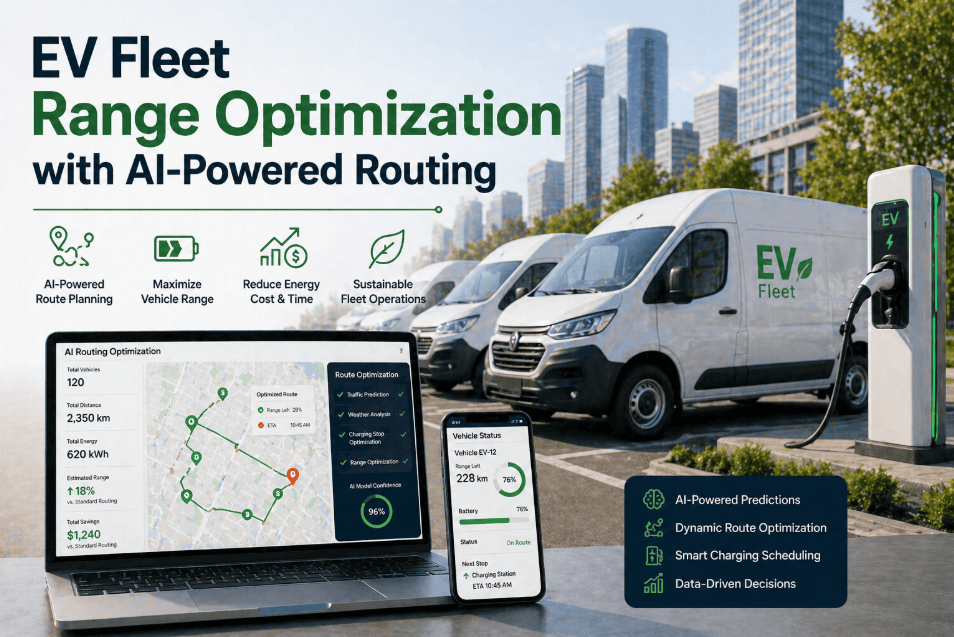
Range anxiety isn't a consumer problem — it's a fleet operations failure. When a dispatcher assigns a 220-mile route to an EV with 180 miles of usable range, the result isn't inconvenience — it's a stranded vehicle, a missed delivery, a tow truck call, and a customer SLA violation that costs more than the fuel savings justified the EV purchase in the first place. The gap isn't in the vehicle's capability. It's in the dispatch system's inability to account for the variables that determine real-world EV range: battery state of charge, ambient temperature, cargo weight, route elevation, driving speed, and charging station availability. OxMaint's AI-powered routing accounts for every one of these variables — so every EV gets dispatched to a route it can complete with documented reserve margin.
EV Fleet Intelligence · AI-Powered Range Management
EV Fleet Range Optimization with AI-Powered Routing
Range isn't a fixed number — it's a function of temperature, payload, terrain, speed, battery age, and HVAC demand. AI routing calculates actual available range per vehicle per trip and matches EVs to routes they can complete — every time.
Every one of these variables is invisible to a standard dispatch system. AI routing calculates the combined impact of all active variables simultaneously — producing a reliable range estimate that accounts for the conditions the vehicle will actually encounter, not its EPA-rated best case.
Cold Weather (below 40°F)
-20 to 30% range
Battery chemistry slows in cold. Cabin heating draws from the pack. Pre-conditioning while plugged in is the primary mitigation.
Heavy Payload
-15 to 25% range
A fully loaded delivery van uses 15–25% more energy than empty. Load planning must feed into range calculations.
Terrain / Elevation Gain
-3 to 5% per 1,000 ft gain
Research found choosing routes with fewer inclines saved up to 46% of battery capacity. Regen braking on descent recovers only a fraction of what climbs consume.
Highway Speed (65+ mph)
-10 to 20% range
Aerodynamic drag increases exponentially with speed. City driving is more energy-efficient for EVs — the opposite of ICE vehicles.
HVAC Usage
-10 to 15% range
Cabin heating and cooling draw directly from the battery. Pre-conditioning while plugged in eliminates the startup penalty.
Battery Age / SOH Decline
-2 to 3% per year
Batteries degrade 2–3% per year. A 3-year-old vehicle at 92% SOH has meaningfully less range than its EPA rating suggests.
AI Routing: How OxMaint Calculates Real-World Range
Input
Vehicle SOC + SOH
Current charge level and battery health history read from telematics. A 75% SOC on a 92% SOH battery yields different usable range than 75% SOC at 100% SOH.
Context
Weather + Terrain + Load
Real-time temperature, forecast wind speed, route elevation profile, and assigned cargo weight feed into the consumption model.
AI Calculation
Predicted Range + Charging Stops
AI combines all variables to produce an adjusted range estimate. If route exceeds range, charging stops are inserted at optimal locations with station availability data.
Output
Confident Dispatch Decision
Dispatcher sees: "This EV can complete this route with 18% reserve margin" or "This route requires diesel assignment." No guesswork. No stranded vehicles.
EV Fleet Range Intelligence
Dispatch Every EV With Confidence. Strand Zero Vehicles.
OxMaint's AI routing eliminates range anxiety from fleet operations — matching vehicles to routes based on real-time conditions, not EPA estimates. Every dispatch is a data-driven decision.
How accurate is AI range prediction compared to EPA estimates?+
EPA range ratings represent ideal conditions — moderate temperature, flat terrain, moderate speed, no payload. Real-world fleet range is typically 15–35% lower depending on conditions. OxMaint's AI routing uses actual vehicle telemetry, real-time weather data, route elevation profiles, and load assignments to predict range with documented accuracy within 5–8% of actual consumption. This precision is what eliminates stranded vehicle incidents.
What happens mid-route if conditions change and range becomes insufficient?+
OxMaint continuously monitors SOC during active routes via telematics. If actual consumption exceeds the prediction — due to unexpected traffic, weather change, or driver behavior — the system sends a proactive alert with the nearest available charging station and updated route options. The dispatcher and driver both receive the notification with enough advance warning to adjust before a range emergency occurs.
Can AI routing work for mixed ICE/EV fleets?+
Yes — and this is where AI routing delivers the most value. In a mixed fleet, some routes are ideal for EVs (urban, flat, moderate distance) while others require diesel (long-haul, mountainous, extreme cold). OxMaint's routing engine evaluates every route against every available vehicle's capabilities and assigns the optimal vehicle-to-route pairing automatically. The result is maximum EV utilization on routes where they excel, with diesel assigned only where range, terrain, or duty cycle requires it.
How does battery SOH tracking improve range predictions over time?+
OxMaint tracks battery state of health over the vehicle's lifetime — monitoring capacity degradation, charge cycle count, and consumption trends. As a battery degrades from 100% to 92% SOH over 3 years, the AI routing model adjusts its range predictions downward accordingly. This means a 3-year-old EV gets dispatched to appropriately shorter routes — not the same routes it could handle when new. SOH data also feeds into replacement cost forecasting and residual value documentation.
OxMaint · AI-Powered EV Fleet Routing
Range Anxiety Is a Data Problem. We Solved It.
EV fleet range optimization isn't about better batteries — it's about better data. OxMaint's AI routing accounts for every variable that determines real-world range, matches EVs to routes they can complete with reserve margin, and eliminates the guesswork that creates stranded vehicles and missed deliveries.