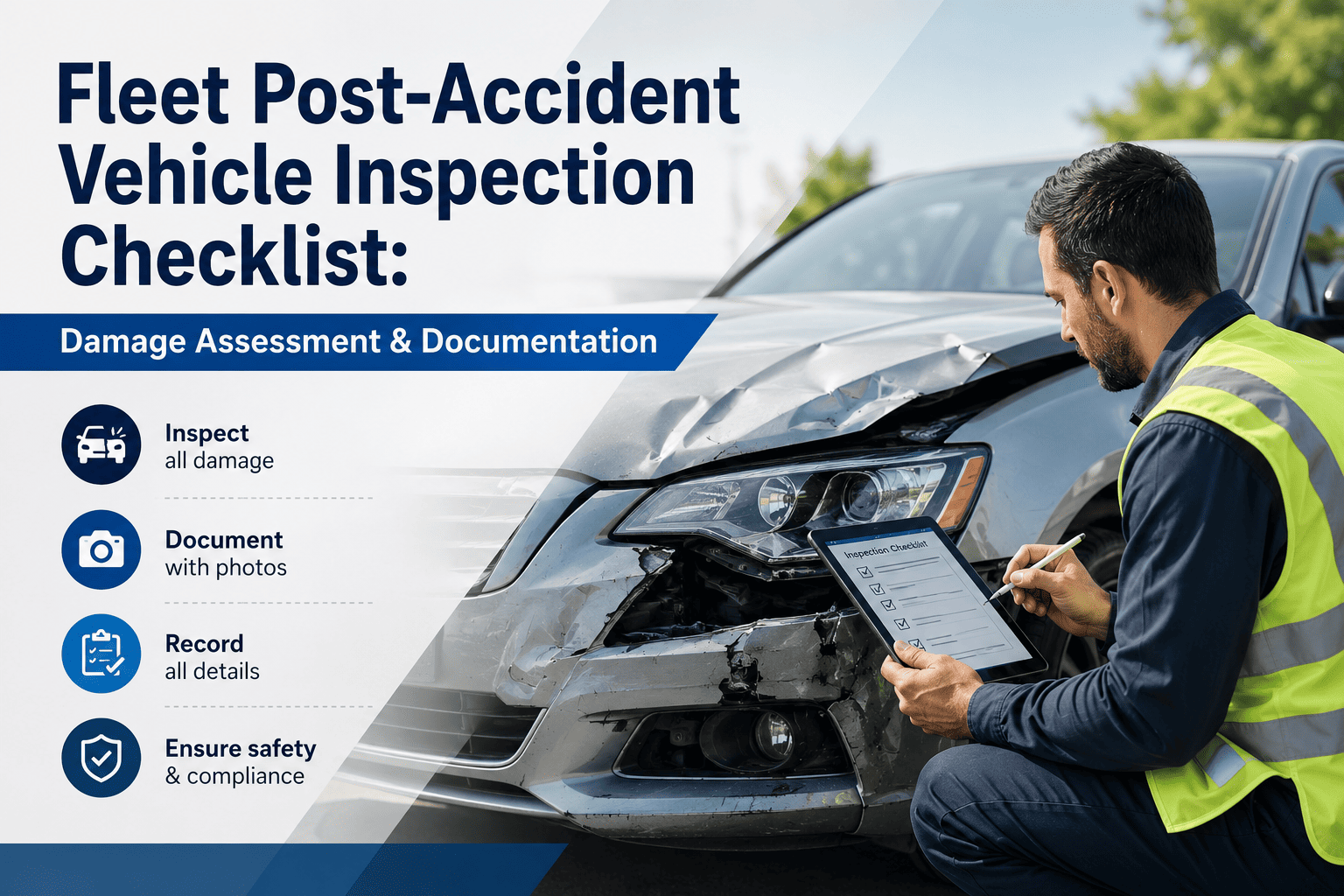
A post-accident vehicle inspection is not optional — it is a regulatory obligation, an insurance necessity, and the first step in protecting your fleet from liability. Whether the collision is minor or major, FMCSA regulations, DOT post-accident drug and alcohol testing requirements, and carrier insurance policies all require immediate, documented inspection before the vehicle returns to service. A missed structural defect, an undocumented airbag deployment, or a skipped DOT drug test can turn a manageable accident into a six-figure compliance violation. Sign Up Free to manage post-accident inspection workflows, damage documentation, and DOT reporting in Oxmaint — so your compliance team has a complete, timestamped record of every post-accident action taken.
1. On-Scene Immediate Response Checklist
The first minutes after a fleet accident determine the quality of your documentation, your exposure to liability, and your compliance with FMCSA notification requirements. Drivers must be trained to follow a consistent on-scene protocol — because an unguided response at an accident scene produces incomplete records that weaken both your insurance claim and your DOT defense. Book a Demo to see how Oxmaint's mobile inspection app guides drivers through on-scene post-accident documentation step by step.
Scene safety — hazard lights, road flares, and warning triangles deployed
Activate hazard lights immediately and deploy all three warning triangles per §393.95 placement rules — failure to secure the scene creates secondary incident liability. Immediate — before any documentation
Injury assessment — all parties checked and emergency services called if needed
Determine injury status for all occupants and third parties — any injury requiring medical treatment beyond first aid triggers DOT post-accident testing and accident register requirements. OOS — injury confirmed
Law enforcement notified — police report number recorded
Obtain the responding officer's name, badge number, and incident report number at the scene — this document is required for insurance processing and FMCSA accident register entries. Defect — no report number
Photographic documentation — all four vehicle sides, impact points, and road conditions
Photograph every damaged panel, the full vehicle from all four sides, tire marks, road conditions, traffic controls, and all other vehicles involved — minimum 20 images. Defect — incomplete photo record
Third-party information — names, license plates, insurer, and contact details
Collect driver's license, vehicle registration, insurance details, and contact information from all involved parties and witnesses before leaving the scene. Defect — incomplete third-party record
Cargo condition — load security, spillage, and hazmat release checked
Inspect cargo for shifting, spillage, or container breach — any hazmat release requires immediate emergency services notification and shipper contact per 49 CFR Part 171. OOS — hazmat release confirmed
ELD and telematics data — preserve event log before any reset or power cycle
Instruct the driver not to power cycle the ELD — preserve the pre-accident and impact event data which provides a timestamped speed, braking, and location record for the 30 minutes prior to impact. Critical — data loss is irreversible
2. Structural and Mechanical Damage Assessment Checklist
A post-accident structural inspection must be performed by a qualified technician before a commercial vehicle returns to service — driver-only visual checks are not sufficient for determining roadworthiness after a collision. Undocumented frame damage, bent axles, and compromised brake lines are the structural defects most commonly missed when fleets skip a formal post-accident inspection process. Sign Up Free to log post-accident damage findings, assign repair work orders, and track return-to-service authorization status per vehicle in Oxmaint.
Frame and chassis — inspect for bends, cracks, and deformation at impact points
Any visible frame deformation, cracked welds, or bent crossmembers are automatic OOS conditions — the vehicle cannot return to service without certified structural repair. OOS — frame damage confirmed
Steering system — check alignment, play, and all steering linkage components
Post-collision impacts frequently transfer force through the steering linkage — verify steering wheel free-play is within specification and inspect tie rods, drag links, and steering box for damage. OOS — any steering defect
Brake system — inspect lines, hoses, chambers, and brake adjustment post-impact
Check all brake air lines and hydraulic hoses for crimping, cracking, or disconnection caused by impact force — any brake system defect is an immediate OOS condition under §393.40. OOS — any brake defect
Suspension — springs, shock absorbers, and axle alignment checked for impact damage
Rear-end and side impacts frequently cause spring breakage or axle misalignment that is invisible from the outside — place the vehicle on level ground and check for uneven stance before road test. OOS — broken spring or shifted axle
Fuel system — tank, lines, and connections inspected for leaks and impact damage
Inspect the fuel tank and all fuel lines for cracks, punctures, or connection failures caused by impact — any fuel leak is a fire hazard and an immediate OOS condition. OOS — any fuel leak
Tires and wheels — inspect for impact damage, bead separation, and rim deformation
Check all tires for sidewall bulging, tread separation, and impact fractures that may not cause immediate deflation but will fail at highway speed — replace any tire showing impact damage. OOS — sidewall damage or rim failure
Lights and electrical — all lighting systems tested after impact including trailer connection
Test all running lights, brake lights, turn signals, and reverse lights — side impact frequently severs trailer wiring harnesses that pass visual inspection but fail under load. Defect — any inoperable light
Airbag deployment status — record deployed units and check steering column for damage
Any airbag deployment requires immediate documentation — a deployed airbag indicates sufficient deceleration force to compromise steering column integrity even if the column shows no visible damage. OOS — deployed airbag unrepaired
3. Safety Equipment Post-Accident Inspection Checklist
Post-accident impacts frequently displace or damage on-board safety equipment — fire extinguishers are knocked from brackets and discharged, first aid kits are used at the scene, and warning triangles are deployed and not retrieved. Every safety item must be verified as present, serviceable, and correctly stowed before the vehicle returns to service. Book a Demo to see how Oxmaint tracks safety equipment status per vehicle and flags items that require replacement after an accident event.
Fire extinguisher — bracket, charge, and seal verified post-incident
Verify the extinguisher is still in its bracket, the gauge is in the green zone, and the tamper seal is unbroken — impact can partially discharge extinguishers without visible evidence. OOS — discharged or displaced
Warning triangles — all three present and retrieved before vehicle moves
Confirm all three warning triangles have been retrieved from the roadway and returned to their storage case before the vehicle is moved — leaving triangles on a highway is a secondary hazard. OOS — any triangle not retrieved
First aid kit — contents used at scene restocked before next dispatch
Log all first aid materials used at the accident scene and restock the kit before the vehicle is returned to service — a partially stocked first aid kit is a compliance defect. Defect — incomplete kit
Seat belts — all positions inspected for webbing damage caused by accident forces
Inspect every seat belt for webbing cuts, fraying, or load-limiter activation caused by the collision — seat belts that absorbed crash energy must be replaced before the next trip. OOS — load-damaged belt
4. DOT Post-Accident Compliance and Documentation Checklist
FMCSA post-accident documentation requirements are time-critical — the drug testing window closes at 32 hours and the alcohol testing window at 8 hours, with no extensions granted regardless of circumstances. Carriers that fail to test within these windows face the same penalty as a confirmed positive test result. Every qualifying post-accident event must be entered in the fleet accident register within 15 days. Sign Up Free to automate DOT post-accident task timelines, testing windows, and accident register entries in Oxmaint so your compliance team never misses a deadline.
DOT qualifying event determination — fatality, injury, or tow-away criteria assessed
Determine immediately whether the accident meets DOT qualifying criteria: any fatality, any injury requiring medical treatment beyond first aid, or any vehicle disabled and towed — if yes, testing is mandatory. OOS — missed testing window
DOT alcohol test — completed within 8 hours of qualifying accident
Direct the driver to an authorized collection site immediately — if the 8-hour window closes before testing is completed, document all good-faith attempts made and retain those records for 12 months. OOS — window missed
DOT drug test — completed within 32 hours of qualifying accident
Initiate drug testing as soon as practical after the alcohol test — the 32-hour window for drug testing requires prompt action, especially for remote accident locations. OOS — window missed
Driver statement — written account completed while details are current
Obtain a written driver statement within 24 hours of the accident — include pre-trip inspection status, route conditions, load details, speed, and sequence of events leading to the collision. Defect — no signed statement
HOS records — driver log for the 8-hour period before accident preserved
Pull and preserve the ELD or paper log record for the full 8-hour period preceding the accident — this record is required by FMCSA inspectors and plaintiff attorneys in any post-accident proceeding. OOS — records not preserved
FMCSA accident register entry — all required fields completed within 15 days
Enter the accident in the carrier's FMCSA accident register within 15 days — include date, location, driver name, number of injuries, fatalities, and whether hazmat was released. Retain for 3 years. Defect — late or missing entry
Insurance claim opened — carrier notified and claim number assigned
Notify your fleet insurer within the policy-required window — most commercial fleet policies require notification within 24 to 72 hours of a qualifying accident regardless of fault. Defect — late notification
Return-to-service authorization — signed off by qualified technician after full inspection
No post-accident commercial vehicle may return to service without a qualified technician's written return-to-service authorization — document the authorization date, technician name, and inspection findings in Oxmaint. OOS — unauthorized return
Frequently Asked Questions
The most common questions from fleet safety and compliance managers about post-accident inspection requirements, DOT testing obligations, and documentation standards.
Any accident involving a fatality always requires testing. For non-fatal accidents, testing is required if the driver received a citation AND the accident resulted in an injury requiring medical treatment beyond first aid, or in a vehicle being disabled and towed from the scene.
No. A commercial vehicle must not return to operation — including being driven to a shop — until a qualified technician has confirmed it is safe and roadworthy. Moving a structurally compromised vehicle is a separate FMCSA violation.
The FMCSA accident register must be retained for 3 years from the date of each accident. Supporting documentation including driver statements, repair records, and testing records should be retained for a minimum of 3 years, though many carriers retain them for the life of the vehicle for litigation protection.
A missed testing window is treated identically to a refusal to test under FMCSA regulations — the driver is placed out of service and cannot operate a CMV until completing the return-to-duty process. The carrier also receives a Controlled Substances and Alcohol BASIC violation.
Yes. Oxmaint's mobile inspection app provides structured post-accident checklists for drivers and technicians, timestamps all documentation, tracks DOT testing window countdowns, and logs damage findings, repair work orders, and return-to-service authorizations per vehicle. Book a Demo to see the complete post-accident workflow.
Most fleet insurers require all four sides of all vehicles involved, close-up shots of all damage points, road conditions and skid marks, traffic controls, scene overview, and any cargo damage. A minimum of 20 photographs is standard practice for a defensible claim file.
We had a qualifying accident where the driver didn't report it as a DOT event — by the time the safety team was notified, the 8-hour alcohol window had closed. After implementing Oxmaint's post-accident workflow with automatic event classification and testing window countdowns, our compliance team receives an immediate alert for every qualifying event. We haven't missed a testing window since.