
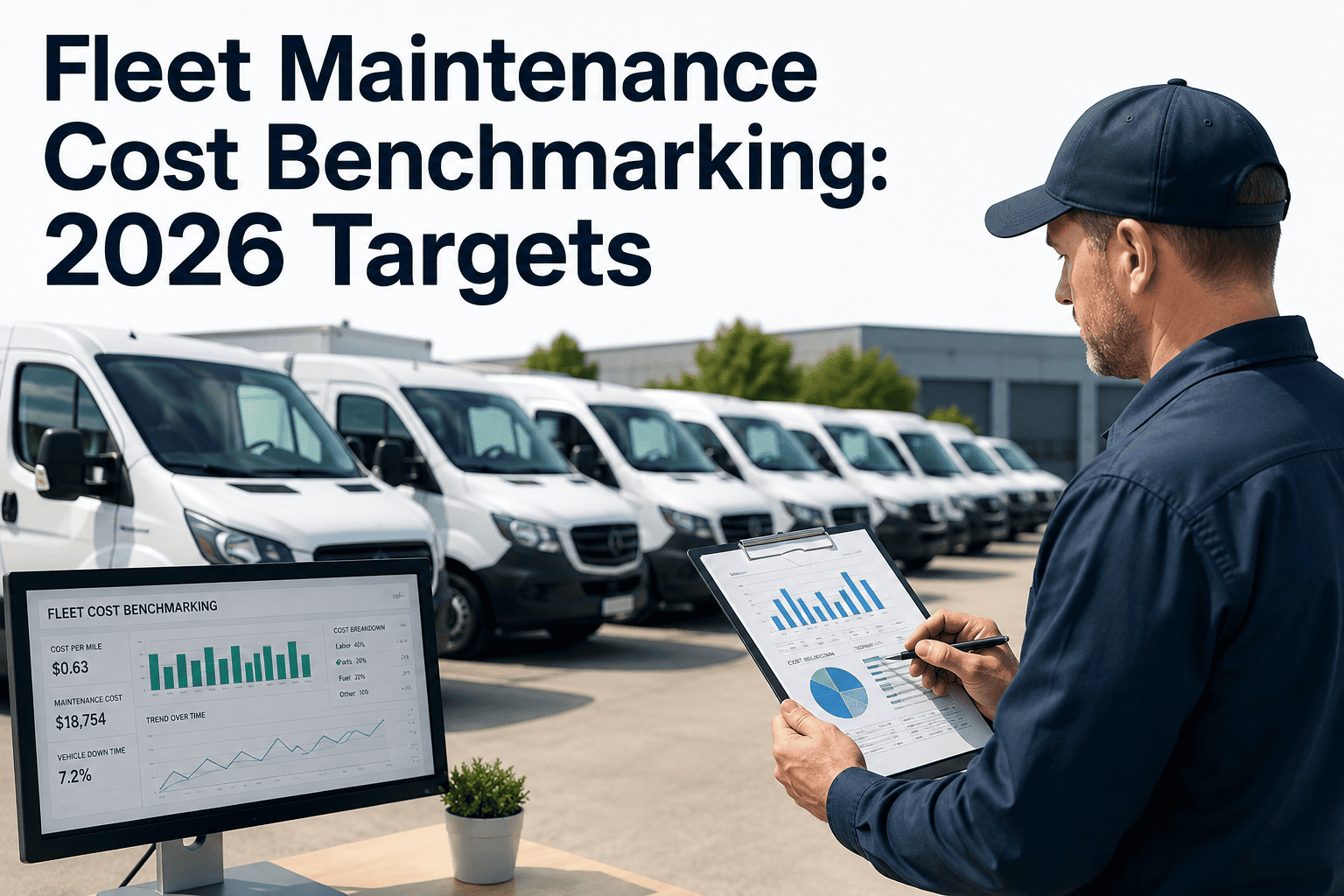
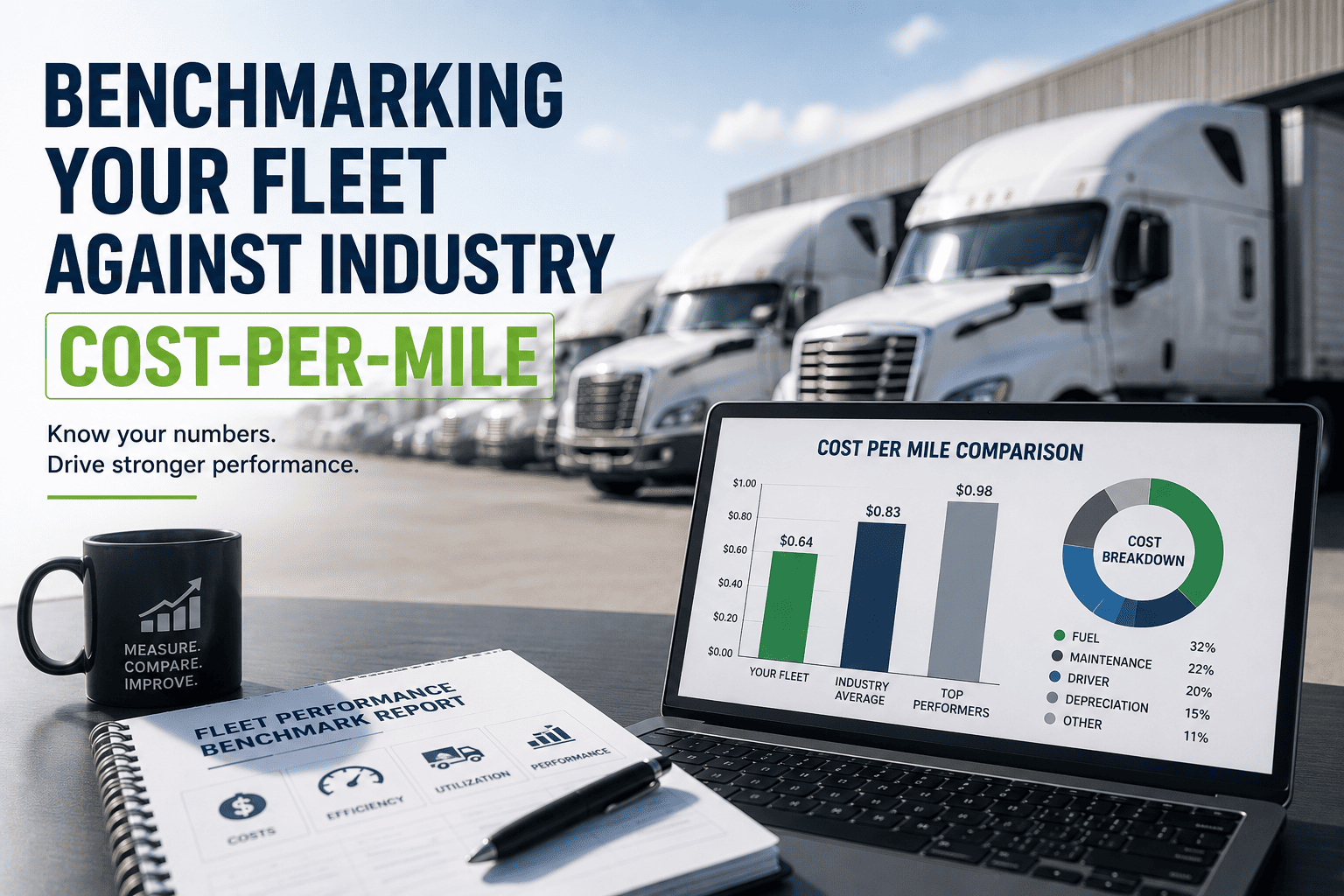
A fleet running $0.54 per mile in a sector where top-quartile performers run $0.38 per mile is not underfunded — it is underinformed. Without an external benchmark, every fleet metric looks acceptable because there is no reference point for what acceptable actually means. Fleet benchmarking closes this gap: it takes your operational, financial, and safety data and positions it against peer fleets of comparable size, vehicle class, and duty cycle — revealing not just where you stand, but exactly which cost categories are creating the gap between your performance and the top quartile in your sector. This guide covers the eight metric categories used in professional fleet benchmarking, the industry data sources that produce defensible peer comparisons, and how Oxmaint's benchmarking module updates your fleet's position against live industry data every reporting period — without an annual consulting engagement. Book a demo to see your fleet's current benchmark position across all eight metric categories in Oxmaint.
Oxmaint's benchmarking module compares your fleet's cost per mile, PM compliance rate, downtime rate, fuel efficiency, and safety score against industry benchmarks updated quarterly — so you know whether your fleet is genuinely performing or just performing better than last year.
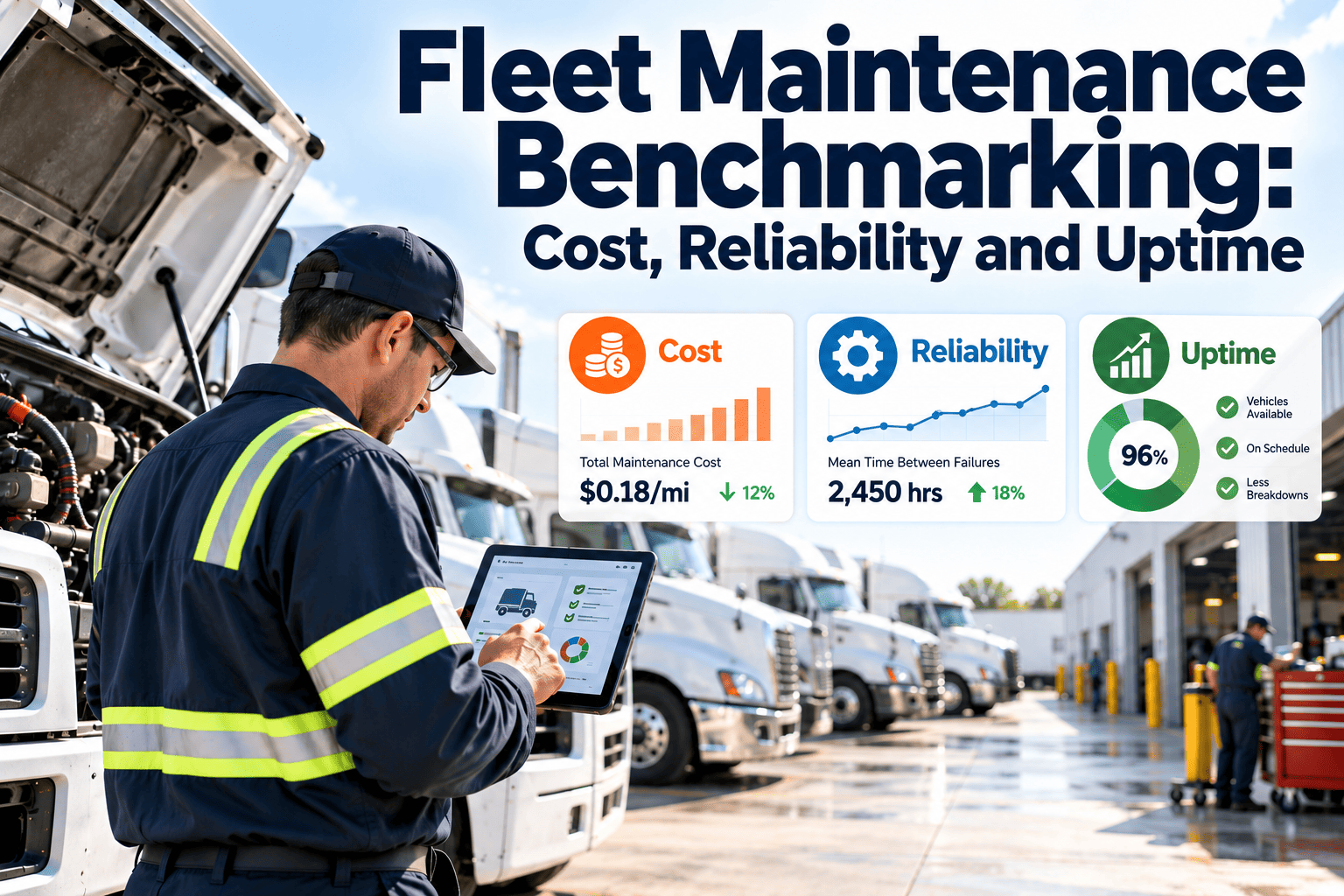
Fleet benchmarking compares your operational metrics against peer fleets in eight categories: financial performance (cost per mile, TCO per vehicle, maintenance spend ratio), maintenance quality (PM compliance rate, MTBF, MTTR, unplanned downtime rate), asset utilization (vehicle utilization rate, idle time, availability rate), fuel and energy efficiency (fuel cost per mile, idle fuel waste, route efficiency score), safety record (accident rate, driver safety score, near-miss frequency, DVIR compliance), driver performance (hours of service compliance, safety score distribution, trip efficiency), fleet compliance (inspection pass rate, permit currency, regulatory violation rate), and fleet renewal health (average fleet age, replacement pipeline coverage, vehicles past economic life). Oxmaint measures all eight and displays your fleet's percentile ranking against industry peers updated quarterly.
The Eight Fleet Benchmark Categories — and What Each Reveals
Each benchmark category answers a different question about fleet performance — and reveals a different cost improvement opportunity when your fleet falls below the industry top quartile. Book a demo to see your fleet's benchmark score across all eight categories.
Cost per mile, total cost of ownership per vehicle, and maintenance spend as a percentage of vehicle value — benchmarked against peer fleets in your sector and vehicle class. A fleet at $0.54/mile that benchmarks against a top-quartile peer at $0.38/mile immediately sees the $116K annual gap on a 50-vehicle fleet — and the benchmark report breaks down which cost category creates the largest portion of that gap.
PM compliance rate, mean time between failures, mean time to repair, and unplanned downtime rate — the four metrics that directly measure whether your maintenance program is preventing failures or reacting to them. Industry top-quartile fleets run ≥92% PM compliance; fleets below 75% compliance typically see 2.3× the MTTR and 4.1× the emergency parts spend of top-quartile performers.
Vehicle utilization rate, idle time percentage, and availability rate — measuring whether your fleet size is correctly matched to your operational demand. Industry benchmark for commercial delivery fleets: ≥78% utilization rate, ≤12% idle time, ≥94% availability. Fleets with utilization below 62% are typically over-fleetted by 15–22% — carrying capital and insurance cost on vehicles that are not earning their keep.
Fuel cost per mile, idle fuel consumption, and route efficiency score — benchmarked against fleets running the same vehicle class on comparable route types. Idle fuel alone averages $1,840 per vehicle per year at current diesel prices — and top-quartile fleets have reduced this to under $420 per vehicle through driver coaching, geofenced idle cutoff, and route optimization. Oxmaint's fuel benchmark shows your fleet's idle waste in dollar terms, not just percentage, alongside the peer comparison.
Accident rate per million miles, driver safety score distribution, near-miss frequency, and DVIR inspection compliance — benchmarked against FMCSA industry data and sector-specific peer groups. Fleets in the top safety quartile pay 22–38% lower insurance premiums than sector average — making safety benchmarking one of the highest-ROI benchmark categories because improvement is directly monetizable in the next insurance renewal cycle.
Average fleet age, percentage of vehicles past optimal economic life, replacement pipeline coverage, and residual value trajectory — benchmarked against industry replacement cycle norms by vehicle class. Fleets with ≥30% of vehicles past their economic life threshold typically face compounding cost increases of 18–24% over the following 24 months as maintenance costs accelerate on aging assets. Oxmaint's fleet renewal benchmark flags this risk before it appears in the P&L.
Is Your Fleet Top Quartile — Or Just Better Than Last Year?
Internal year-over-year improvement can mask sector underperformance. Oxmaint's benchmarking module positions your fleet against peer data quarterly — so you know your absolute rank, not just your relative trend. Book a demo to see your fleet's benchmark position across all eight categories.
Industry Benchmark Data — Top Quartile vs Industry Average by Metric
These benchmarks are derived from FMCSA, ATA Fleet Benchmark Survey, and Oxmaint's anonymized fleet data pool across 1,200+ fleets. They represent achievable targets for fleets of 25 to 500 vehicles in commercial delivery and service operations.
| Metric | Bottom Quartile | Industry Average | Top Quartile | Oxmaint Fleet Avg |
|---|---|---|---|---|
| Cost per mile (light commercial) | $0.58–$0.72 | $0.48–$0.58 | $0.32–$0.42 | $0.38 |
| PM compliance rate | <65% | 71–78% | ≥92% | 94% |
| Vehicle utilization rate | <55% | 62–72% | ≥82% | 84% |
| Unplanned downtime rate | >18% | 9–14% | <4% | 3.8% |
| Emergency parts spend % | >38% | 22–32% | <10% | 12% |
| Accident rate (per M miles) | >2.8 | 1.4–2.2 | <0.8 | 0.72 |
| Mean time between failures (days) | <18 days | 24–34 days | >48 days | 52 days |
| Idle time percentage | >28% | 16–24% | <8% | 7.4% |
Reading Your Benchmark Report — How to Prioritize Improvement
A benchmark report without a prioritization framework produces a list of gaps but no action plan. Use this four-quadrant approach to identify which benchmark gaps to address first — and in what order.
Metrics where your fleet is in the bottom quartile AND the gap translates directly to dollar cost — typically PM compliance rate, cost per mile, and emergency parts spend ratio. A 20-point PM compliance improvement at a 50-vehicle fleet typically produces $84,000 in year-one savings. These are your highest-ROI benchmark gaps — address them before any other category.
Metrics where your fleet is significantly below benchmark AND the gap creates regulatory or liability exposure — accident rate, DVIR compliance, hours of service violations. Insurance renewal negotiations are directly impacted by safety benchmark position — improving from sector average to top quartile accident rate reduces premiums by 22–38% in the next renewal cycle.
Metrics where your fleet is below average but the gap reflects a structural asset or operational issue that requires longer-horizon correction — fleet age, utilization rate, vehicle replacement pipeline. Improvement requires capital planning and procurement lead time rather than operational discipline changes. Start planning 18 months before you need the result.
Metrics where your fleet is already at or above top-quartile benchmark — maintain with existing program structure, monitor quarterly for drift, and use as internal proof points for fleet management budget justifications. Top-quartile performers typically maintain their position through consistent PM discipline rather than periodic improvement campaigns.
Benchmark Results — Fleets That Acted on Oxmaint Benchmark Data
We had been improving year over year for 3 years — PM compliance up, downtime down. Then Oxmaint showed us that every competitor in our sector was improving faster. We were getting better but losing ground relatively. The benchmark report showed us our idle time was 2.4× the top-quartile rate — a problem we never would have found internally because our own trend line looked fine. We cut it by 61% in 8 months and recovered $94,000 in annual fuel cost.
Frequently Asked Questions
Know Your Rank. Close the Gap. Reach Top Quartile in 14 Months.
Eight benchmark categories, quarterly peer comparison, prioritized gap report — automatically generated in Oxmaint every reporting period. No consultant required.


.png)