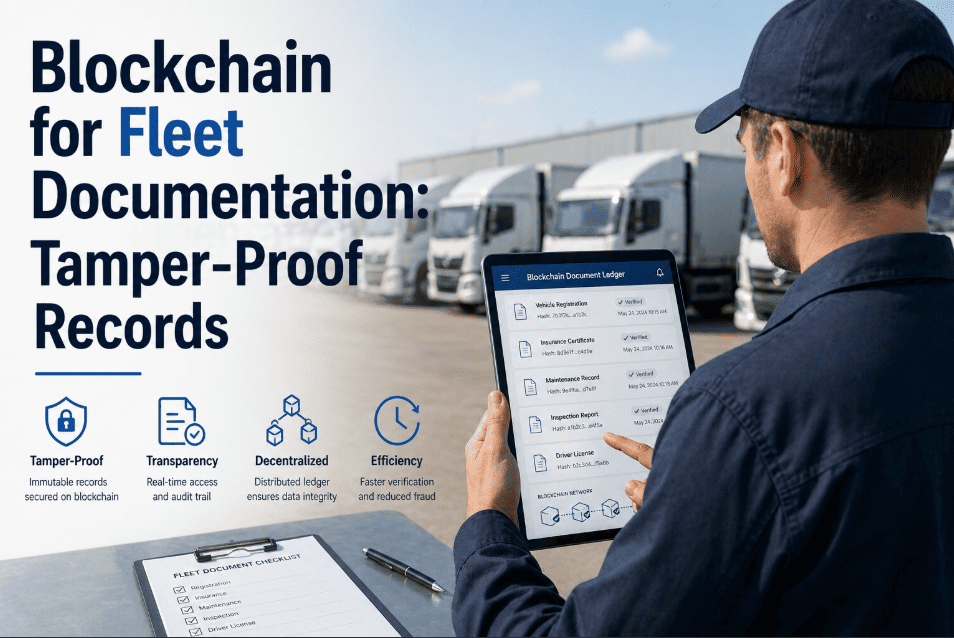
Freight documentation fraud costs the logistics industry an estimated $6 billion annually in the United States alone — through falsified bills of lading, disputed proof-of-delivery records, invoice discrepancies, and cargo claim manipulations that paper and even standard digital records cannot definitively prevent. Blockchain technology addresses this at the document layer: by creating an immutable, cryptographically verified record of every freight transaction — from BOL issuance through delivery confirmation to final invoice — it eliminates the ability to alter, backdate, or dispute records after the fact. Every party in the freight chain sees the same verified document state simultaneously, with every change timestamped, attributed, and permanent. Fleet operations integrating blockchain documentation report 78% reduction in invoice disputes, 65% faster payment cycles, and near-elimination of fraudulent cargo claims against documented shipments. If your freight documentation still relies on paper or standard digital records that can be contested, start a free trial with Oxmaint or book a demo to see blockchain-integrated fleet documentation.
Fleet Documentation · Blockchain · Freight Security
Blockchain for Fleet Documentation — Tamper-Proof BOL, POD, and Invoice Records
Bills of lading that cannot be altered. Proof-of-delivery records that cannot be disputed. Invoice chains that every party sees simultaneously. Blockchain transforms freight documentation from a liability into an audit-ready asset — here is how it works for fleet operations.
$6B
Annual US logistics fraud from falsified freight documentation — blockchain closes this gap
78%
Reduction in invoice disputes for fleets using blockchain-verified documentation
65%
Faster payment cycles when blockchain POD eliminates delivery verification delays
How It Works
Blockchain Fleet Documentation — What It Is and How It Creates Tamper-Proof Records
Blockchain is not a database — it is a distributed ledger where every record is cryptographically linked to the records before and after it. Changing any record breaks the chain, making alteration detectable and functionally impossible. For freight documentation, this means every document in the shipment lifecycle becomes permanently verifiable by all parties simultaneously.
1
Document Created and Hashed
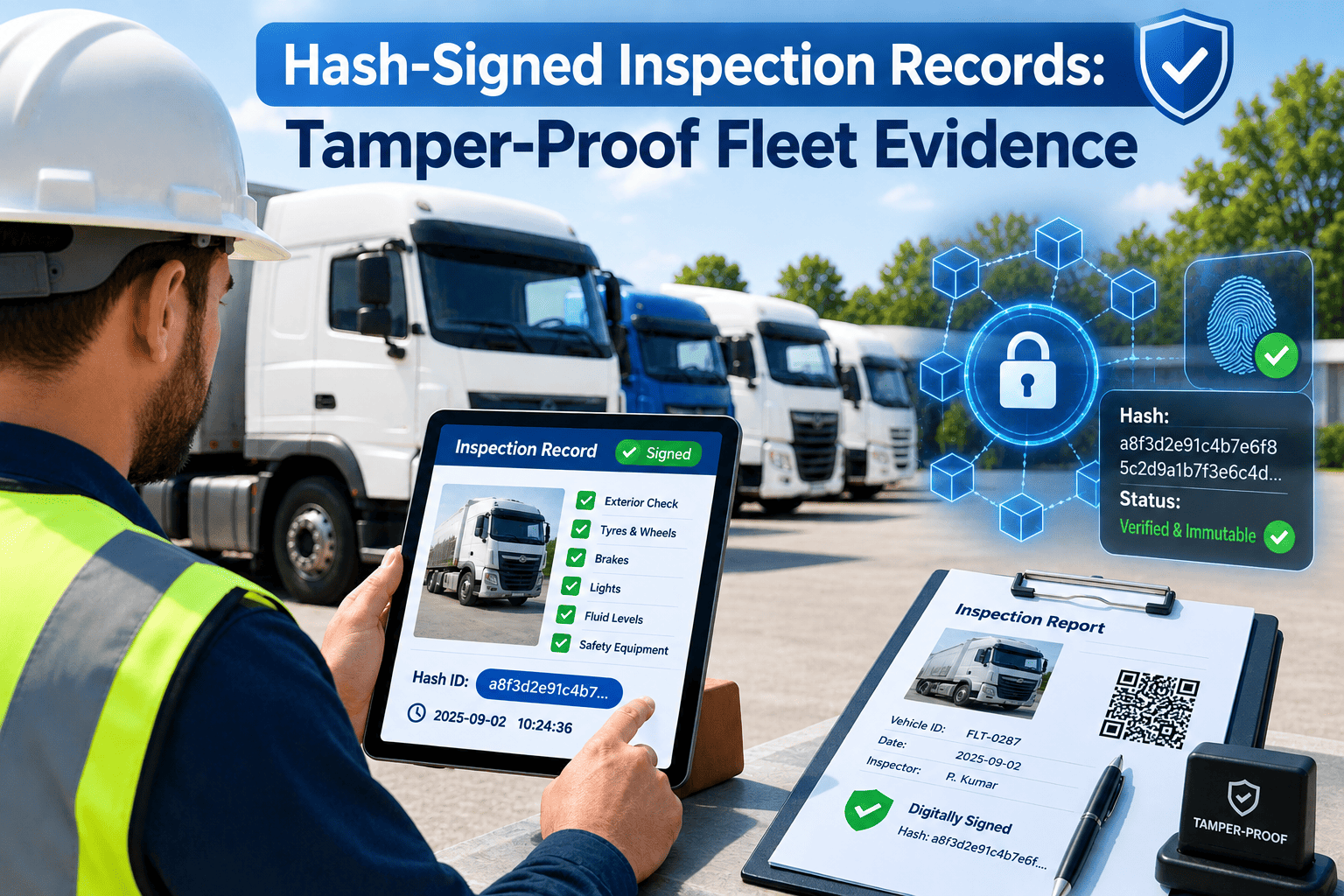
A BOL is issued. The document's contents are converted into a cryptographic hash — a unique fingerprint that changes if even a single character is altered. The hash is recorded on the blockchain with timestamp and issuing party identity.
2
All Parties See the Same Record
Shipper, carrier, broker, and consignee all access the same blockchain-verified document — not copies that can diverge. Every party sees the current verified state and any access or modification attempt is recorded permanently.
3
Events Update the Chain
Pickup confirmed. Border crossing documented. Delivery completed. Driver signature captured. Each event adds a new block to the shipment chain — with timestamp, GPS coordinates, and party identity. The complete chain is the permanent audit trail.
4
Alteration Attempts Are Detected Instantly
If anyone attempts to modify a past record — changing delivery date, altering cargo description, or backdating a signature — the cryptographic hash no longer matches. The blockchain detects the discrepancy and flags the record as compromised.
Document Types
The Four Freight Documents Blockchain Secures
Paper problem: BOL alterations account for 34% of freight fraud — cargo descriptions changed, quantities inflated, consignee details modified after pickup
Blockchain solution: BOL hash recorded at issuance. Any subsequent alteration breaks the cryptographic chain — detectable by any party instantly. Smart contract triggers carrier payment only when BOL terms are met
Paper problem: Disputed deliveries account for $2.1B in annual cargo claims — consignees claim non-delivery, drivers have paper POD but cannot prove timing or condition at delivery
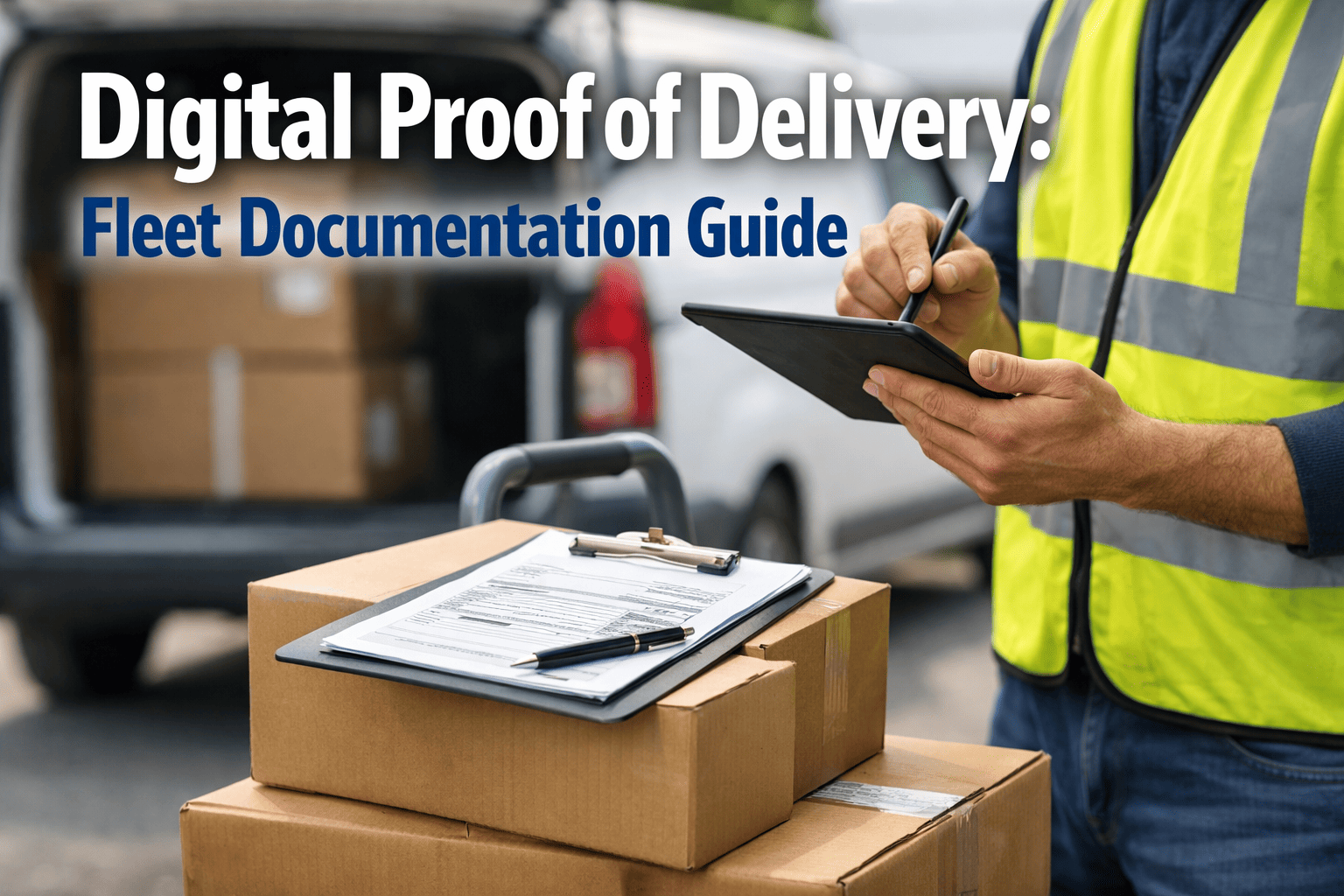
Blockchain solution: Digital POD recorded with GPS coordinates, timestamp, driver identity, and recipient digital signature — all cryptographically linked to the shipment chain. No dispute possible when the delivery record is immutable and independently verifiable
Paper problem: Invoice disputes delay payment by 45–90 days on average — disagreements over service dates, accessorial charges, and rate confirmation create billing cycles that consume 12% of administrative labor
Blockchain solution: Invoice automatically generated from blockchain-verified service events — dates, miles, accessorials, and rates all drawn from immutable chain records. No disputed facts, no billing cycle delays. Payment released against verified delivery trigger
Paper problem: Cross-border freight involves 3–6 parties, multiple jurisdictions, and document handoffs where discrepancies multiply — creating customs delays and compliance liability that costs $800–$4,200 per shipment in delays
Blockchain solution: Single shared blockchain record eliminates document version divergence across jurisdictions. Customs authorities in multiple countries verify the same immutable record — reducing border crossing delays by 40% on blockchain-documented shipments
Blockchain-Integrated Fleet Management
Tamper-Proof BOL, POD, and Invoice Records — Integrated with Your Fleet Management Platform
Oxmaint integrates blockchain verification for freight documentation within the same platform managing your fleet maintenance, work orders, and asset records. Tamper-proof documentation is generated automatically from operational events — no separate blockchain platform required.
Platform Capabilities
How Oxmaint Delivers Blockchain-Verified Fleet Documentation
Auto-Generate
Documents from Operational Events
BOL, POD, and invoice records generated automatically from fleet operational events — pickup confirmation, delivery GPS, driver signature, and service data — without manual document creation. Every document is blockchain-hashed at generation.
Zero manually-created documents — zero manual-error risk
Smart Contract
Automated Payment Triggers
Smart contracts execute payment release automatically when blockchain-verified delivery conditions are met — POD confirmed, cargo condition verified, consignee signed. Payment initiated without manual invoice processing or approval chain delays.
65% faster payment cycle from delivery to settlement
Verification
Multi-Party Document Access
Shippers, carriers, brokers, consignees, and customs authorities access the same blockchain-verified record simultaneously. No document versions, no copy discrepancies, no version disputes. One verified record — visible to all authorized parties.
78% reduction in document disputes across all freight parties
Audit Trail
Complete Chain-of-Custody Record
Every access, modification attempt, signature, and event permanently recorded in the blockchain. Complete chain-of-custody evidence for cargo claims, insurance disputes, regulatory audits, and legal proceedings — exportable in certified format on demand.
Audit-ready chain-of-custody for every shipment automatically
Before vs After
Paper Documentation vs. Standard Digital vs. Blockchain-Verified
| Dimension | Paper Documentation | Standard Digital Records | Blockchain-Verified |
| Alteration detection |
Impossible — paper modified |
Difficult — database editable |
Automatic — hash mismatch detected |
| Multi-party verification |
Separate copies — diverge |
Separate systems — version conflicts |
Single shared verified record |
| Invoice dispute rate |
Industry average: 12% |
Industry average: 8% |
Under 2% with blockchain verification |
| Payment cycle |
45–90 days average |
30–45 days average |
14–21 days with smart contract trigger |
| Cargo claim defensibility |
Weak — paper easily disputed |
Moderate — digital records editable |
Strong — immutable chain evidence |
| Cross-border compliance |
Multiple document versions |
Multiple system versions |
Single shared record across jurisdictions |
| Audit preparation time |
Days of manual assembly |
Hours of system export |
Minutes — certified export on demand |
Documented Outcomes
What Fleet Operations Report After Blockchain Documentation Integration
78%
Reduction in Invoice Disputes
Blockchain-verified service events eliminate the data disagreements that cause billing disputes — all parties reference the same immutable record
65%
Faster Payment Cycles
Smart contract payment triggers on verified delivery reduce payment cycle from 45–90 days to 14–21 days — improving fleet cash flow significantly
40%
Border Crossing Time Reduction
Customs authorities verifying blockchain-documented shipments process clearance faster — same verified record eliminates document discrepancy investigations
Near Zero
Successful Fraudulent Claims
Against blockchain-documented shipments — immutable POD and chain-of-custody records make fraudulent cargo claims legally indefensible
Common Questions
Blockchain Fleet Documentation — Questions Answered
Do all parties in the freight chain need to adopt blockchain for it to work?+
No — and this is a common misconception that has slowed blockchain adoption in logistics. Oxmaint's blockchain documentation model allows the carrier to generate and maintain blockchain-verified records unilaterally. Counter-parties (shippers, consignees, brokers) receive a verification link that allows them to confirm document authenticity without requiring their own blockchain infrastructure. Full smart contract capability (automated payment triggers) requires counter-party participation, but tamper-proof documentation, audit trails, and cargo claim defensibility are available immediately without waiting for industry-wide adoption.
Book a demo to see the counter-party verification flow.
What happens to blockchain records if Oxmaint's servers go down?+
Blockchain records are distributed — they do not live solely on Oxmaint's infrastructure. The cryptographic chain is maintained across distributed nodes, meaning the records exist and are verifiable independently of any single server. Oxmaint's platform provides the interface for creating and accessing records, but the records themselves are not dependent on Oxmaint's availability for verification. This is a core architectural advantage of blockchain over traditional centralized digital records — the evidence survives any single point of failure.
Is blockchain freight documentation legally recognized in the USA, EU, and other jurisdictions?+
Yes — with important nuance. Electronic BOL has been legally valid in the USA since the Electronic Signatures in Global and National Commerce Act (E-SIGN, 2000) and most states have adopted the Uniform Electronic Transactions Act. The EU's eIDAS regulation provides a legal framework for electronic signatures and records. Courts in the US, UK, EU, and Singapore have accepted blockchain records as evidence in commercial disputes. The legal strength of blockchain records — their immutability and cryptographic verification — actually makes them stronger evidence than traditional paper or standard digital records in most jurisdictions.
How does blockchain documentation integrate with existing TMS and ERP systems?+
Oxmaint integrates with major TMS platforms (McLeod, TMW, Oracle TMS, SAP TM) and ERP systems via API — receiving shipment data and triggering blockchain record creation automatically from existing workflows. Fleets do not need to change their TMS or ERP to adopt blockchain documentation — the integration layer creates blockchain records from data already flowing through existing systems. Implementation typically takes 3–6 weeks depending on TMS complexity and the number of document types being blockchain-verified.
Start a free trial to begin the integration assessment.
Tamper-Proof Fleet Documentation
Freight Documents That Cannot Be Altered, Disputed, or Falsified. That Is What Blockchain Delivers.
Oxmaint integrates blockchain verification for BOL, POD, and invoice documentation within the fleet management platform — generating tamper-proof records automatically from operational events, enabling smart contract payment triggers, and providing immutable chain-of-custody evidence for every shipment.