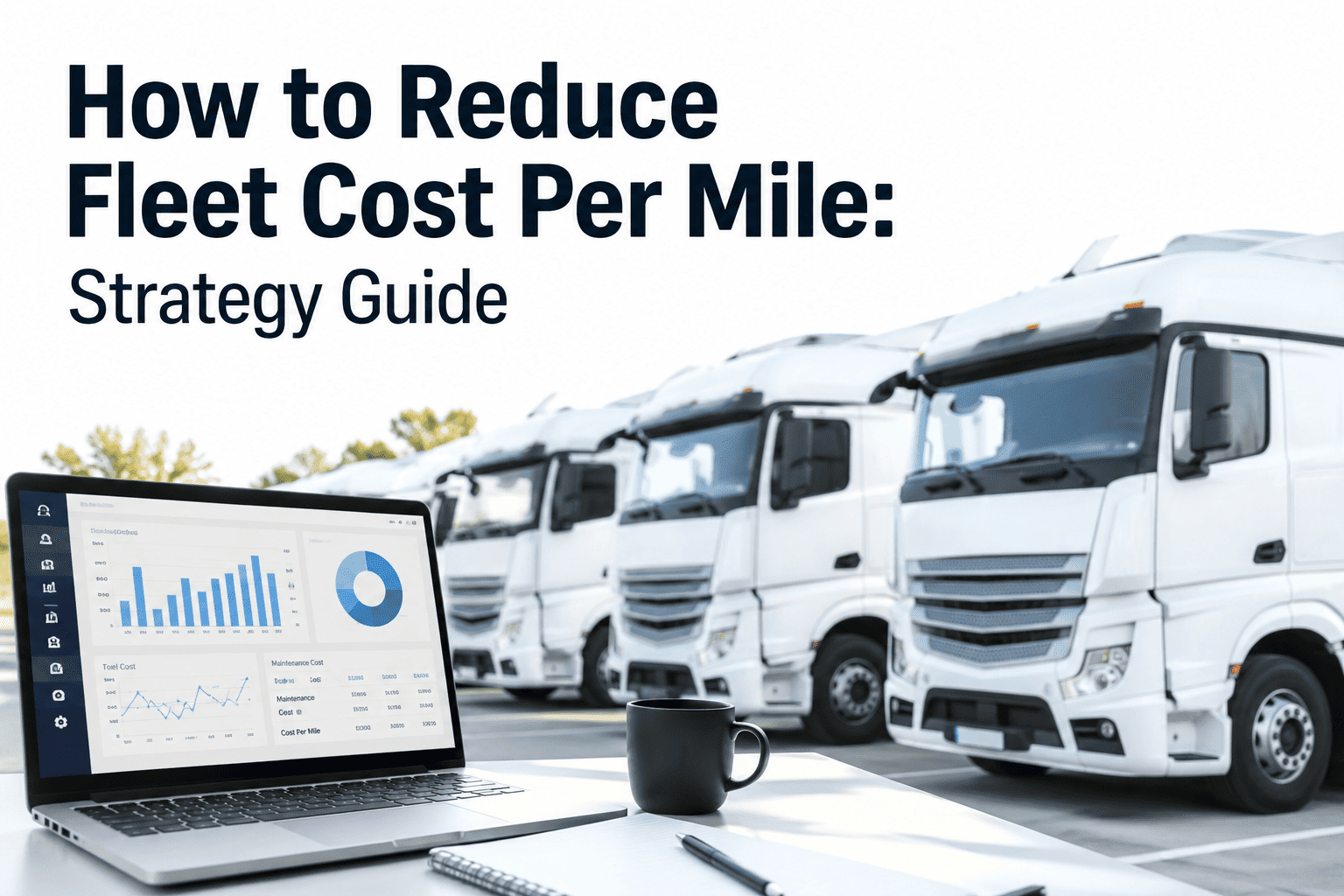
How to Reduce Fleet Cost Per Mile: Proven Strategies
By Jack Miller on April 8, 2026
A regional trucking company in Texas was running a 186-vehicle mixed fleet at $0.74 per mile in total operating cost. Their competitor — same routes, similar vehicles, comparable freight density — was running at $0.51 per mile. The $0.23 difference doesn't sound like much until you multiply it by 8.4 million miles driven annually: $1.93 million in excess operating cost, every year, from the same roads, the same fuel prices, and roughly the same labour market. The difference was almost entirely in how maintenance was managed, how fuel consumption was tracked, how driver behaviour was monitored, and how vehicle replacement decisions were made. None of these are operational mysteries — they are data problems. OxMaint's fleet analytics platform surfaces the cost-per-mile breakdown for every vehicle in your fleet, identifies the highest-cost outliers, and tells you exactly which intervention — a PM change, a driver coaching session, or a vehicle replacement — will move the number. Book a demo to see your fleet's cost-per-mile dashboard.
Cut Your Fleet Cost Per Mile — Starting With Your Top 10% Outliers
AI-driven cost analysis, per-vehicle breakdowns, and automated savings alerts — one platform
Average gap between best-in-class and average fleets on total cost per mile
4.2×
Cost multiplier for reactive repair vs planned PM — the single largest cost-per-mile lever
23%
Average total operating cost reduction in year 1 after deploying AI-driven fleet analytics
The 6 Cost-Per-Mile Drivers — Where Your Money Actually Goes
Fleet cost per mile has six components. Most fleet managers focus on fuel — the most visible line — while the highest-leverage opportunities sit in maintenance, vehicle age, and driver behaviour. OxMaint breaks every dollar into its source so you can act on the highest-return lever first.
1
Maintenance & Repair
28–35% of total CPM
The highest-leverage cost driver. Reactive maintenance costs 4.2× more than planned PM. Every $1 in unplanned repair carries $3–$5 in hidden costs — downtime, towing, rental units, and expedited parts.
2
Fuel Consumption
25–32% of total CPM
Under-inflated tyres add $0.04–$0.07/mi. Aggressive driving adds $0.06–$0.12/mi. Idling more than 10% of engine hours burns $1,200–$2,800 per vehicle annually in fuel with zero productive miles.
3
Depreciation & Capital Cost
18–24% of total CPM
Holding a vehicle past its optimal replacement point accelerates maintenance cost faster than the depreciation savings justify. AI lifecycle analysis identifies the exact mileage where disposal saves money versus continued operation.
4
Labour & Administration
12–18% of total CPM
Technicians spending 40% of their shift on admin, parts chasing, and job lookup instead of turning wrenches is a direct cost-per-mile problem. CMMS work order automation recovers 28% of technician productive time.
5
Insurance & Risk
8–12% of total CPM
Driver safety scores directly influence premium rates at renewal. Fleets reducing incident rates by 40% typically see 8–15% premium reduction. OxMaint safety dashboards track the metrics insurers ask for at underwriting.
6
Tyres, Parts & Consumables
5–8% of total CPM
Emergency parts sourcing at retail rates versus planned procurement at contract rates adds $180–$420 per unplanned repair event. Parts forecasting from PM schedules eliminates the premium entirely.
Fleet Analytics — OxMaint
See Your Fleet's Cost Per Mile — By Vehicle, By Driver, By Route.
OxMaint calculates CPM across all six cost drivers for every vehicle in your fleet — and ranks your highest-cost outliers so you know where to act first.
Replace fixed-calendar PM with telematics-driven intervals per vehicle. Eliminates both over-service (wasted cost) and under-service (failure cost). Average saving: $0.03–$0.06/mi.
Lever 2
Driver Behaviour Coaching
OBD-connected telematics identifies harsh braking, aggressive acceleration, and excessive idling per driver. Targeted coaching reduces fuel cost by $0.04–$0.09/mi and accident frequency by 30–45%.
Lever 3
Digital Twin Replacement Timing
AI models the exact mileage where each vehicle's total cost of ownership flips — where continued operation costs more than replacement. Precision disposal saves $0.04–$0.11/mi on high-age vehicles.
Lever 4
SAP Parts Procurement Integration
OxMaint PM forecasts trigger SAP purchase orders at contract rates before parts are needed. Eliminates emergency procurement premiums averaging $280 per unplanned repair event.
Lever 5
AI Camera Vision Inspection
Computer vision during pre-trip inspections detects tyre wear, brake condition, and visible damage before the vehicle leaves the yard — preventing the high-cost roadside failures that double CPM on the day they occur.
CPM Benchmarks — Where Does Your Fleet Sit?
US fleet cost-per-mile benchmarks vary significantly by vehicle class and operation type. The table below shows 2024 median CPM versus top-quartile performance — and the specific maintenance contribution to the gap.
Vehicle Class
Median CPM
Top Quartile
Maintenance Share
Primary Lever
Class 8 Long-Haul
$0.74
$0.51
$0.22 (30%)
PM interval optimisation
Class 6–7 Regional
$0.88
$0.63
$0.26 (29%)
Brake & tyre PM frequency
LCV / Delivery Van
$0.62
$0.44
$0.18 (29%)
Driver behaviour coaching
Urban Transit Bus
$1.24
$0.91
$0.44 (35%)
Engine hours-based PM
Municipal / Refuse
$1.68
$1.22
$0.57 (34%)
Hydraulic system PM
Light Passenger
$0.38
$0.28
$0.11 (29%)
Multi-trigger PM scheduling
The Cost of Inaction — What Every Deferred PM Really Costs
Every deferred PM has a downstream cost that is always larger than the PM itself. The comparison below shows the compounding effect of deferring the five most common fleet PMs — using US fleet average failure costs from ATRI and ATA data.
Brake Inspection
Deferred 8,000 mi past interval
PM cost if done on time
$180
Roadside brake failure cost
$3,200–$8,400
Downtime (days)
2–4 days
Cost multiplier
17–47×
Engine Oil Change
Deferred 5,000 mi past interval
PM cost if done on time
$120
Engine failure / rebuild
$8,000–$22,000
Downtime (days)
5–14 days
Cost multiplier
66–183×
Tyre Rotation / Inflation
Missed 3 consecutive cycles
PM cost if done on time
$60
Premature tyre set replacement
$1,800–$4,200
Extra fuel cost (under-inflation)
$380–$720/yr
Cost multiplier
30–70×
We were running at $0.81 per mile on our Class 6 regional fleet. After 14 months on OxMaint — AI-optimised PM intervals, driver coaching dashboards, and parts procurement integration — we're at $0.59. On 4.2 million annual miles, that's $924,000 back in the budget every year.
Insurance and Total Cost — How Lower CPM Improves Every Line
Cutting cost per mile is not just a maintenance story. Every improvement in the maintenance line improves the insurance line, the compliance line, and the vehicle residual value line simultaneously. OxMaint tracks the downstream benefit of every PM programme improvement across the full cost-per-mile model.
Insurance Premium Impact
Fleets with documented PM programmes and safety scores qualify for 5–15% premium discounts — saving $8,000–$40,000 annually. OxMaint generates the compliance evidence insurers require at renewal.
Compliance Cost Reduction
FMCSA out-of-service violations average $16,500 per incident in direct fines, downtime, and remediation. OxMaint's automated inspection scheduling eliminates the missed service that creates compliance exposure.
Residual Value Protection
Vehicles with complete OxMaint service records command $2,200–$6,800 higher auction value than identical vehicles with incomplete maintenance histories — directly reducing net depreciation cost per mile.
Driver Retention Savings
Fleets with transparent safety scorecards and driver recognition programmes retain drivers 34% longer. At $8,000–$12,000 per driver replacement cost, retention improvement is a direct CPM lever.
Frequently Asked Questions
What is a good fleet cost per mile target for Class 8 trucks in the US?
Top-quartile Class 8 operators run $0.48–$0.54/mi total CPM. The industry median is $0.71–$0.78/mi. If you're above $0.80/mi, the maintenance and fuel lines are the highest-return starting points.
How does OxMaint calculate cost per mile per vehicle?
OxMaint aggregates all closed work orders, parts consumed, labour time, and fuel data from telematics against each vehicle's actual mileage — generating a live CPM figure updated with every completed job.
How quickly does AI-optimised PM reduce maintenance cost per mile?
Most fleets see measurable reduction within 60–90 days of deploying OxMaint AI interval optimisation. The full annual impact — fewer breakdowns, fewer emergency repairs — typically compounds over 6–12 months.
Which vehicle in a fleet typically has the highest cost per mile?
The highest-CPM vehicle is almost always the oldest unit in the fleet that is past its economic replacement point. OxMaint's lifecycle analytics identifies it within days of data onboarding and quantifies the monthly cost of continued operation.
Can OxMaint integrate with existing telematics and ERP systems?
Yes — OxMaint connects via API to major telematics platforms (Samsara, Geotab, Verizon) and ERP systems (SAP, Oracle). Cost data flows automatically without manual entry or spreadsheet reconciliation.