Fleet Cost Reduction Strategies: 10 Proven Ways to Lower Total Cost of Ownership
By Matt Caldwell on March 19, 2026
Fleet total cost of ownership is the number that most fleet budgets are built around but few organizations measure correctly. Direct costs — fuel, maintenance, insurance, and depreciation — are tracked. Indirect costs — driver downtime, missed delivery penalties, emergency parts premiums, and the administrative overhead of managing compliance manually — are rarely captured in the same ledger. In practice, the gap between tracked costs and actual fleet TCO runs 18–25% for most mid-size commercial operations, which means cost reduction initiatives targeting only visible line items systematically miss the largest saving opportunities. CMMS platforms like OxMaint address this by aggregating every cost dimension — maintenance, fuel, downtime, procurement, compliance — into a unified analytics layer that identifies where money is leaving the operation and quantifies the intervention value before the investment is made. This guide covers all ten proven fleet cost reduction strategies that CFOs and fleet directors can implement in 2026 — with documented saving ranges, implementation timelines, and the analytics framework that makes each strategy measurable.
Fleet Finance · Blog · 2026
Fleet Cost Reduction Strategies: 10 Proven Ways to Lower Total Cost of Ownership
Ten documented fleet TCO reduction strategies — PM optimization, fuel management, driver training, right-sizing, lifecycle planning, tire management, parts procurement, vendor negotiation, technology ROI, and CMMS analytics — with saving ranges and implementation timelines for each.
25%Of fleet TCO goes untracked — indirect costs missed in standard budget reporting
$0.72Average total cost per mile for a commercial fleet vehicle in 2026, all costs included
22%Average fleet TCO reduction achievable by combining all 10 strategies in a structured program
4.8×Higher cost per repair event for unplanned vs. planned maintenance — the single highest-impact cost lever
Understanding Fleet TCO: What Actually Drives Your Cost Per Mile
Before applying cost reduction strategies, fleet directors need a complete TCO model that captures every cost dimension. Most fleet budgets track five cost lines: fuel, maintenance labor, parts, insurance, and depreciation. A complete TCO model adds seven more: driver downtime from unscheduled maintenance, emergency parts sourcing premiums, towing costs, missed delivery penalties, administrative labor for compliance management, over-fleet capacity costs from poor right-sizing, and end-of-life vehicle replacement costs driven by suboptimal lifecycle planning. The organizations that achieve 20%+ TCO reductions are those that measure all twelve dimensions — because the largest savings almost always come from the seven that are rarely tracked.
Fleet TCO Components — Tracked vs. Hidden Costs
Tracked in Most Budgets
28%Fuel
18%Maintenance labor
14%Parts & consumables
16%Insurance & registration
12%Depreciation
Hidden in Most Budgets
4%Driver downtime (unscheduled)
3%Emergency parts premium
2%Towing & roadside costs
2%Missed delivery penalties
1%Compliance admin labor
The 12% of costs in the hidden column typically represent 35–45% of achievable cost reduction — because they are never targeted for optimization
The 10 Fleet Cost Reduction Strategies — Ranked by Average Annual Saving
01
PM Interval Optimization
$1,200–$2,800 / vehicle / year
Correctly calibrated PM intervals — matching trigger type to duty cycle and applying first-to-occur scheduling — reduce both over-maintenance waste and the 4.8× cost penalty of deferred service. Most fleets run either too frequent (wasting labor and parts) or too infrequent (generating failure costs). OxMaint's CMMS PM scheduling uses live telematics data to trigger work orders at the precise interval — eliminating both failure modes simultaneously.
Payback: 30–60 days
Easy to implement
02
Fuel Management Program
$800–$2,200 / vehicle / year
Idling reduction, driver behavior coaching, route optimization, and tire pressure management each deliver independent fuel savings that compound when deployed together. A structured fuel management program integrating telematics-driven idling alerts, route enforcement, and fuel card analytics achieves 12–18% fuel cost reduction at fleet scale — the largest single-category saving for most operations.
Payback: 30–90 days
Moderate effort
03
Driver Training and Behavior Coaching
$600–$1,800 / vehicle / year
Driver behavior simultaneously affects fuel cost (15–25% variance between high and low performers), accident frequency (38% of incidents are behavior-driven), vehicle wear (aggressive driving accelerates brake and suspension wear 30–40%), and insurance premiums (12-month behavior documentation unlocks 8–15% premium reductions). Driver coaching ROI is unique because it improves four cost lines simultaneously — making it the highest compound-return strategy per investment dollar.
Payback: 60–90 days
Moderate effort
04
Fleet Right-Sizing
$4,200–$12,000 / excess vehicle / year
Over-fleeting is one of the most expensive and least-discussed cost drivers in commercial fleet operations. A vehicle that sits idle 40% of available operating time still costs full depreciation, insurance, registration, and periodic PM — typically $8,000–$14,000 annually depending on vehicle class. GPS utilization data and trip history analysis identify vehicles operating below threshold utilization (typically <55% of available hours). Right-sizing to actual demand, supplemented by short-term rental for peak periods, eliminates these carrying costs permanently.
Payback: Immediate on disposal
Requires analysis
05
Vehicle Lifecycle Optimization
$1,800–$5,500 / vehicle / lifecycle
The optimal replacement point for a commercial vehicle is when total cost per mile (depreciation + maintenance) reaches its minimum — which typically occurs between 4–7 years for light commercial and 6–10 years for heavy commercial, but varies significantly by duty cycle and maintenance history. Holding vehicles too long past this point generates accelerating maintenance costs that exceed the savings on depreciation. Disposing too early sacrifices usable service life. CMMS lifecycle analytics calculate the cost-per-mile trend per vehicle and generate replacement recommendations at the optimal point.
Payback: 6–18 months
Requires analytics
06
Tire Management Program
$400–$900 / vehicle / year
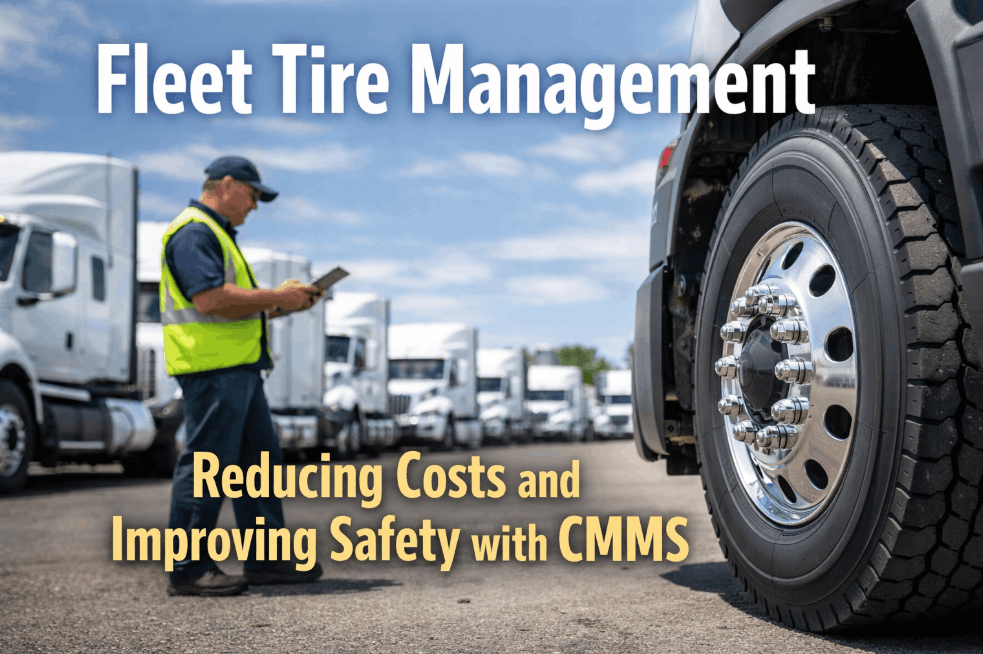
Tire costs are the second-largest maintenance line item for most commercial fleets — and the one with the most systematic waste from poor management. Under-inflation accelerates wear and increases fuel consumption simultaneously. Incorrect rotation intervals produce uneven wear patterns that shorten tire life 20–35%. Retreading eligible tires on eligible routes reduces tire cost per mile by 40–60% versus new tires. A structured tire management program with TPMS monitoring, rotation tracking, and retread qualification generates $400–$900 per vehicle annually with minimal capital investment.
Payback: 60–120 days
Easy to implement
07
Parts Procurement Optimization
$280–$650 / vehicle / year
Emergency parts sourcing carries a 15–30% price premium over planned procurement — and most fleets spend 25–35% of their parts budget at emergency rates because their maintenance scheduling does not provide sufficient lead time for planned purchasing. Shifting to CMMS-generated work orders with 10–14 days advance notice converts emergency procurement to planned purchasing. Combining planned procurement with fleet-wide volume consolidation — buying all brake pads for 40 vehicles simultaneously rather than one vehicle at a time — unlocks additional 8–15% volume discounts from most major suppliers.
Payback: 30–60 days
Easy to implement
08
Vendor Contract Negotiation
$180–$520 / vehicle / year
Fleet maintenance vendors — tire dealers, fuel suppliers, third-party repair shops — set contract pricing based on estimated volume and payment reliability. Fleets that bring documented utilization data, predictable volume forecasts, and reliable payment records consistently negotiate 8–18% lower rates than those without this documentation. CMMS-generated vendor performance reports also provide the factual basis for renegotiating underperforming contracts — labor rate, parts markup, and completion time benchmarks that most fleets currently accept because they lack the data to challenge them.
Payback: At next renewal
Moderate effort
09
Technology Stack Consolidation
$120–$380 / vehicle / year
The average mid-size commercial fleet in 2026 pays for 4–6 separate software subscriptions across GPS tracking, maintenance scheduling, compliance management, fuel analytics, and driver monitoring — systems that do not share data, require duplicate data entry, and each add administrative overhead. Consolidating into a unified platform like OxMaint eliminates subscription redundancy (average saving: $65–$140 per vehicle per year), removes the manual data transfer labor between systems, and unlocks the analytics capabilities that only exist when maintenance, fuel, location, and driver data are in the same database.
Payback: At consolidation
Moderate effort
10
CMMS-Driven Cost Analytics
Unlocks savings from all 9 strategies above
The ten strategies in this guide are not independent interventions — they compound when driven from a unified analytics platform that tracks cost per vehicle, cost per mile, cost per maintenance event, cost per driver, and cost per route simultaneously. The fleet that measures all twelve TCO dimensions, attributes costs to their specific drivers, and evaluates each strategy against documented baselines will consistently find 20–25% more reduction opportunity than the fleet estimating from industry benchmarks. CMMS analytics is not a cost reduction strategy by itself — it is the infrastructure that makes every other strategy measurable, targetable, and accountable.
Payback: 30–60 days
Foundation of all others
Combined TCO Impact: What These Strategies Deliver at Fleet Scale
The ten strategies above are not mutually exclusive — and their savings compound when implemented together. A fleet that deploys PM optimization, fuel management, driver coaching, and right-sizing simultaneously does not simply add the individual savings; the strategies reinforce each other. Better-maintained vehicles get better fuel economy. Better-behaved drivers generate fewer maintenance events. Right-sized fleets run higher utilization per vehicle, improving cost efficiency across every per-vehicle metric. The following projection models the combined impact for a representative 40-vehicle commercial fleet.
Assumes 40-vehicle mixed-duty fleet with current annual spend of ~$1.3M. Represents 22% TCO reduction — within the documented range for structured fleet cost programs in 2026
Start Measuring Every Cost Driver in Your Fleet Today
OxMaint's CMMS analytics platform tracks all 12 TCO dimensions — maintenance, fuel, downtime, procurement, and compliance — giving you the data to target every strategy above. Free to start.
Implementation Priority: Where to Start for Fastest ROI
With ten strategies available, the question for fleet directors and CFOs is sequencing — which to deploy first for fastest return and which to sequence later. The answer is driven by implementation effort relative to saving size and payback timeline. Three strategies consistently deliver the fastest payback with the least organizational resistance: PM optimization (30–60 day payback, no capital investment, pure process change), parts procurement optimization (immediate saving on all future orders once CMMS work orders provide lead time), and fuel management (telematics-driven idling alerts alone typically recover platform costs within 6 weeks).
Implementation Priority Matrix — Effort vs. Annual Saving
High Saving · Low Effort
Start here — fastest ROI
PM Optimization
Parts Procurement
Fuel Management
High Saving · High Effort
Plan carefully — big returns
Fleet Right-Sizing
Lifecycle Optimization
Driver Coaching Program
Moderate Saving · Low Effort
Layer in — quick wins
Tire Management
Tech Consolidation
CMMS Analytics
Moderate Saving · High Effort
Do at renewal cycles
Vendor Renegotiation
Insurance Review
Procurement Contracts
Frequently Asked Questions
What is a realistic fleet TCO reduction target for a first-year program?
A structured first-year fleet cost reduction program targeting PM optimization, fuel management, and parts procurement — the three fastest-payback strategies — typically delivers 12–16% TCO reduction. Adding driver coaching and right-sizing analysis brings that to 18–22% in Year 1. The key is establishing a complete cost baseline before deployment so improvements are attributed accurately. OxMaint's TCO analytics builds that baseline automatically from your first week of connected data.
How do you calculate true fleet cost per mile?
True cost per mile includes all twelve TCO components divided by total fleet miles for the period. Most fleet reports use only direct costs (fuel + labor + parts), which understates actual CPM by 18–25%. The correct calculation adds indirect costs — downtime, emergency premiums, towing, penalties, and compliance labor — to the direct total before dividing by mileage. Book a demo to see how OxMaint calculates and tracks true CPM per vehicle automatically.
At what fleet size do structured cost reduction programs make economic sense?
Structured fleet cost reduction programs deliver measurable ROI at 10+ vehicles — the administrative overhead of CMMS deployment is trivial relative to the saving at any scale above that. The per-vehicle saving is consistent regardless of fleet size; total program ROI obviously scales with vehicle count. Fleets of 10–20 vehicles typically see payback within 45–60 days on the first implemented strategy alone. Sign up for OxMaint free — there is no minimum fleet size for the platform.
How does right-sizing analysis work in practice?
Right-sizing analysis uses 12 months of GPS utilization data — hours operated, trips completed, mileage accumulated, and load records — to calculate each vehicle's utilization rate against its available capacity. Vehicles consistently below 55% utilization are candidates for disposal or redeployment. The analysis also identifies seasonal demand patterns, so fleets can right-size to base demand and supplement with short-term rentals during peak periods — eliminating year-round carrying costs for capacity used only 8–12 weeks annually. OxMaint's utilization reports generate this analysis automatically from your GPS telematics data.
Your Fleet Has $285K+ in Recoverable Cost Sitting in These 10 Strategies.
OxMaint's CMMS platform provides the analytics foundation for all ten fleet cost reduction strategies — tracking every TCO dimension, triggering PM work orders automatically, attributing fuel and maintenance costs per vehicle, and generating the data that makes every strategy measurable, targetable, and accountable. Reduce fleet TCO by 22%, eliminate hidden costs you are currently absorbing, and build the cost visibility that CFOs and fleet directors need to make defensible budget decisions. Free to start. No hardware required. Join 1,000+ fleets managing TCO with OxMaint.