Fleet Cybersecurity Guide: Protect Against Ransomware & GPS Spoofing
By Jack Miller on April 10, 2026
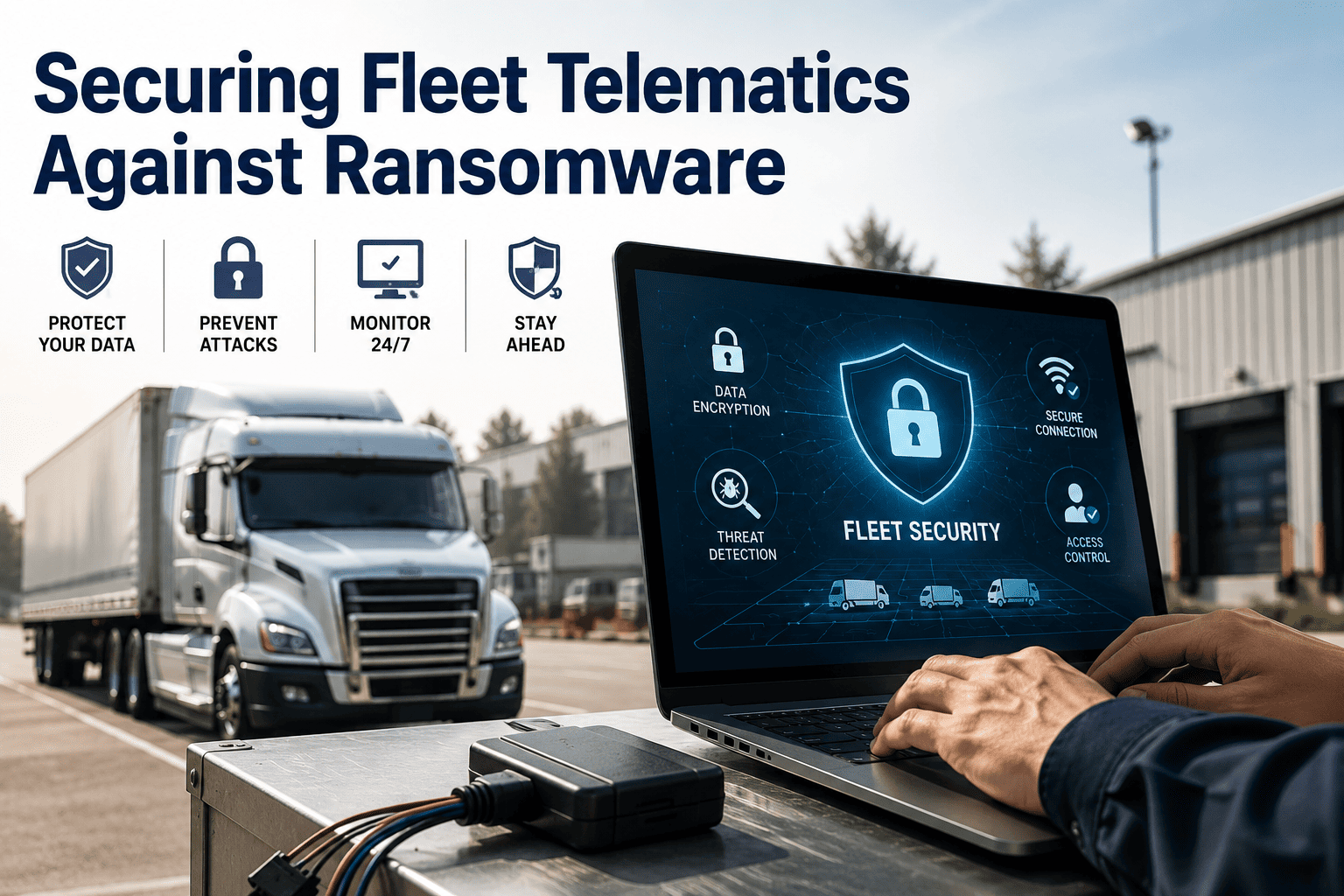
A national freight carrier in Charlotte lost access to their entire fleet management platform on a Wednesday morning in October — ransomware had encrypted the telematics server, the dispatch system, and the maintenance records database simultaneously. 340 trucks were on the road with no GPS tracking, no route data, and no way to communicate work orders to technicians. It took 11 days to restore operations from backup. The ransom demand was $2.4 million. The actual recovery cost — including the IT contractor, the operations disruption, the overtime, and the lost contracts — exceeded $3.1 million. The attack vector was a compromised telematics device that had not been patched for 14 months because nobody had a system tracking firmware update status across the fleet. Modern connected fleets are networks of hundreds of internet-connected endpoints — OBD devices, GPS trackers, ELD units, AI cameras, and maintenance platforms — and every unpatched device is an open door. OxMaint's secure fleet architecture enforces encrypted data transmission, access control, and device health monitoring across your entire connected fleet infrastructure.
Protect Your Connected Fleet from Ransomware, GPS Spoofing & Telematics Attacks
Encrypted transmission, access control, device health monitoring, and zero-trust fleet architecture — OxMaint secure by design
Of fleet cyberattacks in 2025 entered through unpatched or poorly secured telematics and OBD devices — FBI Cyber Division
340%
Increase in ransomware attacks targeting commercial fleet and logistics operators — 2023 to 2025 (CrowdStrike)
Six Cybersecurity Threats That Target Connected Fleets in 2026
Connected fleet vehicles are not just trucks — they are mobile networks carrying OBD devices, GPS trackers, AI cameras, ELD units, temperature sensors, and cellular modems, all transmitting data continuously. Each connected device is a potential attack surface. OxMaint's fleet security architecture addresses all six threat vectors with layered controls built into the platform — not bolted on after the fact.
Ransomware via Telematics Device
Most costly — targets fleet management servers
Unpatched telematics devices create a direct network path to fleet management infrastructure. Attackers exploit known firmware vulnerabilities in OBD dongles, GPS trackers, and ELD units to pivot from the device to the fleet management server. OxMaint enforces device firmware version monitoring and quarantines devices running known-vulnerable firmware before they can be exploited.
GPS Spoofing & Location Manipulation
Cargo theft enabler — falsifies vehicle location
GPS spoofing injects false location signals that cause the fleet management system to show a vehicle at a legitimate location while it is actually being diverted. High-value cargo theft operations in the USA increasingly use GPS spoofing as a first step. OxMaint cross-validates GPS data against cellular tower triangulation and detects location anomalies that indicate spoofing activity.
Telematics Network Interception
Data theft — unencrypted fleet data streams
Fleet telematics data transmitted without TLS 1.3 encryption is readable by any party with access to the cellular network path — including route data, driver schedules, cargo manifests, and vehicle locations. OxMaint enforces AES-256 encryption for all data at rest and TLS 1.3 for all data in transit, with certificate pinning that prevents man-in-the-middle attacks.
Unauthorized Access to Fleet Platform
Credential theft — dispatcher and maintenance system
Fleet management platforms accessed with stolen or brute-forced credentials allow attackers to modify routes, access driver data, read maintenance histories, and plant malware through the platform's legitimate data paths. OxMaint enforces multi-factor authentication, role-based access control, and anomalous login detection that triggers immediate account lockout on suspicious access patterns.
OBD & CAN Bus Injection
Vehicle control attack — diagnostic port exploitation
Physical access to a vehicle's OBD-II port enables injection of malicious CAN bus messages that can alter speedometer readings, disable safety systems, or brick the ECU. A single compromised vehicle in a yard can be used to attack others through the fleet network. OxMaint monitors OBD access events and flags unauthorized diagnostic sessions in real time.
Supply Chain & Vendor Access Compromise
Third-party risk — telematics and parts suppliers
Fleet management platforms that grant broad API access to telematics vendors and maintenance suppliers create supply chain attack surfaces — a compromised vendor becomes a backdoor into the fleet's operational data. OxMaint's zero-trust vendor access model grants suppliers minimum-required API permissions with audit logging of every data access event.
OxMaint — Fleet Cybersecurity
Every Connected Device Monitored. Every Access Controlled. Every Data Stream Encrypted.
Ransomware protection, GPS spoofing detection, TLS 1.3 encryption, MFA, and zero-trust vendor access — fleet security built into the platform.
Secured vs Unsecured Fleet Infrastructure — Annual Risk Exposure
These three tiers show the annual cyber risk exposure for a 150-vehicle connected fleet at each level of security maturity — based on actual incident data from US fleet operators and cybersecurity insurance underwriting benchmarks for commercial transportation companies in 2025–2026. OxMaint's secure architecture brings every fleet to the protected tier from day one.
OxMaint fleet security is not a checklist of features — it is a layered architecture where encryption, access control, device monitoring, and anomaly detection operate simultaneously across every connected endpoint in the fleet. Four technology integrations make the security posture active, not passive. OxMaint's security architecture documentation is available for IT and risk teams on request.
Zero-Trust Access Architecture
OxMaint implements zero-trust access for all users and API integrations — every access request is verified regardless of network origin. Role-based permissions ensure technicians, dispatchers, and managers access only the data and functions required for their role. Vendor API access is scoped to minimum required permissions with full audit logging of every data access event per vendor.
Device Health & Firmware Monitoring
OxMaint continuously monitors the firmware version of every OBD device, GPS tracker, and ELD unit in the fleet — flagging devices running versions with known CVEs and generating a maintenance work order for update. Devices with critically vulnerable firmware are quarantined from the main fleet network until patched, preventing them from serving as ransomware entry points.
AI Anomaly Detection — GPS & Behaviour
OxMaint AI analyses GPS track patterns, login behaviour, and API access patterns continuously — detecting GPS spoofing via cellular triangulation cross-validation, unusual login locations via geofence alerts, and abnormal API access patterns that indicate credential compromise. Anomalies trigger immediate alerts to the fleet security administrator and automatic session suspension pending verification.
SAP & ERP Secure Integration
OxMaint's SAP and ERP integration uses OAuth 2.0 token authentication with IP allowlisting — no shared passwords, no broad database access grants. Data exchange is scoped per-transaction with field-level encryption for sensitive records including driver personal data, cargo manifests, and financial transactions. All integration traffic is logged per record for compliance audit retrieval.
"Our cyber insurance carrier required a security audit before renewal. OxMaint's zero-trust architecture, device firmware monitoring, and encrypted data transmission passed the audit without any remediation items. Our premium dropped $28,000. The security features were already in the platform — we didn't add anything."
— VP of IT & Fleet Operations, National LTL Carrier · 280 vehicles · North Carolina, USA
Frequently Asked Questions
Q1Does OxMaint use end-to-end encryption for all vehicle telematics data?▼
Yes — all data in transit uses TLS 1.3 with certificate pinning that blocks man-in-the-middle interception. All data at rest is AES-256 encrypted. OxMaint does not store decryption keys on the same infrastructure as the encrypted data — a standard separation-of-duties encryption architecture.
Q2How does OxMaint detect GPS spoofing on a vehicle in real time?▼
OxMaint cross-validates GPS coordinates against cellular tower triangulation data on a configurable interval. When the GPS position deviates from cellular-derived position by more than a configurable threshold, OxMaint generates a spoofing alert to the fleet manager and dispatch, with the last verified cellular position shown alongside the GPS position for comparison.
Q3Does OxMaint support multi-factor authentication for all user roles?▼
Yes — OxMaint enforces MFA for all admin and manager accounts by default, with configurable MFA requirement for technician mobile accounts. Supported MFA methods include TOTP authenticator apps (Google Authenticator, Microsoft Authenticator), SMS, and hardware keys. MFA bypass attempts are logged and trigger immediate admin notification.
Q4How does OxMaint handle a ransomware incident if the fleet management server is compromised?▼
OxMaint's cloud architecture uses isolated tenant environments — a compromise of one customer's environment cannot propagate to others. Automated backups run every 4 hours with 30-day retention in geographically separated storage. Most OxMaint customers restore to full operational status within 4 hours of a ransomware event using backup restoration — not 11 days.
Q5Is OxMaint compliant with NIST Cybersecurity Framework and SOC 2 standards?▼
OxMaint is SOC 2 Type II certified and aligns to NIST CSF controls for fleet data and operational technology environments. Security documentation, penetration test reports, and compliance certificates are available to enterprise customers for cyber insurance, vendor risk assessments, and internal IT security reviews upon request.