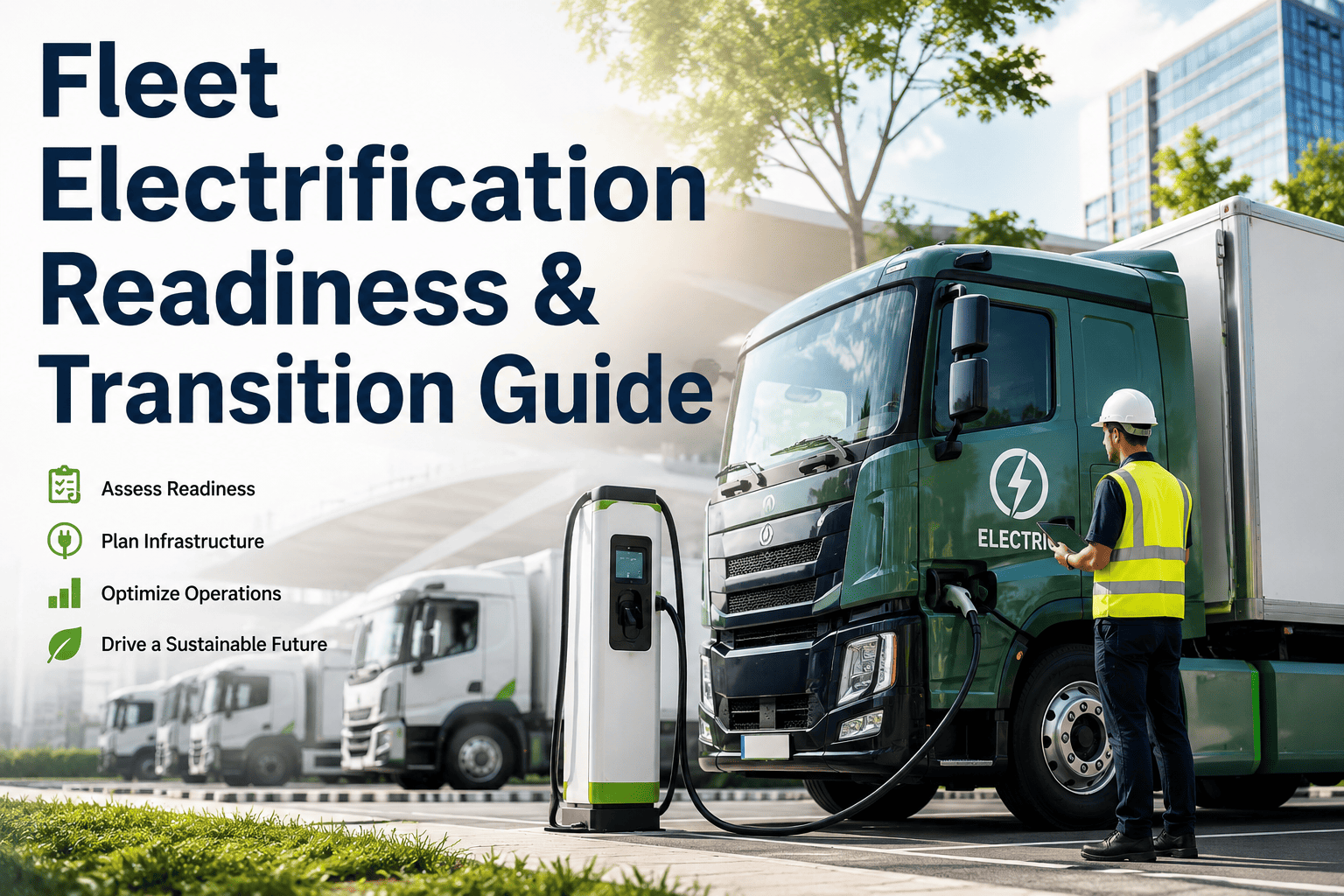
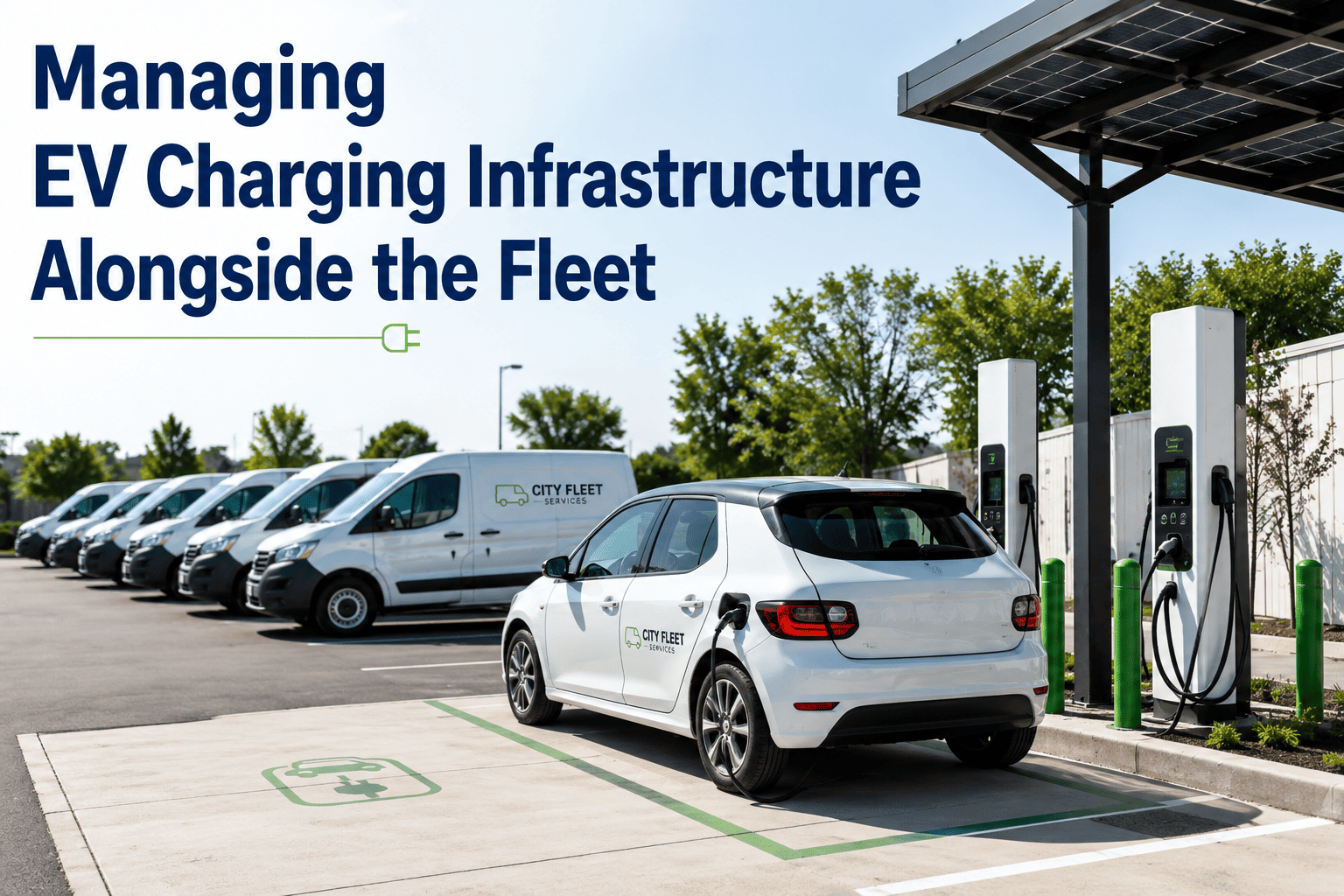
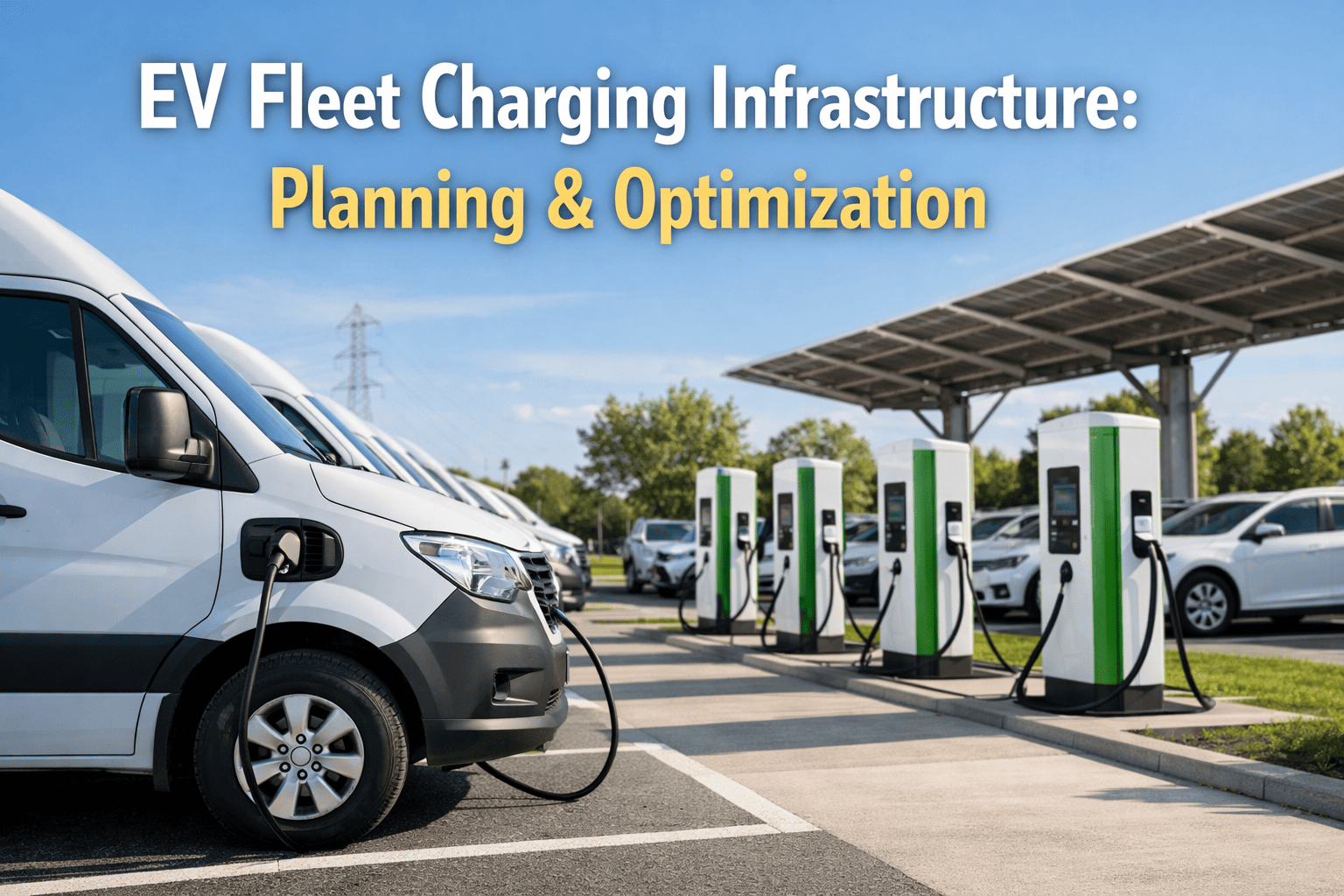
A Fleet Director at a 380-vehicle manufacturing group in the East Midlands described his pre-electrification planning reality in four words: "spreadsheets, guesswork, and diesel." TCO modelling was done annually in Excel, vehicle replacement decisions were made on gut feel and supplier relationships, and the carbon reporting his board required every quarter was assembled manually from fuel cards and mileage logs. When the group moved to a structured fleet electrification management platform, they identified that 22% of their ICE fleet was ready for immediate EV replacement — and that those vehicles alone would recover the platform investment in under 14 months. The spreadsheets are still there. They are just no longer the strategy.
Fleet Electrification Roadmap: Planning the Transition from ICE to EV
A strategic guide for Fleet Strategy & Sustainability Directors across the US, UK, Germany, Canada, Australia, and UAE — covering TCO modelling, vehicle selection, charging infrastructure, grid capacity, and phased deployment timelines.
What Unplanned ICE Fleet Operations Are Actually Costing You
The argument for delaying fleet electrification is always the same: "The business case isn't clear yet." The problem is not the business case — the data consistently supports electrification. The problem is that without a structured fleet electrification planning platform, there is no model connecting today's fuel spend, maintenance cost, and carbon liability to a phased transition plan with defined financial outcomes. Sign up for Oxmaint to start building your fleet electrification roadmap with real TCO data.
The fleet budget shows acquisition cost and fuel spend. It does not show the full 8-year cost picture — including escalating carbon levies, rising diesel maintenance complexity, residual value collapse on ICE assets, and the insurance premium increases tied to emissions zone non-compliance. Fleet directors who model true TCO rather than sticker price consistently find the EV case closes 2–3 years earlier than initial assumptions suggested.
ZEV mandates, ULEZ expansions, EU emissions trading scheme extensions, and US Clean Air Act fleet regulations are not future risks — they are active P&L items. Every ICE vehicle operating in a regulated zone after its applicable deadline triggers a direct cost. Fleets without a fleet decarbonisation roadmap are building undisclosed regulatory liability into their balance sheet every quarter.
ICE fleet maintenance complexity — and cost — increases non-linearly with vehicle age. The same drivetrain components that cost £280 to replace at year 4 cost £640 at year 7, because diagnostic time increases, part availability narrows, and specialist technician availability declines. Fleets with no EV fleet conversion plan are committing to an escalating cost curve with no ceiling, while EV maintenance costs remain structurally flat after the battery warranty period.
Fuel card data lives in one system. Maintenance records in another. Telematics in a third. Carbon reporting is a quarterly manual exercise. Without unified fleet data flowing into a single electrification planning model, it is structurally impossible to identify which vehicles to electrify first, which depots to prioritise for charging infrastructure, or what the phased transition financial profile actually looks like. Book a demo to see how Oxmaint unifies fleet data into a single electrification roadmap.
How a Structured Fleet Electrification Roadmap Works End-to-End
The lifecycle of a successful ICE to EV fleet transition follows five defined phases — each one producing data and infrastructure that the next phase depends on. This is what separates a fleet electrification programme from a procurement exercise: every phase is linked, every output feeds the next, and the completed transition is financially documented from first vehicle to last.
Fleet Audit & TCO Model
Map every vehicle against duty cycle, daily range, and replacement timeline. Build 8-year ICE vs EV TCO model per vehicle segment.
Vehicle Selection & Prioritisation
Score fleet segments against EV suitability criteria. Identify immediate, medium-term, and long-horizon conversion candidates.
Infrastructure & Grid Planning
Grid capacity assessment per depot. Charger type selection, load management design, DNO application, and BESS evaluation where required.
Phased Deployment & Integration
Pilot 10–20 EVs at one depot. Deploy SAP, OBD telematics, and digital twin. Scale across depots using validated data from pilot phase.
Full Fleet & Carbon Reporting
Complete ICE phase-out. Activate V2G where available. Automate Scope 1 carbon reporting. Deliver board-level ESG dashboard.
Core Capabilities of a Best-in-Class Fleet Electrification Platform
When evaluating fleet electrification management software, the capabilities below separate a genuine EV transition planning tool from a spreadsheet with an interface. Each maps to a specific operational problem that informal fleet management cannot solve at programme scale. Sign up to explore every capability in Oxmaint — free to start.
Unplanned ICE Fleet vs. Structured EV Electrification Programme
The comparison below covers the dimensions that matter to Fleet Directors, CFOs, and VP Operations teams evaluating a transition from reactive ICE fleet management to a structured EV fleet conversion programme.
| Fleet Dimension | Reactive ICE Fleet | Oxmaint EV Programme |
|---|---|---|
| TCO Visibility | Annual Excel model — excludes levies and residual value | Live 8-year model per vehicle — all cost components included |
| Vehicle Selection | Supplier relationship and gut feel | Data-scored suitability by duty cycle, range, and depot |
| Charging Infrastructure | Scoped reactively — frequent overspecification or undersizing | Modelled from actual usage data before installation |
| Regulatory Compliance | Tracked manually against multiple zone deadlines | Auto-mapped to fleet segments with deadline alerts |
| Maintenance Planning | ICE servicing schedules — increasing cost and complexity | Predictive EV maintenance via OBD-II and AI diagnostics |
| Carbon Reporting | Quarterly manual exercise from fuel cards | Automated Scope 1 from live telematics — board-ready |
| Deployment Pace | Ad hoc replacement — no phased transition plan | Phased programme with defined phase outputs and timelines |
| ESG Board Reporting | Manual compilation — 3–5 days per quarter | On-demand dashboard — updated daily from fleet data |
| Benchmarks from fleet electrification programmes across UK, US, Germany, and Australia. Results vary by fleet size and duty cycle profile. | ||
Swipe to view all columns on mobile
How Fast Can a Fleet Electrification Programme Go Live?
The most common reason fleet directors delay electrification programmes is the assumption that it requires years of planning before a single vehicle moves. For a structured programme using Oxmaint, a 50–500 vehicle fleet can have its first EVs operational and data-connected within 90 days. Here is what each phase covers.
Fleet Audit, TCO Model & Pilot Selection
Upload fleet register to Oxmaint. Vehicle suitability scoring runs automatically. 8-year TCO model built per segment. 5–15 pilot EVs identified for first depot. Business case validated before any procurement commitment.
Infrastructure Build-Out & Pilot Deployment
DNO application submitted. Depot charging installed. Battery Energy Storage System deployed where required. Pilot EVs delivered and OBD-II telematics connected. AI digital twin activated for charging schedule optimisation.
Scaled Deployment & Technology Integration
20–60% fleet conversion. SAP S/4HANA asset management and EH&S modules integrated. Predictive maintenance active via OBD-II and CAN bus data. PLC-driven charging automation across all depot sites.
Full Electrification & Carbon Reporting Automation
Remaining ICE vehicles phased out on natural replacement cycle. V2G activated where available. Scope 1 carbon reporting fully automated from live fleet data. Board-level ESG dashboard live. Start your Phase 1 fleet audit in Oxmaint now — free.
We modelled six scenarios before committing to a programme. The digital twin alone cut our infrastructure planning time from four months to three weeks — and identified two depot grid upgrades we could defer entirely by right-sizing charger scheduling. The programme paid for itself before we'd converted 18% of the fleet. The data was always there in our telematics platform. We just had no way to connect it to a financial model until Oxmaint built it for us.
The Technology Layer That Makes Fleet Electrification Operationally Viable
EV procurement is the visible part of fleet electrification. The operational performance of an electrified fleet depends on the technology layer beneath it — connecting vehicles, depots, maintenance systems, and enterprise platforms into a single managed programme. Explore how Oxmaint integrates each technology layer for fleet electrification.
AI Camera Vision
In-cab and exterior cameras monitor driver behaviour — harsh braking, aggressive acceleration, rapid regeneration events — that directly accelerate battery degradation. AI vision coaching reduces battery wear by up to 18% and integrates with driver scoring dashboards, HR systems, and fleet telematics.
AI Digital Twin
A virtual replica of your fleet and depot infrastructure — simulating charging schedules, battery degradation curves, route optimisation, and depot energy flows before any capital decision is made. Fleet directors use digital twins to model the financial impact of each phase before committing, reducing programme risk by up to 40%.
OBD-II & Predictive Maintenance
OBD-II ports and CAN bus telematics stream real-time state-of-charge, range prediction, battery health scores, and fault codes. AI analysis predicts component failures weeks ahead — reducing unplanned downtime by 35%, extending battery life, and feeding maintenance data directly into SAP PM and CMMS platforms.
SAP S/4HANA Integration
Fleet energy costs, EV maintenance records, carbon accounting, and asset depreciation flow directly into SAP S/4HANA Asset Management and EH&S modules. Eliminates manual reporting, automates Scope 1 compliance, and delivers board-level sustainability dashboards that institutional investors require for ESG ratings.
PLC Charging Automation
Programmable Logic Controllers automate depot charging schedules — managing simultaneous charge sessions, enforcing demand charge limits, and interfacing with building energy management systems. PLC-driven automation reduces peak demand charges by 25–35% and integrates with OCPP-compliant charging infrastructure across all major manufacturers.
Frequently Asked Questions
Stop Planning the Transition. Start Executing It.
Build your TCO model, score your fleet, and run your Phase 1 assessment — today.