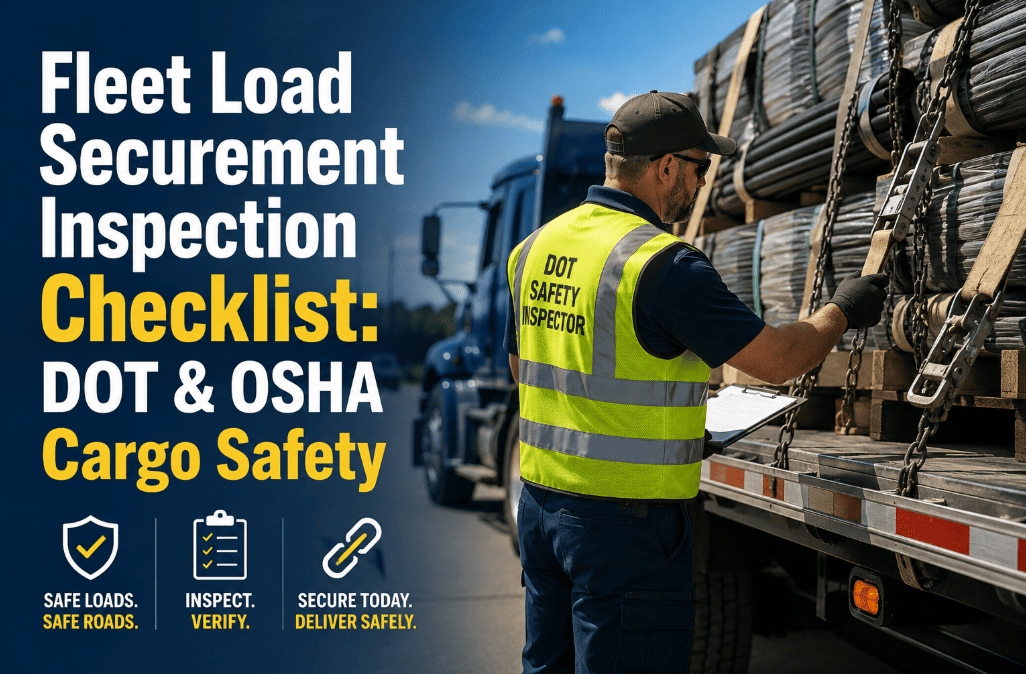
A flatbed load that departs with tie-down straps rated at 3,333 lbs working load limit securing a machine weighing 22,000 lbs has not been secured — it has been decorated with straps that will fail sequentially under the first emergency braking event, releasing a projectile onto the highway that no following driver has any ability to avoid. FMCSA 49 CFR Part 393 Subpart I defines load securement requirements with mathematical precision: aggregate working load limit, minimum number of tie-downs, header board requirements, blocking specifications, and chain grade requirements are not guidelines — they are federal law with per-violation penalties and safety consequences that cannot be undone after the load shifts. This checklist gives your fleet managers, drivers, and load planners a complete DOT and OSHA-compliant load securement framework covering tie-down ratings, aggregate working load limit calculation, anchor point inspection, chain and binder condition, flatbed blocking, and cargo documentation — structured so every load is traceable in your OxMaint compliance tracking platform with timestamped records that prove your loads were secured correctly before departure, not reconstructed after a cargo loss event.
Fleet Load Securement Inspection Checklist: DOT & OSHA Cargo Safety
A load-by-load DOT and OSHA-compliant securement inspection framework covering tie-down working load limits, aggregate WLL calculation, anchor point condition, chain and binder inspection, flatbed blocking and bracing, and cargo documentation — built for fleet operations where an under-secured load becomes a highway cargo loss, a fatality, and a federal enforcement action.
Aggregate Working Load Limit Calculation
FMCSA 49 CFR 393.102 requires that the aggregate working load limit of all tie-downs used to secure a cargo article must be at least 50% of the article's weight. This is not a discretionary guideline — it is the minimum mathematical standard, and it means that securing a 20,000 lb machine with four straps rated at 2,000 lbs WLL each (8,000 lbs aggregate) provides only 40% of the required WLL and is a federal violation from the moment the trailer leaves the loading dock. WLL calculation must be performed before departure, not estimated by visual inspection of the strap count.
Webbing Straps & Ratchet Binders
A webbing strap that has a cut across 10% of its width has not lost 10% of its breaking strength — it has potentially lost the majority of its strength at that point, because webbing failure initiates at the weakest cross-section and propagates instantaneously across the full width under dynamic load. FMCSA 393.104 specifies the conditions under which a strap must be removed from service — and those conditions include cuts, abrasion, heat damage, knots, and chemical contamination, all of which are visible on a pre-departure inspection and none of which are visible from the cab during transit.
A cargo loss event is investigated by FMCSA, OSHA, and the carrier's insurer simultaneously — and the first question all three ask is whether there is a signed pre-departure load securement record. OxMaint captures WLL calculations, strap condition checks, and anchor point verifications with driver signatures and GPS-stamped departure records that are ready for production within minutes of a cargo event.
Chains & Binder Inspection
A Grade 43 high-test chain used where a Grade 70 transport chain is required has approximately 75% of the working load limit of the Grade 70 chain for the same link size — and the driver who selected it by sight rather than by reading the chain grade stamp has built a securement system that is under-rated by 25% on every chain in the load. Chain grade is not visible without reading the embossed markings on the links, and binder capacity is not visible without reading the WLL tag. Both require active verification, not visual estimation.
Anchor Points & Trailer Tie-Down Rails
A tie-down strap attached to an anchor ring that has a hairline crack at its weld to the trailer rail is not providing the WLL printed on the strap — it is providing whatever residual strength remains in the cracked weld, which may be zero under the dynamic loads of an emergency braking event. Anchor point inspection is not a formality that the driver performs while walking past the trailer; it is the assessment of every connection point between the securement system and the trailer structure that will determine whether the load stays on the trailer or becomes part of the road.
Blocking, Bracing & Header Board Requirements
Blocking and bracing reduce the load on the tie-down system by preventing the cargo from moving in the directions that generate the highest forces on the tie-downs — forward under braking, rearward under acceleration, and laterally under cornering. FMCSA 393.106 recognises blocking and bracing as part of the compliant securement system, and a load that is properly blocked and braced can achieve compliance with fewer tie-downs than a load that relies entirely on friction and tie-down tension. The converse is also true: a load without blocking is placing maximum demand on every tie-down in the system from the first braking event.
Commodity-Specific Securement Requirements
FMCSA 49 CFR 393 Subpart I includes commodity-specific securement rules for logs, dressed lumber, metal coils, paper rolls, intermodal containers, automobiles, heavy vehicles, concrete pipe, intermodal containers, and other regulated commodity classes. These rules specify securement methods, minimum tie-down counts, and structural requirements that override the general rules when they impose stricter requirements. A driver who applies the general securement rules to a steel coil load — which has a specific rolling restraint requirement — has not complied with the law, even if the aggregate WLL calculation would pass the general standard.
Load Securement Documentation & En-Route Inspection
FMCSA 393.100 requires that cargo be re-examined after the first 50 miles of travel and at every change of duty status during the trip. This requirement exists because tie-down tension relaxes as cargo settles into the trailer floor, webbing stretches slightly under sustained load, and temperature changes cause dimensional changes in both the cargo and the securement materials. An en-route inspection is not optional — it is a regulatory requirement, and a carrier whose driver cannot demonstrate en-route inspection compliance has a per-violation exposure for every re-inspection that was not conducted.
Six Metrics That Prove Your Fleet Load Securement Programme Is DOT Compliant
| Metric | How to Measure | Target | Frequency |
|---|---|---|---|
| Pre-Departure Record Completion | Loads with signed securement record / Total loads dispatched | 100% | Daily |
| Aggregate WLL Compliance | Loads meeting ≥50% WLL / Cargo weight requirement | 100% | Per load |
| 50-Mile Re-Inspection Completion | Loads with logged 50-mile inspection / Total loads | 100% | Daily |
| Tie-Down Defect Rate at Inspection | Defective tie-downs found / Total tie-downs inspected | Trending toward zero | Weekly |
| Cargo Securement Violation Rate | DOT securement citations / Total roadside inspections | Zero | Monthly |
| Equipment Replacement Compliance | Condemned items replaced before next use / Total condemned | 100% | Weekly |
Frequently Asked Questions
What is the minimum aggregate working load limit required under FMCSA for load securement?
FMCSA 49 CFR 393.102 requires that the aggregate working load limit (WLL) of all tie-downs used to secure a cargo article must be at least 50% of the article's weight. This is the minimum — not the recommended — standard. For a 30,000 lb load, the minimum aggregate WLL is 15,000 lbs. If the load is particularly hazardous, has a high centre of gravity, or is being transported on routes with significant grades, industry best practice is to exceed the minimum by 25–50%. The WLL used in the calculation must be the rated WLL of the weakest component in each tie-down assembly — the strap, the hook, the anchor point, or the binder, whichever is lowest. OxMaint includes a built-in WLL calculator that guides drivers through the aggregate WLL calculation before departure.
What is the difference between Grade 43, Grade 70, and Grade 80 chain for load securement?
Chain grade refers to the minimum breaking force per unit of chain cross-sectional area. Grade 43 (high-test chain, typically yellow chromate finish) is the lowest grade acceptable for general towing and is embossed with "4" or "43" on each link. Grade 70 (transport chain, typically gold or yellow zinc finish) is the standard for load securement on commercial vehicles and is embossed with "7" or "70." Grade 80 and Grade 100 are alloy chains used in overhead lifting and rigging with a higher strength-to-weight ratio. FMCSA requires Grade 70 as the minimum for load securement tie-down chains. Using Grade 43 where Grade 70 is required underrates the WLL of each chain by approximately 25–30%.
How often must a driver re-inspect cargo securement during a trip?
FMCSA 49 CFR 393.100(b) requires that cargo be re-examined and the securement re-adjusted as necessary at the following intervals: (1) after the first 50 miles of travel; (2) at every change of the driver's duty status; and (3) after every 3 hours of driving or every 150 miles, whichever comes first. Each re-inspection must be documented in the driver's records. The 50-mile first inspection is the most critical because this is when the greatest amount of cargo settling and strap relaxation occurs from the initial securement. See how OxMaint generates automatic 50-mile re-inspection reminders linked to the driver's active load.
What conditions require a webbing strap to be removed from service?
FMCSA 49 CFR 393.104 requires that tie-down devices be in good working order and removed from service if any of the following conditions are present: a cut, abrasion, or tear that affects more than 10% of the webbing's width; a knot at any point in the webbing; evidence of acid or alkali damage (typically visible as chalky white staining or brittleness); heat damage indicated by glazing, melting, or charring; hardware that is cracked, broken, or deformed; and missing or illegible WLL markings. Webbing that is faded, stiff, or heavily soiled should also be evaluated — UV degradation can significantly reduce webbing strength without visible damage at the surface.
Are there specific securement requirements for transporting heavy construction equipment on a flatbed?
Yes. FMCSA 393.130 covers the securement requirements for heavy vehicles, equipment, and machinery. The key requirements are: (1) wheeled vehicles must have their wheels and tracks blocked or chocked against forward and rearward movement; (2) tie-downs must be attached to the vehicle at designated frame or manufacturer-specified tie-down points — not to components such as axles, steering linkages, or accessories that can separate from the vehicle; (3) tow trucks and other vehicles secured by their wheel lifts must also have the vehicle's front or rear additionally secured with chains; (4) the aggregate WLL requirement still applies in addition to these specific requirements. OxMaint includes commodity-specific securement prompts for heavy equipment loads in the pre-departure inspection workflow.
Every Load Calculated. Every Tie-Down Verified. Every Record Signed.
OxMaint converts your load securement inspection into a mobile pre-departure record with WLL calculation, tie-down condition capture, en-route re-inspection logging, and one-click DOT compliance reports — so the next roadside inspection or cargo loss investigation starts with your documentation, not your liability.