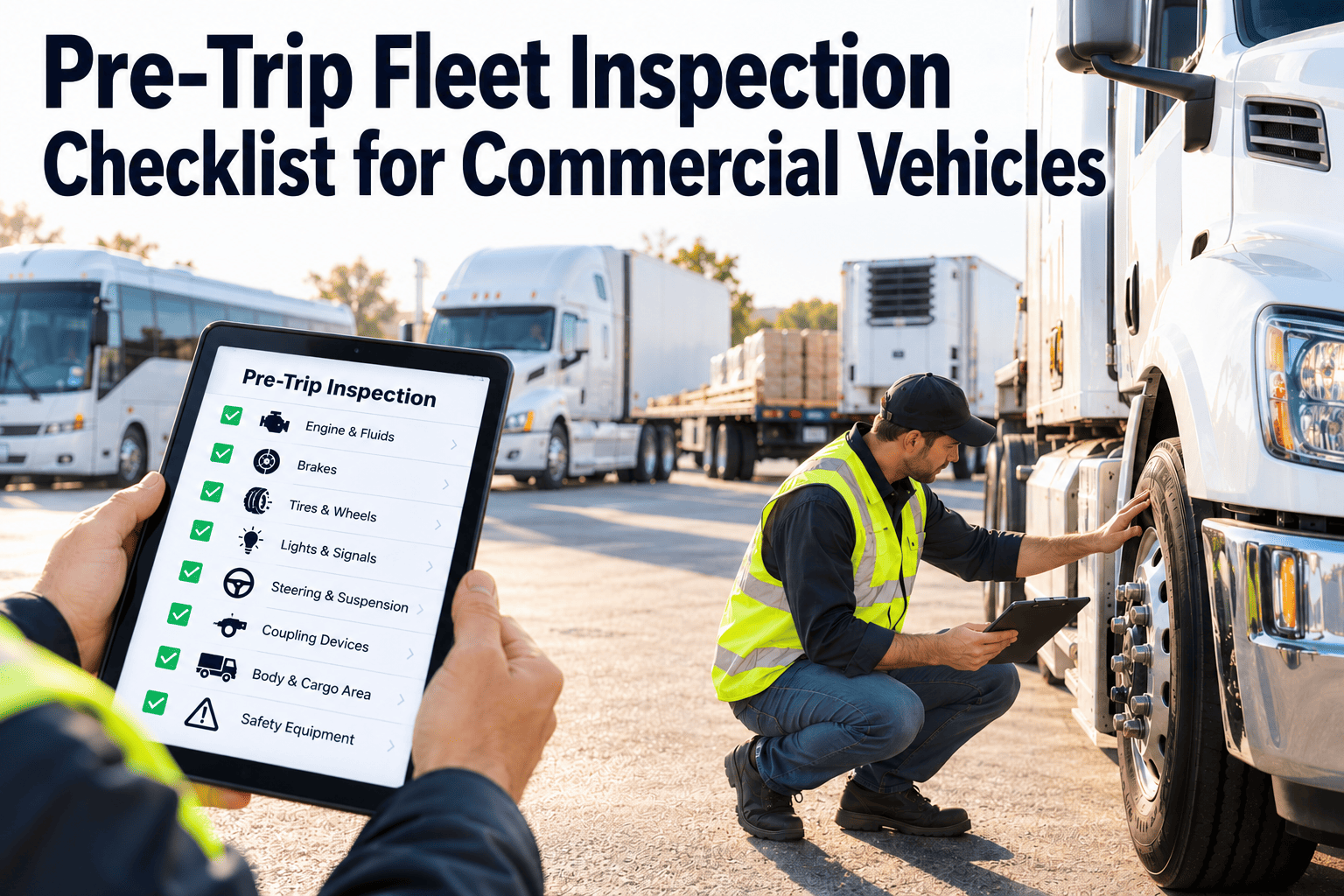
A trailer that departs a yard with a lighting circuit that has an intermittent ground fault, a brake chamber with a cracked diaphragm, or a kingpin that has worn beyond its discard specification is not a compliant commercial vehicle — it is a moving violation waiting to be discovered at a DOT roadside inspection, a brake failure event waiting for the first sustained downgrade, and a liability exposure that begins the moment the tractor pulls it off the yard. In fleet operations, trailers are the highest-volume and lowest-scrutinised assets in the fleet: they change hands between tractors, sit on drops for days without inspection, and accumulate defects that no single driver sees from beginning to end. This checklist gives your fleet managers, drivers, and safety officers a complete DOT-aligned trailer safety inspection framework covering lighting circuits, brake systems, structural integrity, coupling components, tyres, and dispatch documentation — structured so every inspection is traceable in your OxMaint compliance tracking platform with timestamped records that prove your trailers are inspected before every dispatch, not just when a DOT inspector walks up to the cab window.
Fleet Operations · DOT Compliance · Trailer Safety
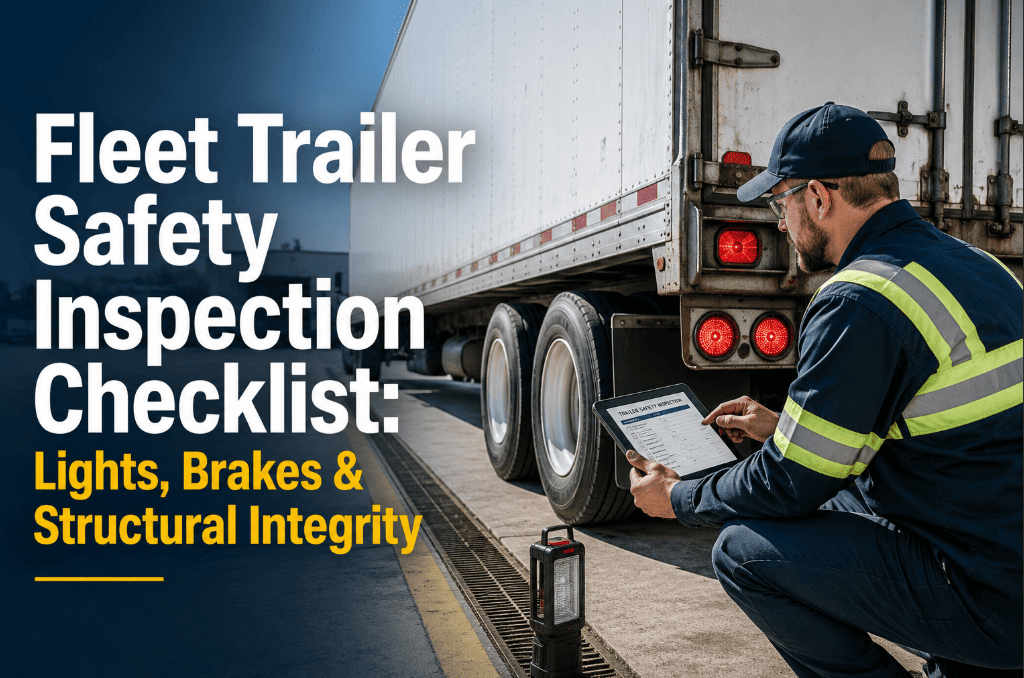
Fleet Trailer Safety Inspection Checklist: Lights, Brakes & Structural Integrity
A component-by-component DOT-aligned trailer safety inspection framework covering lighting circuits, brake systems, structural integrity, kingpin and fifth wheel, tandem axles, tyres, and dispatch documentation — built for fleet operations where an uninspected trailer becomes an out-of-service vehicle, a driver violation, or an at-fault accident.
7
Inspection Categories
50+
Check Points
100%
Compliance Target
P1
Safety Priority
High-Risk Trailer Defect Scenarios in Fleet Dispatch Operations
Brake System Failure
Failed brake chambers or dragging brakes cause loss of control on downgrades
Kingpin Wear
Worn kingpin allows trailer separation from the fifth wheel under braking
Lighting Circuit Failure
Failed stop or marker lights create rear-end collision risk and DOT violations
Tyre Blowout
Under-inflated or damaged tyres cause blowouts at highway speed
Structural Crack
Undetected frame or cross-member cracks lead to progressive structural failure
DOT Out-of-Service
Roadside inspection violations result in OOS orders, delays, and SMS score impact
DPre-Dispatch
WWeekly
MMonthly
QQuarterly
AAnnual
Category 01
Lighting System — Stop, Marker & Clearance Lights
Trailer lighting violations are the single most common category of DOT roadside inspection violations in the United States, and they are also among the most preventable. A stop light that fails because its connector socket has corroded from road salt exposure, a marker light that burns out because its lens cracked and allowed water ingress, or a turn signal that flashes at double speed because a bulb has failed in the circuit — each of these defects would have been caught by a functional lighting check before dispatch and none of them would have reached the roadside inspection.
All stop lights tested — brake pedal depressed with the tractor connected and all stop lights confirmed illuminated simultaneously; a stop light that is dim rather than fully bright has a high-resistance connection or a failing bulb that will fail completely under the heat of a loaded highway run
DDriver · Pre-dispatch lighting check log
Turn signal function verified on both sides — left and right turn signals activated and confirmed to flash at the correct rate (60–120 flashes per minute per FMVSS 108); a signal flashing faster than normal indicates a failed bulb in the circuit; LED trailer lighting that does not flash at all indicates a failed module or trailer connector pin issue
DDriver · Turn signal function log
All clearance and marker lights confirmed illuminated — all amber side marker lights and red rear clearance lights confirmed lit with the running lights on; a clearance light that is out makes the trailer appear narrower than it is to following and overtaking traffic in low-light conditions
DDriver · Clearance and marker light log
Trailer connector (7-pin) inspected for corrosion, bent pins, and secure engagement — connector pins cleaned with electrical contact cleaner if corroded; bent pins straightened or replaced; connector confirmed to seat fully with the locking ring engaged; a loose connector causes intermittent lighting faults that are impossible to reproduce at a workshop but occur constantly at highway vibration
DDriver · Trailer connector inspection log
Reflective tape and conspicuity markings inspected — retroreflective tape on the rear and sides of the trailer inspected for sections that have peeled, faded, or been covered by mud or freight labels; FMCSA 49 CFR 393.11 requires conspicuity tape to be in good condition and unobstructed; missing sections must be replaced before dispatch
WFleet Inspector · Conspicuity tape inspection log
Category 02
Brake System — Service, Emergency & Parking
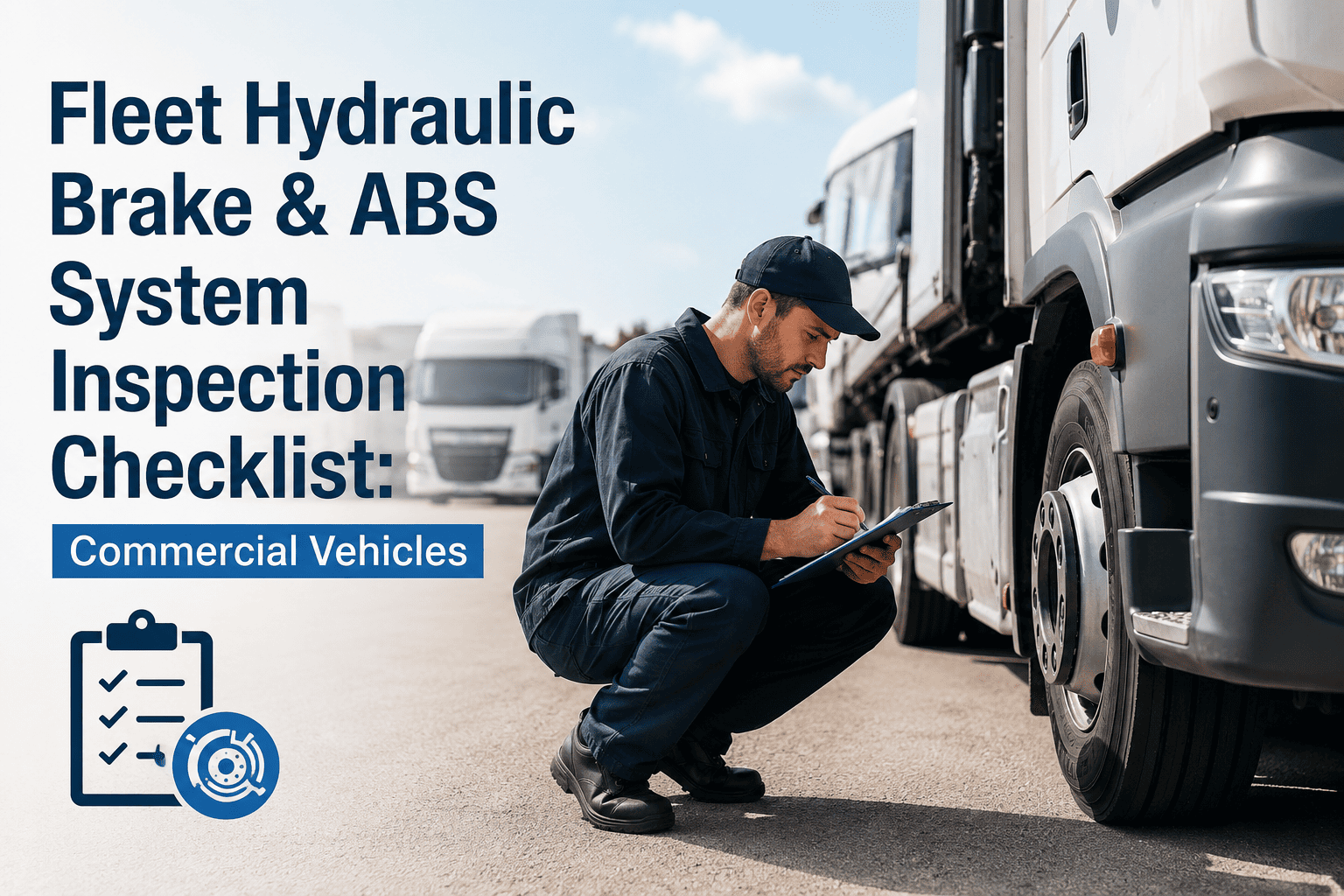
FMCSA data consistently identifies brake system violations as the leading mechanical cause of large truck crashes. A trailer brake chamber with a cracked diaphragm delivers reduced braking force on that axle end without producing any visible external indication. A brake stroke that has exceeded its adjustment limit increases stopping distance progressively as the adjustment worsens, without producing a warning light, a noise, or any other signal that the driver can detect from the cab. Brake inspection requires physical measurement — not visual inspection from a distance.
Brake pushrod stroke measured at each chamber with brakes applied — brake applied at 90 psi and pushrod stroke measured at each chamber; stroke must not exceed the maximum adjustment limit for the chamber size (e.g., 2 inches for a Type 30 chamber); any chamber exceeding the limit placed out of service immediately for brake adjustment
DDriver / Fleet Inspector · Brake stroke measurement log
Brake chambers inspected for cracks, leaks, and corrosion — chamber body, clamp ring, and pushrod boot inspected; air leaks at the chamber identified by feel or soapy water test; a cracked chamber body is an immediate out-of-service condition; corrosion on the clamp ring threads is a leading indicator of imminent chamber separation
DDriver · Brake chamber inspection log
Air line connections and glad hands inspected — glad hand seals inspected for cuts or deformation that allows air leakage; air lines confirmed free of chafing, kinking, or contact with hot surfaces; trailer supply and control lines connected to the tractor in the correct positions (red to red, blue to blue)
DDriver · Air line and glad hand inspection log
Brake lining thickness measured at accessible positions — brake lining thickness measured at the thinnest point visible through the inspection hole; linings at or below 1/4 inch (6.4 mm) at the thinnest point are at or near the discard limit and require replacement at the next maintenance window; linings at less than 1/4 inch are an immediate out-of-service condition
MFleet Mechanic · Brake lining measurement log
Spring brake (parking brake) function tested — tractor supply line disconnected and trailer spring brakes confirmed to apply automatically; supply line reconnected and trailer service brake system charged; spring brakes confirmed to release when system pressure reaches 60 psi; spring brakes that do not release below 60 psi have a relay valve fault
WDriver / Fleet Inspector · Spring brake function test log
DOT roadside inspections are unannounced — and a trailer out-of-service order doesn't just delay the load, it impacts your CSA score for 24 months. OxMaint timestamps every trailer inspection, captures brake stroke measurements, and flags trailers due for mandatory inspection before they're dispatched — giving your fleet safety team complete, audit-ready DOT compliance records on demand.
Category 03
Kingpin, Fifth Wheel & Coupling Integrity
The kingpin-to-fifth-wheel interface is the single mechanical connection that keeps the trailer attached to the tractor under braking, cornering, and load transfer events. A kingpin that has worn beyond its 3.5-inch diameter discard specification allows lateral play in the fifth wheel that can cause trailer oscillation at highway speed. A fifth wheel that is not fully latched will allow the kingpin to release under the load transfer of the first significant braking event. Neither condition is detectable from the cab; both require a physical check at coupling.
Fifth wheel latch engagement confirmed before departure — after coupling, driver attempts to pull forward against chocked trailer wheels to confirm the kingpin is captured; the trailer must not move forward relative to the tractor; a kingpin that releases during this test was not properly latched and must be recoupled before departure
DDriver · Fifth wheel latch pull-test log
Kingpin diameter measured with a kingpin wear gauge — kingpin diameter measured at the load-bearing surface with a go/no-go wear gauge; a kingpin measuring less than 3.5 inches at the load-bearing surface is worn beyond the discard limit and requires trailer removal from service; visual inspection alone cannot detect a worn kingpin
MFleet Mechanic · Kingpin diameter measurement log
Safety chains or cables confirmed attached — safety chains connected from the tractor to the trailer in a crossed configuration; chains of sufficient length to allow turning without binding but without excessive sag; safety chains that drag on the ground create a road hazard and will be cited at roadside inspection
DDriver · Safety chain attachment log
Landing gear fully retracted and crank handle secured — landing gear cranked to full retraction and confirmed not to drag on the road surface; crank handle removed and stored or secured in its holder; a landing gear that contacts the road surface on a dip or during loaded cornering will dig into the pavement and cause trailer damage or loss of control
DDriver · Landing gear retraction log
Category 04
Tyres & Wheels
A trailer tyre that is 20% under-inflated does not look flat — it looks normal to a driver performing a visual inspection from three metres away. That same tyre is generating internal heat at a rate that will cause structural separation of the belt package within the next 100 miles of highway operation if it is not inflated. Tyre inspection on a fleet trailer requires a calibrated gauge, not a kick test, and it requires that every tyre on the trailer is checked — including the inner duals that are invisible from the outside of the trailer.
All tyre inflation pressures measured with a calibrated gauge — all trailer tyres (including inner duals) measured individually and confirmed within the manufacturer's specified pressure range for the load being carried; a difference of more than 5 psi between inner and outer dual tyres indicates the lower-pressure tyre is carrying a disproportionate share of the load
DDriver · Tyre pressure measurement log
Tyre tread depth measured at the shallowest groove — tread depth measured with a calibrated gauge; FMCSA requires minimum 2/32 inch on all trailer tyres; tyres at 4/32 inch or below should be scheduled for replacement; tyre with exposed cords, visible sidewall damage, or a bulge is an immediate out-of-service condition
DDriver · Tread depth measurement log
All lug nuts present and confirmed torqued — all lug nuts present on every wheel; any missing lug nut is an immediate out-of-service condition regardless of how many nuts remain on the wheel; lug nuts checked for hand-tightness to identify those that have loosened and torqued to specification with a calibrated torque wrench
DDriver · Lug nut check log
Hub and drum temperature checked after first 8 miles of operation — hubs and brake drums checked for abnormally high heat (hot enough to prevent hand contact) after the first 8 miles; a hot hub indicates a failing wheel bearing; a hot drum on one wheel indicates a dragging brake that requires immediate attention before the brake component overheats to failure
DDriver · Hub temperature post-initial-run log
Category 05
Structural Integrity — Frame, Floor & Body
A trailer that has been loaded with a forklift that missed the floor pocket and punctured the floor crossmember, or that has been backed into a dock leveller at 5 mph, accumulates structural damage that is not reported, not visible from the exterior, and not discovered until a subsequent inspection or — in the worst case — a structural failure under a loaded highway run. Structural inspection requires systematic examination of the frame rails, crossmembers, floor, and body panels — not a glance from the driver's seat window.
Frame rails inspected for cracks, bends, and corrosion — both main frame rails inspected along their full length from the front bolster to the rear bumper; any crack perpendicular to the rail direction is a critical structural defect requiring immediate removal from service; corrosion that has penetrated more than 25% of the rail cross-section requires engineering assessment
WFleet Inspector · Frame rail inspection log
Crossmembers and floor structure inspected — floor crossmembers inspected for bends, cracks, or displaced positions; a crossmember that has been displaced from its mounting position by a forklift impact no longer contributes to floor load distribution and creates a concentrated load path that can cause progressive floor collapse under repeated loading
WFleet Inspector · Crossmember and floor inspection log
Rear impact guard (ICC bumper) confirmed present and undamaged — rear impact guard inspected for bends, cracks, or missing mounting bolts; FMCSA 49 CFR 393.86 requires the rear impact guard to be within 12 inches of the rear of the trailer and capable of withstanding a specified impact load; a severely bent or partially detached guard is an out-of-service condition
DDriver · Rear impact guard inspection log
Cargo doors, hinges, and seals inspected — door hinges inspected for wear or seized pins that prevent full door opening; door latches confirmed to engage securely and release without excessive force; door seals inspected for tears or compression set that would allow cargo shifting to be detected externally or allow water ingress during rain
DDriver · Door and seal inspection log
Category 06
Tandem Axle & Slider Mechanism
A tandem axle slider that is locked in a position that puts the trailer over its maximum bridge formula weight on a regulated route is not a weight compliance issue — it is a statutory violation that triggers fines calculated per pound of overweight, multiplied by the number of axles out of compliance, and applied at the first weigh station the tractor-trailer passes through. Slider position verification before dispatch is the one check that determines whether the load can legally complete its route without a weight station citation that exceeds the value of the freight.
Tandem slider position confirmed for legal axle weight distribution — slider position set per the load plan to achieve compliant weight distribution across drive and trailer axles; slider pin confirmed fully engaged in the correct position hole; a slider pin that does not fully engage will allow the tandem to slide during braking, changing axle weights dynamically during operation
DDriver · Tandem slider position log
Slider lock pins and retaining clips confirmed fully engaged — slider pin inspected from both sides of the trailer frame to confirm full engagement through the frame rail and slider tube; retaining clips or cotter pins confirmed present; a slider pin without a retaining clip can walk out of engagement during extended operation and cause the tandem to drift from its set position
DDriver · Slider pin engagement log
Tandem axle alignment verified — both axle ends visually confirmed to be perpendicular to the trailer centerline; a tandem that is dog-tracking (visibly angled to the trailer centerline) causes accelerated tyre wear on all four tandem tyres and requires axle alignment correction before the trailer is dispatched for a long-haul route
MFleet Mechanic · Tandem alignment inspection log
Category 07
Compliance Documentation & Dispatch Records
A trailer that passes every physical inspection item but is dispatched without a signed inspection record, with an expired annual inspection certificate, or without the driver's previous DVIR reviewed and cleared, is a trailer that will generate a DOT citation at the first roadside inspection — not for its mechanical condition, but for the absence of the documentation that is required to prove its mechanical condition was verified. Compliance documentation is not paperwork that follows the inspection; it is the legally required evidence that the inspection occurred.
Driver Vehicle Inspection Report (DVIR) completed and signed before departure — DVIR completed covering all required inspection items per FMCSA 49 CFR 396.11; driver signs the DVIR certifying the equipment is in safe operating condition or documenting specific defects; DVIR uploaded to CMMS with trailer asset ID and driver name before the tractor departs
DDriver · DVIR completion and upload log
Annual DOT inspection certificate confirmed current and displayed — annual inspection certificate (Form MCS-150 or equivalent state form) confirmed to be less than 12 months old and displayed on the trailer in a location visible to a roadside inspector; an expired annual inspection certificate is an immediate out-of-service condition at a Level 1 roadside inspection
DDriver / Fleet Admin · Annual inspection certificate currency log
Previous DVIR defects confirmed cleared by maintenance — DVIR from the previous driver reviewed; any defects reported by the previous driver confirmed to have a maintenance sign-off in the CMMS before the current driver accepts the trailer; a driver who accepts a trailer with an open defect from the previous DVIR is jointly responsible for operating a vehicle with a known defect
DDriver / Fleet Maintenance · Defect clearance confirmation log
Trailer registration and plates confirmed current — trailer registration plates confirmed present, legible, and current; registration expiry date confirmed to be beyond the planned trip return date; a trailer whose registration expires during a multi-day trip cannot legally return to base without first renewing the registration
MFleet Administrator · Registration currency verification log
Compliance KPIs
Six Metrics That Prove Your Trailer Fleet Is DOT Dispatch Compliant
| Metric |
How to Measure |
Target |
Frequency |
| DVIR Completion Rate |
DVIRs completed before departure / Total dispatches |
100% |
Daily |
| Out-of-Service Rate |
Trailers placed OOS at roadside / Total inspected |
<1% |
Weekly |
| Annual Inspection Currency |
Trailers with valid annual cert / Total active trailers |
100% |
Monthly |
| Brake Stroke Compliance |
Chambers within stroke limit / Total chambers measured |
100% |
Per pre-dispatch |
| Lighting Defect Rate |
Pre-dispatch lighting defects found / Total inspections |
Trending downward |
Weekly |
| Defect Closure Time |
Hours from DVIR defect to maintenance close-out |
<24 hours |
Daily |
FAQs
Frequently Asked Questions
What FMCSA regulations require trailer pre-trip inspection?
FMCSA 49 CFR 396.11 requires that every driver inspect the vehicle they are about to operate, prepare a written Driver Vehicle Inspection Report (DVIR), and sign the DVIR certifying that the vehicle is in safe operating condition or identifying any defects. 49 CFR 396.13 requires the driver to review the previous DVIR and certify that any reported defects have been repaired or that repair is not necessary before the vehicle is operated. For trailers, the annual inspection requirement under 49 CFR 396.17 requires a comprehensive inspection by a qualified inspector at intervals not to exceed 12 months. OxMaint generates FMCSA-compliant DVIRs with driver signatures and timestamps for every trailer dispatch.
What is the maximum allowable brake pushrod stroke for a Type 30 brake chamber?
For a Type 30 brake chamber (the most common size on full-size semi-trailers), the FMCSA out-of-service criterion is a pushrod stroke exceeding 2 inches (51 mm) with the brake applied at 90 psi system pressure. For a Type 24 chamber, the limit is 1.75 inches (44 mm). These are the out-of-service thresholds; the adjustment limit (the point at which the brake should be adjusted before it reaches the OOS threshold) is typically 1.75 inches for a Type 30. Brakes found at or beyond the OOS threshold at a roadside inspection result in an immediate out-of-service order for the trailer. See how OxMaint captures brake stroke measurements as a mandatory numeric field in the pre-dispatch inspection.
How does a trailer's CSA score impact the fleet's Safety Measurement System rating?
Under FMCSA's Safety Measurement System (SMS), violations discovered at roadside inspections are assigned to the motor carrier and scored in the Unsafe Driving, HOS Compliance, Driver Fitness, Controlled Substances/Alcohol, Vehicle Maintenance, Hazardous Materials Compliance, and Crash Indicator BASICs. Vehicle Maintenance violations — which include lighting, brake, and structural defects — are weighted based on severity and remain on the carrier's SMS record for 24 months. A carrier whose Vehicle Maintenance BASIC score exceeds the intervention threshold may receive a compliance review, warning letter, or targeted enforcement action from FMCSA.
What is the minimum tyre tread depth required on trailer tyres under FMCSA regulations?
FMCSA 49 CFR 393.75 requires a minimum tread depth of 2/32 inch (1.6 mm) measured in any two adjacent major tread grooves at any location on the tyre for all trailer tyres. For front (steer) tyres on the tractor, the minimum is 4/32 inch. Tyres with less than the minimum tread depth, tyres with exposed cord, tyres with sidewall damage through the cord, or tyres with a bump or bulge indicating separation are all out-of-service conditions. Industry best practice is to replace trailer tyres at 4/32 inch rather than waiting for the 2/32 inch regulatory minimum.
How often must a commercial trailer receive its annual DOT inspection?
FMCSA 49 CFR 396.17 requires that every commercial motor vehicle, including trailers, be inspected at least once every 12 months by a qualified inspector. The inspection must meet the minimum standards in Appendix G to Subchapter B of Chapter III. The inspection certificate must be retained on the trailer for the duration of its validity and must be available for review by a DOT inspector at any roadside stop. Trailers operating in interstate commerce without a valid annual inspection certificate are placed out of service immediately upon discovery. OxMaint tracks annual inspection expiry dates for every trailer in your fleet and generates renewal reminders 60 days before expiry.
Digitize Trailer Compliance
Every Trailer Inspected. Every Brake Measured. Every DVIR Signed.
OxMaint converts your trailer pre-dispatch inspection into mobile DVIRs with brake stroke capture, lighting check confirmation, annual inspection expiry tracking, and one-click DOT compliance reports — so the next roadside inspection is a pass, not an out-of-service order.