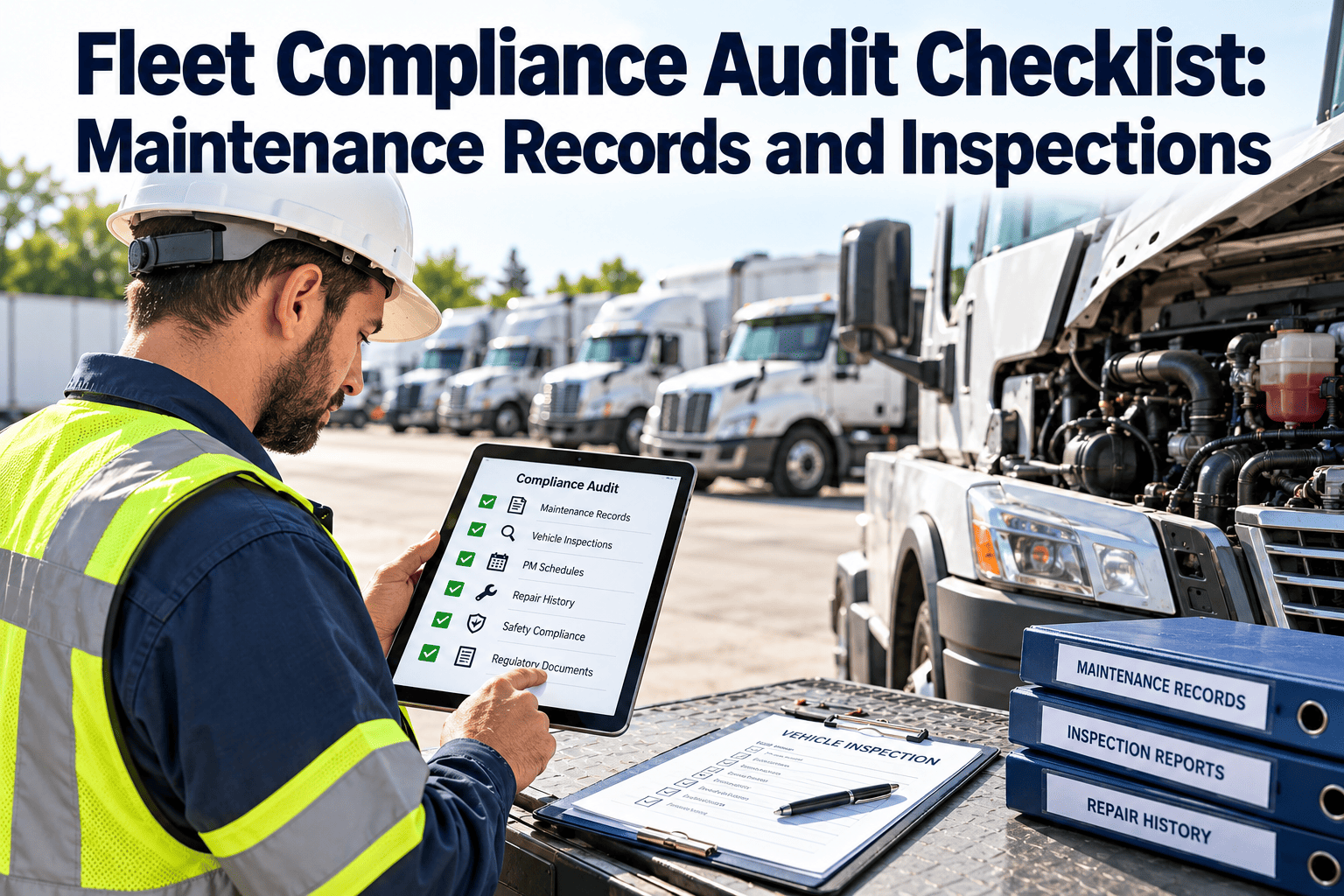
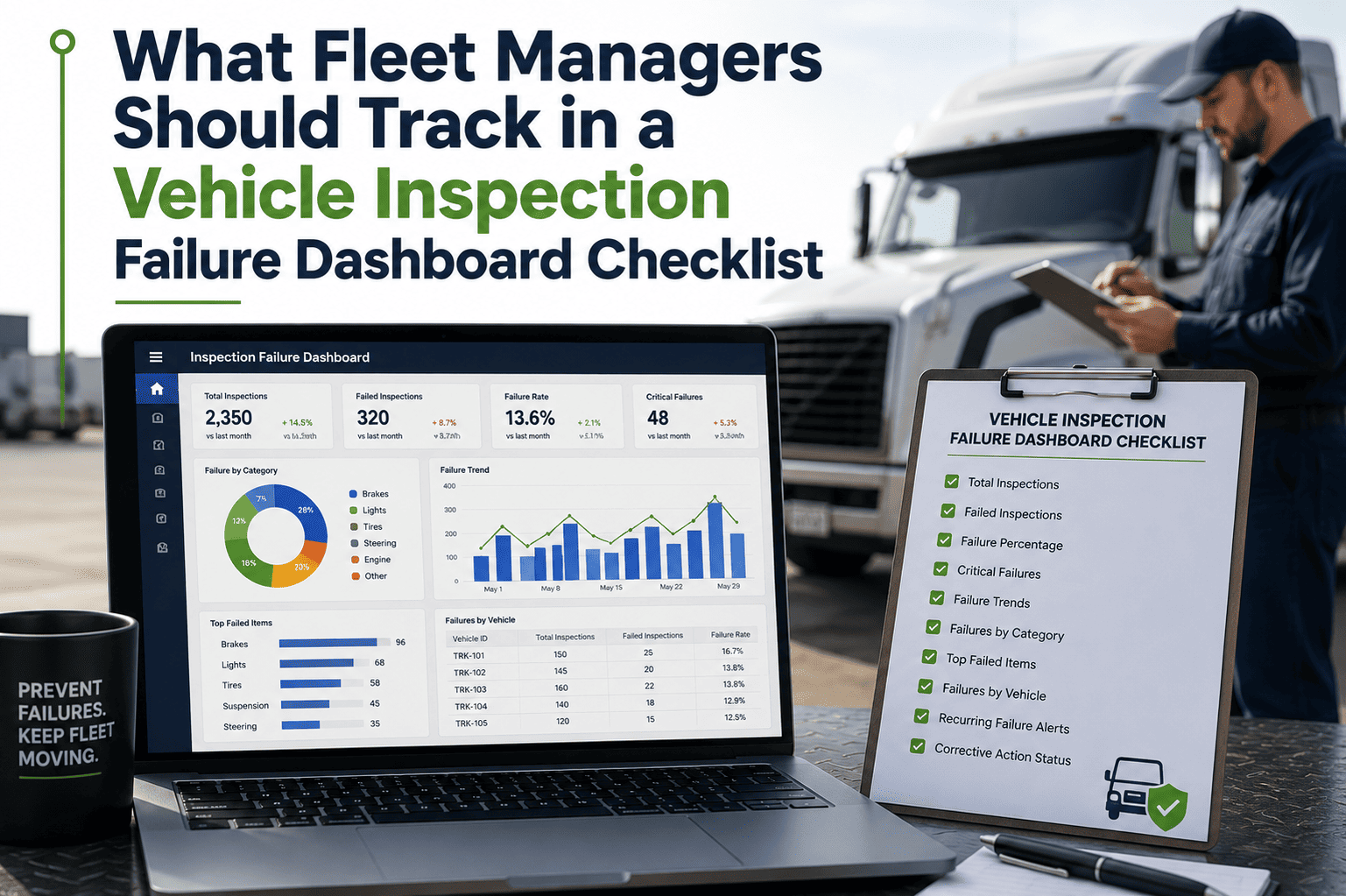
A fleet operations manager who conducts a monthly audit by reviewing last month's repair orders without examining driver files, PM compliance rates, parts inventory levels, or regulatory documentation is not conducting a safety audit — they are conducting a cost review with a safety label on it. The monthly fleet audit is the systematic verification that every compliance obligation the fleet carries — FMCSA driver qualification files, DOT inspection currency, preventive maintenance completion rates, hours-of-service record availability, and insurance certificate validity — is being met simultaneously, not just the obligations that generated a repair invoice in the past 30 days. This checklist gives your fleet operations managers, safety directors, and compliance officers a complete monthly audit framework covering vehicle records, driver qualification files, PM schedule compliance, parts and fluid inventory, regulatory documentation, and safety performance metrics — structured so every audit is traceable in your OxMaint compliance tracking platform with timestamped records that prove your fleet is managed to compliance standard, not just to budget, when a DOT compliance review, an insurance audit, or a company safety committee inspection arrives.
Fleet Operations · Safety & Compliance · Monthly Audit
Fleet Monthly Maintenance & Safety Audit Checklist: Operations Manager Guide
A category-by-category monthly fleet audit framework covering vehicle maintenance records, driver qualification files, PM compliance rates, parts inventory, regulatory documentation, and safety performance metrics — built for operations managers where a missed monthly audit becomes a DOT compliance gap, an insurance exposure, or a preventable incident.
7
Audit Categories
50+
Check Points
100%
Compliance Target
P1
Management Priority
High-Risk Compliance Gaps Revealed by Monthly Fleet Audits
Expired CDL or Medical Card
Driver operating with an expired license or medical certificate creates a per-trip DOT violation
PM Overrun
Vehicles operating past their PM interval void warranties and increase breakdown risk
Expired DOT Inspection
A vehicle with an expired annual inspection sticker is an out-of-service violation at any roadside check
Incomplete Driver Files
Missing MVR, drug test, or employment verification creates FMCSA Part 391 violations
Parts Stockout
Critical parts unavailability forces vehicles to operate past PM intervals or await extended downtime
Insurance Lapse
Certificate of insurance not updated after policy renewal creates uninsured operation exposure
DDaily
WWeekly
MMonthly
QQuarterly
AAnnual
Category 01
Vehicle Maintenance Records & PM Compliance
A PM compliance rate of 85% in a fleet of 50 vehicles means that at any given time, approximately 7–8 vehicles are operating past their scheduled maintenance interval — accumulating wear on components that were designed to be inspected, adjusted, or replaced on a specific cycle. The monthly audit's PM compliance review is not a retrospective report on what maintenance was completed; it is a forward-looking identification of which vehicles are approaching or have passed their PM due points before they become breakdown events or DOT violations.
PM completion rate calculated for the month — all PMs scheduled in the month compared against PMs completed; any vehicle more than 10% over its PM interval (e.g., more than 600 miles over a 6,000-mile PM) identified by name and unit number; PM overrun vehicles scheduled for immediate service before the next dispatch cycle
MFleet Operations Manager · Monthly PM compliance report
Vehicles approaching next PM interval identified and pre-scheduled — all vehicles within 500 miles or 30 days of their next PM interval identified from CMMS; maintenance appointments scheduled before the vehicles reach their due point; pre-scheduling PM work reduces unplanned downtime and ensures parts are available before the vehicle arrives in the shop
MFleet Operations Manager · Upcoming PM schedule review
Repair order review for repeat failures — all repair orders from the month reviewed for recurring fault codes, repeat component failures, or the same defect appearing more than once on the same vehicle; a brake adjustment that was completed three times in one month is not a maintenance issue — it is a brake system component failure that requires a root cause investigation
MFleet Operations Manager · Repeat failure analysis report
Unscheduled breakdown events reviewed and root-caused — all roadside breakdowns, towing events, and on-site mechanical failures from the month reviewed; each event assessed for whether it was predictable from the vehicle's maintenance history or pre-operation inspection records; breakdown events that were predictable represent a failure of the preventive maintenance programme, not a random mechanical failure
MFleet Operations Manager · Monthly breakdown root cause report
Annual DOT inspection currency confirmed for all vehicles — every commercial vehicle in the fleet confirmed to have a current annual DOT inspection with at least 30 days remaining before expiry; any vehicle with an inspection expiring within 30 days scheduled for inspection immediately; a vehicle operating with an expired inspection sticker is placed out of service until inspected
MFleet Operations Manager · DOT inspection currency tracker
Category 02
Driver Qualification Files & Licensing Compliance
FMCSA 49 CFR Part 391 requires that every motor carrier maintain a driver qualification file for each commercial driver that contains specific documents — and the regulation does not provide a grace period for missing documents or expired credentials. A driver whose medical certificate expired yesterday is not a driver who can operate a CMV today while the fleet manager arranges a new physical. They are a driver who cannot operate a CMV at all until a current medical certificate is in the file, and every mile operated between the expiry date and the updated certificate is a per-trip violation.
All CDL expiry dates reviewed and renewals initiated 60 days in advance — CDL expiry date for every commercial driver confirmed in the fleet management system; any CDL expiring within 60 days flagged and the driver notified to initiate renewal; drivers with expired CDLs removed from the dispatch schedule until the license is renewed
MFleet Operations Manager · CDL expiry tracking report
DOT physical medical certificate expiry confirmed current for all CDL drivers — medical certificate expiry date confirmed for every driver operating a CMV requiring a CDL; drivers with medical certificates expiring within 60 days scheduled for DOT physical renewal; drivers whose certificates have lapsed removed from CMV operation immediately
MFleet Operations Manager · Medical certificate currency report
Annual Motor Vehicle Record (MVR) pull completed for all drivers — MVR ordered from the state DMV for every driver who has not had an MVR pulled in the past 12 months; MVR reviewed for new violations, license suspensions, or endorsement changes that affect the driver's eligibility to operate specific vehicle types; MVR with disqualifying violations results in immediate driver suspension pending investigation
AFleet Safety Director · Annual MVR review log
Pre-employment and random drug and alcohol testing records confirmed current — random testing pool participation confirmed for all safety-sensitive drivers; random selection records, test results, and chain-of-custody documentation confirmed in the driver qualification file; FMCSA requires a minimum 50% random drug testing rate and 10% random alcohol testing rate per year for the fleet
MFleet Safety Director · Drug and alcohol testing compliance report
HOS records reviewed for violations — hours-of-service logs or ELD records reviewed for any violations from the past month; drivers with HOS violations issued a written corrective notice; a pattern of HOS violations on a specific route indicates a dispatch scheduling problem that must be corrected at the operations level, not just documented as a driver performance issue
MFleet Operations Manager · Monthly HOS violation review
DOT compliance reviews don't announce themselves 30 days in advance. OxMaint tracks every driver's CDL expiry, medical certificate date, MVR pull schedule, and vehicle DOT inspection currency — and alerts your operations manager before any item lapses, so your fleet is audit-ready every day of the month, not just on audit day.
Category 03
Parts Inventory & Maintenance Supplies Review
A fleet maintenance programme that runs out of the oil filter for its most common engine platform on the second week of the month is not a programme with a supply chain problem — it is a programme without a minimum stock level system. Parts stockouts force one of two outcomes, both of which are worse than the cost of carrying adequate inventory: the vehicle operates past its PM due date while waiting for parts, or the vehicle is taken out of service and a replacement is sourced at a premium. Monthly parts inventory review is the systematic prevention of both outcomes.
Critical parts minimum stock levels reviewed and replenishment orders placed — minimum stock levels for high-turnover parts (oil filters, air filters, fuel filters, brake pads, belts, light bulbs) compared against current inventory; any item below minimum stock level generates a purchase order before the stock is exhausted; minimum stock level set to cover 6 weeks of average consumption
MFleet Maintenance Manager · Parts inventory review and order log
Lubricant and fluid inventory confirmed adequate for the next month's PM schedule — engine oil, transmission fluid, coolant, brake fluid, and DEF inventory confirmed against the forecasted consumption for the next month's PM schedule; fluid orders placed to maintain a minimum 4-week supply; fluid stored in correctly labelled, sealed containers with no cross-contamination risk
MFleet Maintenance Manager · Fluid inventory confirmation log
Tyre inventory reviewed and rotation/replacement schedule confirmed — available spare tyres inventoried by size and condition; tyre rotation due dates reviewed for all vehicles; tyres with tread depth below 4/32 inch (steer) or 2/32 inch (drive/trailer) identified and scheduled for immediate replacement; seasonal tyre changeover schedule confirmed
MFleet Maintenance Manager · Tyre inventory and rotation review
Parts supplier performance reviewed — delivery lead times, fill rates, and parts quality issues from the past month reviewed with key suppliers; parts that were incorrect, defective, or delivered past the agreed lead time documented; supplier performance trends tracked to identify when a secondary supplier relationship needs to be established for critical components
MFleet Operations Manager · Supplier performance review log
Category 04
Regulatory Documentation & Insurance Currency
A motor carrier whose operating authority is technically current but whose insurance certificate of filing on record with FMCSA has lapsed because the broker renewed the policy but did not file the updated BMC-91 form has a compliance gap that will only be discovered when a roadside inspector or opposing counsel pulls the FMCSA record. Regulatory documentation currency is not self-maintaining — it requires a monthly review of every filing, every certificate, and every permit to confirm that the administrative renewal processes have completed correctly and that what the fleet believes is current actually is current in the relevant regulatory system.
FMCSA operating authority and MCS-150 biennial update confirmed current — carrier's operating authority status confirmed on FMCSA's SAFER system; MCS-150 biennial update filing date reviewed; carriers that miss the MCS-150 update deadline by more than 6 months have their operating authority revoked automatically; next MCS-150 update due date calendared 60 days in advance
MFleet Safety Director · FMCSA compliance status review
Insurance certificates confirmed current and filed with FMCSA — primary liability, cargo, and physical damage insurance certificates reviewed for expiry date; BMC-91 and BMC-34 filings on FMCSA system confirmed to match current policy terms; insurance broker notified to file updated BMC forms immediately upon policy renewal before the old policy expiry date
MFleet Operations Manager · Insurance certificate currency review
Hazmat permits and endorsements confirmed current if applicable — any vehicle operating under a hazmat transportation permit reviewed for permit expiry; drivers operating vehicles carrying hazardous materials confirmed to hold a current hazmat endorsement on their CDL; hazmat registration with PHMSA confirmed current for the carrier
MFleet Safety Director · Hazmat permit and endorsement review
State-specific operating permits and oversize/overweight permits reviewed — all state operating permits, fuel tax permits (IFTA), and oversize/overweight corridor permits reviewed for expiry; IFTA quarterly fuel tax return filing confirmed current; IRP registration plates and cab cards confirmed in the vehicle for all jurisdictions in which the fleet operates
MFleet Operations Manager · Permit currency review log
Vehicle registration currency confirmed for all units — registration expiry date confirmed for every vehicle in the fleet; any vehicle with registration expiring within 60 days has renewal initiated; vehicles with expired registration are not dispatched; IRP cab card current year confirmed in the cab of every interstate CMV
MFleet Administrator · Vehicle registration currency log
Category 05
Safety Performance Metrics & Incident Review
A fleet's FMCSA Safety Measurement System (SMS) score is calculated from the past 24 months of roadside inspection results, violations, and crash data — which means every incident that occurs this month will affect the fleet's CSA scores for the next 24 months. The monthly safety performance review is the systematic examination of whether the fleet's current operating practices are producing the safety outcomes the operations manager believes they are, or whether there are developing trends in near-misses, minor collisions, and violation categories that predict a serious incident if not addressed in the current review cycle.
FMCSA CSA SMS scores reviewed for all BASIC categories — current month's CSA percentile rankings for all seven BASIC categories (Unsafe Driving, HOS Compliance, Driver Fitness, Controlled Substances/Alcohol, Vehicle Maintenance, Hazardous Materials, Crash Indicator) reviewed; any BASIC approaching the intervention threshold (65th percentile for most; 80th percentile for Crash Indicator and Controlled Substances) triggers an action plan before the threshold is crossed
MFleet Safety Director · Monthly CSA score review
All accidents and incidents from the month reviewed and classified — each incident classified as preventable or non-preventable using the NSC or ATRI preventability standard; preventable incidents reviewed for root cause (driver behaviour, vehicle condition, or environmental factor); trend analysis performed to identify whether incident causes are concentrated on specific routes, drivers, or vehicle types
MFleet Safety Director · Monthly incident review and classification report
Roadside inspection results reviewed and driver coaching initiated — all Level I, II, and III roadside inspections from the month reviewed; out-of-service violations reviewed for whether the cited condition was present on the vehicle's last pre-trip inspection record; driver coaching conducted within 5 business days of any roadside violation for the responsible driver
MFleet Safety Director · Roadside inspection review and coaching log
Near-miss reports reviewed and corrective actions confirmed — all near-miss reports submitted by drivers during the month reviewed; corrective actions for near-misses from the previous month confirmed as implemented; a near-miss report programme that collects reports but does not produce visible corrective actions within 30 days will stop generating reports as drivers conclude that reporting produces no outcome
MFleet Safety Director · Near-miss review and corrective action log
Category 06
Fleet Asset Status & Utilisation Review
A fleet operations manager who does not know the utilisation rate of every vehicle in the fleet does not know whether the fleet is sized correctly for the current operation. Under-utilised vehicles generate fixed costs (insurance, registration, depreciation) without contributing to revenue. Over-utilised vehicles are driven past their PM intervals, have higher wear rates, and produce driver fatigue events that are invisible in a utilisation report but visible in roadside inspection records and incident statistics. Monthly asset utilisation review is the commercial and safety case for fleet size optimisation.
Vehicle utilisation rates calculated for the month — miles or hours operated per vehicle compared against the fleet's target utilisation rate; vehicles below 60% utilisation for the second consecutive month flagged for disposal or redeployment review; vehicles consistently above 110% of target utilisation flagged for additional capacity assessment before they become a breakdown and compliance risk
MFleet Operations Manager · Monthly vehicle utilisation report
Vehicle downtime hours reviewed and classified — total downtime per vehicle calculated and classified as scheduled (planned PM), unscheduled (mechanical failure), or administrative (waiting for parts, waiting for driver); unscheduled downtime above 5% of available operating hours per vehicle triggers a root cause review; administrative downtime above 2% triggers a parts ordering or dispatch scheduling process review
MFleet Operations Manager · Monthly downtime classification report
Fuel consumption and MPG reviewed per vehicle — fuel consumption for each vehicle compared to its baseline MPG for the same vehicle type and payload class; vehicles showing more than 10% MPG degradation from baseline flagged for investigation; common causes of MPG degradation are tyre inflation, air filter restriction, injector wear, and driver behaviour — each requires a different corrective action
MFleet Operations Manager · Monthly fuel efficiency report
End-of-life vehicles identified and decommission planning initiated — vehicles approaching or exceeding the fleet's replacement criteria (typically 500,000 miles for Class 8, 200,000 for medium duty, or 5 years for vans) identified; cost-per-mile for candidate vehicles compared against fleet average to confirm replacement economics; decommission checklist initiated and replacement order placed before the vehicle reaches end-of-life in service
MFleet Operations Manager · End-of-life vehicle identification report
Category 07
Monthly Audit Sign-Off & Action Item Tracking
A monthly audit that produces a completed checklist but no action items, no assigned owners, and no follow-up dates is not a compliance programme — it is a compliance performance. The value of the monthly audit is not in the completion of the checklist; it is in the identification of gaps, the assignment of corrective actions to specific individuals with specific due dates, and the review of those actions at the following month's audit to confirm they were implemented. An audit without accountability is documentation without improvement.
All action items from the previous month's audit reviewed for completion — each corrective action from the previous month's audit reviewed against its assigned due date and owner; incomplete actions carried forward with an updated due date and escalation to the fleet director if the same action has been carried forward for more than two consecutive months
MFleet Operations Manager · Previous month action item close-out review
New action items from this month's audit assigned with owners and due dates — every gap identified in the current month's audit assigned to a specific named individual (not a role or department) with a specific due date; action items entered into CMMS as work orders or tasks so they appear in the assignee's outstanding work queue rather than only in a static audit report
MFleet Operations Manager · Current month action item assignment log
Monthly audit report completed and submitted to fleet director — completed audit report including all seven category scores, the action item register, and the month's key safety performance metrics submitted to the fleet director within 5 business days of month end; audit reports retained for a minimum of 3 years as evidence of the fleet's compliance management programme
MFleet Operations Manager · Monthly audit report submission confirmation
Safety committee meeting conducted and minutes filed — monthly safety committee meeting held with fleet operations manager, maintenance manager, safety director, and driver representatives; meeting agenda includes the month's safety metrics, incident reviews, CSA scores, and open action items; meeting minutes filed in CMMS with a link to the corresponding month's audit report
MFleet Safety Director · Safety committee meeting minutes
Driver communication issued summarising the month's safety performance — a brief safety communication issued to all drivers within 5 business days of the safety committee meeting; communication covers the month's safety statistics, any new compliance requirements, and acknowledgment of drivers with zero violations or incidents; drivers who receive no feedback on the fleet's safety performance have no organisational context for their individual compliance behaviour
MFleet Safety Director · Driver safety communication distribution record
Compliance KPIs
Six Metrics That Prove Your Fleet Monthly Audit Programme Is Delivering Compliance
| Metric |
How to Measure |
Target |
Frequency |
| PM Completion Rate |
PMs completed on time / Total PMs scheduled |
100% |
Monthly |
| Driver Qualification File Completeness |
Drivers with all FMCSA-required documents current / Total drivers |
100% |
Monthly |
| DOT Inspection Currency |
Vehicles with current annual DOT inspection / Total fleet vehicles |
100% |
Monthly |
| CSA SMS Score (Vehicle Maintenance BASIC) |
Fleet's FMCSA Vehicle Maintenance BASIC percentile |
Below 65th percentile |
Monthly |
| Audit Action Item Closure Rate |
Action items closed by due date / Total action items assigned |
100% within 30 days |
Monthly |
| Unscheduled Downtime Rate |
Unscheduled downtime hours / Total available operating hours |
<5% per vehicle per month |
Monthly |
FAQs
Frequently Asked Questions
What FMCSA regulations does a monthly fleet audit need to verify compliance with?
A comprehensive monthly fleet audit should verify compliance with: 49 CFR Part 391 (Driver Qualifications — CDL, medical certificate, MVR, drug and alcohol testing); 49 CFR Part 395 (Hours of Service — ELD records, HOS violation review); 49 CFR Part 396 (Inspection, Repair, and Maintenance — PM completion, annual inspection currency, DVIR records); 49 CFR Part 383 (CDL standards); and 49 CFR Part 387 (Minimum Levels of Financial Responsibility — insurance certificate filings). Motor carriers operating under a safety fitness rating should also monitor their FMCSA SMS BASIC scores monthly, as these scores affect shipper contracting decisions and FMCSA intervention targeting. OxMaint tracks all regulatory expiry dates and PM due points and alerts your operations manager before any item lapses.
How often must a fleet pull MVRs for its commercial drivers?
FMCSA 49 CFR Part 391.25 requires motor carriers to review the driving record of each driver at least once every 12 months. The review must be documented in the driver's qualification file with the date the record was obtained and the signature of the reviewing official. Some insurance carriers require MVR pulls more frequently — quarterly for high-risk drivers or drivers with a recent violation. State-specific requirements may also apply for non-CDL drivers operating company vehicles. The 12-month pull schedule should be tracked in the fleet management system with reminders generated 30 days before each driver's annual MVR due date. See how OxMaint automates MVR pull reminders by driver across your entire fleet.
What is a CSA BASIC score and when does it trigger a DOT intervention?
The FMCSA's Compliance, Safety, Accountability (CSA) programme uses the Safety Measurement System (SMS) to calculate a percentile ranking for each motor carrier across seven Behaviour Analysis and Safety Improvement Categories (BASICs): Unsafe Driving, Hours-of-Service Compliance, Driver Fitness, Controlled Substances/Alcohol, Vehicle Maintenance, Hazardous Materials Compliance, and Crash Indicator. A carrier's percentile ranking within each BASIC is based on the severity and recency of violations and crashes over the past 24 months. When a carrier reaches the intervention threshold — 65th percentile for most BASICs, 80th percentile for Crash Indicator and Controlled Substances/Alcohol — FMCSA may initiate a warning letter, an offsite investigation, or a full compliance review. Monthly SMS score monitoring allows the fleet to identify adverse trends before the intervention threshold is crossed.
What documents must be in a DOT driver qualification file?
FMCSA 49 CFR Part 391 requires each driver qualification file to contain: application for employment; motor vehicle record from each state where the driver held a license in the past 3 years; certificate of road test or equivalent; annual review of driving record; annual driver's certification of violations; medical examiner's certificate (current DOT physical); written examination results (if required); documentation of entry-level driver training (for new CDL drivers); and drug and alcohol pre-employment test results. The file must be maintained for as long as the driver is employed and for 3 years after employment ends for most documents. Files must be available for inspection by FMCSA within 48 hours of a request.
How should a fleet operations manager prioritise action items from a monthly audit?
Monthly audit action items should be prioritised using a two-dimension framework: regulatory exposure (the severity of the compliance consequence if the gap is not corrected) and correction lead time (how long it takes to resolve). Items with both high regulatory exposure and long lead times — such as a driver with an expiring medical certificate who needs to be scheduled for a DOT physical — should be actioned immediately regardless of their apparent urgency, because the lead time means that delay creates a compliance lapse that cannot be corrected quickly. Items with high regulatory exposure and short correction times should be resolved within 24 hours. Items with lower regulatory exposure and longer resolution times can be scheduled within the month. OxMaint generates audit action items as CMMS work orders with priority classifications so they appear in the responsible person's task queue automatically.
Digitize Fleet Monthly Audit Compliance
Every Vehicle Tracked. Every Driver File Current. Every Audit Item Closed.
OxMaint converts your monthly fleet audit into a structured digital workflow with PM compliance dashboards, driver credential expiry alerts, CSA score tracking, action item assignment, and one-click audit reports — so your fleet operations manager has a complete compliance picture on the first day of every month, not the last.