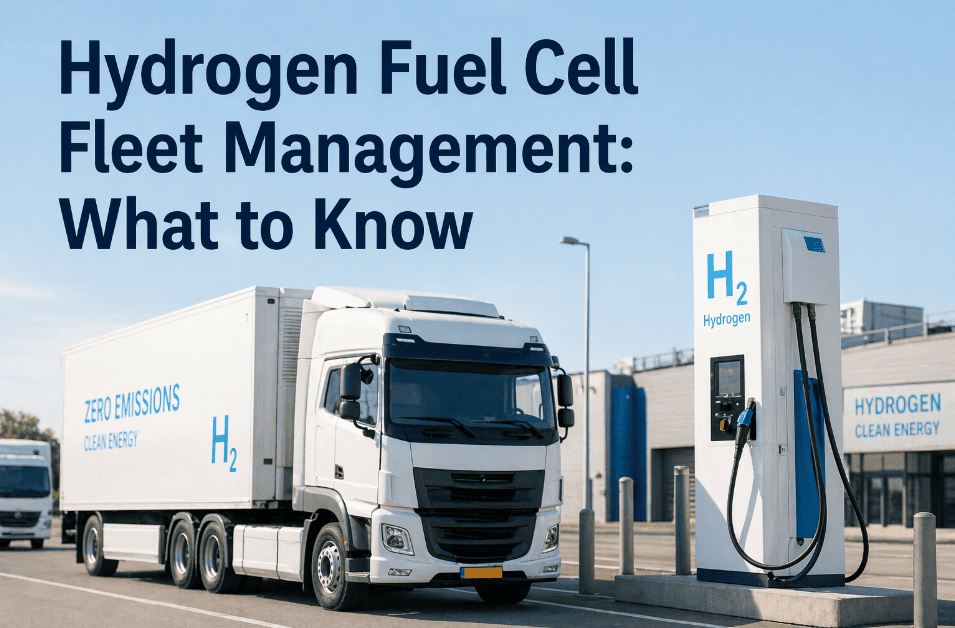
Hydrogen fuel cell vehicles are no longer a concept fleet managers read about in trade publications — they're operating on real routes today. Toyota's Kenworth T680 FCEV is hauling containers at the Port of Long Beach. Hyundai's XCIENT Fuel Cell is running regional routes in California and Europe. Shell, BP, and TravelCenters of America are building heavy-duty hydrogen refueling corridors. But most fleet managers considering hydrogen transition face the same knowledge gap: the technology is real, the business case is emerging, and the operational playbook is still being written. Hydrogen fuel cell trucks deliver the range and refueling speed of diesel — 400+ miles, 15-minute fill — with zero tailpipe emissions. The challenge is infrastructure scarcity, hydrogen cost volatility ($10–$16/kg versus diesel energy equivalence at $6–$8), and maintenance protocols that combine high-voltage EV complexity with compressed gas handling requirements. This guide gives fleet managers the operational framework to evaluate hydrogen seriously — from refueling logistics to fuel cell maintenance to the hybrid hydrogen-electric architectures that will dominate Class 8 zero-emission fleets by 2030. Oxmaint helps fleets managing hydrogen vehicles track fuel cell health, schedule specialized maintenance, and document compliance across mixed alternative-fuel operations.
Hydrogen Fuel Cell Fleet Management: What Fleet Managers Need to Know in 2026
Evaluate hydrogen fuel cell vehicles for your fleet — refueling logistics, fuel cell maintenance, cost benchmarks, and the hybrid architectures changing long-haul zero-emission transport.
Hydrogen vs. Battery Electric — Choosing the Right Zero-Emission Technology
The hydrogen vs. battery debate is the wrong framing. The right question is: which zero-emission technology fits which route profile? Hydrogen wins on range and refueling speed. Battery wins on infrastructure availability and energy cost. Most large fleets will operate both — the question is which routes get which technology.
Hydrogen Refueling — The Infrastructure Reality in 2026
Hydrogen infrastructure is the biggest operational challenge for fleet managers evaluating FCEV trucks. Unlike EV charging, you can't just install a depot station for $50K — a 350 kg/day commercial hydrogen station costs $3–$6 million to build. Here's how fleets are solving refueling logistics today, and what the network will look like by 2030.
On-Site Depot Station
Best for fleets of 20+ FCEVs at a single depot. Cost: $3–$6M. Payback period 5–8 years. Requires utility hydrogen supply agreement and 12–24 months permitting.
Public Network Partnership
Contract with existing corridor stations (Shell, FirstElement, TravelCenters). Limits route flexibility but eliminates capital investment. Best for routes near CA H2 corridor.
Mobile Refueling Trailer
Portable hydrogen tube trailers deployed to your depot. Cost: $150K–$300K/trailer. Capacity 200–400 kg. Requires third-party hydrogen supply contract and safety training.
Shared Consortium Station
Co-invest in a shared station with 3–5 other fleets. Splits capital cost, shares capacity. Requires coordination agreement on refueling windows and priority access.
Track Fuel Cell Health & Refueling Across Your Fleet
Oxmaint manages hydrogen FCEV maintenance schedules, fuel cell performance monitoring, and compliance documentation alongside your diesel and BEV assets.
What Maintaining a Hydrogen Fuel Cell System Actually Looks Like
Fuel cell maintenance combines high-voltage EV protocols with compressed gas handling requirements — it's more complex than either diesel or battery electric alone. Most OEMs (Toyota, Hyundai, Nikola) provide 5–10 year fuel cell stack warranties covering performance degradation, but fleet-level maintenance is still required. Here's the actual maintenance schedule.
When Does Hydrogen Actually Make Financial Sense?
Hydrogen economics are improving faster than most fleet managers realize. The Inflation Reduction Act's Section 45V hydrogen production credit can reduce green hydrogen cost by $3/kg starting 2025. Here's the cost trajectory that will drive fleet adoption decisions.
"We deployed three Toyota Kenworth FCEVs on our Port of Long Beach routes as a pilot. Refueling takes 15 minutes — our drivers love it. The fuel cost hurts at $12/kg but the carbon credits, customer sustainability premiums, and CARB compliance position make the business case work right now. We're ordering ten more for 2026."
— Director of Sustainability, 180-vehicle drayage fleet, Southern California
How Oxmaint Supports Hydrogen FCEV Operations
Hydrogen fuel cell vehicles require a maintenance management system that understands alternative fuel complexity — not a generic CMMS with a text field labeled "fuel type." Book a demo to see Oxmaint configured for hydrogen FCEV alongside your diesel and BEV assets.
Fuel Cell Stack Monitoring
Track output voltage, efficiency degradation, and operating hours per stack. Alert when performance drops below OEM threshold.
H2 Safety Compliance
Track technician certifications for compressed gas and HV work. Enforce safety protocols via work order checklists. Log all leak tests.
DOT Pressure Vessel Records
Maintain annual inspection records, hydrostatic test dates, and valve certification documentation for every hydrogen storage tank.
Mixed-Fleet Scheduling
Manage FCEV, BEV, and diesel PM schedules in a single system with vehicle-type-specific templates for each powertrain.
Fuel Cost Tracking
Track hydrogen consumption, cost per kg, and cost per mile per vehicle. Compare FCEV economics against diesel equivalents on the same routes.
Emissions Reporting
Generate Scope 1 and Scope 3 emissions reports showing FCEV zero-emission performance for CARB, customer sustainability audits, and carbon credit claims.
Frequently Asked Questions
Are hydrogen fuel cell trucks viable for my fleet today?
How much does hydrogen fuel cost compared to diesel?
What certifications do technicians need to service FCEV trucks?
How long does a hydrogen fuel cell stack last?
Can Oxmaint manage hydrogen vehicles alongside diesel and electric trucks?
Manage Every Powertrain From One Platform
FCEV, BEV, diesel, CNG — Oxmaint handles all of them.