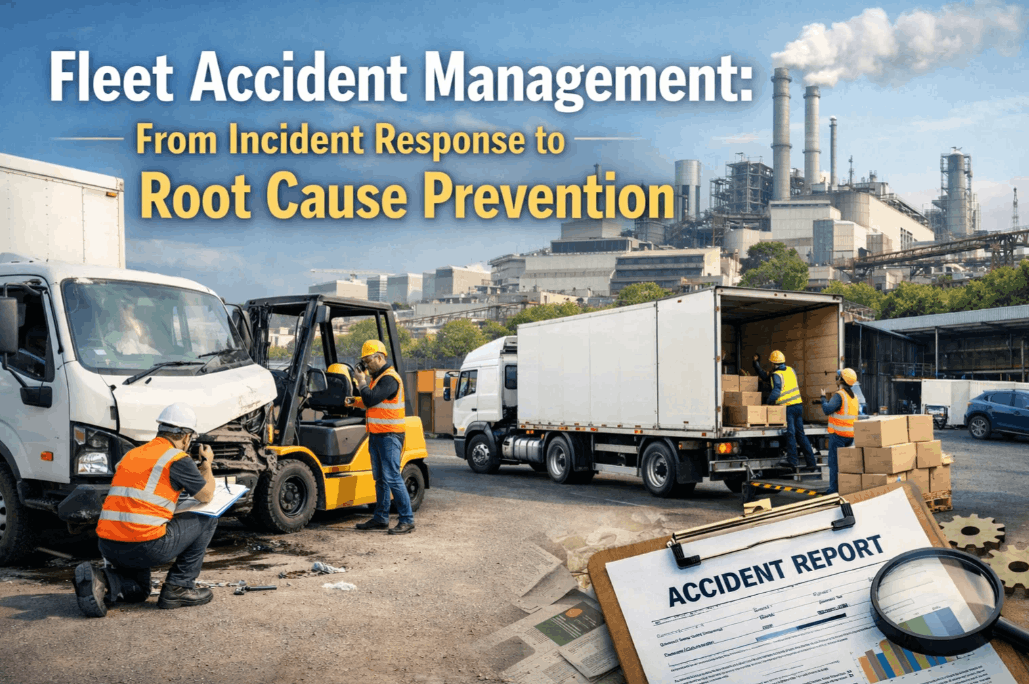
A regional utility contractor in Phoenix was running 140 service vehicles when one of their trucks rear-ended a stopped sedan on I-10 at 7:23 AM on a Tuesday in March 2022. The crash was the second at-fault incident for the driver in 11 months. The company's incident response relied on the driver calling the dispatcher, the dispatcher calling the safety manager, the safety manager reaching out to the insurance carrier, and someone at the office pulling the vehicle's maintenance record from the CMMS to verify it was in compliance. By the time the first notice of loss (FNOL) reached the insurance carrier, it was 9:47 AM — 2 hours and 24 minutes after the collision. The dashcam footage had not been pulled. The driver had given a recorded statement to the other party's insurance representative without any supervisor present. The liability adjuster later cited the delayed FNOL and undocumented incident response as factors in the settlement amount — which came in at $340,000 against a comparable incident where a fleet with an automated incident response protocol settled for $180,000. OxMaint incident management automates the first 60 minutes of fleet incident response — FNOL filing, dashcam footage retrieval, maintenance record pull, and supervisor notification — so the critical first-hour window is managed by the system, not by whoever happens to answer the phone. Book a demo to see what a documented incident response protocol looks like for a 140-vehicle fleet.
Delayed FNOL in the Phoenix contractor incident — vs under 15 minutes with OxMaint automated first response
$160K
Difference in settlement amount between documented and undocumented incident response protocols in comparable collisions
68%
Of at-fault claim disputes are more successfully defended when dashcam footage is retrieved and FNOL filed within 30 minutes
The Fleet Incident Response Timeline — What Happens Automatically in OxMaint
The first 60 minutes after a fleet incident determine the quality of the evidence chain, the speed of the FNOL filing, and the ability to defend against exaggerated or fraudulent claims. OxMaint automates the critical first-hour response so the outcome is determined by the protocol, not by who happens to be on call.
App: "Supervisor en route. Do not give statements."
60 min
Evidence package complete — locked
Vehicle inspection scheduled if driveable
App: "Drug test appointment sent to phone."
Without OxMaint: All five steps are manual phone calls averaging 2+ hours. With OxMaint: Automated in 15 minutes — supervisor spends time managing the scene, not assembling the record.
Incident Management — OxMaint
The First 60 Minutes After a Collision Determine the Claim Outcome. Is Your Protocol Automated?
The Four Components of an Effective Fleet Incident Response Protocol
Effective fleet incident management is not about reacting faster — it is about having a documented protocol that executes consistently regardless of time of day, severity of the incident, or who is managing the response. OxMaint structures all four components into one automated workflow.
OxMaint Incident Protocol — Four Components, One Automated Workflow
Evidence Capture
Dashcam clip auto-retrieved on G-force trigger
GPS speed and location at impact locked
Driver photo capture guided — scene, vehicles
Maintenance compliance record auto-attached
FNOL Filing
Carrier FNOL in required format — under 15 min
Claim number received and linked to incident WO
Evidence package attached to FNOL automatically
Bodily injury flag — escalation protocol triggered
Driver Guidance
Post-incident protocol steps sent to mobile app
No-admission-of-fault reminder — on screen
Drug test appointment link sent automatically
Other party information — guided capture form
Incident Management Outcomes — Manual vs OxMaint Automated Protocol
The cost of an unmanaged fleet incident is not just the claim settlement — it is the difference between a defended claim and an indefensible one. OxMaint's documented incident response changes the claim outcome, not just the response speed.
Incident Factor
Manual Response
OxMaint Automated
Claim Impact
FNOL filing time
2–4 hours — phone chain
Under 15 minutes — automated
Preserves carrier claim defence rights
Dashcam footage
Requested after claim filed — often unavailable
Auto-retrieved at G-force trigger
At-fault dispute defence improved 68%
Maintenance compliance
Manual pull — delays FNOL
Auto-attached in 5 minutes
Eliminates negligent maintenance argument
Driver statement
Often given without supervisor — unguided
App guidance — no admission until coached
Liability admission risk eliminated
Drug test compliance
Dispatcher has to remember — often late
Test appointment auto-sent to driver app
Federal compliance — regulatory risk removed
Settlement difference
$340K average — undocumented response
$180K average — documented protocol
$160K per comparable incident
"Our $340,000 settlement was the wake-up call. The liability adjuster told us the delayed FNOL, the unguided driver statement, and the gap in the maintenance record were the three factors that made the claim indefensible. We deployed OxMaint incident management the following month. We've had four incidents since — all defended successfully. The protocol is the difference."
— Director of Safety & Risk, Utility Contractor · Phoenix, Arizona · 140 service vehicles
Incident Management by Fleet Incident Type
Different incident types require different first-response protocols — a minor parking lot bump requires different evidence capture than a highway collision with injuries. OxMaint routes each incident type through the appropriate protocol automatically based on severity detection from telematics data.
Severity 1
Injury / Fatality
Immediate supervisor and legal counsel alert
Scene preservation protocol — app guidance
Full FNOL + bodily injury carrier notification
Driver drug test — same-day DOT protocol
Evidence chain locked — litigation hold flag
Severity 2
Property Damage / No Injury
Auto FNOL — 15-minute protocol
Dashcam and GPS data locked immediately
Vehicle condition photos — guided capture
Maintenance record auto-attached to claim
Subrogation candidate flagged automatically
Severity 3
Minor / Parking Lot
Driver self-report via OxMaint app
Photo evidence — both vehicles + surroundings
Other party information guided capture
Supervisor notified within 30 minutes
Body shop estimate WO auto-created
Severity 4
Near-Miss / ADAS Event
ADAS AEB activation triggers incident record
Dashcam clip auto-pulled — 30-sec window
Driver coaching WO generated — same day
Route context logged — route risk flag
Pattern tracking — 3 near-misses = coaching
Technology: How OxMaint Connects Incident Data Across the Full Response Chain
OxMaint connects incident detection, evidence capture, carrier notification, and maintenance record verification into a single automated workflow — eliminating the manual hand-offs that create delays, gaps, and claim vulnerability.
OBD / Telematics — Collision Detection from G-Force Data
OxMaint receives G-force impact data from Samsara, Geotab, and Verizon Connect telematics units — triggering the incident response workflow automatically when the impact exceeds the configured threshold. Speed, location, heading, and driver ID are locked at the moment of impact. The entire evidence capture sequence initiates without any human action required — even if the driver is injured and cannot report the incident.
AI Camera Vision — Dashcam Auto-Retrieval and Scene Analysis
Within 2 minutes of G-force trigger, OxMaint requests the dashcam clip from Lytx, Samsara, or Mobileye camera systems automatically — securing the 30-second pre-impact and post-impact footage before it can be overwritten. AI camera vision analyses the clip — identifying at-fault indicators, following distance at impact, traffic conditions, and weather — providing the initial liability assessment that supports FNOL submission and claim defence preparation.
Maintenance Record Auto-Pull — Compliance Evidence in the Claim Package
OxMaint automatically attaches the affected vehicle's complete maintenance record — PM compliance, last inspection date, outstanding work orders, and brake and tire service history — to the incident record within 5 minutes. This documentation addresses the most common negligent maintenance allegation in commercial vehicle litigation before the opposing party has time to request it through discovery. The maintenance record is timestamped, immutable, and formatted for legal submission.
SAP / HR Integration — FMCSA Drug Test Compliance Tracking
OxMaint sends the post-incident drug test appointment notification to the driver's mobile app automatically — and tracks test completion against the FMCSA-mandated timeline in the driver's HR record. Test completion posts to SAP SuccessFactors or Workday HCM automatically. Fleets that miss post-incident drug test timelines face FMCSA violation risk independent of the incident outcome — OxMaint eliminates the manual follow-up that causes these misses.
AI Digital Twin — Pattern Detection Across Incident History
OxMaint AI analyses incident history across the fleet — identifying route segments with elevated incident frequency, drivers with recurring near-miss patterns, and vehicle types with higher-than-expected damage severity. Pattern detection generates preventive action work orders before the next incident occurs — routing changes, targeted coaching assignments, or vehicle inspection triggers based on incident location analysis.
Claim Management Dashboard — All Incidents, One View
Fleet safety managers see every open incident — claim number, carrier, adjuster contact, evidence status, and repair status — on one OxMaint dashboard. Subrogation candidates are flagged for recovery by the fleet's legal team. Incidents approaching statute of limitations for counter-claim filing are alerted. The claim management dashboard eliminates the Excel tracking sheet that most fleet safety teams use to manage what should be a systematic, auditable process.
At-fault dispute defence improvement with dashcam footage retrieved within 30 minutes
$160K
Average settlement difference — documented vs undocumented incident response in comparable collisions
2 min
Dashcam clip auto-retrieved after G-force trigger — before any human action required
Frequently Asked Questions
OxMaint receives G-force impact data from connected telematics units (Samsara, Geotab, Verizon Connect) and initiates the incident workflow when the impact exceeds a configured threshold. The system also accepts driver-initiated reports via the mobile app for incidents below the G-force threshold. Both trigger the same evidence capture, FNOL, and notification sequence — the only difference is the detection source.
OxMaint requests the dashcam clip from Lytx, Samsara, or Mobileye within 2 minutes of G-force trigger — securing the 30-second pre-impact and post-impact footage to the OxMaint incident record before it can be overwritten by the camera's rolling buffer. The footage is locked and attached to the incident file automatically, with no dispatcher action required to preserve the evidence.
OxMaint's FNOL package includes: vehicle ID and policy number, incident date/time/GPS location, speed at impact from telematics, driver ID and licence number, dashcam clip link, and vehicle PM compliance record — assembled automatically in the format accepted by the fleet's carrier. Most carriers receive the complete FNOL package within 15 minutes of the collision with all required supporting documentation already attached.
OxMaint sends a step-by-step post-incident guidance sequence to the driver's mobile app — checking if anyone is injured, instructions to stay at the scene, no-admission-of-fault reminder, guided photo capture for scene documentation, a form for recording other party information, and the drug test appointment link. The guidance reaches the driver within 60 seconds of incident detection — before most dispatchers have even been notified by phone.
Yes — OxMaint sends the post-incident drug test appointment notification to the driver automatically and tracks completion against the FMCSA-mandated timeline. Test completion status posts to the driver's HR record in connected HR systems. Overdue tests generate an escalation alert to the safety manager. The compliance documentation is exportable for FMCSA audit requests and insurance carrier reviews.
Incident Management — OxMaint
$160,000 Difference. 15 Minutes vs 2 Hours. Protocol vs Phone Chain.