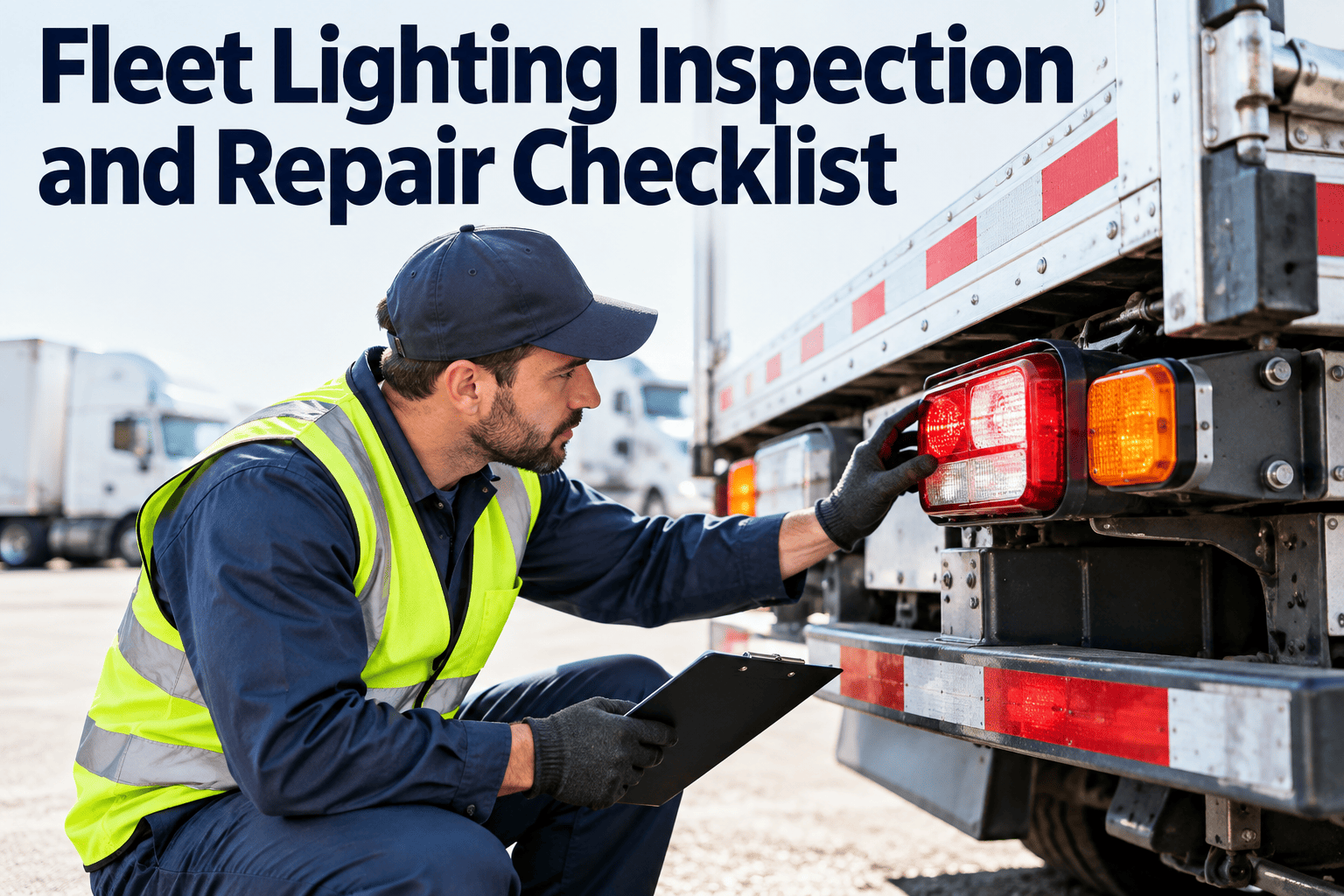
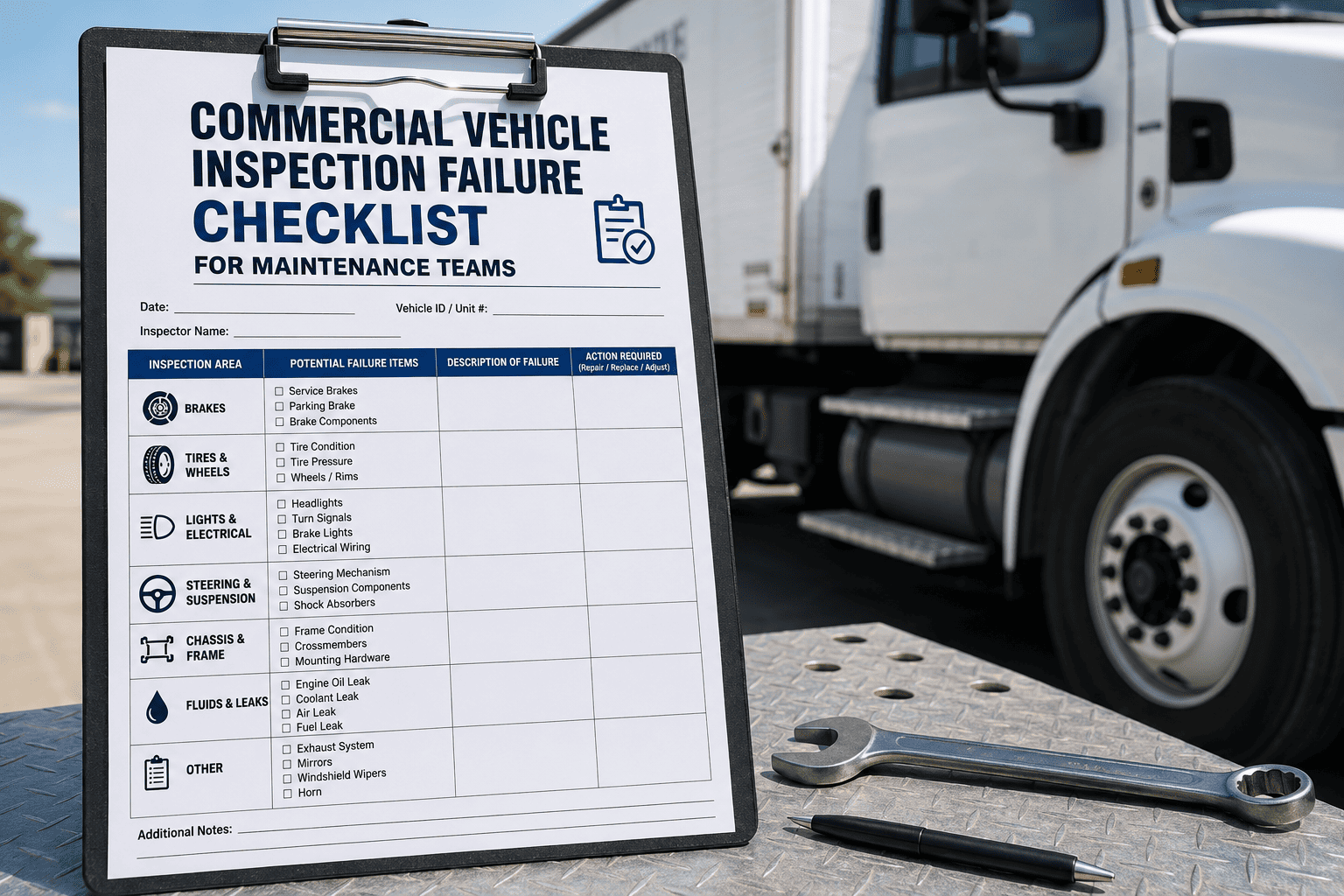
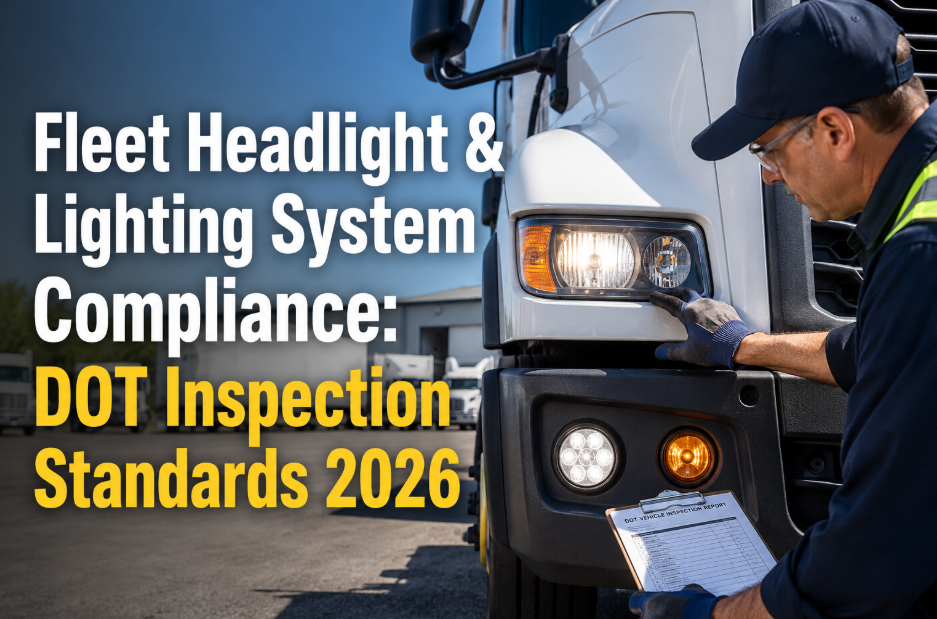
Lighting violations are the most common after-dark roadside enforcement finding on commercial vehicles — and the most preventable. A single inoperative stop lamp, a missing clearance light, or a reflector tape section peeled away by winter road spray is all it takes to generate an OOS citation, a CSA Vehicle Maintenance BASIC score impact, and in the most serious cases, a secondary collision when a following vehicle cannot see your truck stopping in time. FMVSS 108 defines exactly which lamps are required, where they must be positioned, what color they must emit, and at what intensity — leaving no ambiguity about what passes and what fails. Oxmaint's lighting inspection module guides technicians through every required lamp and circuit, records pass/fail results per position, and auto-generates repair work orders for every defect found.
Fleet Lighting Inspection — 5-Stage Process
A thorough lighting compliance inspection follows five stages — from pre-inspection circuit checks to final documentation. Skipping any stage leaves defects undiscovered, generates OOS citations, and creates gaps in the maintenance record that surface during DOT compliance reviews.
Technology Transforming Lighting Compliance
Manual lighting inspection relies on a technician walking around the vehicle, operating each switch, and making a visual judgement. Four technologies reduce both the time and the error rate of lighting compliance checks — turning a 45-minute manual process into a data-driven, sub-10-minute scan. Oxmaint connects all four into one lighting inspection workflow.
1. Headlights, Brake Lights and Turn Signals Checklist
The primary lighting systems — headlamps, stop lamps, and turn signals — are the OOS categories most frequently cited at roadside inspections. These are not discretionary defects: a single inoperative stop lamp is an immediate OOS condition under FMVSS 108 regardless of how many others are working. Record lighting inspection results per position with Oxmaint.
Headlamps — low beam and high beam, both sides
Both headlamps must illuminate on both beams. Aim must be within DOT specification — horizontally and vertically. A lamp aimed significantly above horizontal is OOS. OOS — inoperative or misaimed
Stop lamps — brake application test, all positions
All stop lamps must illuminate on brake application. A single inoperative stop lamp is OOS — no exceptions, no partial credit for remaining lamps. OOS — any single lamp inoperative
Turn signals — flash rate 60–120 per minute, both sides
Turn signals must flash at 60–120 flashes per minute on both sides. Test front and rear signals independently. An incorrect flash rate indicates a circuit fault or incorrect bulb type. Defect — wrong flash rate
Hazard flashers — independent operation from turn signals
Hazard flashers must operate independently of the ignition and turn signal switch. Verify all four corners flash simultaneously at correct rate with engine on and off. Defect — partial or no operation
Lamp lenses — cracks, moisture ingress, and colour integrity
Inspect all lamp lenses for cracks, cloudiness, or moisture accumulation that reduces output or alters colour. A red lamp with a cracked lens showing white light fails the colour requirement. Defect — lens compromised
OBD tip: Body control module fault codes for stop lamp open circuits and turn signal bulb-out faults appear in OBD data before the driver notices any change. Oxmaint pulls these codes at every telematics sync, alerting maintenance before the next pre-trip inspection. See Oxmaint's real-time lighting fault monitoring.
2. Clearance, Marker and Identification Lamps Checklist
Clearance, marker, and identification lamps define the vehicle's outline to other road users — they are the first lights visible from a distance at night and are critical for preventing rear-end and sideswipe collisions. Vehicles over 80 inches wide have additional lamp requirements that many smaller-fleet operators are unaware of until a roadside citation reveals the gap.
Front clearance lamps — amber, both sides, vehicles >80" wide
Two amber front clearance lamps required on vehicles over 80 inches wide — mounted at the widest point to show the vehicle's full width to approaching traffic. OOS — missing on >80" vehicle
Rear clearance lamps — red, both sides, vehicles >80" wide
Two red rear clearance lamps required on vehicles over 80 inches wide — positioned as close to the top and widest point of the vehicle as practicable. OOS — missing on >80" vehicle
Identification lamps — 3 amber front, 3 red rear, vehicles >80" wide
Three amber identification lamps centred on the front and three red identification lamps centred on the rear are required on vehicles over 80 inches wide. All three in each cluster must illuminate simultaneously. OOS — any lamp inoperative
Side marker lamps — amber front, red rear, both sides
Side marker lamps are required on all CMVs — amber at the front half and red at the rear half of each side. They must be visible from 500 feet at night. Defect — inoperative or missing
Intermediate side marker — required on vehicles over 30 feet
Vehicles over 30 feet in length require an intermediate side marker lamp on each side at approximately the midpoint. Often missing on trailers as it is not covered in basic pre-trip training. Defect — missing on >30 ft vehicle
3. Reflectors, Conspicuity Tape and Auxiliary Lights Checklist
Reflectors and conspicuity tape provide passive visibility when vehicle lighting circuits fail or when a vehicle is parked without power. FMVSS 108 requires specific reflector positions and mandates DOT conspicuity tape on trailers manufactured after 1993. A trailer with peeled or faded tape and missing reflectors is one of the most commonly cited equipment violations at weight station inspections. Track reflector and tape inspection findings per trailer in Oxmaint.
Reflex reflectors — red rear, amber front, all required positions
Red reflex reflectors required at the rear and on each side at the rear. Amber reflex reflectors on each side at the front. Reflectors must be clean and undamaged — a reflector that is painted over, cracked, or missing its reflective surface is a defect. Defect — missing or damaged
DOT conspicuity tape — trailers manufactured after December 1, 1993
Alternating red-and-white retroreflective sheeting required along the full length of both sides and across the full width of the rear. Any section missing, peeled, or so faded it is no longer retroreflective is a defect requiring replacement. OOS — significant missing section
Licence plate lamp — illuminates plate at night
At least one lamp must illuminate the rear licence plate from the top or sides so it is clearly visible from 50 feet at night. A missing or inoperative plate lamp is a separate lighting violation from the plate being visible in daylight. Defect — inoperative lamp
Backup alarm — required on vehicles with obstructed rear view
Where required by OSHA or employer policy, backup alarm must activate immediately on reverse gear engagement. Verify alarm audibility at the rear of the vehicle with doors closed and engine running. Defect — inoperative alarm
Auxiliary work lights — secured mounting and switch operation
All auxiliary lamps must be securely mounted — vibration-loose auxiliary lamps are a secondary hazard. Work lights must switch off when not in required use. Verify no auxiliary lamp interferes with or is confused for required DOT lamps. Defect — loose mounting
AI Camera Vision tip: Oxmaint's AI-assisted drive-through scan identifies missing or faded conspicuity tape sections, missing reflectors, and inoperative lamp positions on trailers entering the depot — flagging every defect before the trailer is assigned to the next load. Book a demo to see AI lighting scan in Oxmaint.
4. Electrical Wiring and Connector Inspection Checklist
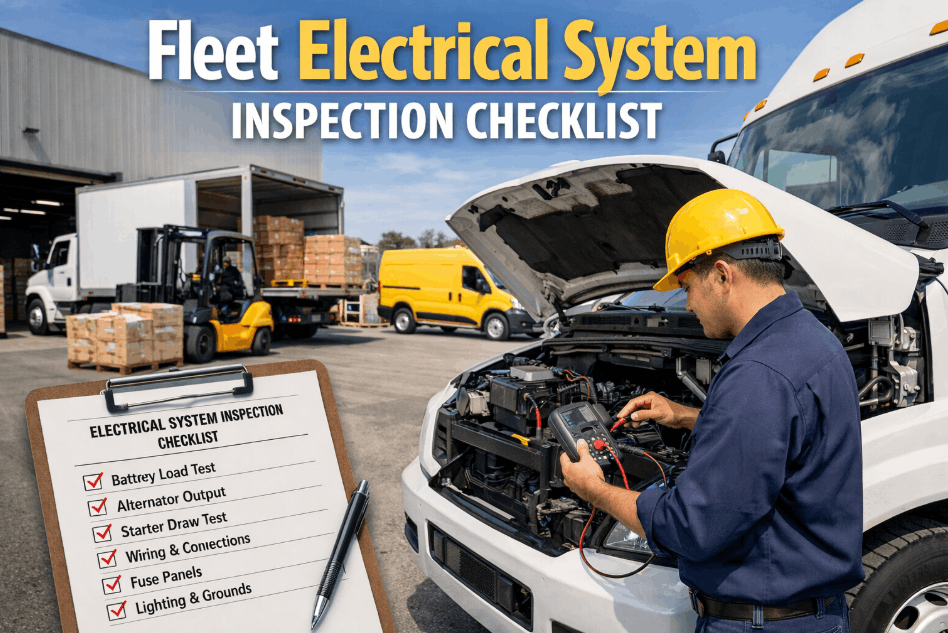
Most lighting failures are not lamp failures — they are wiring and connector failures. A 7-way connector with two corroded pins, a wiring harness chafed through against a frame rail, or a ground strap with 80% of its strands broken will produce intermittent lighting faults that appear, clear, and reappear without any lamp being actually defective. Chasing the lamp when the problem is the circuit wastes hours of technician time.
7-way electrical connector — all 7 pins for condition and corrosion
Inspect all 7 pins for corrosion, bending, and secure retention. Clean with contact cleaner and apply dielectric grease at every PM. A corroded pin produces intermittent faults that disappear when the connection is wiggled. Defect — corroded/bent pins
Wiring harness — chafing, heat damage, and securing clips
Inspect all visible wiring harnesses for chafing on frame members and heat damage near exhaust routing. Any harness with exposed conductor is a fire risk and an electrical fault waiting to happen. OOS — exposed conductor
Ground straps and bonding connections — resistance test
Test lighting circuit ground resistance with a multimeter — resistance above 0.1 ohm indicates a deteriorated ground that will cause dim lamps and intermittent faults across multiple circuits sharing that ground path. Defect — above 0.1 ohm
Fuse and relay panel — all lighting fuses present and correct rating
Check all lighting circuit fuses are present, the correct amperage, and not bypassed with wire. A fuse bypassed with wire is both an OOS condition and a fire hazard — document and report to workshop management. OOS — fuse bypassed
Lighting was our biggest CSA score driver — we had 14 roadside citations in one quarter, all lighting. After deploying Oxmaint's lighting inspection module and connecting our telematics for real-time bulb-out fault alerts, we dropped to zero lighting citations in the following two quarters. The 7-way connector inspection alone resolved six recurring intermittent fault calls.
Frequently Asked Questions
The most common questions from inspection technicians and fleet managers about lighting compliance requirements and FMVSS 108.
Yes — under §393.9, any required lamp that is inoperative is an OOS condition. Stop lamps are required at every position specified in FMVSS 108. There is no provision for "enough other lamps are working" — one failure is one violation.
On any vehicle over 80 inches (6 ft 8 in) in overall width. This includes most Class 8 tractors, most semi-trailers, and many Class 6–7 straight trucks. If unsure, measure — the threshold is the vehicle's overall width, not the cab width.
Driver pre-trip inspection covers primary lamps daily. A technician-level inspection covering all lamp positions, lens condition, connector integrity, and wiring should be completed every 30 days or at every PM service — whichever comes first. High-mileage vehicles and trailers should be inspected more frequently.
Trailers manufactured after December 1, 1993 must have alternating red-and-white retroreflective sheeting along both sides and across the full rear width. Sections that are peeled, faded below minimum retroreflectivity, or missing must be replaced — partial tape is a defect, not partial credit.
Yes, if the LED module is SAE-certified for the lamp function being replaced and produces the correct colour and intensity. Uncertified LED bulbs inserted into incandescent sockets often fail photometric requirements even if they appear bright. Always verify SAE certification on LED replacements.
Oxmaint provides a guided digital lighting inspection covering every FMVSS 108 position, records pass/fail per lamp with technician sign-off, auto-generates repair work orders for defects, and maintains a lighting inspection history per vehicle for DOT audit retrieval.