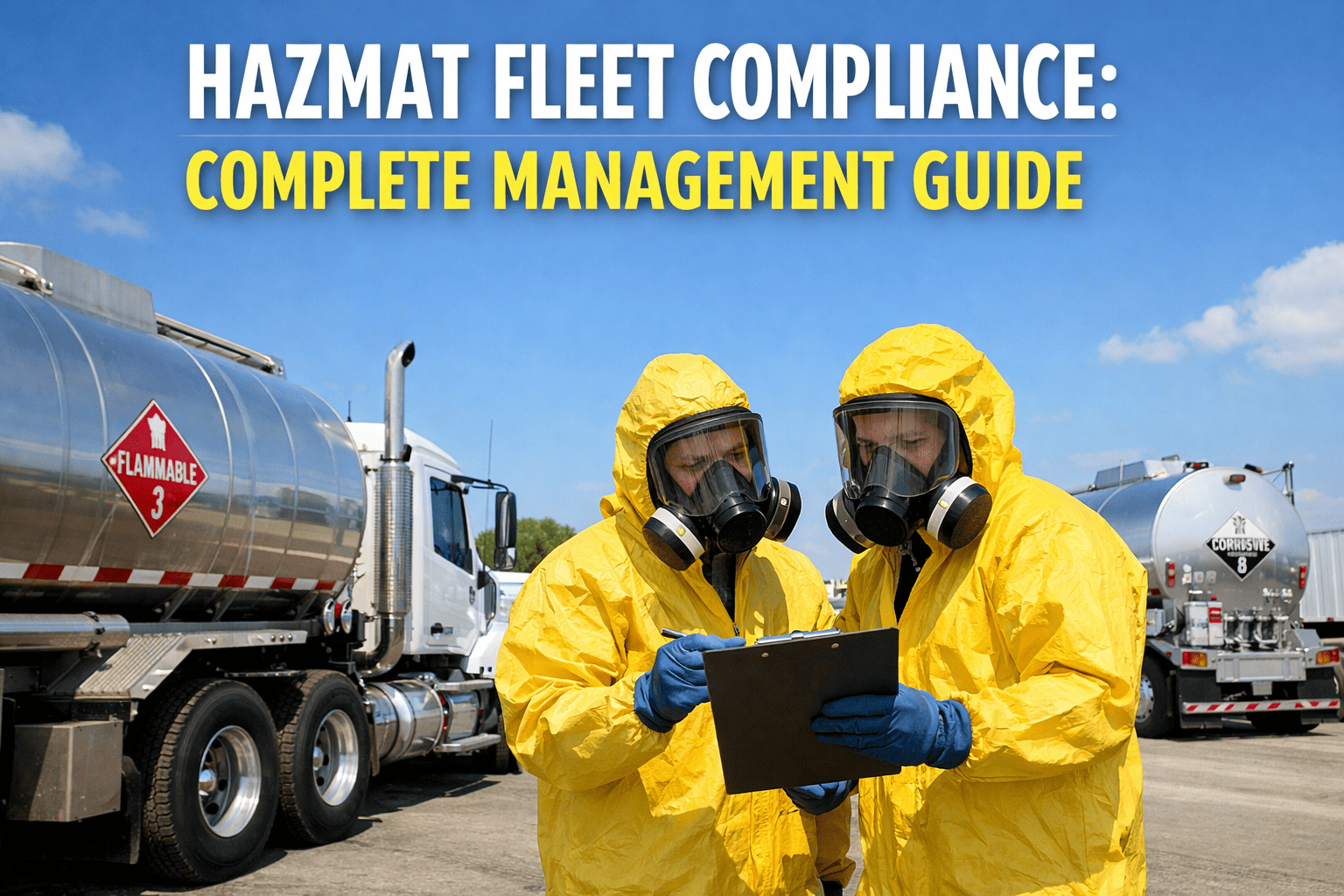
A regional carrier in Texas faced a $94,000 DOT fine after an audit revealed that three drivers had transported placarded hazmat loads without current HazMat Endorsements on their CDLs — not because the safety director didn't care, but because the endorsement expiration tracking lived in a spreadsheet that was last updated four months before the audit. The loads were compliant on the day the endorsements were issued. The system had no mechanism to flag the expiration before a dispatcher sent an unqualified driver onto a hazmat route. Hazmat fleet compliance is the highest-stakes compliance domain in commercial trucking — carrying criminal liability for responsible parties, five-figure per-violation civil penalties, out-of-service orders that freeze entire fleets, and reputational exposure that can cost operating authority. Managing it through spreadsheets, paper logs, and dispatcher memory is not a risk management strategy. It is a liability accumulation strategy. OxMaint AI hazmat fleet compliance management automates the entire compliance lifecycle — driver certification tracking, placard requirement determination, route restriction enforcement, shipping paper verification, and incident documentation — so every hazmat move in your fleet is compliant before the wheels turn. Sign in to OxMaint to configure hazmat compliance tracking for your fleet, or book a demo to see how OxMaint automates hazmat driver certification, routing, placarding, and shipping paper management across your entire operation.
Hazmat Fleet Compliance · DOT Dangerous Goods Management · Driver Certification Tracking · OxMaint AI
Driver HazMat Endorsements. Placard Requirements by Load. Route Restriction Verification. Shipping Paper Compliance. OxMaint AI Manages Every Hazmat Obligation Before Every Dispatch — Automatically.
OxMaint AI hazmat fleet management integrates driver certification records, load classification data, route restriction databases, and shipping paper requirements into a unified pre-dispatch compliance check — flagging every hazmat compliance gap before a wheel turns rather than after a roadside inspection or DOT audit finds it.
$94K
DOT fine for a Texas carrier whose drivers operated on expired HazMat Endorsements — a compliance gap that an automated certification tracking system would have flagged 90 days earlier
$84,820
maximum per-violation civil penalty for serious hazmat violations under 49 CFR — each non-compliant shipment is a separate violation, multiplying exposure across an audit period
Criminal
liability exposure for responsible individuals — knowing violations of hazmat regulations carry up to 5 years imprisonment under 49 U.S.C. § 5124 for persons in responsible positions
$84K
The maximum per-violation civil penalty for serious hazmat violations is $84,820 — and each non-compliant shipment is counted as a separate violation under DOT enforcement. A fleet that moved 15 non-compliant hazmat loads in the audit period does not face one $84,820 fine. It faces 15 separate violations — each carrying up to $84,820 in civil penalty exposure, plus potential criminal referral for responsible individuals who knew or should have known about the violations. OxMaint AI hazmat compliance management prevents the violation from occurring at all — by verifying driver certification, load classification, placarding requirements, and routing restrictions at the dispatch stage, before every hazmat load is assigned.
Four Hazmat Compliance Domains OxMaint AI Manages for Fleet Operations
CERT — Driver Certification
HazMat Endorsement Tracking and Pre-Dispatch Certification Verification
Every driver operating a vehicle transporting placarded quantities of hazardous materials must hold a valid HazMat Endorsement on their CDL — a requirement that involves both state DMV renewal and TSA security threat assessment. OxMaint AI tracks every driver's HazMat Endorsement expiration date, TSA approval status, and any endorsement restrictions — generating automated alerts at 90, 60, and 30 days before expiration and blocking hazmat dispatch assignments for drivers whose endorsement is within 30 days of expiry or has already expired. Pre-dispatch compliance verification confirms HazMat Endorsement validity before the load is assigned — meaning no dispatcher can knowingly dispatch a driver without current certification and no compliance gap can develop silently between annual spreadsheet reviews.
Sign in to OxMaint to configure HazMat Endorsement tracking for your driver roster.
Key Certification Data OxMaint Tracks per Driver
CDL HazMat Endorsement expiration — state-specific renewal date per driver
TSA security threat assessment — approval date, threat assessment renewal status
HAZWOPER training — if required for specific hazard class operations
Company hazmat training — 49 CFR Part 172 Subpart H training completion per driver
Endorsement restrictions — any hazard class limitations on individual endorsements
Certification Failures OxMaint Prevents
Expired endorsement dispatch — driver assigned hazmat load after CDL HME expiration
TSA approval lapse — TSA security threat assessment expired without renewal flagged
Training gap — hazmat training record expired between DOT compliance audit cycles
PLAC — Placarding Requirements
AI Placard Requirement Determination by Hazard Class and Quantity
Placarding requirements under 49 CFR Part 172 Subpart F depend on the hazard class, quantity, and configuration of the hazardous materials being transported — and the determination is more complex than a simple lookup table. Table 1 materials require placards in any quantity. Table 2 materials require placards when the aggregate gross weight exceeds 1,001 pounds. Mixed loads involving multiple hazard classes have combined-loading placard rules. OxMaint AI placard determination engine applies the correct rule set to each load's manifest — calculating the required placards by hazard class, quantity, and load configuration and presenting the placard requirement to the dispatcher and driver before departure. Discrepancy between the manifest-calculated requirement and the driver's reported placard configuration generates a pre-departure hold flag. No load departs with an incorrect placard configuration without generating a compliance alert that requires supervisor acknowledgement.
Book a demo to see AI placard determination in OxMaint for complex multi-hazard-class loads.
Key Placarding Determinations OxMaint Calculates
Table 1 vs. Table 2 classification — per hazard class per shipment
Aggregate weight threshold — 1,001-lb Table 2 trigger per load manifest
Mixed load rules — required placards for combination hazard class loads
Subsidiary hazard placards — additional placards required for subsidiary risk classes
Placarding Failures OxMaint Prevents
Missing Table 1 placard — any quantity requiring placard dispatched without one
Incorrect weight threshold — Table 2 load above 1,001 lb dispatched unplacarded
Mixed load omission — secondary hazard class placard missing from combination load
ROUTE — Routing Restrictions
Hazmat Route Restriction Database and Pre-Trip Routing Compliance
Certain hazardous materials — explosives, radioactive materials, and specific other hazard classes — are restricted from certain routes under 49 CFR Part 397, and additional state and local restrictions apply in tunnel prohibitions, urban zones, and bridge limitations that vary by jurisdiction. Route planning for hazmat loads cannot rely on standard navigation systems that are not hazmat-aware. OxMaint AI route restriction verification cross-references the load's hazard class and UN number against the federal and state routing restriction database — flagging prohibited routing segments, identifying required alternative routes, and confirming that the planned route does not pass through any restricted zone. For fleets operating Controlled Routes for radioactive materials or explosives, OxMaint tracks route pre-approval documentation and ensures drivers are operating on approved routes with current documentation.
Sign in to OxMaint to configure hazmat route restriction verification for your fleet's operating territory.
Key Route Compliance Data OxMaint Verifies
49 CFR Part 397 routing requirements — federal preferred routes by hazard class
State hazmat routing restrictions — state-specific prohibitions and required routes
Tunnel and bridge restrictions — jurisdiction-specific infrastructure prohibitions
Controlled route documentation — pre-approval records for radioactive and explosive loads
Routing Failures OxMaint Prevents
Prohibited tunnel transit — explosive or hazmat load routed through restricted tunnel
State restriction violation — load bypassing required state route for the hazard class
Expired controlled route approval — radioactive load operating on outdated pre-approval
SHIP — Shipping Papers
Shipping Paper Verification, Emergency Response Information, and Document Retention
Shipping papers for hazmat shipments must include the proper shipping name, hazard class, identification number, packing group, total quantity, emergency contact number, and ERG guide reference — in the correct sequence and format specified by 49 CFR Part 172 Subpart C. A shipping paper that omits any required element is a compliance violation regardless of whether the load itself is correctly packaged and placarded. OxMaint shipping paper management verifies the completeness of incoming shipping papers against the 49 CFR required element checklist — flagging missing or incorrect fields before the load is accepted, generating electronic copies stored against the load record, and maintaining the required 375-day retention period for shipping paper documentation. Emergency response information accessibility verification confirms that the required 24-hour emergency contact is reachable and that ERG reference information is in the cab before departure.
Book a demo to see shipping paper compliance verification and retention management in OxMaint.
Key Shipping Paper Elements OxMaint Verifies
Proper shipping name — 49 CFR Hazardous Materials Table entry confirmed
Hazard class and UN number — classification verified against manifest content
Packing group — I, II, or III designation confirmed for applicable materials
Emergency contact — 24-hour number confirmed active before departure
ERG reference — correct ERG guide number present and accessible in cab
Shipping Paper Failures OxMaint Prevents
Missing required element — incomplete shipping paper accepted without verification
Incorrect classification — wrong hazard class or UN number on accepted shipping paper
Retention gap — shipping papers not retained for full 375-day required period
OxMaint AI · Hazmat Fleet Compliance Management
Driver Certifications. Placard Determinations. Route Restrictions. Shipping Paper Verification. Every Hazmat Compliance Check Automated Before Every Dispatch.
OxMaint AI prevents the compliance gap before the wheel turns — not after the roadside inspection or DOT audit identifies the violation that costs six figures.
Three AI Technologies That Power OxMaint Hazmat Compliance
How OxMaint AI Closes Every Manual Hazmat Compliance Gap
Technology · Pre-Dispatch AI
Automated Pre-Dispatch Hazmat Compliance Check
OxMaint AI runs a multi-factor compliance check on every hazmat load assignment before dispatch confirmation — verifying driver HazMat Endorsement currency, placard requirement accuracy, route restriction clearance, and shipping paper completeness in a single automated workflow. Any failing element generates a hold flag that requires compliance officer acknowledgement before dispatch proceeds. No hazmat load can be dispatched through OxMaint without clearing every automated compliance gate.
Outcome: Zero hazmat loads dispatched with unverified compliance status
Technology · Certification AI
Proactive Certification Expiration Management
OxMaint AI monitors every driver's HazMat Endorsement expiration date and TSA approval status — generating escalating alerts at 90, 60, and 30 days before expiration and automatically restricting hazmat dispatch assignments for drivers within 30 days of expiry. The 90-day alert window provides adequate lead time for CDL renewal appointments, TSA biometric re-enrollment, and replacement driver qualification — eliminating the reactive scramble when an expired endorsement is discovered the morning of a scheduled hazmat run.
Outcome: Zero expired HazMat Endorsement dispatches at fleets on OxMaint certification tracking
Technology · Incident AI
Hazmat Incident Documentation and NRC Reporting Workflow
When a hazmat incident occurs — release, near-release, or equipment failure during transport — OxMaint AI guides the responsible official through the required National Response Center notification workflow, generates the DOT Hazardous Materials Incident Report form data, and maintains the complete incident documentation record for the required two-year retention period. Time-critical NRC notification deadlines are tracked from first knowledge of the incident with automatic escalation if the 30-minute notification window is approaching.
Outcome: NRC notification deadline met on every qualifying hazmat incident event
Hazmat Compliance Risk Register — Where Violations Carry the Highest Penalty Exposure
Critical — Criminal Exposure
Transporting Without HazMat Endorsement
Operating a placarded vehicle without a valid CDL HazMat Endorsement is a federal violation carrying up to $84,820 per violation civil penalty and potential criminal liability for responsible parties. OxMaint pre-dispatch certification verification closes this risk before dispatch.
Critical — Per Load Penalty
Improper or Missing Placarding
Placarding violations are among the most commonly cited hazmat violations at roadside inspections — and each shipment is a separate violation. OxMaint AI placard determination engine calculates the correct requirement for every load before departure, eliminating the manual lookup error that generates most placarding violations.
Critical — Out-of-Service
Prohibited Route Violation
A hazmat vehicle on a prohibited route — explosives through a restricted tunnel, radioactive materials on a non-approved route — faces immediate out-of-service order plus civil penalties. OxMaint route restriction verification confirms route compliance before trip departure for every hazmat assignment.
Elevated — Documentation
Incomplete Shipping Papers
Missing required shipping paper elements — proper shipping name, UN number, emergency contact — generate violations even when the load itself is compliant. OxMaint shipping paper verification checks every required element before the load is accepted into the dispatch queue.
Elevated — Training
Hazmat Training Record Gaps
49 CFR Part 172 Subpart H requires recurrent hazmat training every three years. Training records must be maintained and produced on DOT request. OxMaint tracks training completion dates per driver and generates renewal alerts before the three-year interval expires.
Elevated — Retention
Shipping Paper Retention Failure
Carriers must retain shipping papers for 375 days after the hazmat shipment is completed. OxMaint electronic shipping paper capture and automated retention management ensures every hazmat document is available for the full required period without manual filing system maintenance.
Hazmat Compliance Coverage — OxMaint Automation by Regulatory Domain
Documented Outcomes — Fleets Using OxMaint AI Hazmat Compliance
Zero
hazmat certification violations at fleets using OxMaint pre-dispatch HazMat Endorsement verification — in every DOT compliance review since deployment
$0
in placarding and shipping paper penalties at fleets using OxMaint AI load compliance checks — down from an average of $31,000 per audit cycle before implementation
100%
NRC reporting deadline compliance at fleets using OxMaint incident documentation workflows — no 30-minute notification deadline missed in any qualifying incident
$84,820
maximum per-violation penalty under 49 CFR hazmat regulations — each non-compliant shipment is a separate violation during DOT audit
375 days
required shipping paper retention period — OxMaint electronic capture and automated retention eliminates manual filing system maintenance
30 min
NRC notification deadline for qualifying hazmat incidents — OxMaint tracks from first knowledge and escalates if deadline approaches unacknowledged
5 yrs
maximum imprisonment for knowing hazmat violations — criminal liability that applies to individuals in responsible positions, not just the carrier entity
The $94,000 fine that Texas carrier paid was entirely preventable. Their drivers had valid endorsements on the day they were hired. The spreadsheet just didn't tell anyone when they expired. OxMaint would have flagged it 90 days earlier.
Pre-dispatch certification verification. AI placard determination. Route restriction check. Shipping paper validation. OxMaint closes every hazmat compliance gap before the load moves — not after the audit finds it.
We haul Class 3 flammables and Class 8 corrosives — the HME tracking alone used to be a full-time administrative job across 140 drivers. OxMaint automated the entire certification calendar. The 90-day alerts gave us enough runway to get renewals done without any scramble. We went through two DOT compliance reviews after deployment with zero hazmat certification findings. Before OxMaint, we averaged two or three certification findings per review and were paying penalties every 18 months.
— VP of Safety and Compliance, Chemical Carrier · Southeast US · 140 HME drivers tracked in OxMaint · user since 2022
Frequently Asked Questions — Hazmat Fleet Compliance Management with OxMaint AI
How does OxMaint track CDL HazMat Endorsement expiration across a large driver roster?
Every driver's HazMat Endorsement expiration date is entered into OxMaint at onboarding and updated at each renewal — generating automated alerts at 90, 60, and 30 days before expiration to the driver and safety manager simultaneously. Drivers within 30 days of expiry are automatically blocked from hazmat dispatch assignment until renewal is confirmed.
Sign in to OxMaint to configure HazMat Endorsement tracking for your driver roster.
How does OxMaint AI determine placard requirements for complex multi-hazard-class loads?
OxMaint AI applies the 49 CFR Part 172 Subpart F placard determination rules to each load's manifest — classifying each hazardous material as Table 1 or Table 2, calculating aggregate gross weight for Table 2 materials, and identifying required placards for subsidiary hazard classes in combination loads. The calculated placard requirement is presented to the dispatcher for pre-departure verification.
Book a demo to see placard determination in OxMaint.
Can OxMaint verify hazmat routing restrictions for specific hazard classes and states?
Yes. OxMaint's route restriction database covers federal preferred routes under 49 CFR Part 397, state-specific hazmat routing requirements, and major tunnel and bridge prohibitions by hazard class and UN number. Route verification is run against the planned trip route at the pre-dispatch stage — flagging any restricted segment before the driver departs. The database is updated as regulatory changes occur.
How does OxMaint handle the 30-minute NRC notification requirement for hazmat incidents?
OxMaint hazmat incident reporting workflow is triggered from the moment an incident is logged — presenting the NRC notification checklist, tracking the 30-minute deadline from first knowledge of the incident, and escalating to the safety director if the notification window is approaching without confirmed submission. Incident documentation is stored for the required two-year retention period automatically.
Does OxMaint manage the 49 CFR Part 172 Subpart H hazmat training record requirements?
Yes. OxMaint tracks hazmat training completion dates for every driver against the required three-year recurrent training cycle — generating renewal alerts at 90, 60, and 30 days before each driver's training renewal date. Training completion certificates are stored against the driver record for DOT audit production. Drivers with lapsed training are flagged in pre-dispatch compliance checks alongside expired HazMat Endorsements.
Every Hazmat Load Your Fleet Moves Carries $84,820 in Per-Violation Penalty Exposure. OxMaint AI Verifies Compliance Before Every Dispatch — So the DOT Inspector Never Finds What Your Spreadsheet Missed.
Driver certification tracking. AI placard determination. Route restriction verification. Shipping paper validation. NRC incident workflows. OxMaint manages every hazmat compliance obligation across your fleet so no load moves without confirmed compliance.



-compliance-checklist.png)