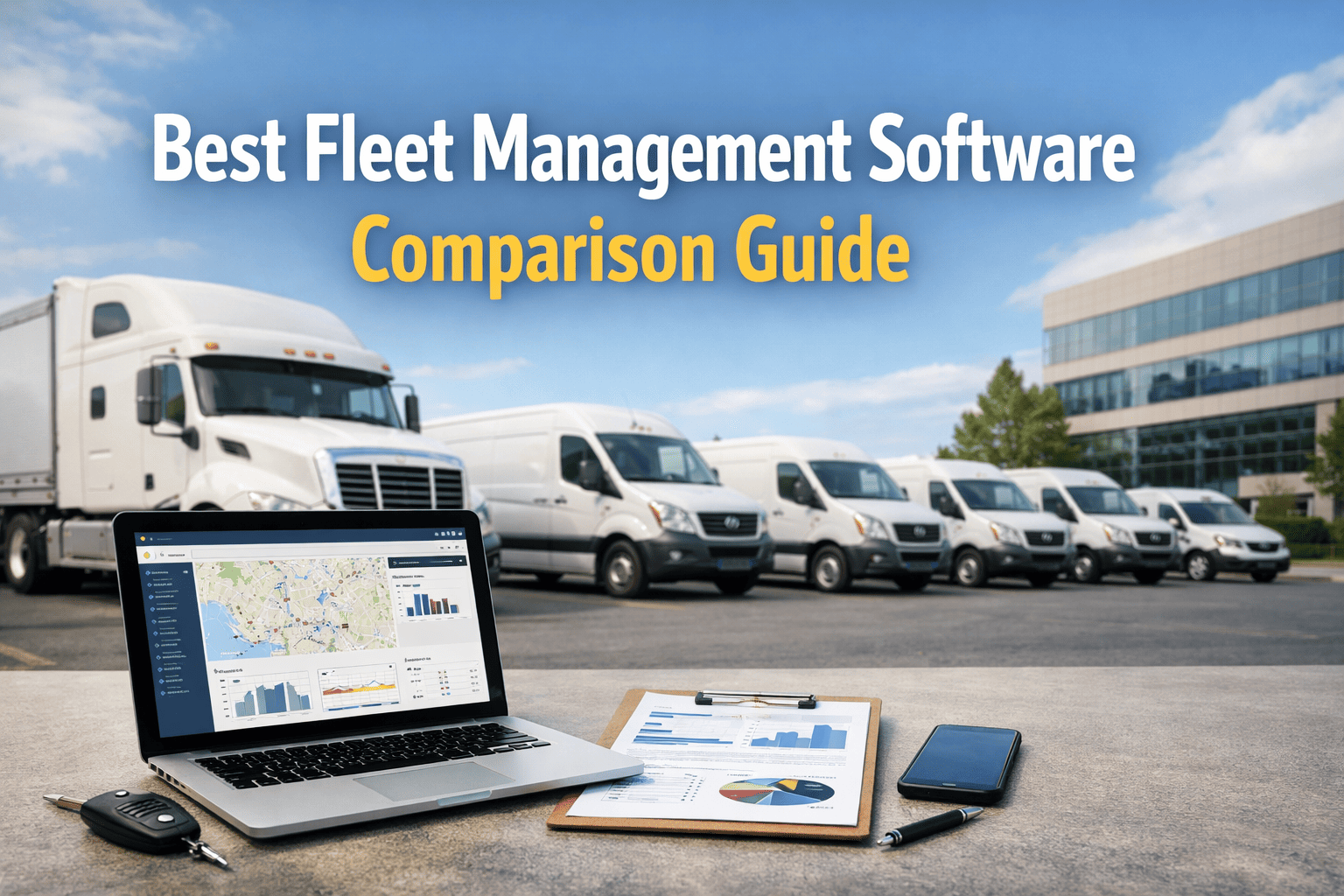
The fleet maintenance software market is no longer a niche category — it is a $30 billion industry in 2026 and growing at nearly 17% annually. That growth means more platforms, more noise, and more risk of choosing a tool that looks great in a demo but fails your team in production. The wrong choice costs more than the subscription: it costs you in unplanned downtime, compliance gaps, frustrated technicians, and executive reports built from disconnected spreadsheets. This comparison guide cuts through the confusion. We break down what separates purpose-built fleet maintenance platforms from GPS-first tracking tools, what features actually drive ROI, and what to demand from any vendor before signing a contract. If you already know what you need, sign up for OxMaint free and see the difference firsthand.
$30B
Fleet management software market in 2026
49%
Of fleet market revenue is now software-led
70%
Of new deployments are cloud-native in 2026
45%
Reduction in unplanned downtime with the right platform
OxMaint · Fleet Maintenance Platform
Stop comparing. Start operating with a platform built for real fleets.
OxMaint is a maintenance-first fleet CMMS that combines preventive scheduling, digital work orders, compliance documentation, parts inventory, and fleet analytics in one cloud-native platform. Free to start. Live in days.
FreeTo start — no credit card
DaysTo full deployment
1,000+Fleets already running
45%Less unplanned downtime
What Fleet Maintenance Software Actually Does
Fleet maintenance software is a purpose-built digital platform that centralizes every function needed to keep vehicles running, compliant, and cost-efficient. It is not a GPS tracker. It is not a spreadsheet replacement. It is the operational backbone that connects preventive schedules, repair histories, parts inventory, compliance records, and cost analytics into a single unified system — accessible to every technician, dispatcher, and fleet manager in real time.
Preventive Maintenance Scheduling
Automated PM schedules triggered by mileage, engine hours, or calendar intervals. Notifications dispatched to technicians before service is due. Completion tracked and recorded per vehicle.
Work Order Management
Digital creation, assignment, and tracking of every repair job. Full technician history, parts usage, labor time, and cost captured per work order — eliminating paper-based guesswork.
Compliance Documentation
Digital DVIR forms, DOT inspection records, ELD data, and regulatory logs stored and audit-ready. Generate complete compliance reports for FMCSA or DOT audits in minutes, not days.
Parts and Inventory Control
Real-time parts inventory with reorder alerts, vendor management, and procurement tracking. Know exactly what is in stock before a technician starts a job — eliminating costly delays.
Total Cost of Ownership Analytics
Per-vehicle TCO tracking covering fuel, maintenance, parts, labor, and depreciation. Identify your highest-cost assets, compare lifecycle costs, and make data-backed replacement decisions.
Mobile-First Field Access
Technicians and drivers complete inspections, update work orders, log parts, and capture photos from any smartphone or tablet. No desktop terminal. No paper forms. Every action synced in real time.
The 5 Platform Categories — and Where They Fall Short
Not all fleet software is built the same. Understanding the five dominant platform types helps you identify which category fits your operation — and which limitations you will hit within the first six months.
GPS Tracking Tools
Real-time location visibility, geofencing, driver monitoring, route replay
No maintenance depth, no work orders, no compliance documentation, no TCO reporting. Maintenance is bolted on as an afterthought — not built as a core function.
Examples: Samsara, Verizon Connect, Motive
Legacy CMMS Platforms
Deep maintenance history, asset registry, work order management
Not fleet-native, complex UI, long implementation timelines, mobile experience poor, no telematics integration, not designed for driver or field technician workflows.
Examples: IBM Maximo, SAP PM, Infor EAM
ELD / Compliance Platforms
HOS tracking, ELD mandate compliance, FMCSA reporting, driver logs
Compliance-only scope. No maintenance scheduling, no work orders, no parts inventory, no cost analytics. Requires additional tools for every other operational function.
Examples: KeepTruckin ELD, BigRoad, Rand McNally
Fuel Card Dashboards
Fuel spend visibility, transaction reporting, per-vehicle fuel cost tracking
Single-dimension visibility only. No maintenance records, no inspection workflows, no work order management. Fuel data is isolated from the broader operational picture.
Examples: WEX, Fleetcor, Comdata dashboards
Purpose-Built Fleet CMMS
Maintenance-first architecture: preventive scheduling, work orders, compliance, parts inventory, TCO analytics, telematics integration, and mobile access — unified in one platform.
This is the category where OxMaint competes — and the only category that addresses the full maintenance lifecycle without requiring multiple subscriptions or manual integrations.
Examples: OxMaint, Fleetio, RTA Fleet Management
Head-to-Head Feature Comparison
This comparison covers the features that matter most to fleet maintenance managers — not sales-deck checkboxes, but the capabilities that directly impact uptime, compliance, and cost control.
Feature
GPS-First Tools
Legacy CMMS
OxMaint
Preventive Maintenance Scheduling
Basic / limited
Yes — complex setup
Full — mileage, hours, calendar
Digital Work Orders
Limited or absent
Yes — desktop-heavy
Full — mobile-first
DOT / FMCSA Compliance Docs
ELD only
Custom build required
Built-in — audit-ready
Parts and Inventory Tracking
Not available
Yes — complex config
Full — reorder alerts included
TCO Analytics Per Vehicle
Fuel cost only
Manual configuration
Automatic — full lifecycle
Mobile App for Technicians
Driver-focused only
Poor — desktop primary
Built mobile-first
Telematics Integration
Proprietary hardware only
Limited / custom API
Any provider — open API
Deployment Time
Days (tracking only)
Months — IT-heavy
Days — no IT required
Multi-Site Fleet Support
Basic location grouping
Yes — complex hierarchy
Native multi-site architecture
Free Tier Available
No
No
Yes — free to start
8 Critical Evaluation Criteria Before You Choose
01
Maintenance-First vs. Tracking-First Architecture
Ask every vendor: was this platform built for maintenance management, or is maintenance a feature added to a GPS tracking product? The architectural difference determines how deeply PM scheduling, work orders, and parts tracking are built into the platform — versus bolted on as add-ons.
02
Mobile Experience for Technicians
72% of fleet work happens away from a desktop. The platform your technicians actually use is the one they can access on the shop floor, at roadside, and in the yard from a smartphone. A poor mobile experience means the system doesn't get used — and your data is worthless.
03
Compliance Documentation Depth
DOT non-compliance penalties exceed $16,000 per violation. Your platform must generate audit-ready DVIR records, inspection reports, and driver qualification file documentation — not just store them. Ask vendors specifically about FMCSA audit export capabilities before committing.
04
Total Cost of Ownership Tracking
Fuel cost per mile tells you one number. Full TCO — combining fuel, maintenance, parts, labor, insurance, and depreciation — tells you which vehicles to replace and when. If the platform can't produce per-vehicle TCO reports automatically, you are still making CapEx decisions on guesswork.
05
Integration Architecture
Your fleet software must talk to your telematics hardware, fuel card provider, accounting system, and parts suppliers. Platforms without open APIs force manual re-entry — undermining the real-time intelligence you are paying for. Always ask for API documentation before signing.
06
Deployment and Onboarding Speed
Legacy CMMS implementations average 3-6 months and require dedicated IT resources. Cloud-native platforms should deploy in days, not months. Ask vendors: how long until my first digital work order? If the answer is longer than two weeks, that is a configuration overhead problem disguised as a feature.
07
Scalability and EV Readiness
Electric vehicles crossed 20% of global market share in 2025. Your platform needs to support EV-specific maintenance schedules, battery health tracking, and charging management today — not in a future roadmap version. Mixed fleets are the reality in 2026, not the exception.
08
True Total Cost of Software
Subscription price is only the beginning. Factor in implementation fees, data migration costs, per-seat pricing that punishes growth, hardware requirements, and training time. Average savings from the right fleet maintenance platform reach $3,120 per vehicle annually — ROI of 50-87x at typical SaaS pricing.
OxMaint · Fleet Maintenance CMMS
Done evaluating? OxMaint meets every criterion above — out of the box.
Maintenance-first architecture. Mobile-first field experience. Built-in compliance tools. Open API integrations. Full TCO analytics. Free to start, live in days. Sign up free or book a demo to see every feature in action.
Reactive vs. Proactive Maintenance: What the Data Proves
Reactive Maintenance (No Software)
Emergency repairs cost 4.8x more than planned maintenance
Unplanned downtime averages 1-3 days per incident per vehicle
Compliance records manually assembled — hours per audit
Parts ordered in emergency — 40% markup on reactive procurement
No visibility into which vehicles are approaching failure
CapEx replacement decisions based on gut feel, not data
Result: higher costs, more downtime, compliance risk, and no visibility into where money is going
VS
Proactive Maintenance with OxMaint
Preventive schedules eliminate 70% of emergency repairs over 12 months
Vehicle uptime exceeds 92% with automated PM compliance tracking
Audit-ready compliance export in minutes — not manual assembly
Parts inventory managed in-system — no emergency procurement markup
Predictive alerts surface vehicles approaching failure 2-3 weeks early
TCO analytics drive data-backed replacement decisions per vehicle
Result: 45% less downtime, 25% lower maintenance cost, full compliance readiness, clear ROI within 90 days
ROI by the Numbers
$3,120
Average annual savings per vehicle with the right fleet maintenance software
Source: Fleet Management Software Market analysis, 2026
25%
Reduction in total maintenance costs through preventive scheduling and IoT monitoring
Source: Global Market Insights fleet management data, 2025
15%
Fuel cost reduction through route optimization and driver behavior monitoring
Source: AI-driven fuel management optimization benchmarks, 2025-2026
30 days
Typical payback period for fleet maintenance software at $36-60 per vehicle monthly
Source: Fleet software ROI analysis, $3,120 annual savings benchmark
Frequently Asked Questions
What is the difference between fleet management software and fleet maintenance software?
Fleet management software is a broad category covering vehicle tracking, dispatch, driver management, fuel monitoring, and compliance. Fleet maintenance software is the specialized subset — or the core of a full-featured CMMS — focused specifically on keeping vehicles operational through preventive scheduling, work orders, inspection management, parts inventory, and repair history. The most effective platforms for operations-focused teams are maintenance-first — tracking capabilities are integrated, not primary. OxMaint is built maintenance-first, which means your PM schedules, work orders, and compliance documentation are core features, not add-ons.
Sign up free to explore the difference directly.
How do I know if my fleet is too small or too large for a CMMS platform?
Fleet maintenance software delivers ROI at almost any fleet size that runs regular PM schedules. Fleets of 5 vehicles benefit from digitizing inspection records and work orders. Fleets of 500 depend on automated scheduling and TCO analytics for cost control. The threshold question is not fleet size — it is whether unplanned downtime, manual compliance assembly, or emergency repair costs are affecting your operation. If the answer to any of those is yes, a CMMS pays for itself within weeks. OxMaint supports fleets from 10 to 10,000 vehicles on the same platform architecture.
Book a demo to discuss your specific fleet size and requirements.
Can fleet maintenance software integrate with our existing GPS and telematics devices?
Yes — and this is a critical evaluation criterion. Platforms that require proprietary hardware create vendor lock-in and force you to replace existing investments. OxMaint provides open API integrations that accept telematics data from any GPS provider — your existing devices continue generating data that flows directly into maintenance alerts, predictive PM triggers, and fleet analytics dashboards. Fuel card systems and accounting software can also be integrated to provide complete operational and financial visibility in one platform. If your current provider requires hardware replacement as a condition of using their software, that is a significant red flag.
Sign up free and connect your existing telematics from day one.
What should I expect during fleet maintenance software implementation?
Implementation complexity varies significantly by platform type. Legacy on-premises CMMS implementations average 3-6 months and require IT resources, server infrastructure, and dedicated configuration specialists. Cloud-native platforms like OxMaint deploy in days — most fleets are creating digital work orders within their first week. Implementation includes importing your vehicle data, configuring PM schedules per vehicle type, setting up user roles and access controls, and training your technicians and managers on the mobile app. OxMaint provides hands-on onboarding support throughout this process. There is no server infrastructure, no IT department involvement, and no hardware procurement required.
Book a demo to walk through the onboarding process for your fleet size.
OxMaint · Fleet Management Platform
The comparison is over. OxMaint is the maintenance-first platform your fleet needs in 2026.
Join 1,000+ fleet operations running on OxMaint. Preventive maintenance scheduling, digital work orders, compliance automation, parts inventory, and full TCO analytics — all in one cloud-native platform. Free to start. Live in days. Results within weeks.
$3,120Savings per vehicle per year
45%Less unplanned downtime
30 daysAverage payback period
DaysTo full deployment