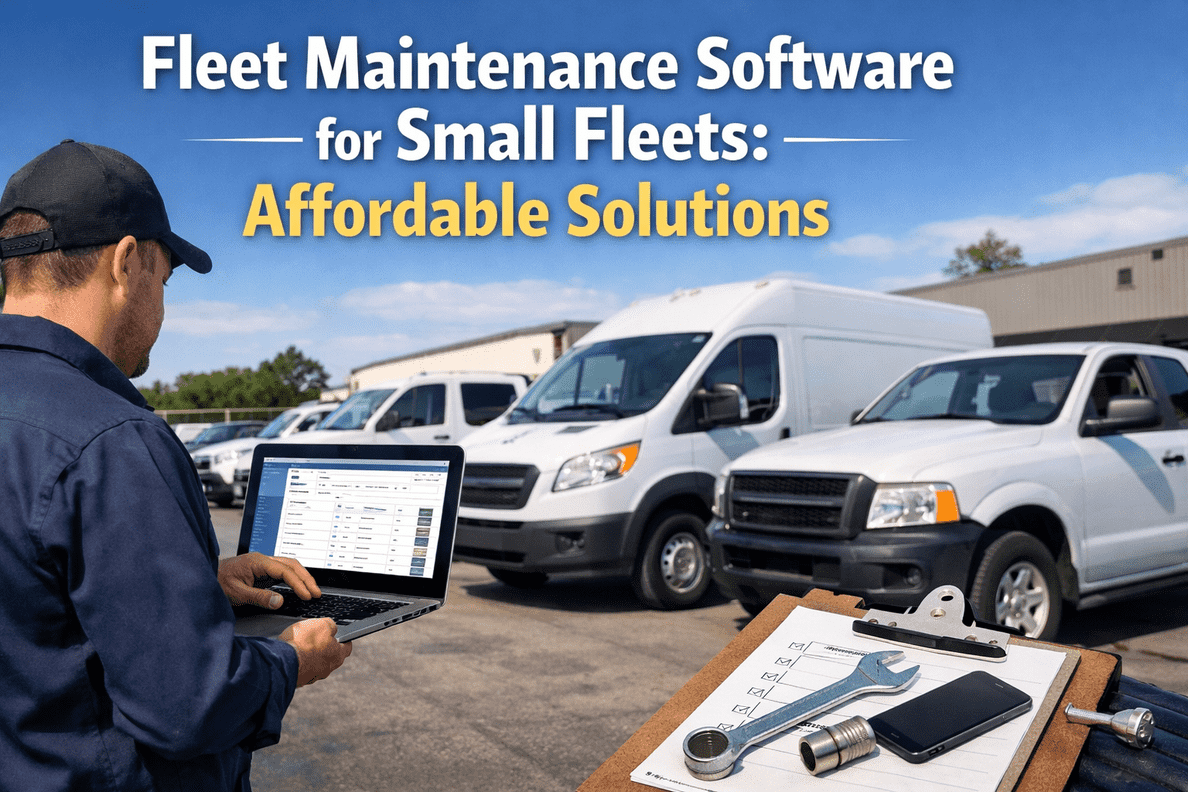
Small fleets are the backbone of countless industries — trades, delivery, field services, construction, healthcare transport — yet they are consistently the least supported by fleet technology. Only 14% of small fleets currently use any form of maintenance software, meaning the majority are still managing vehicles through spreadsheets, group chats, and paper inspection sheets that go missing before anyone reads them. The cost of this gap is not abstract: unplanned vehicle breakdowns cost between $400 and $1,200 per incident depending on vehicle type and location, and a 10-vehicle fleet experiencing just four unplanned breakdowns per year is losing $2,000–$5,000 before accounting for the knock-on disruption to scheduling, customer commitments, and team time. The good news is that affordable, cloud-based fleet maintenance software designed specifically for small operations has fundamentally changed the value equation in 2025–2026. Platforms like OxMaint now give a 5-vehicle business the same maintenance intelligence that enterprise fleets previously paid tens of thousands to access — at a fraction of the cost, deploying in days, with no IT department required. This guide covers everything a small fleet operator needs to know about choosing, evaluating, and getting ROI from affordable fleet maintenance software in 2026. Ready to see it in action? Sign up for OxMaint free and have your fleet set up today.
14%
Only 14% of small fleets currently use fleet maintenance software — the competitive gap is wide open
$3,120
Average annual savings per vehicle delivered by fleet management software across fuel, maintenance, and admin
40%
Lower maintenance costs achievable for small fleets using preventive maintenance scheduling and digital work orders
7.2 mo
Typical payback period — a 50-vehicle fleet saving $250/month from a $1,800/year software investment breaks even in 7.2 months
Affordable Fleet Maintenance Software Built for Small Operations
OxMaint gives small fleets the same preventive maintenance scheduling, digital work orders, inspection enforcement, and cost analytics that enterprise operations use — free to start, deployed in days, no IT required.
The Small Fleet Problem
Why Small Fleets Pay More Per Vehicle Than Enterprise Operations — And How to Close the Gap
Small fleets face a structural disadvantage: they experience the same breakdowns, compliance requirements, and fuel inefficiencies as large operations — but without the systems, dedicated staff, or budget to manage them proactively. The result is a cost-per-vehicle that consistently runs higher than larger fleets, not because the vehicles are worse, but because the management layer is absent.
01
Reactive Maintenance Costs 4–8x More
Emergency repairs, roadside callouts, and towing combined cost 4–8 times more than the same repair completed as a planned service. Small fleets running on paper logs miss the early-warning signals that trigger planned intervention — and pay the premium instead.
02
Missed Service Intervals Go Undetected
Without automated PM scheduling, oil changes, brake checks, and safety inspections drift past their due dates. 82% of fleet operators still rely on manual tracking — meaning the majority are operating with missed intervals they don't know exist until a vehicle fails or an inspection flags a violation.
03
Compliance Risk Without Documentation
DVIR requirements, registration renewals, insurance documentation, and safety inspection records create a compliance burden that paper systems cannot manage reliably. A single missed inspection record can expose a small fleet operator to fines, vehicle impoundment, and insurance complications.
04
No Visibility Into Fleet Health or Cost
Without digital records, small fleet operators cannot calculate cost-per-vehicle, identify which assets are draining budget disproportionately, or make evidence-based replacement decisions. Fleet management becomes a series of gut-feel judgements rather than data-supported choices.
05
Scheduling Chaos Disrupts Revenue Operations
A vehicle unexpectedly out of service on a job day is not just a maintenance problem — it's a customer commitment failure. Small businesses with tight vehicle-to-job ratios cannot absorb unplanned downtime the way large fleets can. One breakdown can cascade into a day of rescheduling and customer tension.
06
Enterprise Software Is Priced Out of Reach
Traditional fleet CMMS platforms were built for fleets of 200+ vehicles with implementation budgets of $20,000+, dedicated IT teams, and months of onboarding. A tradesperson with 6 vans or a delivery business with 12 trucks cannot justify that investment — leaving them with nothing but spreadsheets and hoping for the best.
What to Look For
The 8 Features Small Fleets Actually Need in Maintenance Software — and Why Each One Matters
Small fleet operators don't need the full complexity of enterprise fleet platforms. They need the right 8 capabilities — implemented simply, working reliably, and accessible from a phone. Here's the feature checklist that separates genuinely useful small fleet software from overpromising platforms.
Preventive Maintenance Scheduling
Automated PM schedules based on mileage, engine hours, or calendar intervals. The system sends reminders before service is due — not after it's overdue. This single feature accounts for the majority of downtime reduction in small fleet programmes.
Digital Work Orders
Create, assign, track, and close maintenance tasks digitally. Every repair is recorded with parts used, labour time, cost, and technician attribution — building a complete service history per vehicle that drives future maintenance decisions.
Mobile-First Inspection Checklists
Digital daily vehicle inspection reports (DVIRs) completed by drivers on their phones. Failed inspection items generate automatic maintenance notifications. Inspection completion rates move from 60–70% on paper to 100% enforced digitally.
Vehicle Cost Tracking Per Asset
Total cost of ownership per vehicle — purchase price, maintenance history, fuel, insurance, and repair spend aggregated by asset. Identify which vehicle in your fleet is costing 3x more per month than the others before the next repair event makes the decision for you.
Parts and Inventory Management
Track spare parts usage per vehicle and per service type. Know what's in stock, what's running low, and what the actual cost of parts consumed per asset was over the past 6 months. Eliminates emergency parts procurement at inflated rates.
Compliance Documentation
Automatically generated and stored inspection records, maintenance logs, and registration reminders. Audit-ready documentation retrievable in seconds — not hours spent searching binders for the record an inspector needs to see right now.
Cloud-Based with Mobile Access
No server, no IT department, no hardware procurement. Access from any phone, tablet, or browser. Real-time updates visible to owner, manager, and technician simultaneously. Cloud-based deployment accounts for 72% of new fleet software implementations in 2025 for exactly these reasons.
Fast Onboarding — Days, Not Months
A small fleet operator cannot spend 6 months in an implementation project. Look for platforms where vehicle data import, PM schedule configuration, and team setup takes less than a week. OxMaint gets most small fleets creating their first digital work orders within 48 hours of signup.
Reactive vs. Preventive
The Cost Difference Is Not Marginal — It Is Structural
The most important shift in small fleet maintenance is moving from reactive to preventive operations. The cost difference between these two modes is not a matter of a few percentage points — it is a fundamental restructuring of your maintenance economics.
Maintenance Area
Reactive Operations — Paper or Spreadsheet
Preventive with OxMaint — Digital Platform
Breakdown frequency
4–6 unplanned events per vehicle per year on average for fleets with no PM programme
50–60% reduction in unplanned events within 90 days of digital PM scheduling go-live
Cost per repair event
$400–$1,200 per emergency breakdown including towing, emergency labour, and expedited parts
Planned service cost 4–8x lower — same component replaced at scheduled interval, standard rates
Service interval accuracy
Intervals drift 10–30% past due date without automated reminders — 82% of small fleets run this way
Automated mileage/calendar triggers send reminders before intervals are missed — 100% on-schedule
Compliance documentation
2–4 hours manual assembly per audit event. Paper records incomplete or missing for older vehicles.
Audit-ready records retrievable in under 60 seconds. Every service, inspection, and part auto-logged.
Vehicle cost visibility
No per-vehicle cost data. Replacement decisions made by age or gut feel. High-cost assets go undetected.
Total cost per vehicle visible month-by-month. Evidence-based replacement decisions. CapEx forecasting enabled.
Inspection completion rate
60–70% on paper — drivers skip checklists without accountability. Defects go unreported until failure.
100% enforced digitally — mobile app completion required, defects auto-generate work orders immediately.
Payback timeline
No investment, but ongoing reactive repair costs compound — typically $3,000–$8,000 per vehicle annually
Software pays back in 6–8 months. Average $3,120 annual saving per vehicle after first year of operation.
Deployment timeline
Paper systems never truly deploy — they accumulate inconsistencies and gaps indefinitely with no improvement path
OxMaint: vehicle import on Day 1, first digital work orders by Day 2, full PM schedules live by Week 1
OxMaint for Small Fleets
How OxMaint Delivers Enterprise-Grade Fleet Maintenance at Small Fleet Pricing
OxMaint is built for asset-intensive operations that need a maintenance-first CMMS platform — not a GPS tracking tool with maintenance bolted on. Here's what makes it the right choice for small fleets in 2026.
01
Import Your Fleet in Minutes
Add vehicles individually or import your fleet data in bulk. Set vehicle type, mileage, service history, and registration dates. The asset registry is live from minute one — no configuration project, no consultant required.
02
Configure PM Schedules Per Vehicle
Set preventive maintenance triggers by mileage, engine hours, or calendar interval per vehicle or per vehicle class. Oil changes, brake inspections, tyre rotations, and safety checks are scheduled automatically and send reminders before they fall due.
03
Assign Digital Inspections to Drivers
Drivers complete daily vehicle inspection reports on their phones before starting their shift. Failed items generate maintenance alerts and work orders instantly. Inspection completion rates and defect history per vehicle build automatically from the first day.
04
Manage Work Orders From Phone to Close
Create, assign, and track maintenance work orders digitally. Technicians update status, log parts used, and record labour time from mobile. Every work order closes with a full record — building the maintenance history that drives future PM scheduling accuracy.
05
Monitor Fleet Health on One Dashboard
Fleet condition dashboard shows vehicles by maintenance status, upcoming service due dates, open work orders, inspection pass rates, and cost-per-vehicle trend. Everything visible at a glance — from any device, in real time.
06
Pull Compliance Records in 60 Seconds
Inspection logs, service records, and maintenance history are auto-generated and stored per vehicle. When an auditor, insurer, or regulator requests documentation, retrieve a complete, timestamped record set in under 60 seconds — not a frantic binder search.
ROI by the Numbers
What Affordable Fleet Maintenance Software Delivers for Small Fleets — Measured and Documented
40%
Lower Maintenance Costs
Fleets using digital PM scheduling and work order management report 20–40% reductions in total maintenance spend within the first year — driven by replacing reactive emergency repairs with planned interventions at standard labour rates.
50%
Less Unplanned Downtime
Industry benchmarks from Verizon Connect and Automotive Fleet 2025–2026 reports document up to 50% unplanned downtime reduction for fleets moving from reactive to preventive maintenance programmes with digital enforcement.
$3,120
Annual Saving Per Vehicle
Industry data documents average savings of $3,120 per vehicle annually from fleet management software — combining fuel optimization (38%), maintenance reduction (31%), administrative efficiency (18%), and insurance/compliance savings (13%).
7.2 mo
Typical Payback Period
A 50-vehicle fleet spending $1,800/year on software and saving $250/month from reduced downtime and admin labour breaks even in 7.2 months. Smaller fleets paying less per vehicle often achieve payback even faster from the first prevented breakdown event.
Frequently Asked Questions
Fleet Maintenance Software for Small Fleets — What Operators Ask First
What is the realistic cost of fleet maintenance software for a small fleet of 5–20 vehicles in 2026?
Fleet maintenance software pricing in 2026 ranges from free entry-level tiers to $50 per vehicle per month for premium enterprise platforms. For small fleets of 5–20 vehicles, the realistic cost range for a platform that covers the core requirements — preventive maintenance scheduling, digital work orders, inspection checklists, and basic reporting — is $5 to $20 per vehicle per month, or roughly $300 to $4,800 annually for a 20-vehicle fleet. OxMaint offers a free tier that covers core maintenance features with no financial commitment required to get started. The more relevant number for small fleet operators is not the subscription cost but the payback calculation: industry data shows average annual savings of $3,120 per vehicle from fleet management software. For a 10-vehicle fleet, that's a potential $31,200 in annual savings against a software cost of $600–$2,400 — a return that makes almost any affordable platform a straightforward financial decision. The risk is not spending money on software. The risk is continuing to pay $400–$1,200 per unplanned breakdown when preventive scheduling would have caught the issue at a $60 planned service.
Sign up for OxMaint free to start tracking your fleet costs immediately, or
book a demo to see a cost calculation specific to your fleet size.
Does a fleet with fewer than 10 vehicles actually need dedicated maintenance software — or is a spreadsheet good enough?
Spreadsheets are adequate for fleet documentation as long as every interval is tracked perfectly, every driver reports every defect reliably, every service record is filed consistently, and nobody ever forgets to update a row. In practice, that does not happen — and the consequences of spreadsheet gaps are not small. Missed oil changes accelerate engine wear. Unreported brake defects become roadside failures. Undocumented inspection records become compliance liabilities when a regulator asks for them. The argument for a spreadsheet is that it costs nothing. The counter-argument is that the invisible costs of running without maintenance structure consistently exceed software subscription costs by 5–10x for most small fleets. A fleet of 6 vehicles experiencing three preventable breakdowns per year at $500 average cost is losing $1,500 per year — more than most small fleet software subscriptions cost. Beyond cost, there is the compliance risk: a single missed DVIR record or expired inspection log can result in vehicle impoundment or fines that dwarf any software cost. OxMaint's free tier gives fleets under 10 vehicles a structured alternative to spreadsheets at zero cost. There is no financial argument for choosing a spreadsheet over free, purpose-built software.
Sign up free and run both in parallel for 30 days — the data will make the decision obvious. Or
book a demo to see the operational difference firsthand.
How long does it actually take to set up fleet maintenance software for a small fleet — and do I need technical skills?
For a cloud-based platform like OxMaint designed for small fleet operators, setup takes hours, not days or weeks. The typical deployment sequence for a 5–20 vehicle fleet runs as follows: Day 1 — vehicle data import (make, model, year, current mileage, registration details) and user account setup for any drivers or technicians who need access. This takes 1–2 hours depending on fleet size and whether existing records are in a spreadsheet that can be imported directly. Day 1–2 — preventive maintenance schedule configuration. For each vehicle or vehicle class, set the service intervals you want automated: oil change every 5,000 miles, brake inspection every 10,000 miles, annual safety inspection reminder 30 days before due date. The platform generates the PM schedule from these inputs automatically. Day 2 — mobile app setup for drivers and technicians. The inspection checklist and work order workflows are accessible through the app with no training manual required — the interface is designed for people who work with vehicles, not software. No technical skills are required at any stage. OxMaint's onboarding team assists with data import and configuration if needed. The platform is cloud-based, requires no server installation, no IT department involvement, and no hardware procurement.
Sign up free and complete your vehicle import today, or
book a demo for a guided walkthrough with your actual fleet data.
Can OxMaint handle mixed small fleets with different vehicle types — vans, trucks, cars, and equipment?
Yes. OxMaint manages any combination of vehicle types in a single fleet registry: light commercial vans, heavy-duty trucks, passenger cars, trailers, construction equipment, electric vehicles, and specialist vehicles. Each asset type can have its own maintenance schedules, inspection checklist items, and service interval triggers — while sharing a unified dashboard for fleet-wide visibility. For a small trades business running a mix of pickup trucks, work vans, and a trailer, this means each asset type has the correct service intervals configured independently (a trailer has different PM requirements than a diesel van), while the owner sees all vehicles in one view with their upcoming service dates and current condition status. OxMaint's asset hierarchy also supports the mixed-asset reality of many small businesses: the same platform that manages your vehicles can manage your equipment, tools, and other maintained assets — reducing the number of separate tracking systems your business needs to run. Condition-based triggers allow service intervals to be set by mileage, engine hours, or calendar date per asset — whichever is most relevant to how that specific vehicle or piece of equipment is used.
Sign up free and add your first vehicle today, or
book a demo to see multi-asset-type fleet configuration in a live environment.
What compliance documentation does fleet maintenance software generate automatically — and which regulations does it help small fleets meet?
Fleet maintenance software generates five categories of compliance-relevant documentation automatically from daily operational workflows. First, daily vehicle inspection records (DVIRs): every driver inspection completed in the mobile app is timestamped, driver-attributed, and stored per vehicle — satisfying DOT pre-trip inspection requirements and OSHA vehicle safety documentation standards. Second, preventive maintenance records: every completed service event is logged with date, mileage, technician attribution, parts used, and cost — creating the continuous maintenance log that regulatory audits and insurance reviews require. Third, work order history: every repair event, its cause, completion, and cost, is preserved in a searchable record per vehicle. Fourth, defect and repair tracking: failed inspection items and their subsequent repair work orders are linked as a complete event chain — demonstrating that defects were identified and resolved. Fifth, registration and certification reminders: OxMaint tracks expiry dates for registrations, insurance renewals, and periodic safety inspections — generating advance reminders before documents lapse. For USA operations this covers DOT and FMCSA documentation standards. For UK fleets it satisfies MOT and DVSA record-keeping requirements. For Australian operations it supports state roadworthiness and heavy vehicle compliance records.
Sign up free to start generating compliant fleet records from today, or
book a demo to see the compliance documentation interface for your specific jurisdiction.
Affordable Fleet Maintenance Software. Free to Start. Live in Days.
OxMaint gives small fleets preventive maintenance scheduling, digital work orders, driver inspection enforcement, and fleet cost analytics in a single platform. No hardware. No IT project. No implementation fees. Start free and see measurable results within weeks.