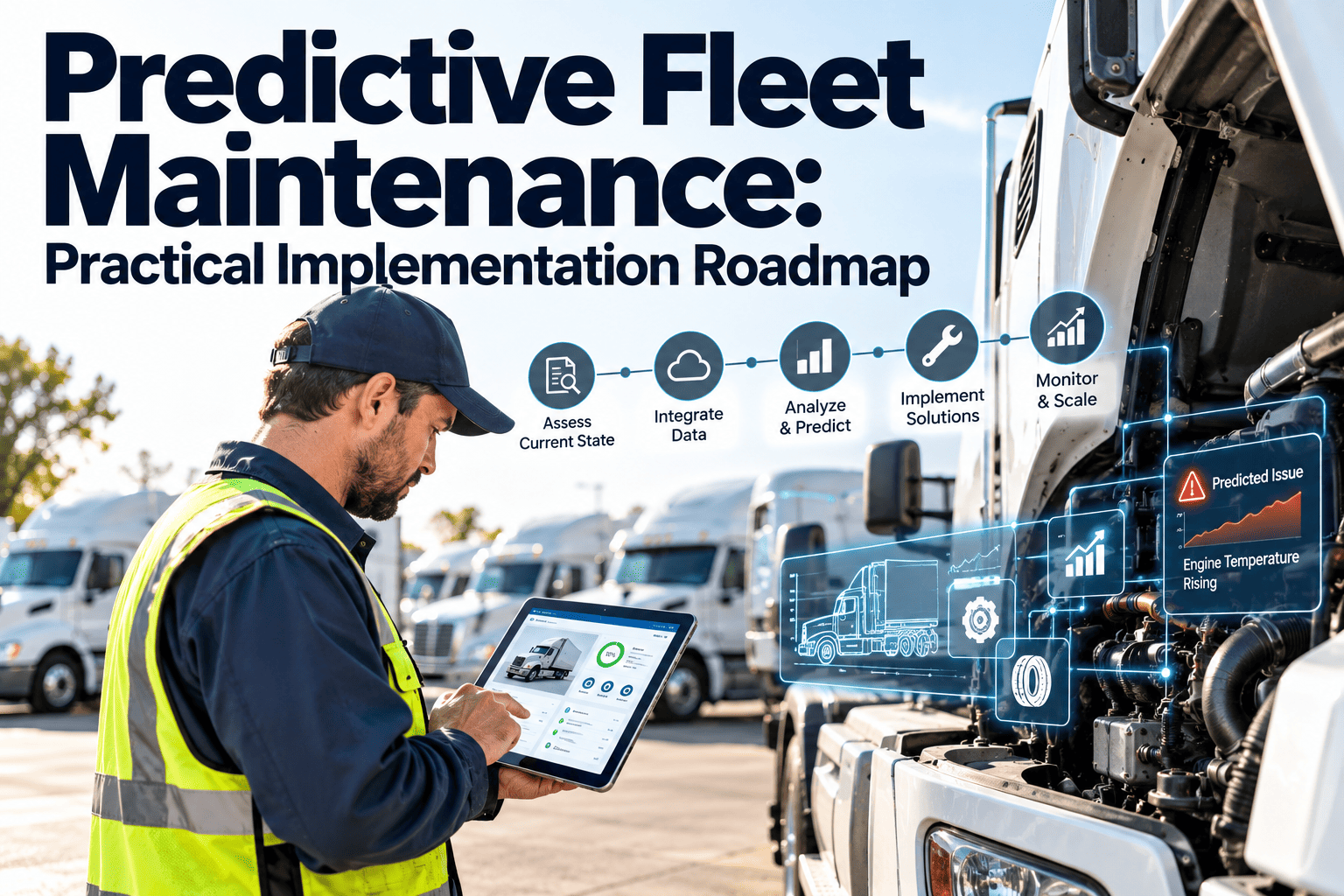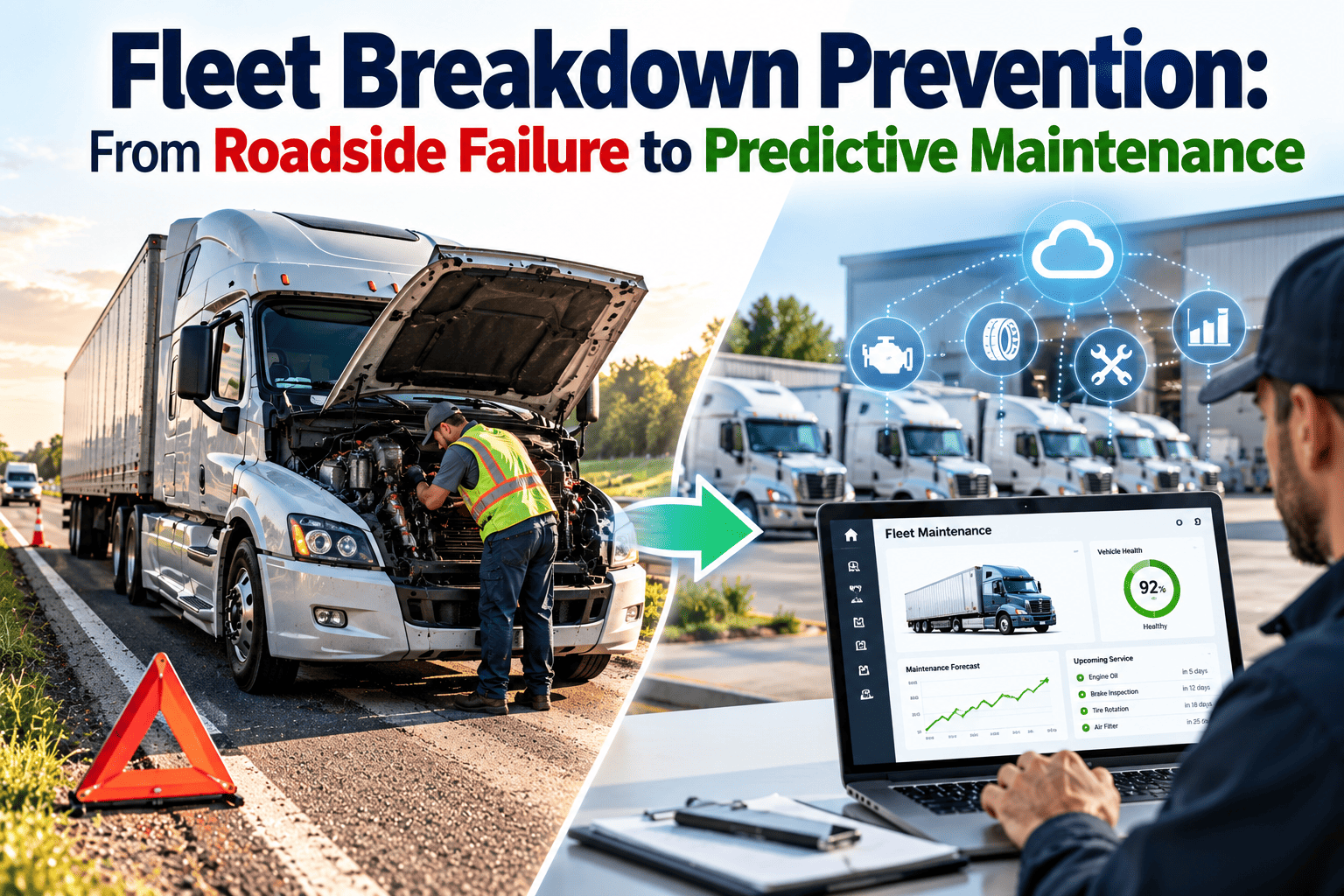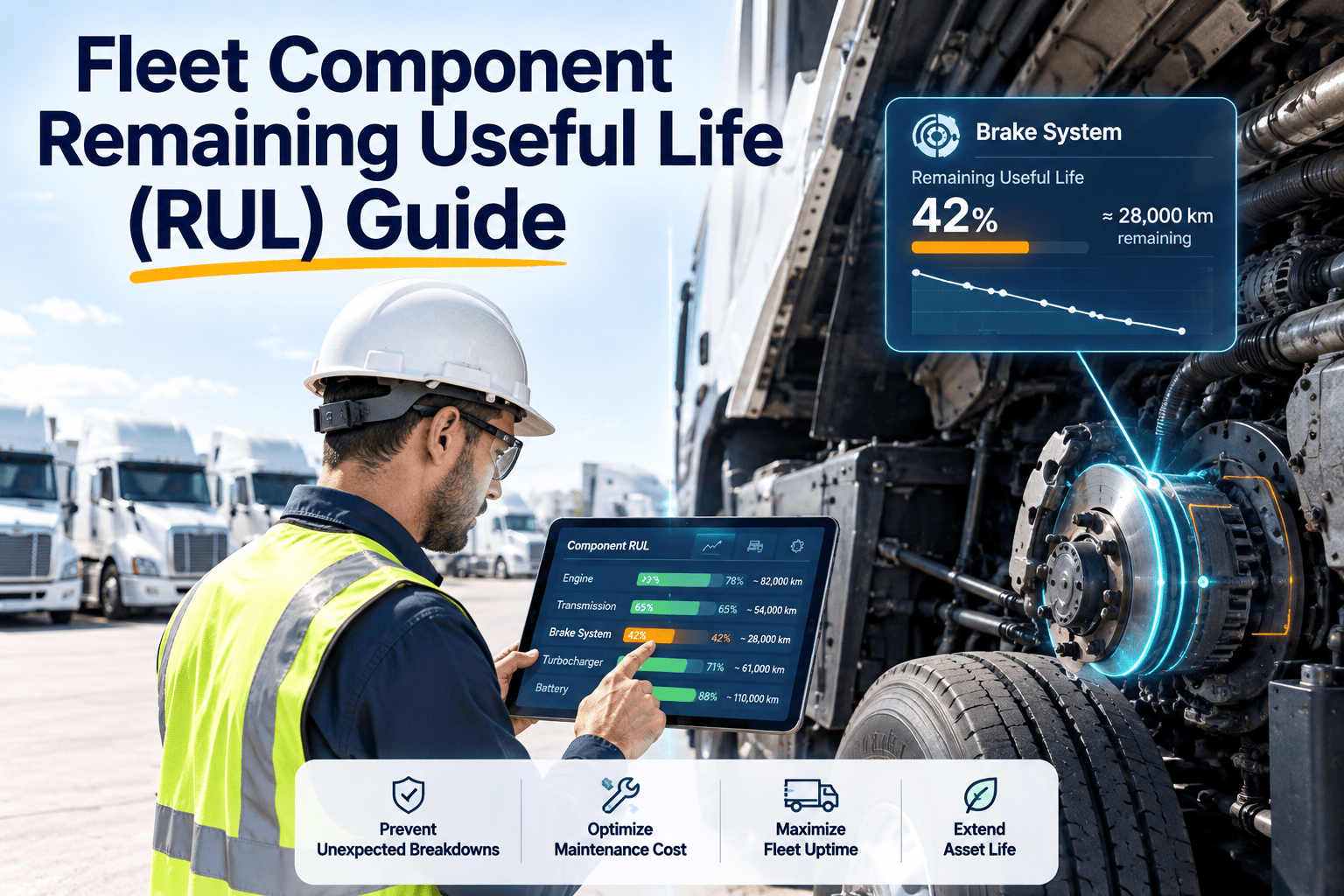
Fleet predictive maintenance failure signatures are the measurable deviations in component behavior — coolant temperature creep, transmission slip frequency, brake-pad wear rate — that precede breakdowns by days or weeks. When fleet reliability engineers learn to detect these component failure signatures early, they shift from reactive firefighting to condition-based interventions that cut unplanned downtime by 30–50 percent and extend asset life. OxMaint turns fleet failure signature detection into automated, scheduled maintenance action through signature-based alert design, condition trending, and work order automation. You can Start Free Trial to see how the platform surfaces these warnings across your vehicles today.
Fleet Predictive Maintenance
Your components are already signaling failure. Are you listening?
Fleet predictive maintenance delivers documented ROI only when you can read the failure signatures that precede breakdowns — coolant temperature drift, transmission slip counts, brake-wear acceleration. OxMaint detects those signatures weeks ahead and converts them into scheduled work orders automatically.
What the Data Shows
Why most fleets miss component failure signatures until it's too late
The average heavy-duty truck generates over 200 data parameters per second through its J1939/CAN bus — yet 70 percent of fleet maintenance teams only act on diagnostic trouble codes, which fire after damage has already begun. Fleet failure signature detection works because components degrade along observable curves, not cliffs.
The gap between reactive and predictive maintenance is rarely a sensor problem — it's a signal-processing and workflow problem. Telematics providers stream the data, but most CMMS platforms lack the analytics layer to trend it, threshold it, and push a work order when a signature crosses from normal degradation into pre-failure. OxMaint closes that gap by applying AI-driven condition monitoring to every asset in your fleet, turning raw telemetry into prioritized, actionable maintenance tasks.
Core Signatures
The three fleet component failure signatures that deliver the fastest ROI
Not every parameter is worth trending. Fleet reliability programs that focus on a handful of high-value failure signatures — the ones tied to costly, common breakdown modes — see payback within the first quarter. These three signatures are where predictive maintenance consistently pays for itself.
Coolant temperature creep signature
A healthy engine runs within a narrow 8–10°F band. When the baseline coolant temperature drifts upward by 6–8°F over two to three weeks while load and ambient conditions stay constant, the signature points to thermostat sticking, radiator fouling, or water-pump impeller wear — all precursor conditions to overheating failure. OxMaint trends coolant temperature against ambient and load baselines automatically and triggers a work order at the 5°F sustained-deviation threshold, giving shops 10–14 days to inspect before derate codes set.
Transmission slip frequency signature
Modern automated manual transmissions log slip events — brief RPM spikes during clutch engagement — as internal counters. A fleet component failure prediction model that trends slip-event count per 1,000 miles catches clutch wear, solenoid degradation, and fluid breakdown 3–5 weeks before the transmission throws a DTC or enters limp mode. One regional fleet OxMaint worked with avoided $18,000 in transmission replacements across 22 units simply by acting on slip-count trends at the 75th-percentile deviation.
Brake pad wear-rate acceleration signature
Brake-pad thickness alone tells you what's left, but wear-rate acceleration tells you what's about to happen. When the miles-per-millimeter of pad consumption doubles compared to the vehicle's own 30-day rolling baseline, the signature flags caliper drag, air-system imbalance, or driver-behavior changes that will consume the remaining pad material 40–60 percent faster than scheduled. OxMaint's asset-tracking module stores per-vehicle wear baselines and flags acceleration anomalies, routing a brake inspection work order before the next CVIS deadline.
From Detection to Action
How to turn fleet failure signature detection into scheduled work orders
Detecting a signature without a workflow is just expensive data. The fleet reliability programs that achieve 30–50 percent downtime reduction treat signature detection as the first step in a four-stage pipeline that ends with a completed, documented work order — not an alert someone ignores.
Baseline establishment
OxMaint ingests 30–60 days of telematics history per vehicle to build a per-asset normal-operating envelope for each monitored parameter — coolant temp, slip count, pad wear rate, oil pressure, battery voltage, and DPF backpressure. The system adapts the baseline to seasonal and route-profile shifts automatically, so alerts reflect real deviation, not weather.
Signature threshold design
Reliability engineers set deviation thresholds — a sustained 5°F coolant creep, a 75th-percentile slip-count increase, a 2× wear-rate acceleration — and OxMaint's AI engine monitors every asset against those thresholds in near real time. Thresholds are versioned and auditable, supporting ISO 55000 asset-management and FMCSA compliance requirements.
Automated work-order generation
When a signature crosses threshold, OxMaint auto-generates a work order pre-populated with the asset ID, the detected signature, recommended inspection steps, required parts, and priority level — routed to the right technician based on skill, availability, and shop capacity. No phone calls, no spreadsheets, no missed alerts buried in a telematics dashboard.
Closed-loop verification
After the repair, OxMaint continues trending the same parameter to confirm the signature returned to baseline — closing the loop and feeding the accuracy of the threshold model. Over 90 days, the system learns which signatures predicted real failures versus false positives, sharpening detection precision with each cycle.
See your fleet's failure signatures before they become roadside breakdowns
Book a 30-minute demo and we'll show you exactly how OxMaint would have caught the last three unplanned failures in your fleet — using your own asset data patterns.
Real-World Example
A worked example: 180-vehicle regional fleet, $42K monthly breakdown spend
Consider a 180-asset regional distribution fleet spending $42,000 per month on unplanned breakdowns — towing, emergency parts, driver detention, and lost revenue. Here's how fleet predictive maintenance signatures change that math over six months.
Month 0–1: Baseline and signature mapping
OxMaint ingests 45 days of telematics across all 180 units, baselining coolant temperature, transmission slip counts, brake-wear rate, oil pressure, and DPF backpressure. The system identifies 14 vehicles already exhibiting active failure signatures — none of which the fleet's preventive maintenance schedule had flagged.
Month 2–3: First wave of signature-driven interventions
Eleven of the 14 flagged vehicles receive scheduled shop visits. Technicians confirm real defects in nine — three thermostats, four clutch packs at 60-percent wear, two caliper drags. Total scheduled repair cost: $11,200. Estimated avoided roadside-failure cost: $34,000.
Month 4–6: Sustained reduction
Monthly unplanned-breakdown spend drops from $42K to $26K — a 38-percent reduction. Mean time between failures improves 22 percent. The fleet redirects recovered shop hours from emergency triage to preventive and predictive tasks, compounding the gains.
Example: ($42,000 × 0.38) × 12 − platform cost = $167,000+ net annual savings on a 180-vehicle fleet.
How OxMaint Helps
OxMaint capabilities that make fleet predictive failure detection actionable
OxMaint isn't just a CMMS that stores work orders — it's an AI-powered EAM platform built to detect component failure signatures, trend them, and convert them into completed maintenance actions. Here are the four capabilities that move fleet PdM from pilot to portfolio-wide reliability program.
AI condition trending
OxMaint's AI engine continuously trends every monitored parameter against per-asset baselines, detecting sustained deviations — not just threshold breaches. Outcome: catch failures 14–21 days earlier than DTC-based systems and reduce false-positive alerts by up to 40 percent.
Automated work-order routing
When a signature fires, OxMaint generates a fully populated work order — asset, defect description, parts, priority, recommended steps — and routes it to the right technician by skill and availability. Outcome: eliminate 90 percent of the manual triage and dispatch time between detection and repair.
Asset and parts inventory linkage
Every signature-driven work order checks spare-parts availability in real time and reserves components automatically — no waiting for parts after the vehicle is already in the bay. Outcome: cut average repair cycle time 25–35 percent and eliminate parts-related service delays.
Reliability analytics dashboard
OxMaint's analytics surface MTBF, MTTR, signature accuracy, and downtime-by-failure-mode in real time — the metrics your reliability program needs to prove ROI and improve threshold models. Outcome: give fleet managers and executives a single source of truth for maintenance performance and compliance audit-readiness.
"Within the first 60 days OxMaint flagged coolant-temperature signatures on nine trucks we didn't know had problems. Seven of them turned out to have real thermostat or radiator issues. That alone paid for the platform for the year."
Frequently Asked Questions
Fleet predictive maintenance failure signatures: what teams ask
What is a fleet predictive maintenance failure signature?
A failure signature is a measurable, repeatable pattern of deviation in a component's operating data — such as coolant temperature creep, transmission slip-count increase, or brake-wear acceleration — that precedes a breakdown by days or weeks. Detecting these signatures lets fleet maintenance teams schedule repairs before the component fails in service, cutting unplanned downtime and emergency repair costs by 30–50 percent. OxMaint automates signature detection by trending telemetry against per-asset baselines and generating work orders when deviations cross threshold.
How does fleet failure signature detection differ from standard preventive maintenance?
Standard preventive maintenance runs on fixed intervals — miles, hours, or calendar — regardless of actual component condition, which means up to 23 percent of PM tasks are premature and many real failures are missed between intervals. Signature-based predictive maintenance triggers work orders only when a component's data shows pre-failure behavior, so you repair what needs repairing exactly when it needs it. You can Start Free Trial to see how OxMaint overlays predictive signatures on your existing PM schedule.
What data sources does OxMaint use for fleet component failure prediction?
OxMaint ingests J1939/CAN-bus telemetry from your telematics or fleet-management provider — parameters like coolant temperature, transmission slip events, oil pressure, battery voltage, DPF backpressure, and brake-pad thickness — plus driver inspection reports and historical work-order data. The platform needs 30–60 days of baseline history per vehicle to build accurate normal-operating envelopes before active signature detection begins.
How long does it take to see ROI from fleet predictive maintenance signatures?
Most fleets see measurable downtime reduction within the first 60–90 days after baseline establishment, because OxMaint immediately identifies vehicles already exhibiting active failure signatures that the current PM program has missed. A 180-vehicle fleet spending $42K monthly on breakdowns can realistically cut that spend by 35–40 percent within six months, delivering net annual savings of $150K or more after platform costs. Book a Book a Demo session and we'll model the exact payback for your fleet size and breakdown spend.
Can OxMaint scale fleet PdM from a pilot to my entire fleet?
Yes — OxMaint is built to scale from a 10-vehicle pilot to a multi-thousand-asset portfolio without re-implementation. Per-asset baselines, threshold models, and work-order automation rules apply uniformly across the fleet, and the analytics dashboard rolls up reliability metrics by vehicle class, route, depot, or region. Most fleets expand from pilot to full deployment within one quarter once the first signature-driven interventions prove the ROI.
Stop reading breakdown reports. Start reading failure signatures.
Every day without predictive signature detection is another day your components are warning you in data you're not acting on. OxMaint makes those warnings visible — and turns them into completed work orders before the tow truck shows up.
Free 14-day trial · No credit card