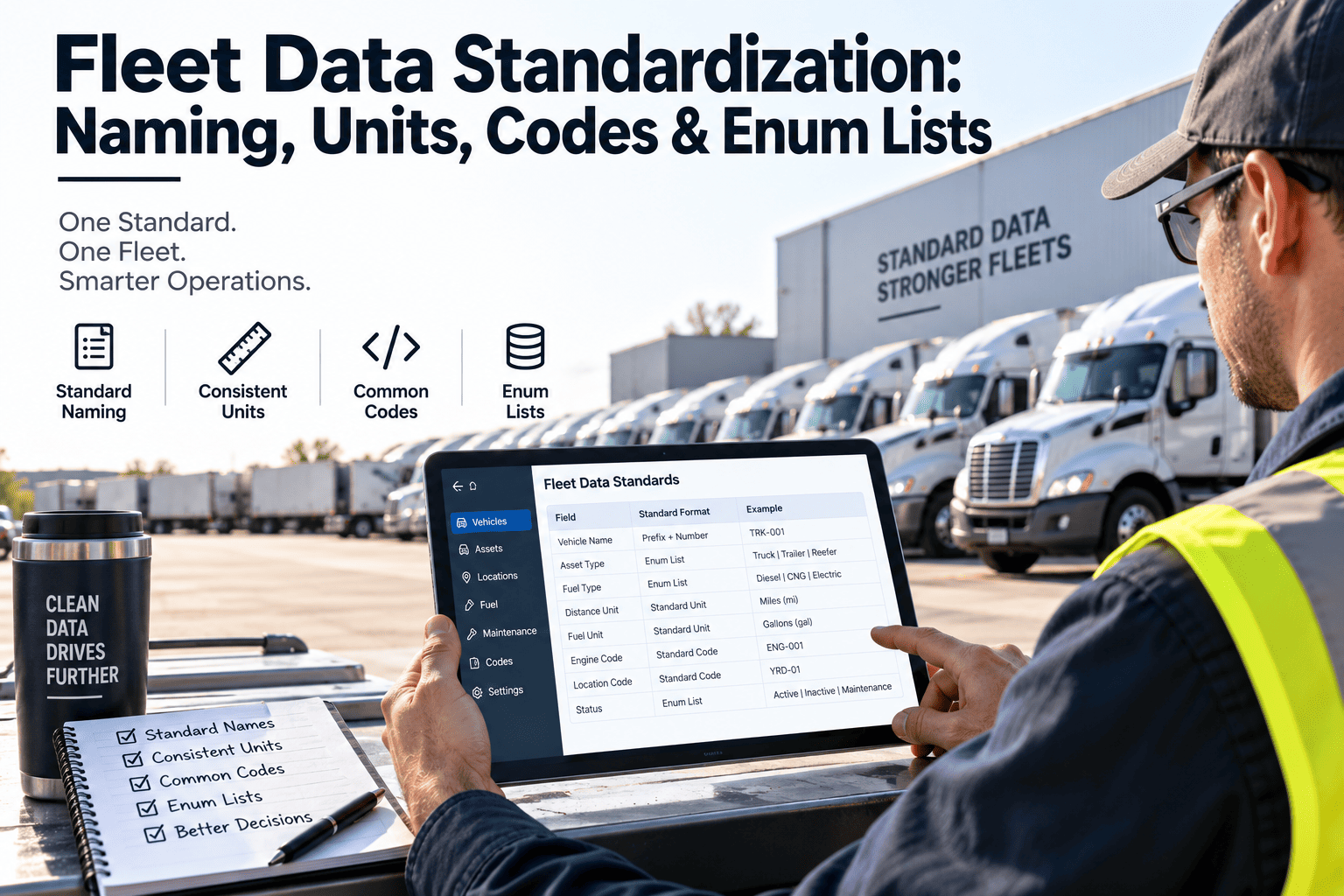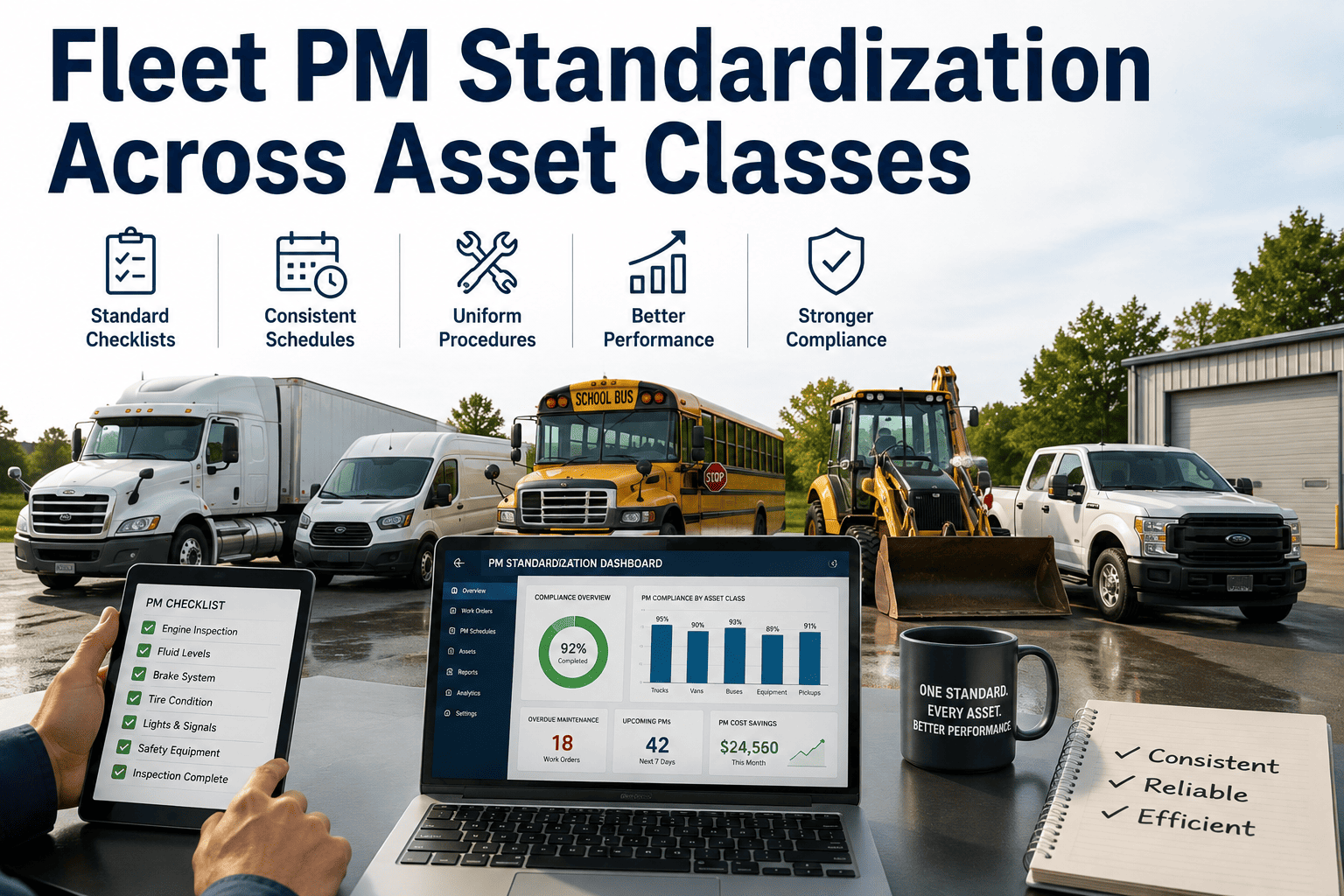
Reports are only as good as the records underneath them. When one truck is entered as "Unit 214" in one shop, "T-214" in another and by a mistyped VIN on an outside invoice, its repair history splits into pieces nobody can trust. Component names drift the same way, so five technicians describe the same brake job five ways. A fleet maintenance master data standard sets one set of rules for identifying vehicles, grouping them into classes and naming components. With those rules in place, a fleet CMMS can produce cost, reliability and compliance reports that stand up to scrutiny.
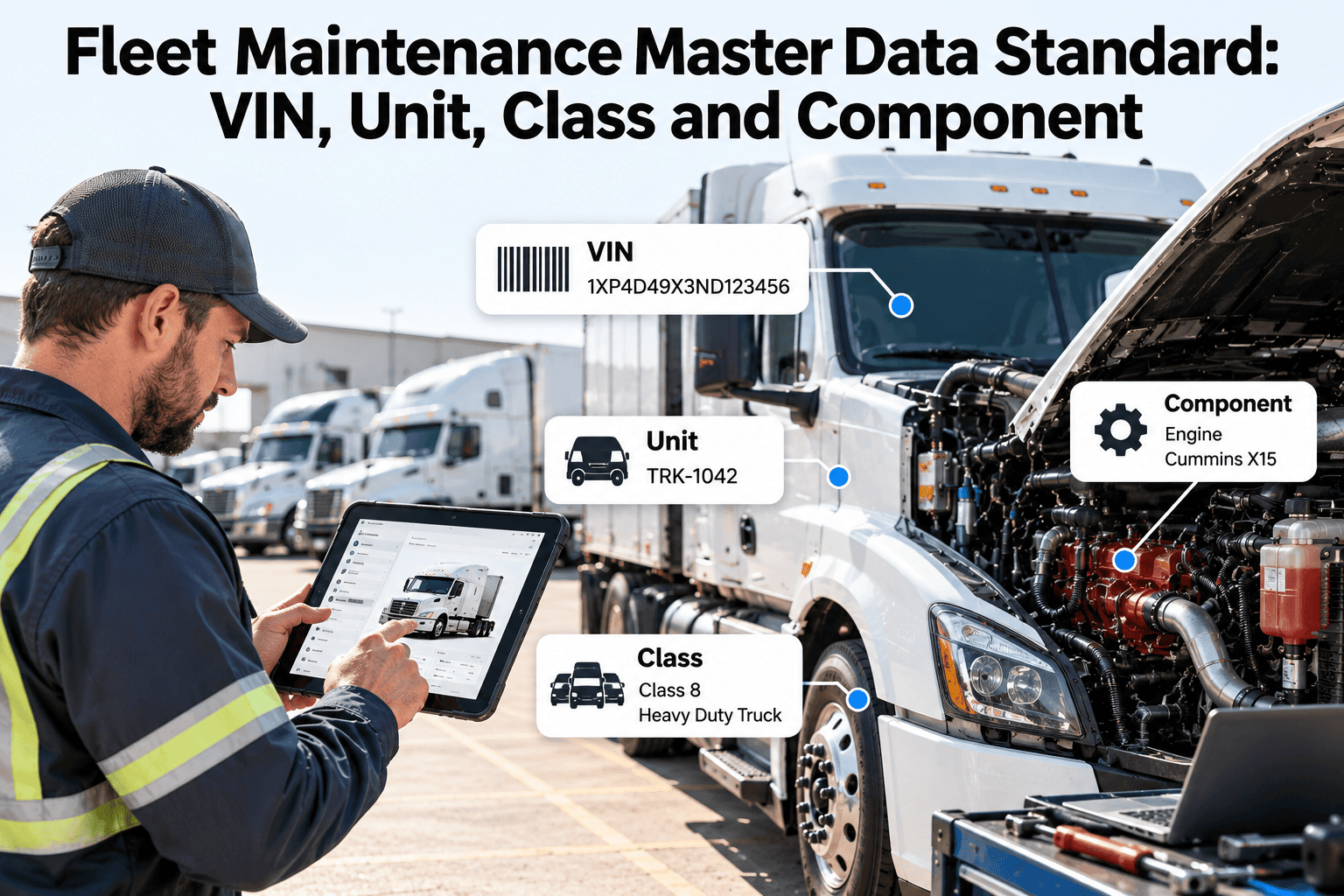
Fleet Maintenance Master Data Standard: VIN, Unit, Class and Component
Define how every vehicle, class and component is identified once, so work orders, PM schedules, parts and reports all point to the same clean record.
Why Master Data Is a Maintenance Problem
The Four Levels of the Standard
VIN: the permanent identity
The VIN is the vehicle's unique, manufacturer-assigned identifier and never changes. It is the anchor for recalls, warranty, registration and resale. Store it exactly as stamped, validate length and characters on entry, and treat it as the unique key.
Unit number: the operational name
Unit numbers are how drivers and dispatchers refer to a vehicle. They can change, be reused or be painted on a different truck, so keep them as a labeled field separate from the VIN and track changes with dates.
Class: the maintenance grouping
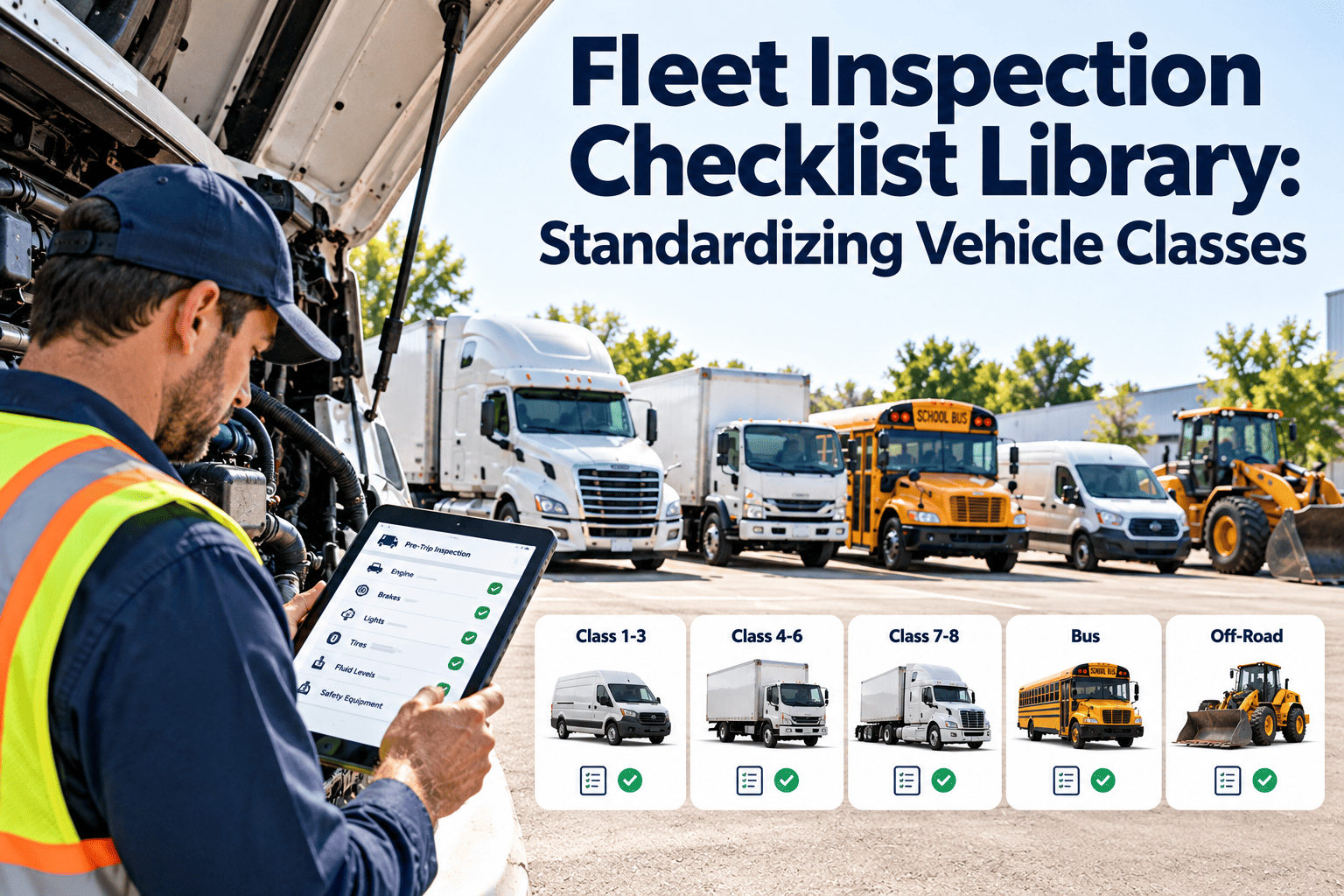
A class groups vehicles that share maintenance needs: type, weight rating, engine and duty cycle. Classes drive PM templates, parts lists, inspection checklists and benchmark comparisons.
Component: the system and part level
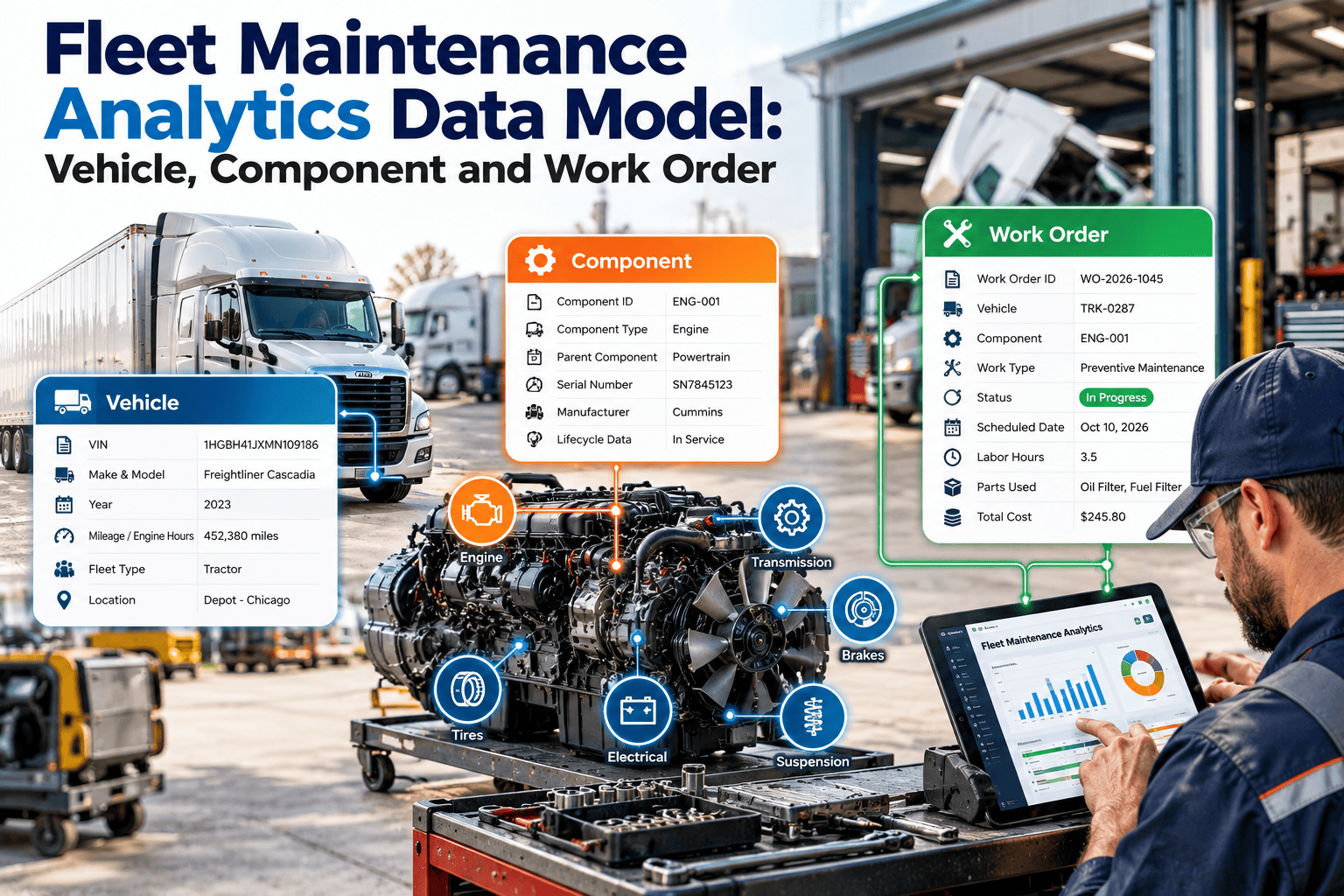
Components are organized by system, assembly and part, such as brakes, axle, drum, shoe. A standard hierarchy lets repairs roll up for analysis and links parts to the right place on the vehicle.
Required Fields on Every Vehicle Record
| Field | Rule | Why it matters |
|---|---|---|
| VIN | 17 characters, unique, validated at entry | Prevents duplicates and supports recalls and warranty |
| Unit number | Format agreed fleet-wide, unique among active units | Consistent naming for drivers and shops |
| Class | Selected from a controlled list | Drives PM templates and benchmarks |
| Make, model, year | Selected or decoded, not free typed | Enables parts and campaign matching |
| Engine and transmission | Model and spec recorded | Correct fluids, parts and intervals |
| In-service date and cost | Required | Lifecycle and replacement analysis |
| Meter type and reading | Odometer or hours, updated each work order | Accurate PM due dates |
| Location and status | Controlled values: active, spare, out of service, disposed | Correct reporting by depot and availability |
Naming Rules That Prevent Drift
Controlled lists, not free text
Use pick lists for class, status, location, failure and repair codes. Free text is for notes only.
One format per field
Decide on capitalization, separators and leading zeros once, and write them into the standard.
No meaning packed into unit numbers
Embedding location or year in a unit number creates problems when vehicles move or get reassigned.
Record changes, never overwrite
When a unit number changes, keep the old value in history so past work orders still make sense.
Build Your Asset Records Once, Correctly
Set up units, classes and components in a system that enforces your standard on every work order.
Component Hierarchy: From System to Part
The Technology and Maintenance Council of the American Trucking Associations publishes Vehicle Maintenance Reporting Standards, widely known as VMRS codes, which many fleets use as a starting point for system, assembly and component coding. Adapt them to your fleet rather than inventing a scheme from scratch.
How to Classify Vehicles
- Vehicle type: tractor, straight truck, van, trailer, bus, service body, support equipment.
- Weight rating: light, medium or heavy duty, which affects inspection and compliance requirements.
- Powertrain: diesel, gasoline or alternative, since fluids, aftertreatment and service needs differ.
- Duty cycle: long haul, local delivery, stop-and-go or off-road, which changes wear and PM intervals.
- Ownership: owned, leased or rented, which changes warranty, return and reporting rules.
Data Governance: Keeping It Clean Over Time
Assign an owner
One person or team owns the standard and approves changes to lists and codes.
Validate at entry
Use required fields, length checks and duplicate warnings instead of cleaning later.
Audit regularly
Check for missing meters, blank classes and duplicate VINs on a set schedule.
Train and document
Give technicians and parts staff a short guide with examples of correct entries.
Pre-Migration Cleanup Checklist
- Export every vehicle list from spreadsheets, accounting and telematics.
- Match records by VIN and flag duplicates or invalid lengths.
- Agree on the class list and map each vehicle to one class.
- Confirm current meter readings and in-service dates.
- Decide which historical work orders to import and how to code them.
- Test with one depot before loading the whole fleet.
VIN Validation Rules to Enforce at Entry
- Exactly 17 characters, with no spaces, and stored in uppercase.
- The letters I, O and Q are not used in a standard VIN, so their presence signals a typing error.
- Position 9 is a check digit on vehicles built for North America, which allows automated validation.
- Position 10 indicates model year and position 11 the assembly plant, which can be cross-checked against the make and model entered.
- Decode the VIN on entry where possible, and let a person confirm the make, model, year and engine rather than typing them.
- Block duplicate VINs and warn when a unit number is already in use.
Assets Without a Standard VIN
Trailers
Trailers carry a VIN and should be handled like power units, with their own class, PM schedule and inspection requirements.
Off-road and shop equipment
Forklifts, generators and similar equipment use serial numbers. Define a rule so serial and unit numbers do not clash with VINs.
Attached systems
Refrigeration units, liftgates, power take-offs and auxiliary power units may need their own records, linked to the vehicle they are installed on.
Temporary and rental units
Give them a clear status and an end date so they do not pollute active fleet totals but still hold repair history.
Parent and Child Asset Relationships
| Parent asset | Child asset examples | Why record separately |
|---|---|---|
| Tractor | Engine, transmission, fifth wheel | Major components can be rebuilt, swapped or warrantied independently |
| Straight truck | Body, liftgate, power take-off | Different service intervals and inspection items |
| Refrigerated trailer | Refrigeration unit | Separate hours, service schedule and cargo-critical failure risk |
| Bus | HVAC, doors, fare equipment | High failure frequency and service impact |
Failure, Cause and Repair Codes
| Code type | Question it answers | Example |
|---|---|---|
| Failure | What went wrong or what was observed? | Air leak, overheating, no start |
| Cause | Why did it happen? | Wear, defective part, damage, missed service |
| Repair or action | What was done? | Replaced, adjusted, cleaned, reprogrammed |
| System and component | Where on the vehicle? | Brakes, rear axle brake, shoe |
Master Data Mistakes and Their Fixes
| Mistake | Consequence | Fix |
|---|---|---|
| Using the unit number as the only identifier | History is lost when numbers change or are reused | Use the VIN as the permanent key |
| Free-text component names | The same part appears under many names | Use a controlled component list |
| Too many classes | Benchmarks become too thin to trust | Merge classes with similar maintenance needs |
| Stale meter readings | PM due dates drift and work bunches up | Require a reading on every work order |
| Disposed units left active | Overdue PMs appear for vehicles that are gone | Use a controlled status with disposal date |
| Different codes per depot | Cross-location reports cannot be compared | Adopt one standard and one owner |
Roles and Responsibilities
Data owner
Approves classes, codes and field rules, and decides what changes are allowed.
Shop supervisors
Make sure technicians use the right codes and record meter readings.
Parts staff
Maintain part records, link them to components and merge duplicate items.
Fleet administrator
Adds and retires units, checks VINs and updates status and location.
Measuring Data Quality
Completeness
Share of units with VIN, class, meter reading and in-service date filled in.
Uniqueness
Count of duplicate VINs, unit numbers and part numbers found in each audit.
Timeliness
Age of the latest meter reading and the delay between repair and work order closeout.
Consistency
Share of work orders using standard failure, cause and repair codes.
Class Structure: A Worked Example
| Class | Includes | Why it is separate |
|---|---|---|
| Light-duty vans | Cargo and passenger vans under a light weight rating | Short PM intervals, high stop-and-go wear, tires and brakes dominate |
| Medium-duty trucks | Box trucks and service bodies | Mixed use, body equipment and liftgates add inspection items |
| Heavy tractors | Over-the-road and regional tractors | Aftertreatment, air systems and annual inspection focus |
| Trailers | Dry vans, flatbeds, refrigerated trailers | No engine, different inspection and wheel-end priorities |
| Vocational units | Dump, refuse, utility and similar | Hydraulics and body systems drive cost |
Unit Number Conventions
Keep them short and readable
Drivers and dispatchers say unit numbers aloud and write them on forms. Short numbers with a consistent format reduce errors and make verbal handoffs simpler.
Avoid encoding changeable facts
Putting depot, year or class into the number means it becomes wrong when the vehicle moves or is reassigned. Store those facts as fields instead.
Never reuse an active number
Reusing a number after disposal can merge histories of two different vehicles. If reuse is unavoidable, link each number to its VIN and valid dates.
Show the number on the vehicle
A visible unit number that matches the system prevents wrong-vehicle work orders and helps with inspection and roadside reports.
Retirement and Disposal Records
- Change status to disposed, sold or returned instead of deleting the record, so cost history remains for analysis.
- Record the disposal date, final meter reading and reason, such as sale, lease return or accident total loss.
- Cancel open PMs and close open work orders so they do not distort compliance and backlog figures.
- Retain inspection and maintenance records for the period required by your regulations and policies.
- Keep the final cost summary on the asset to support future replacement and residual value discussions.
What the Written Standard Should Contain
- Purpose, scope and the person responsible for maintaining the document.
- Definitions of VIN, unit number, class, asset, component and any local terms.
- Required and optional fields for each asset type, with an example of a correct record.
- The approved lists for class, status, location, failure, cause and repair codes.
- Unit number format rules, including what happens when numbers change or are retired.
- Rules for linking child assets, attachments and trailers to parent vehicles.
- The process for requesting a new code or class, and who approves it.
- Audit schedule, quality measures and how errors are corrected.
Rollout Sequence
Draft
Write the standard with input from shop, parts, compliance and finance. Keep it short enough that people read it.
Pilot
Apply it to one depot or class. Note where the rules caused confusion and refine the wording and lists.
Migrate
Clean and load the remaining assets, using validation to catch errors at import instead of after reports are built.
Sustain
Run scheduled audits, review change requests and refresh training whenever staff or processes change.
Signs Your Master Data Needs Attention
- Reports disagree: two reports show different totals for the same unit or class and nobody can explain why.
- Searches fail: technicians cannot find a unit by number, so they create a new record instead.
- PM surprises: services come due for vehicles that are no longer in service, or never come due for active ones.
- Parts confusion: the same part appears under several numbers, and stock counts never match what is on the shelf.
- Audit stress: pulling a unit's complete history takes days because records are scattered across systems.
How Oxmaint Supports Master Data Discipline
Asset register
Keep a structured record for every unit, including specs, documents and status.
PM by class
Apply schedules and checklists to groups of similar vehicles.
Work order linkage
Every repair attaches to a specific asset and builds its history.
Inventory links
Associate parts with the assets and components they fit.
Frequently Asked Questions
Standardize Once, Report With Confidence
Give every vehicle, class and component a clean identity so maintenance data supports real decisions.