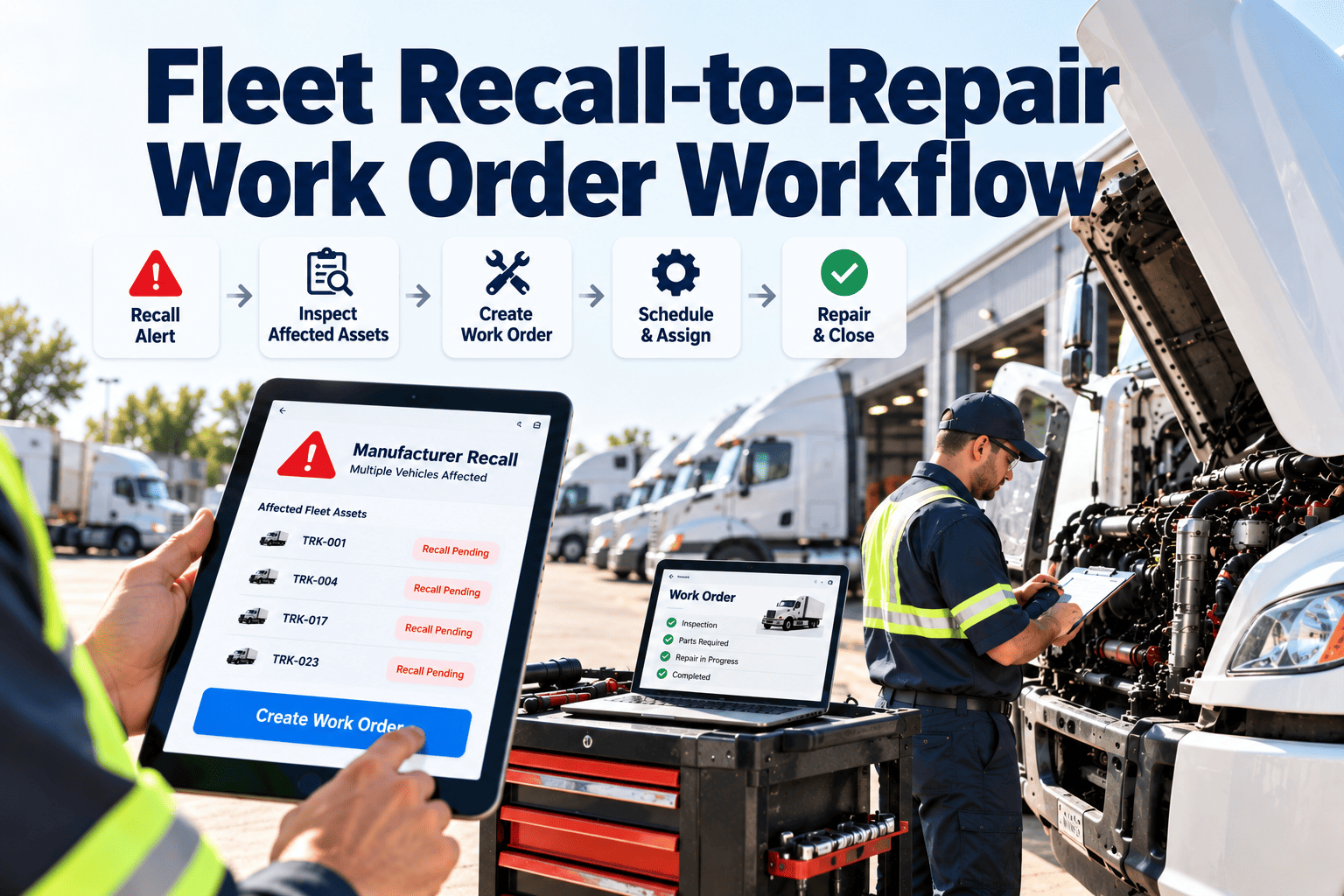
A safety recall notice is easy to receive and surprisingly easy to lose. It arrives by mail, by dealer portal, or in an email forwarded between three people, and then it waits for someone to match it to a vehicle. In a fleet of hundreds of units, that gap is where open recalls sit unrepaired for months. A defined workflow turns each notice into a tracked repair with a parts order, a shop slot, and proof of completion. The sections below follow that path, and a fleet work order system keeps every step connected.
Fleet Recall-to-Repair Work Order Workflow
Move every safety recall from notice to verified repair with clear ownership, parts readiness, downtime planning, and a document trail that holds up when someone asks for proof.
The scale of recalls fleets are managing
NHTSA reported 997 vehicle safety recalls in 2025, affecting more than 29 million vehicles. It also notes that millions of recalled vehicles go unrepaired every year.
Where fleets lose time
- Notices go to a registered address that no maintenance person monitors.
- Recall status lives in an email thread rather than on the vehicle record.
- Remedy parts are not yet available, and nobody revisits the vehicle when they arrive.
- Repairs happen at a dealer, but the completion paperwork never reaches the fleet files.
- Units rotate between depots, so the recall follows the wrong location.
Six stages, each with an owner and an exit condition
A stage is finished only when its exit condition is met. That rule prevents recalls from being marked done when they are merely scheduled.
Owner: Fleet administrator. Exit: The notice is logged with campaign number, make, model, and affected component.
- Source routes include mailed owner letters, dealer notices, the manufacturer fleet portal, and routine VIN checks on NHTSA's recall lookup.
Owner: Asset coordinator. Exit: Every affected VIN in the fleet is identified and linked to the campaign.
- Run the whole fleet VIN list through the lookup in batches and record the result, including vehicles with no open recall.
Owner: Maintenance manager. Exit: A priority and an interim instruction are set for each unit.
- Read the manufacturer's safety description. Some campaigns say to stop driving the vehicle. Others allow continued operation with a workaround. Follow the notice, and involve your safety lead if wording is unclear.
Owner: Planner. Exit: A work order exists per vehicle with parts status, location, and a scheduled slot.
- If the remedy is not yet available, create the work order anyway in a waiting-for-parts status so it surfaces automatically later.
Owner: Technician or dealer. Exit: The remedy is performed and signed off by the person who did it.
- In-house repairs capture photos, parts used, and labor. Dealer repairs require the dealer invoice or recall completion record.
Owner: Fleet administrator. Exit: The VIN shows the recall as complete and the record is filed.
- Re-run the VIN lookup after the repair. Close the work order only when the status matches your files.
What to do when the remedy is not yet available
Manufacturers sometimes announce a recall before the repair parts are ready. The fleet still has to manage the exposure during that window.
Remedy available
- Order or confirm parts
- Choose in-house or dealer repair
- Schedule around dispatch demand
- Complete and verify
Remedy not available
- Apply the manufacturer's interim instruction
- Flag the unit on the dispatch board
- Create a waiting-for-parts work order
- Review status on a fixed weekly cadence
Stop tracking recalls in inboxes
Create a work order per affected vehicle, attach the notice, and see open recalls across every depot on one dashboard.
The record set that proves a recall was handled
Good records answer three questions quickly: what was the defect, what was done, and when. Define a standard packet for every recall.
| Document | Purpose | Where it should live |
|---|---|---|
| Recall notice | Shows campaign number, defect, and remedy | Attached to the work order |
| VIN lookup result | Shows open or complete status at a point in time | Vehicle record, dated |
| Parts order or availability note | Explains any delay | Work order notes |
| Repair record or dealer invoice | Shows who did the remedy and when | Work order attachment |
| Technician sign-off | Names the person responsible | Work order completion |
| Post-repair lookup | Confirms the recall now shows complete | Vehicle record, dated |
Set your retention period with your compliance and legal advisers. Fleet regulations differ by vehicle type and operation, and recall records can matter long after the repair.
Batching recall repairs without hurting dispatch
Count and rank
Total affected units by depot, and rank them by the manufacturer's urgency and your operating risk.
Align parts and bays
Confirm remedy kits, estimate labor hours per unit, and reserve shop capacity.
Repair in waves
Pull units in groups sized to what dispatch can spare, combining the recall with due preventive maintenance when sensible.
Verify and report
Re-check every VIN, close work orders, and report completion rate to management.
Combining work saves trips
- Pair recall repairs with scheduled preventive maintenance on the same visit.
- Resolve open defect reports from drivers on the same unit while it is in the bay.
- Group units by remedy type so technicians repeat the same procedure.
KPIs for recall performance
Completed recall repairs divided by affected fleet units, tracked per campaign.
Days between receiving a notice and having a work order for every affected VIN.
Average days a recall stays open once the remedy is available.
Share of closed recalls with the full record packet attached.
The bar lengths are illustrations of direction, not benchmarks. Set your own targets from your baseline.
How Oxmaint supports each stage
Mistakes that leave recalls open
Closing on scheduling
A booked appointment is not a repair. Close only on proof.
Checking once
New recalls appear after purchase. Repeat fleet-wide VIN checks on a schedule.
Ignoring trailers and equipment
Recalls cover equipment and components, not only tractors and vans.
No owner for dealer work
Assign someone to collect dealer paperwork and update the file.
Who does what in a recall workflow
Recall work fails in the handoffs. A simple responsibility table removes the question of who was supposed to call the dealer.
| Task | Responsible | Backup | Informed |
|---|---|---|---|
| Monitor notices and VIN lookups | Fleet administrator | Asset coordinator | Maintenance manager |
| Match affected VINs | Asset coordinator | Fleet administrator | Depot supervisors |
| Set priority and interim rules | Maintenance manager | Safety lead | Dispatch |
| Order parts and book bays | Planner | Parts clerk | Depot supervisors |
| Perform and sign off repairs | Technician or dealer | Lead technician | Planner |
| Verify and file records | Fleet administrator | Asset coordinator | Compliance contact |
Situations that complicate recall repairs
Leased or financed vehicles
Notices may go to the lessor. Ask them to forward every campaign letter and agree who arranges the repair.
Dealer-only remedies
Many remedies must be done by an authorized dealer. Book early, track the appointment on the work order, and request the completion paperwork.
Units on the road
Long-haul vehicles may not return for weeks. Use partner shops or dealers near the route and keep the same work order.
Upfit and body equipment
Recalls can involve equipment added after the chassis was built. Keep upfit makers and part numbers on the asset record.
Used or acquired units
Run a VIN lookup before putting an acquired vehicle into service, and log the result at intake.
Repeat or related campaigns
A second recall on the same system may follow a failed remedy. Link the work orders so the history stays visible.
What to tell drivers and dispatch
Drivers are often the first to notice symptoms, and dispatch decides whether a unit moves. Both need short, clear messages.
- State the affected component, the symptom to watch for, and what to do if it appears.
- Say whether the vehicle may continue in service, exactly as the manufacturer notice describes.
- Give the repair date or the reason there is not one yet.
- Ask drivers to log any related defect in their next inspection so it is linked to the recall work order.
- Close the loop when the repair is complete so crews know the issue is resolved.
A first-month setup checklist
- Export a clean VIN list for every unit and trailer
- Run the first fleet-wide lookup
- Name the recall owner and backup
- Create work orders for all open recalls
- Rank by safety wording and operating risk
- Confirm remedy availability
- Schedule repairs in waves
- Brief drivers and dispatch
- Set up a weekly open-recall review
- Verify completed VINs again
- File the record packets
- Set the repeat lookup schedule
Choosing where each recall repair happens
Some remedies require an authorized dealer. Others can be done in your own shop when the manufacturer allows it and parts are supplied. Decide per campaign, using the same criteria each time.
| Factor | Favors dealer | Favors in-house |
|---|---|---|
| Manufacturer rules | Remedy limited to authorized dealers | Procedure and parts released for fleet shops |
| Special tools or software | Proprietary diagnostic or reflash tools needed | Standard tools and trained technicians available |
| Travel time | Dealer is close to the depot or route | Unit is already at the shop for other work |
| Warranty and reimbursement | Dealer handles claims paperwork | Fleet is approved to submit its own claims |
| Downtime | Dealer can start the same day | Shop can slot it between planned jobs |
Ask the manufacturer or dealer for written confirmation of any in-house authorization and keep it with the campaign file.
Why recall work slips even in organized fleets
A fifteen-minute weekly recall review
- Open the list of work orders tagged as recall and sort by age.
- Check which waiting-for-parts items now have a remedy available.
- Confirm every scheduled repair has a date, a bay, and an owner.
- Flag any unit that is overdue and decide whether dispatch needs a warning.
- Look at repairs completed since last week and verify their documents.
- Record decisions in the work orders, not in a separate meeting note.
What an unmanaged recall can cost a fleet
Recall repairs are normally free to the owner, so the cost of a missed one rarely shows up as a repair bill. It appears elsewhere.
Safety exposure
The recalled defect exists to protect drivers and the public. An open recall leaves that risk in service.
Unplanned downtime
A failure that the remedy would have prevented removes the vehicle at a time you did not choose.
Liability questions
After an incident, investigators and insurers may ask whether known recalls were addressed. Talk to your insurer and legal adviser about expectations.
Resale and lease returns
Open recalls can complicate sales and returns, and cleaning them up in bulk is slower than handling them as they arrive.
Connecting recalls to the rest of the maintenance record
- Tag recall work orders with a distinct type so they can be filtered and reported on separately.
- Link driver inspection defects to the matching campaign when symptoms appear before the repair.
- Record remedy parts against the work order so stock and cost stay accurate.
- Keep warranty or reimbursement claim details in the same record when a claim applies.
- Review recall history when evaluating whether to repair, replace, or sell a unit.
Fleet recall workflow questions
How do I find open recalls across my whole fleet?
Check VINs on NHTSA's lookup, up to 100 at a time, and log each result on the vehicle record.
Should I create a work order if parts are not ready?
Yes. A waiting-for-parts work order keeps the vehicle visible. You can set that up in Oxmaint.
Who should close a recall work order?
The person who verifies the post-repair VIN status and confirms the record packet is complete.
Can recall repairs be combined with preventive maintenance?
Often yes. Combining visits reduces downtime. A short demo shows how schedules line up.
How long should recall records be kept?
Ask your compliance adviser, because requirements vary. Many fleets keep them for the life of the vehicle.
Make every recall a closed, documented job
Give your team one place to log, schedule, repair, and verify recall work across the fleet. Start now or walk through your process with us.