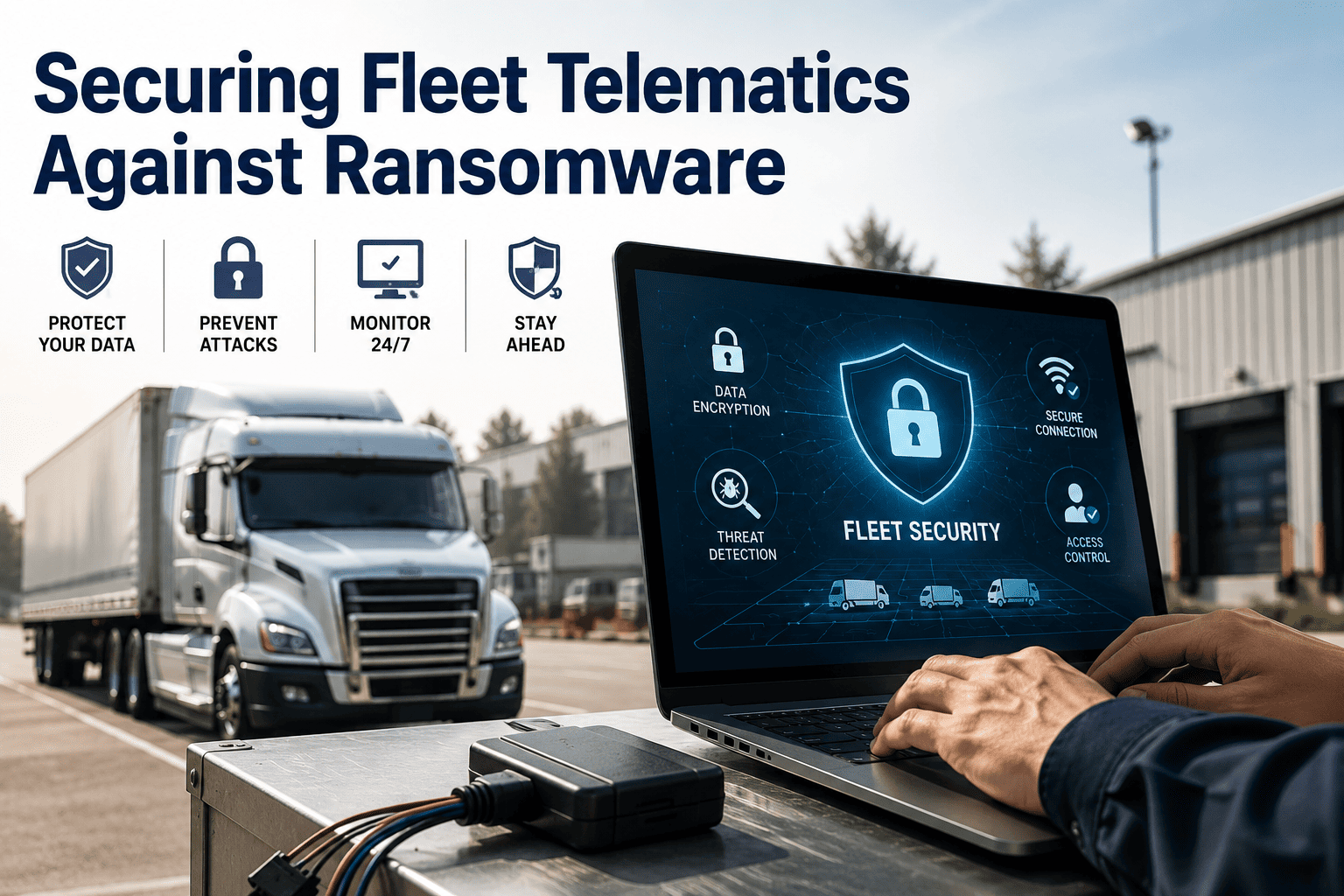
Connected telematics systems have quietly become the most exposed asset in a modern fleet — always online, cloud-managed, and packed with the operational data a threat actor can encrypt, exfiltrate, or quietly manipulate for competitive advantage. In 2026 several major carriers reported ransomware incidents that grounded operations for days, turning a theoretical risk into a line-item loss on the P&L. This guide maps the three-layer attack surface (device firmware, cloud platform, API integrations) and the defense-in-depth practices — vendor certification, MFA, RBAC, key rotation, firmware discipline, and an offline-first incident plan — that keep a fleet running through a vendor breach. To operationalize these controls inside your maintenance stack, you can Start Free Trial of Oxmaint and scope telematics integrations from day one.
Can your fleet keep moving if your telematics vendor goes dark tomorrow?
A single unpatched gateway or one over-permissioned API key can cascade into a full operational shutdown. The carriers that recovered fastest in 2026 were not the ones with the biggest budgets — they were the ones with offline-first incident plans and least-privilege access already enforced.
Three layers where ransomware actually enters a fleet
Every modern telematics deployment exposes three distinct attack surfaces. Hardening only one leaves the other two as open doors — and threat actors in 2026 routinely chained all three in a single intrusion.
The Telematics Device
ELDs · Gateways · Embedded Linux / RTOSModern ELDs and gateways run embedded Linux or RTOS firmware that must receive security patches on a vendor release schedule. Devices running unpatched firmware are vulnerable to remote exploit — an attacker on the same cellular segment can pivot from a single truck to the fleet's entire data stream.
The Cloud Platform
SaaS Backend · Tenant Data · User CredentialsThe vendor's SaaS backend holds every vehicle's location, diagnostic, and driver data alongside every user's credentials. A single vendor breach exposes the entire tenant base — and in multi-tenant architectures, lateral movement between fleets has been documented within hours of initial access.
API Integrations
Third-Party Systems · Key Scoping · WebhooksEvery third-party system that receives telematics data via API — maintenance software, fuel cards, TMS, analytics dashboards — is a potential attack vector back into the core platform. Over-permissioned, never-rotated API keys are the single most common initial-access method observed in 2026 fleet incidents.
Six controls that separate resilient fleets from ransomware victims
These are not aspirational. Carriers that enforced all six recovered from vendor incidents in under 24 hours; those that enforced fewer than three were down for four days or longer.
SOC 2 Type II Certified Provider
Select telematics vendors with current SOC 2 Type II certification and public security disclosure practices. Ask for the most recent audit letter, the breach notification timeline (should be ≤72 hours), and the sub-processor list before signing.
MFA Enforced on Every Account
Multi-factor authentication on every user account — dispatchers, maintenance techs, drivers with portal access, and service-vendor logins. Phishing-resistant MFA (TOTP or hardware key) is now the floor; SMS-based MFA is no longer adequate for fleet operations.
Role-Based Access Control
A dispatcher should never be able to export the full fleet's vehicle data. RBAC scopes read, write, export, and admin actions per role — and surfaces anomalies in activity logs when a low-privilege account suddenly attempts bulk export.
API Key Rotation & Least-Privilege
Rotate API keys every 90 days, scope each key to the minimum endpoints required, and revoke dormant keys monthly. In Oxmaint, telematics integrations use scoped API keys and surface unusual access patterns in activity logs by default.
Firmware Update Discipline
Devices are patched on the vendor's release schedule — typically quarterly for critical CVEs. Track firmware versions across the fleet, flag devices more than two releases behind, and enforce staged rollouts so a bad patch cannot brick the entire fleet at once.
Offline-First Incident Plan
Assume a 24–72 hour telematics outage. Maintain paper DVIRs, offline route sheets, a cached driver roster, and a manual work-order workflow that can bridge the gap. Test the plan quarterly — an untested plan is a wish.
What a 48-hour telematics ransomware shutdown actually costs
A regional carrier operating 240 power units with a connected CMMS learned this the hard way in Q1 2026. Here is the cost stack they documented for their cyber-insurance claim.
| Loss Category | Mechanism | Documented Cost |
|---|---|---|
| Loads not tendered | Dispatch could not see real-time tractor location; 38 loads refused | $184,000 |
| Manual DVIR & HOS re-entry | 72 hours of back-office overtime to reconstruct logs | $22,500 |
| Customer SLA penalties | 11 contractual late-delivery penalties triggered | $47,200 |
| Forensic & remediation | IR retainer, key rotation across 9 integrated systems | $68,000 |
| Deductible (cyber policy) | Self-insured retention before coverage triggered | $50,000 |
| Total documented loss | $371,700 | |
The carrier had MFA enforced but no RBAC and a single API key shared across three integrations with full read/write scope. Retrofitting least-privilege scoping and a tested offline plan cost $14,200 — roughly 3.8% of the loss they absorbed.
Stop assuming your telematics vendor will never be breached
Scope API keys, enforce MFA by default, and surface unusual access patterns before they become an insurance claim.
A 90-day hardening roadmap for fleet telematics
You do not need to do everything on Monday. You do need a sequenced plan that closes the highest-leverage gaps first and builds toward a tested offline capability.
Identity & Access Lockdown
Enforce MFA on every telematics and CMMS account. Audit user lists, remove dormant accounts, and map permissions to roles. Disable shared logins and service-vendor accounts that lack individual identities.
API & Integration Hardening
Inventory every API key in circulation. Re-scope each to least privilege, rotate all keys, and set a 90-day rotation cadence. In Oxmaint, scoped keys and activity-log alerts surface anomalous access automatically.
Device Firmware & Vendor Review
Pull firmware versions across the fleet. Flag devices more than two releases behind and schedule staged patching. Request the latest SOC 2 Type II letter from your telematics vendor and review their breach-notification SLA.
Offline Drill & Plan Sign-off
Run a 4-hour tabletop drill simulating a full telematics outage. Dispatch from paper, run manual DVIRs, and process work orders offline. Document gaps, update the incident response plan, and brief leadership on residual risk.
Fleet telematics ransomware: what operators actually ask
Does FMCSA require cybersecurity certification for ELDs?
No — FMCSA does not yet require cybersecurity certification for ELDs, though the registered-device list does screen for basic tampering resistance. Industry practice is moving faster than the regulation: carriers and brokers now routinely request SOC 2 Type II evidence and breach-notification timelines during vendor selection, and cyber-insurance underwriters are beginning to make both a condition of coverage in 2026.
How long should a fleet be able to operate without telematics?
Plan for 24–72 hours of full telematics unavailability. That means cached driver rosters, paper DVIRs, offline route sheets, and a manual work-order workflow your maintenance team has actually practiced. Carriers that tested this quarterly recovered from real incidents in under a day; those that never drilled were down for four or more.
What is the single highest-impact control we can enforce this week?
Phishing-resistant MFA on every account, followed immediately by RBAC that prevents non-admin users from bulk-exporting fleet data. These two controls block the most common 2026 entry paths — credential stuffing and insider-facilitated exfiltration — at near-zero cost. You can stand both up in Oxmaint and connect your telematics provider with scoped keys when you Start Free Trial.
How often should telematics API keys be rotated?
Rotate every 90 days at minimum, and immediately whenever an integration vendor offboards a developer or changes their own sub-processor list. Each key should be scoped to the exact endpoints that integration needs — never full read/write across the fleet — and dormant keys should be revoked during a monthly access-review cadence.
Will cyber insurance cover a telematics ransomware incident?
Increasingly, only if you can prove you enforced MFA, RBAC, key rotation, and an incident response plan before the breach. Underwriters in 2026 are declining or heavily sub-limiting claims where the insured cannot produce evidence of these controls. Treat the controls above as both a security and an insurance-eligibility requirement — and book a walkthrough at Book a Demo if you need a documented controls map.
Harden your fleet before the next vendor incident makes headlines
Scoped API keys, MFA by default, RBAC, and activity-log alerts — configured the day you sign up, not after a breach.
Free 14-day trial · No credit card