Fleet Cybersecurity: Protecting Connected Vehicles and Management Systems
By Alex Jordan on March 31, 2026
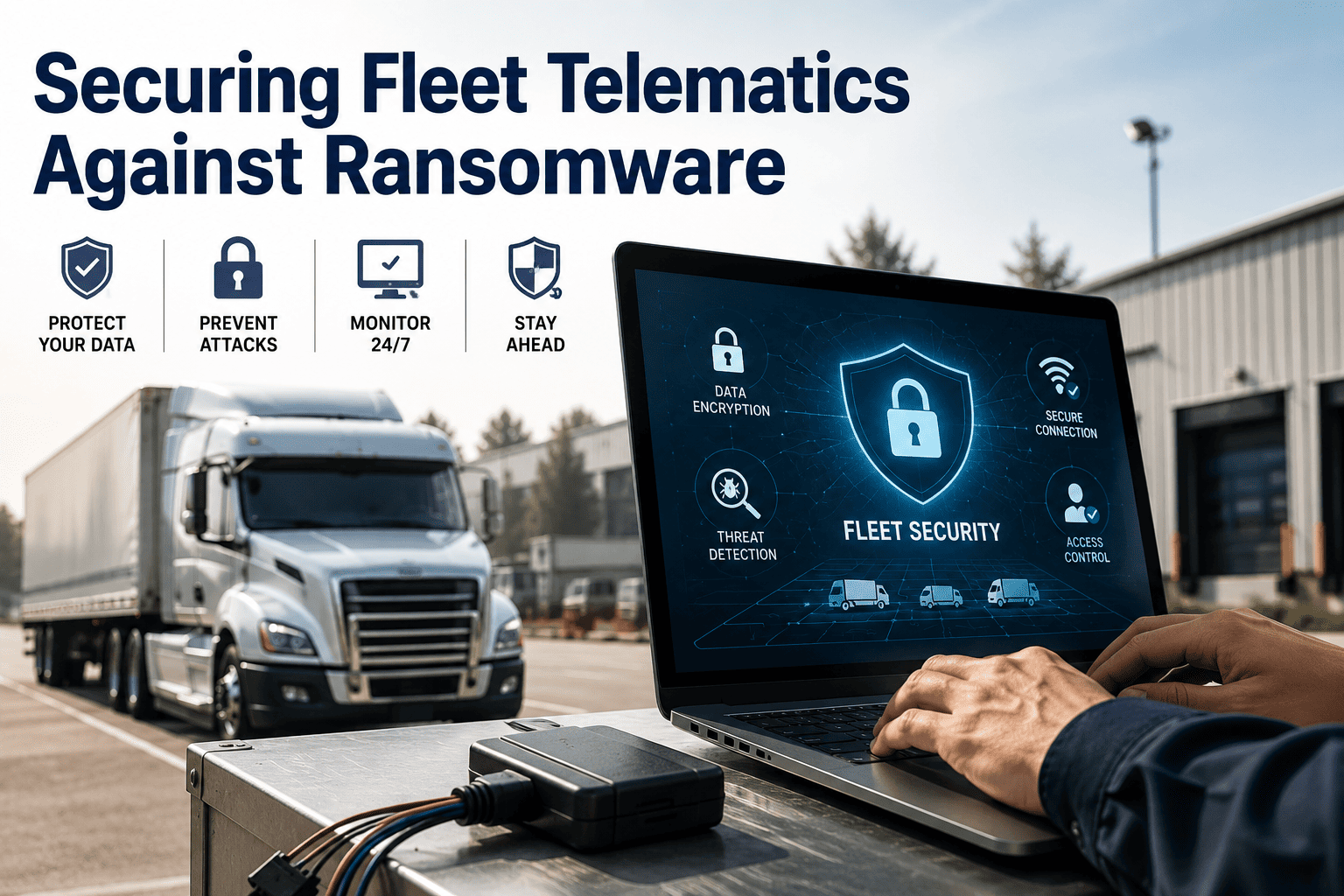
Connected fleet vehicles are now legitimate cyberattack targets — not to steal trucks, but to access operational data, driver records, and the financial systems linked to every telematics and CMMS platform. A single breached portal credential gives an attacker full access to vehicle location history, driver behaviour data, and maintenance records — and in unprotected architectures, the ability to interact with vehicle control systems via an unsecured OBD port. OxMaint's CMMS platform is built on enterprise-grade security — MFA-enforced access, AES-256 encryption, audit logging, and immutable backups protecting every fleet record from day one.
Fleet IT Security · Blog · 2026
Fleet Cybersecurity: Protecting Connected Vehicles and Management Systems
Telematics vulnerabilities, GPS spoofing, CAN bus attacks, cloud platform security, and how fleet management platforms protect operational data — the IT and fleet security officer's guide to the connected vehicle threat landscape.
How a Fleet Cyber Breach Unfolds — The 6-Stage Attack Chain
Fleet cybersecurity incidents rarely start with a sophisticated exploit — they start with an unsecured OBD device, a default-password telematics portal, or a driver clicking a phishing link. The attack chain below shows the six stages of a typical connected fleet breach, from initial access through to regulatory exposure. Understanding each stage helps IT and fleet security teams identify the specific controls that break the chain before damage occurs. OxMaint's security architecture interrupts the chain at Stages 2, 3, and 4 — where most fleet operators currently have no controls.
Fleet Cyber Attack Chain — 6 Stages from Entry to Damage
1
Initial Access
Unsecured OBD device, phishing link, or default portal password
Entry
→
2
Lateral Movement
Pivots from telematics to CMMS using shared credentials
High
→
3
Privilege Escalation
Admin rights obtained — full vehicle, driver, and SAP data visible
Critical
→
4
Data Exfiltration
Driver records, route history, and maintenance data stolen silently
Breach
→
5
Disruption
Ransomware locks CMMS and telematics — operations paralysed
Severe
→
6
Legal Exposure
GDPR 72-hr notification missed — ICO/FTC investigation and fine
Legal
The 6 Primary Fleet Cyber Threats — Attack Method + Defence Control
Connected fleet operations expose six distinct attack surfaces — each with a different exploit method and a different defence control. Treating fleet cybersecurity as a single problem produces generic solutions that protect against none of them effectively. OxMaint's security model addresses all six — MFA, encryption, device whitelisting, API key rotation, immutable backups, and annual penetration testing.
Credential Attack
Critical
Phishing email → password stolen → full CMMS access with no MFA barrier
Defence MFA enforced + role-based access controls on all accounts
Security Posture: Unsecured vs. Basic vs. OxMaint-Secured Fleet
The gap between an unsecured fleet and a properly-secured one is measurable across six dimensions — from breach detection time to regulatory fine exposure. Every "Basic Security" column represents the most common fleet security posture: a password policy but no MFA, no audit logs, and no encrypted maintenance data. OxMaint delivers the full Secured column by default, not as a paid add-on.
Security Area
Unsecured Fleet
Basic Security
OxMaint Secured
Access Control
Shared passwords, no MFA — any stolen credential = full access
Individual logins, no MFA — phishing and brute-force still succeed
MFA + role-based access — 99% of credential attacks blocked
Encryption
Plaintext maintenance data — readable if intercepted in transit
HTTPS only — data at rest unencrypted on most basic platforms
TLS 1.2+ in transit · AES-256 at rest — unreadable if intercepted
Breach Detection
External report after 207 days — data stolen for months undetected
Manual firewall review — days to detect active intrusion attempt
Cybersecurity Maturity Scoring — How Protected Is Your Fleet?
Fleet cybersecurity maturity exists on a spectrum from no controls to a fully integrated zero-trust architecture. The scoring framework below lets IT and fleet security officers assess their current posture — identifying the highest-risk gaps and the controls that deliver the most risk reduction per effort invested.
MFA on all accounts. Role-based access. AES-256 encryption. Immutable backups. Tested incident response. Annual penetration test completed.
Profile: Meets ISO 27001, NIST CSF, and GDPR requirements. Best cyber insurance rates achievable.
4
MFA Active · Encrypted · Audit Logs On
Core controls in place. MFA enforced. Encrypted. Audit logs active. Incident response documented — not yet tested against a live scenario.
Action: Schedule penetration test. Run tabletop incident exercise. Close vendor security assessment gaps.
3
Password-Only · Basic Encryption · No Plan
Platform has HTTPS but no MFA. No audit logging. No incident response procedure. OBD devices uncontrolled. Some role restrictions exist.
Gap: MFA is a one-afternoon configuration that eliminates 99% of credential attacks immediately.
2
Shared Passwords · No Controls · No Policy
Shared logins. No MFA. No access logging. OBD ports open. Driver data accessible to all users regardless of operational role.
Risk: One phishing email compromises the entire operational dataset. Immediate action required.
1
Unprotected — Active Breach Exposure
No controls. Default credentials unchanged. No encryption awareness. A breach is invisible until an external party reports it months later.
Risk: GDPR/CCPA penalty exposure is active right now. Emergency security audit required immediately.
Technology: AI, OBD, SAP, PLC — Expanding the Attack Surface
The technology stack that drives predictive fleet maintenance also expands the cyber attack surface — and must be secured accordingly. OBD-II and J1939 telematics are the highest-risk physical vector — every connected dongle is a potential CAN bus entry point. AI Digital Twin models consume sensitive operational data requiring AES-256 protection and scoped access controls. AI Camera Vision stores driver imagery falling within GDPR and CCPA scope. SAP integrations create a bidirectional channel between CMMS and financial systems — a compromised account becomes a financial system entry point. PLC networks extend the attack surface to physical depot infrastructure.
OBD / J1939
Highest Physical Risk
CAN bus access if device uncontrolled
Physical OBD lock + approved device whitelist. Every unknown device blocked before CAN bus access is possible.
AI Digital Twin
Sensitive Data Scope
Route + driver data — AES-256 required
Access scoped to operational functions only. No bulk export. Model inputs and outputs encrypted in transit and at rest.
AI Camera Vision
GDPR / CCPA Scope
Driver imagery — retention policy mandatory
Retention policy enforced. Driver notification met. Images processed on-device — not retained indefinitely in cloud storage.
SAP / PLC
Financial + Physical Risk
Service accounts only — no personal credentials
SAP via dedicated service account. PLC network isolated. Access scoped to minimum required data fields across all integrations.
"
Our IT audit flagged 14 fleet platform accounts with shared credentials and no MFA. Every account had full access to 62 vehicles' location history, driver data, and maintenance records. We enforced MFA and role-based access through OxMaint in one afternoon. The auditor cleared the finding same day — what would have been a GDPR exposure was fixed before any incident occurred.
Is OxMaint GDPR and CCPA compliant for fleet driver data?
Yes — OxMaint operates under GDPR data processing agreements for EU customers and CCPA compliance for US operators. Driver data is encrypted at rest, role-access controlled, and subject to configurable retention policies. Review our security documentation here.
What is a CAN bus attack and how serious is it for fleet vehicles?
The CAN bus connects a vehicle's ECUs internally. A device plugged into the OBD port can inject CAN messages — potentially affecting braking and steering systems. Physical OBD port locks and device whitelisting are the essential defences.
How does OxMaint protect fleet data in transit and at rest?
All data is encrypted with TLS 1.2+ in transit and AES-256 at rest. Backups are immutable with 30-day retention and point-in-time restore capability. Audit logs record every admin action with full timestamp and user attribution.
What to do if a fleet cybersecurity breach is suspected?
Immediately revoke all fleet platform credentials and force resets across all accounts. Contact your DPO — GDPR requires supervisory authority notification within 72 hours if personal data is involved. Engage a cyber incident response firm for forensic investigation immediately.
Your Fleet Data Is Already Valuable to Attackers. Is It Protected?
OxMaint provides MFA, role-based access, AES-256 encryption, and audit logging by default. Free to start.