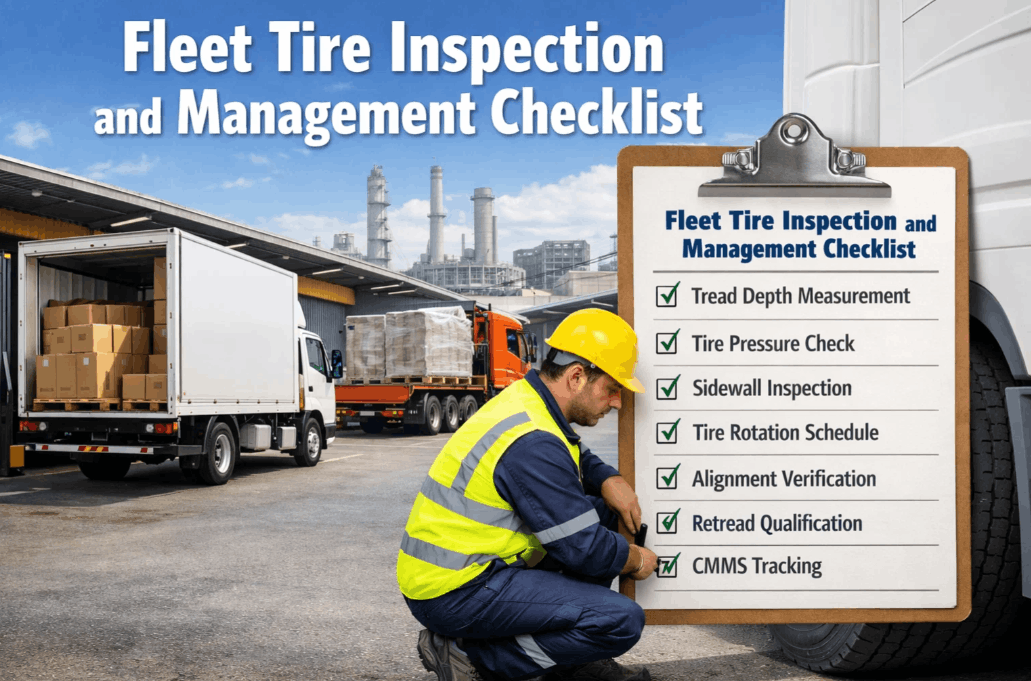
Tire failures are the most common cause of commercial vehicle breakdowns and a leading contributor to fatal truck crashes — yet the majority are caused by conditions that a structured inspection programme would have caught weeks earlier. Under-inflation, undetected sidewall damage, worn tread beyond the replacement trigger, and missed rotation intervals cost U.S. fleets an estimated $15 billion annually in premature tire replacement, fuel penalty, and incident costs. Oxmaint's tire management module tracks every tire by position, records tread depth and pressure measurements per inspection, calculates wear rate per axle, and schedules rotation and replacement before the OOS threshold is reached — turning reactive tire spend into a predictable, manageable maintenance cost.
Tire Position Map — Inspection Priority by Axle
Different axle positions wear at different rates and carry different regulatory requirements. The position map below shows a standard tractor-trailer configuration — tap any position label to understand the specific checks, wear rates, and OOS thresholds that apply to that location. Use this as your inspection starting reference before beginning measurements.
How Technology Is Transforming Tire Management
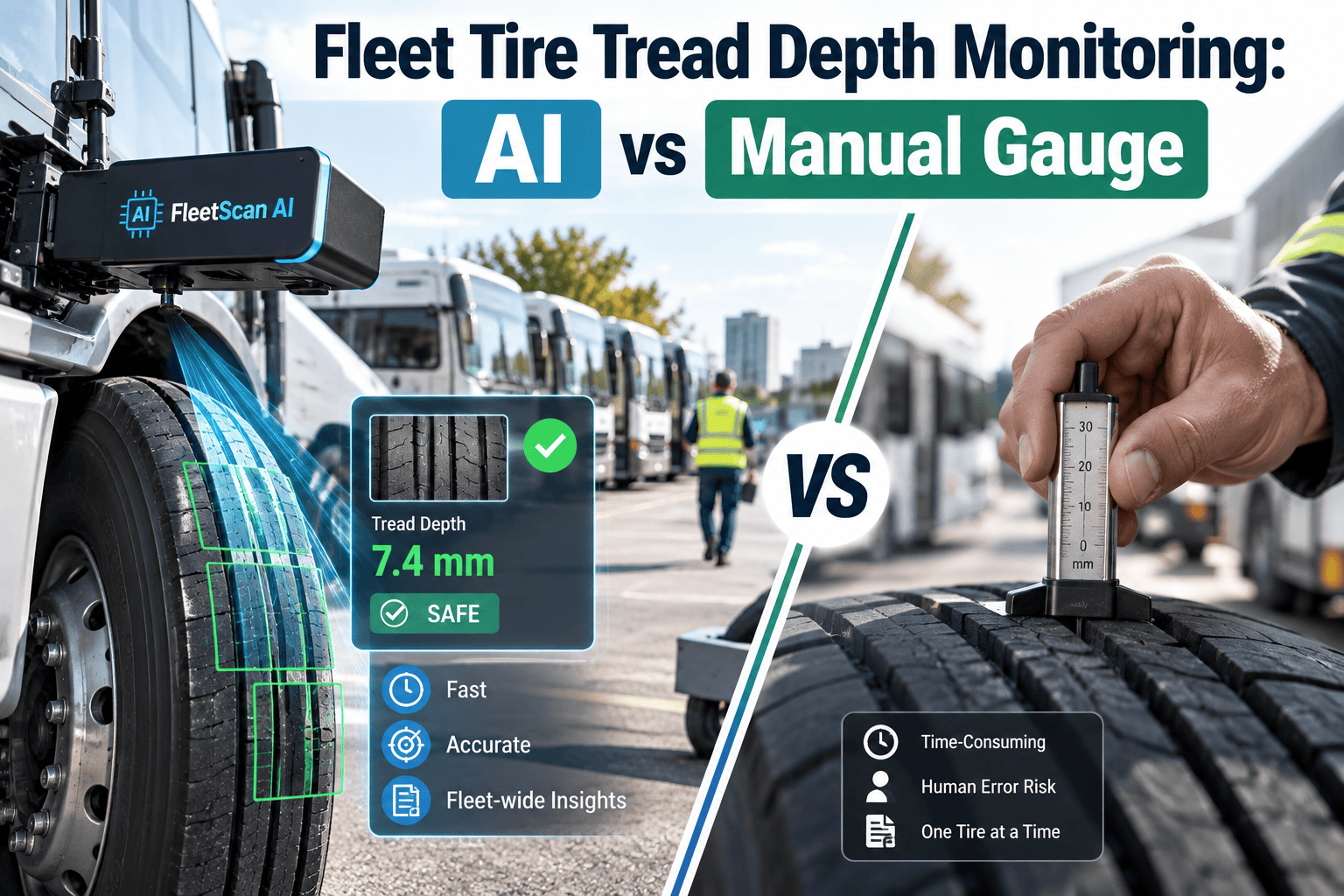
Manual tire inspection with a tread gauge and pressure stick remains the foundation — but four technologies now extend what a technician can detect, predict, and record, reducing inspection time, improving pressure compliance accuracy, and connecting every tire to a traceable digital lifecycle record. Oxmaint integrates all four into the same tire inspection workflow your team already uses.
1. Tread Depth and Pressure Inspection Checklist
Tread depth and pressure are the two most impactful tire metrics in any fleet — and the two most frequently measured incorrectly. A single average tread depth across a tire tells you nothing about uneven wear patterns caused by alignment or inflation issues. Pressure checks without a calibrated gauge are guesses. Every measurement below must be performed with the correct tool and recorded per position. Record per-position tread and pressure measurements in Oxmaint — automatically compared to previous records to flag accelerating wear.
Tread depth — measured at three points across the tread width
Measure at the centre and both shoulders of each tire using a calibrated tread depth gauge. A tire showing 4/32" at centre and 2/32" at one shoulder has an alignment or inflation problem that averaging would hide. Record all three measurements per tire and flag any position showing more than 2/32" differential across the tread width. OOS — at/below trigger
Cold inflation pressure — all positions including spare
Check pressure cold (before driving or within 1 hour of short-distance operation). Use a calibrated dial or digital gauge — stick gauges are not accurate enough for fleet tyre management. Target pressure from the door placard or fleet specification sheet, not the maximum moulded into the tire sidewall. Record measured pressure per position and compare to target. Defect — 10%+ variance
Dual tire pressure matching — drive and trailer axles
Dual tires must be within 5 psi of each other. A dual pair with unequal pressure causes the higher-pressure tire to carry more load — accelerating its wear and fatiguing the overloaded casing. If consistently out of match, investigate the valve stem and valve core condition on the inner dual, which is more frequently neglected during manual checks. Defect — above 5 psi diff
Dual tire tread depth matching — drive and trailer axles
Dual tires must be within 4/32" of each other in tread depth. Mismatched duals cause the smaller-diameter tire to drag and the larger to carry excess load — generating heat buildup in both. Any dual pair exceeding the 4/32" mismatch limit requires immediate separation, with the worn tire repositioned to an appropriate single position. Defect — above 4/32" diff
Valve stems and valve cores — all positions
Check all valve stems for cracking, bending, or missing caps. Valve cores must not show signs of leakage — apply a drop of soapy water to detect slow core leaks that TPMS sensors may not detect until pressure is significantly low. Replace any bent or cracked valve stem — a failed valve stem is a sudden pressure loss event. Defect — bent/cracked stem
OBD / TPMS tip: TPMS sensor data integrated into Oxmaint logs pressure history per position between physical inspections — a position that consistently reads 8–10 psi below target within 48 hours of inflation indicates a slow leak requiring valve core inspection or repair before the next departure. See Oxmaint's TPMS integration.
2. Sidewall and Physical Condition Inspection Checklist
Sidewall damage is the tire failure mode most frequently missed during informal pre-trip checks — and the one most likely to cause a catastrophic blowout at highway speed. Every tire requires a physical sidewall inspection that cannot be done by walking past the vehicle. Every position requires the technician to crouch down, look at the full sidewall face, and physically run their hand across the tire surface.
Sidewall bulge inspection — both sidewalls, all tires
A sidewall bulge indicates internal belt or ply separation — the tire's structure has failed at that point and can no longer contain pressure under load. Any sidewall bulge is immediate OOS regardless of tread depth or inflation pressure. Move the vehicle to the tire change bay immediately — do not allow departure under any circumstance. OOS — any bulge
Sidewall cuts, abrasions, and exposed cords
Inspect both sidewalls for cuts that penetrate through the rubber compound to the casing cords. Any cut that exposes the fabric or steel cord layer is OOS — a cord-exposed sidewall cannot be repaired. Check for curb abrasion damage on the outer sidewall of steer tires — repeated curb contact progressively weakens the sidewall casing in urban route vehicles. OOS — cord exposed
Tread surface condition — chunking, cracking, and foreign objects
Inspect the full circumference of each tire's tread surface for chunked tread blocks, deep shoulder cracking, or embedded objects. Remove all embedded objects and probe the hole for depth — a penetration reaching the cord layer requires immediate assessment for tire removal. Tread chunking on drive tires indicates overloading, overinflation, or traction event damage. Defect — deep penetration
Weather cracking (ozone cracking) — sidewalls and tread grooves
Inspect for fine surface cracking in the sidewall compound and at the base of tread grooves — common on tires that sit in storage or on low-utilisation vehicles. Shallow surface crazing is cosmetic. Cracking that is deep enough to see the casing cords when the sidewall is flexed indicates a tire that has lost structural integrity and must be removed from service. Defect — deep cracking
Rim / bead seating — visual inspection at full inflation
At full inflation, visually inspect the bead seating line around the full circumference of both beads. The moulded bead seating ring must be uniformly visible above the rim edge. Any section where the bead ring disappears indicates incomplete seating — deflate and remount. A tire running on a partially seated bead is a progressive failure mode. OOS — partial seating
3. Tire Rotation and Alignment Verification Checklist
Rotation and alignment are the two most cost-effective tire management interventions available to fleet maintenance teams. A missed rotation interval costs an average of 20–25% of a tire's remaining service life. A vehicle running with 0.5° of toe misalignment destroys 30,000 miles of tread life per year on the steer axle. Schedule tire rotation and alignment checks automatically by mileage trigger in Oxmaint.
Rotation interval compliance — mileage trigger check
Verify the vehicle is within the fleet's rotation interval policy — typically 5,000–8,000 miles for mixed-service vehicles. Record current odometer reading and compare to the last rotation record in the CMMS. Any vehicle beyond its rotation trigger must be rotated at this service event regardless of visible wear, as the rotation delivers its benefit by preventing uneven wear from developing, not reversing it after it starts. Defect — past trigger
Wear pattern analysis before rotation decision
Before rotating, assess the wear pattern on each tire to identify the cause. Centre wear = chronic over-inflation. Shoulder wear = chronic under-inflation. Feather/saw-tooth wear = toe misalignment. One-sided shoulder wear = camber issue. Cupping/scalloping = worn shock absorbers. Correcting the cause before rotating prevents the same pattern developing on the next set. Defect — pattern present
Wheel alignment — toe, camber, and caster measurement
Check wheel alignment at every tire rotation or whenever a wear pattern indicates misalignment. Toe out-of-specification of 1/8" generates an equivalent feather wear rate of approximately 100 miles of tread per mile driven on steer tires. Camber out of specification causes one-sided shoulder wear that removes usable tread life from the outboard or inboard shoulder depending on direction of lean. Defect — out of spec
Wheel balance — after every remount or rotation
Balance all tires after every rotation or remount event. An unbalanced tire generating 0.5 oz of imbalance creates vibration equivalent to hitting a 1-inch bump 800 times per minute at highway speed — destroying shock absorbers and generating cupping wear. Check balance weights are present after washing events, as high-pressure washing commonly removes clip-on weights. Defect — unbalanced
Wheel nut torque — re-check after rotation
Torque all wheel nuts to specification with a calibrated torque wrench after every tire rotation or wheel removal event. Check torque again at 50–100 miles after remount — wheel nuts can settle after initial torque if mating surfaces are contaminated. Loose wheel nuts at highway speed generate vibration that fatigue wheel studs and eventually result in wheel separation. OOS — loose nuts
AI Digital Twin tip: A tire wear rate model built into the vehicle's digital twin compares measured tread depth against mileage accumulated since the last rotation — detecting accelerating wear rates that indicate alignment or inflation problems developing between scheduled alignment checks, rather than waiting for visible patterns to appear. Book a demo to see predictive tire wear scheduling.
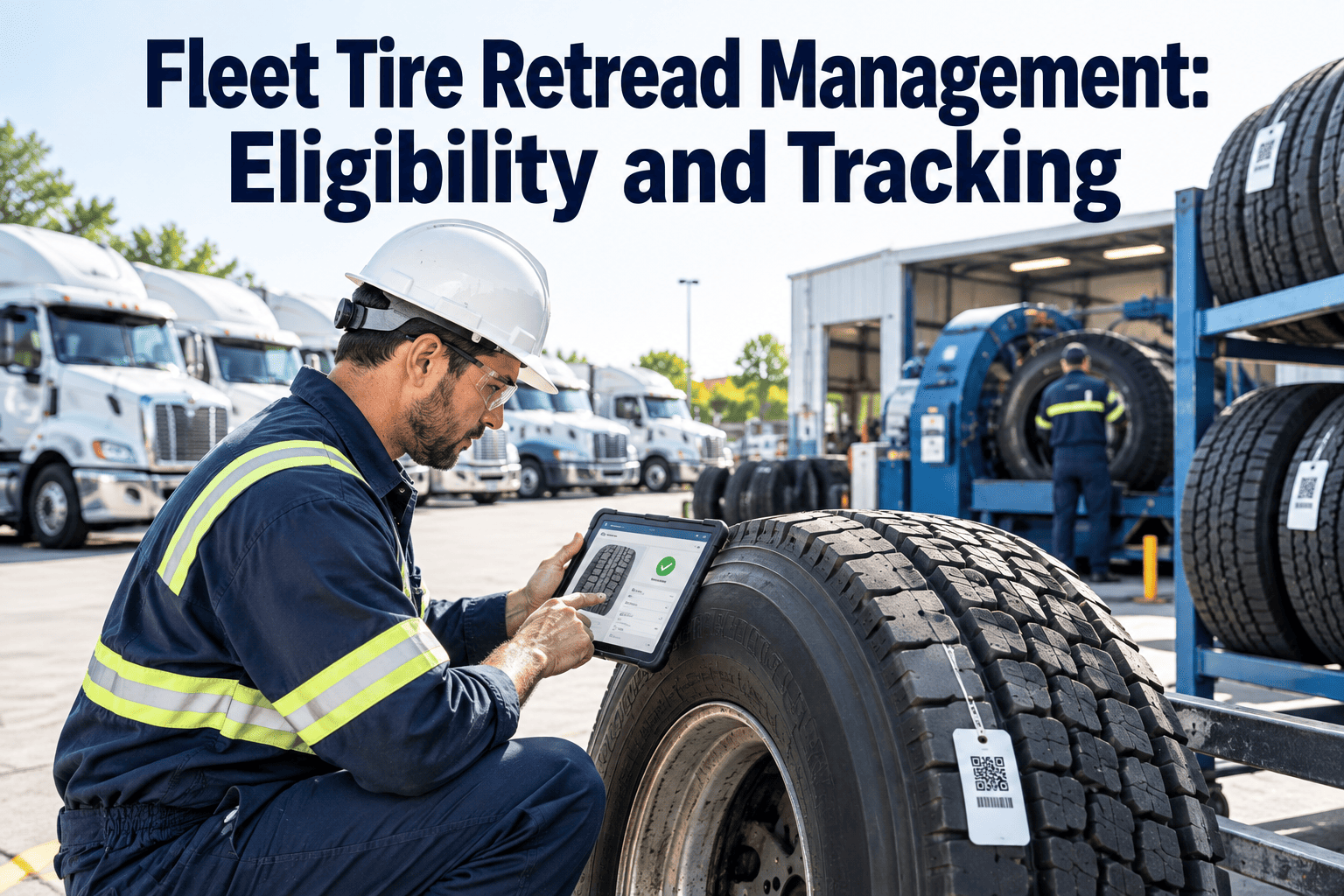
4. Retread Qualification Checklist
Retreads are an economically and environmentally sound choice for drive and trailer axle positions when qualified correctly. A retread on a casing with hidden damage is a liability — but a retread on a properly inspected and qualified casing delivers equivalent performance to a new tire at 30–50% of the cost. The qualification inspection below determines whether a casing is retread-eligible before it leaves the fleet's hands.
Casing structural integrity — shearography or visual inspection
Inspect casing for belt edge separations, ply-to-ply separations, and sidewall delamination. Shearography (electronic non-destructive testing) is the gold standard — detecting internal separations invisible to visual inspection. Any casing with a confirmed internal separation is not retread-eligible. Document inspection result and casing DOT serial number for retread traceability records. Defect — reject casing
Sidewall condition — repair eligibility assessment
Sidewall punctures and cuts can be repaired within RMA (Rubber Manufacturers Association) limits — typically no larger than 3/8" and not in the bead or flex zone. Any sidewall repair outside the RMA limit disqualifies the casing from retreading. Check for previous sidewall repairs — casings with multiple repairs require engineering approval before retreading is permitted. Defect — outside repair limit
Bead condition — wire integrity and seating surface
Inspect bead bundle area for broken wires, corrosion, or deformation from rim damage. Any bead with broken steel wires is non-retreadable — the bead is a structural component that maintains casing shape at inflation pressure. Check bead seating surface for gouges or corrosion from rim contact that would prevent correct seating on a new rim after retreading. Defect — broken wires
Casing age and retread count verification
Check the DOT date code on the casing — most retread specifications limit casings to 7 years from manufacture date at the time of retreading, regardless of physical condition. Verify the casing's retread count from fleet records — most manufacturers permit a maximum of 3 retreads on a single casing for drive and trailer positions before the casing is retired to scrap. Defect — exceeds age/count
We cut our annual tire spend by 22% in the first year after implementing Oxmaint's tire tracking — not by buying cheaper tires, but by finally measuring wear rates per position and rotating at the right interval. We also identified three vehicles with alignment problems we'd been unknowingly destroying tires on for years. The data was there; we just weren't capturing it.
Tire Management — Key Compliance Metrics
Average reduction in annual tire spend achievable through structured CMMS-tracked rotation, alignment, and wear rate monitoring — without changing tire brand or spec.
Tread life reduction from a tire running at 20% under-inflation — the most common and most preventable tire cost in commercial fleet operations globally.
Digital twin wear rate modelling gives technicians 4–6 weeks of advance notice before any tire position reaches the fleet replacement trigger — eliminating reactive emergency replacements.
Cost saving per position from a correctly qualified retread vs. new tire replacement — delivering equivalent service life at 30–50% of new tire cost on drive and trailer axles.
Frequently Asked Questions
The most common questions from fleet maintenance technicians and managers about tire inspection standards, replacement triggers, and lifecycle tracking.
The FMCSA OOS limit (2/32" non-steer, 4/32" steer front) is the legal minimum — tires at this level have significantly degraded wet stopping performance. Best-practice fleet replacement triggers are 4/32" on non-steer positions and 6/32" on steer axle tires, providing a safety margin and reducing OOS risk at unscheduled roadside inspections.
Every 5,000–8,000 miles for mixed-service vehicles. Heavy-haul and constant-speed highway vehicles may extend to 10,000 miles. The critical rule: rotate at the interval that prevents uneven wear from developing, not after it has already appeared. Visible wear patterns indicate the rotation interval is already too long for that vehicle's duty cycle.
Retreaded tires are prohibited on the front steer axle of any commercial motor vehicle under FMCSA §393.75 — regardless of retread quality or casing condition. Retreads are permitted on drive and trailer axle positions when the casing passes qualification inspection and the retread meets applicable speed and load ratings for the position.
Feathering (saw-tooth wear where tread blocks are rounded on one edge and sharp on the other) is caused by toe misalignment — the tire is scrubbing sideways as it rolls forward. Even 1/16" of toe error generates significant feathering. Correct alignment before rotation and verify the steering linkage is not worn before assuming alignment adjustment will hold.
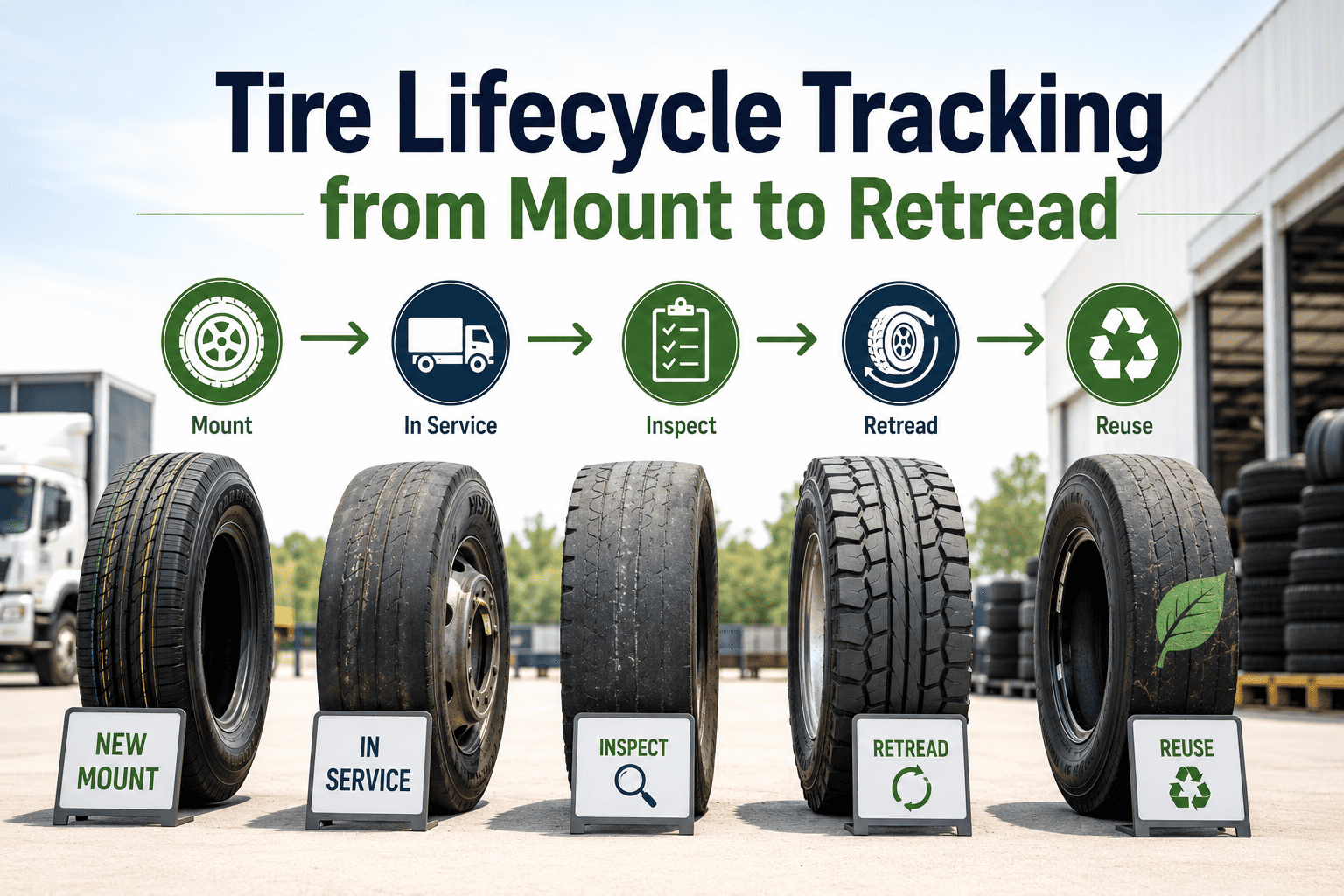
Oxmaint records each tire by DOT serial number, assigns it to a vehicle and position, logs every tread depth and pressure measurement at every inspection, tracks rotation history with position mapping, calculates cost-per-mile from purchase price and miles accumulated, and maintains the full history record when the tire is removed for retreat or disposal — providing a complete lifecycle traceability record per tire.
4/32" is the generally accepted maximum tread depth differential between dual tires on the same axle. Above this, the smaller-circumference tire drags rather than rolls freely — generating heat, accelerating wear on both tires, and increasing rolling resistance. Some manufacturers specify tighter tolerances; always consult the tire manufacturer's fitment guide for the specific tire size and load rating.